Deneen Allen: How a Reluctant Author Turned 25 Years of Tourism Expertise Into a Book
✨ Episode Summary
⭐ Top Moments

Deneen Allen
★ Scribe Case Study
How Deneen Allen Turned 25 Years of Tourism Expertise Into the Front Door to Her Firecircle Community
After her team spent three years convincing her to write it, tourism innovator Deneen Allen turned her signature method into a book with Scribe Media, and now uses it as …
📚 Books by Deneen Allen
Transcript
Deneen Allen: Think about why you're even considering the book and think ahead to the ways that your book can have an impact for your life or your business. And do it for the right reasons that make sense for you. And be really professional about how you do this. You'll be so glad that you did.
Eric Jorgenson: Thank you so much, Dineen, for being here and sharing your story with us. I am very excited because I feel like I grew up in Michigan. I grew up watching BBC. I feel like an honorary Canadian. I'm an advocate, an evangelist for Canada on behalf of all my American friends who don't have as much cultural overlap with them. So I'm glad to have you here and get to learn more about you and what you do.
Deneen Allen: Well, thank you, Eric. I'm thrilled to be here. Thanks for the invitation.
Eric Jorgenson: To contextualize that comment and the rest of our conversation, would you give us a brief overview of your background and your company and what you do?
Deneen Allen: Yeah, absolutely. My background is long and deep in tourism and hospitality development and also in design. So, you know, long career in commercial design and building out hospitality projects and then consulting. And I even owned an inn and a catering company and a gourmet food shop and then another gourmet food shop. So I've been an operator and a consultant in hospitality. And that consulting led to the understanding that there were some pretty deep gaps in the knowledge base of small and medium-sized enterprise operators in tourism and hospitality. And that's how I ended up somehow in the education space around entrepreneurship and hospitality and tourism. But we can talk more about that because that's where the book comes in.
Eric Jorgenson: Yeah. How long have you been kind of in, in education mode instead of actively operating?
Deneen Allen: Oh gosh. I'm still consulting with FireCircle and the five by five method, almost six years now.
Eric Jorgenson: Amazing. Okay. So how, where were you kind of in that journey when you got the tickle that maybe a book would be the right project for you?
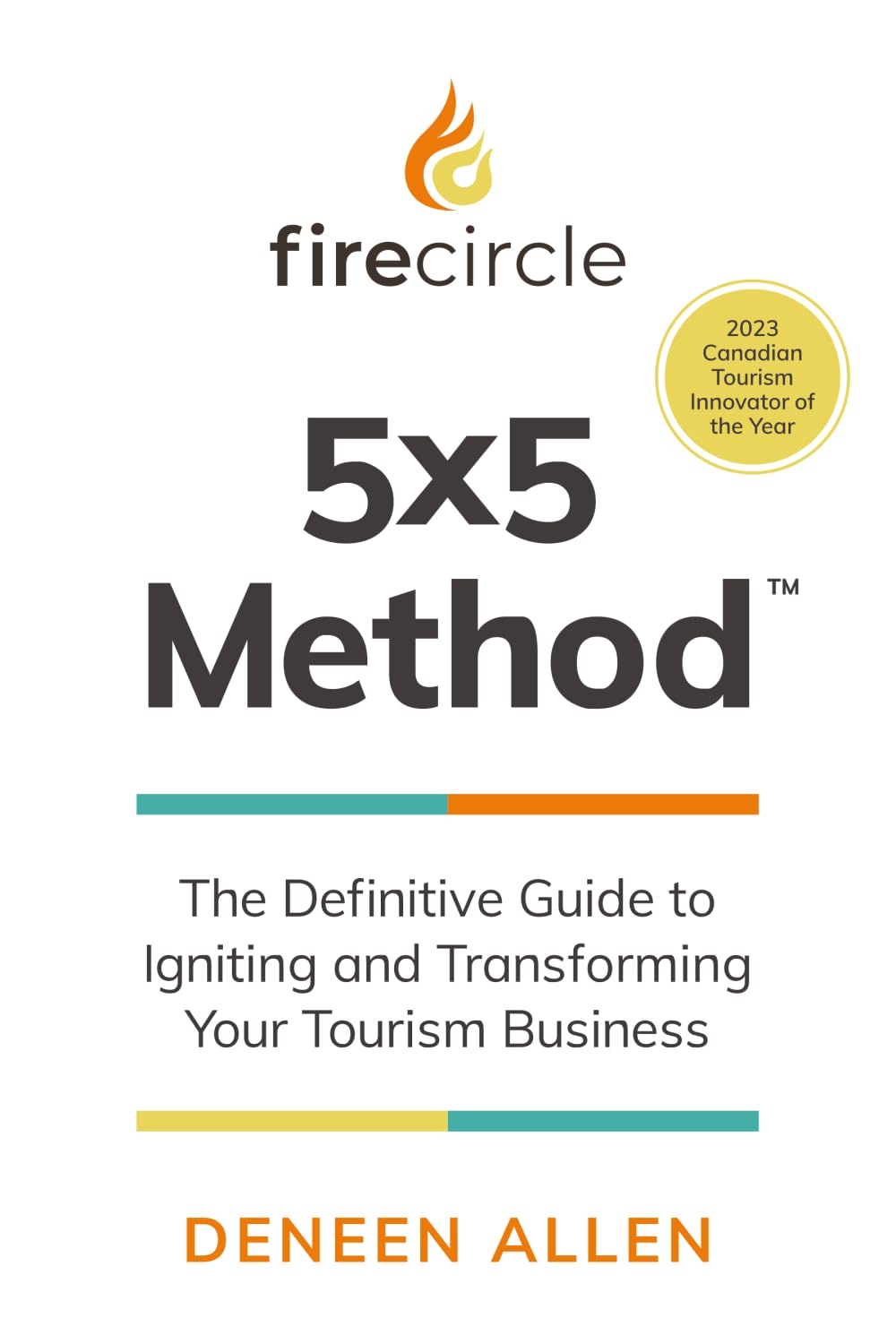
Deneen Allen: You mean when my team got the tickle that the book has the fire circle five by five method was written in 2019. I wrote, I wrote, I wrote the program in 2019. and we launched on an LMS this digital five-by-five program, which is five steps and 25 workshops, all guiding you through either starting a tourism business or repointing, recalibrating your existing business. that the program was already written. So my team, way back then, I would say 2021, 2022, they were saying things like, you know, we really need to make this a book. And I kept saying, no, it's a digital program. Why do we need a book? And so it took, how many years is that? It took them about three years to convince me. I started writing the book in January of 2025 and here we are. And now I can't imagine not having the book because it's such an incredible additional tool so it's sort of like a companion to the digital program so you don't have to be online all the time if you're making your way through that program. And it's also just a really simple point of entry for anyone who's thinking about starting a It can actually be any business, but we're focused on tourism and hospitality. So it's become this really useful tool. And now we're starting to have what we call entrepreneur circles locally here in Vancouver, where I live. And we're going to expand across the country, but bringing tourism entrepreneurs together to talk about tourism and their businesses. And this book is just a great entry point for them.
Eric Jorgenson: That's fantastic. I am very curious how the book sort of fits into the rest of the business, the rest of the ecosystem that you've got.
Deneen Allen: Well, definitely the digital, the online program is very, very deep in terms of the amount of information and the workshops, all the templates, all the resources that we provide through that program. And so the book is really I like to call it a monograph of the full program. So it's almost like a little capsule of the whole program. And so it's really a simpler way to access the program. and you can journal in the book as you go. And it's still following the methodology. So it's almost like a little summary companion guidebook slash journal. And it seems to be working that way as well for people who are already in the program. They're using it as their companion guidebook to the program.
Eric Jorgenson: Yeah, I wondered how often sort of someone is already in your on your email list or comes to a program and the book is part of their experience or whether they're like discovering you by encountering the book, whether, you know, in a bookstore or online or through search or whatever it is. Is it sort of the entry point or is it part of the journey once? OK.
Deneen Allen: It is both. We do live group calls every week on Zoom that are open to everybody, and those are mentorship. We're coaching people and mentoring people in those calls, but they're also open for conversation with. tourism operators from across the country. And so some of those businesses are finding that, you know, they're joining those calls. The link has been shared with them by a friend or colleague. They're joining those calls, then they're finding out that there's a book We do our marketing and some of our database who are not engaging directly with our digital programs are finding the book that way. So some new members, let's say, to Fire Circle, the book is the entry point. And then for other members who have been with us for years, it's just an additional tool for them.
Eric Jorgenson: Super interesting. So anybody who shows up to these kind of weekly calls, you're like, oh, you're new, let me welcome you. Can I ship you a book? Are you sending them for free? Do you just direct them to the page?
Deneen Allen: We send them a link. I mean, we figure, you know, they're coming to these calls at no cost. So, you know, a $24.99 paperback is not a big investment for them to make in their business if they're truly curious about what we're doing. But we are also running some promotions where we'll send out a book and it includes a month of free membership in Fire Circle. So they have to buy the book first because there's a secret code in the book that they then, all that stuff that you do with promotions. So we're using it as a marketing tool. We're using it as a way of familiarizing potential members with Fire Circle. We're using it as a tool for existing members. So it's really serving a lot of different purposes. And so I'm very grateful to my team for talking me into this. And by the way, it was a lot of work. I'm sure every author would say the same thing when they get to the end of a book. It's not for the faint of heart. I'm so glad that I did it.
Eric Jorgenson: Yeah, it's one of those things that actually, the reason it's valuable is because it's hard. What was Phil Knight's quote? The cowards never started and the weak died along the way and that leaves us. It is so difficult to put a good book out into the world. It does take time. It takes investment. And that's why it's a signal. That's why it's meaningful. And then when people pick it up and Find it useful. You know, that just builds this immense amount of trust. I'm glad that your team talked you into it. I'm curious sort of how, how did that evolution go? You said it took, it took a couple of years.
Deneen Allen: Oh yeah, it took probably about three years and well, you know, we've just been very busy as well, right? I mean, I consult as well as running Fire Circle. So it's just the busyness of life also that it was a bit daunting for me to think about writing a book, but I'm so glad that you said that about, you know, the value when something finally makes its way into a book. it hasn't been taken lightly. Someone has thought deeply about the story or deeply about the resource and put all that time and energy into it. And I think that's what's so valuable. If you think about I was very protective as well about the 5x5 method when I first wrote it. So you have to imagine, given where I am in my life and my career, that when I first wrote the 5x5 method back in 2019, the digital program That was the distillation of everything that I knew and had done for probably 25 years in tourism and hospitality and design and construction and marketing and finance. So all of these things had been coalescing in my brain and all the consulting that I was doing kept bringing up the same five themes of gaps of knowledge. It didn't matter who the client was. It didn't matter if it was a multimillion-dollar resort that I was developing or if it was the acquisition of a fishing lodge for an Indigenous community in Northern Canada. The gaps in knowledge were were all there in different degrees, for sure, but it was in those five areas. So by the time I was writing the digital program, it was actually out of a little bit of frustration of needing to repeat myself over and over again to my consulting clients. And I thought, how do we get this information out and disseminate it in a much broader fashion? How do we get it to all of those small operators in northern Canada who can't keep coming to workshops in person, etc., etc.? By the way, that was pre-COVID, so you can imagine during COVID, it became even more valuable to access information digitally. So, You know, that knowledge base that sort of made its way into the digital program, that is now what is, you know, all those years of consulting and operating and my own experience, that is now distilled even further in the guidebook. And it's $24.99 for the paperback. Do you know what I mean? It's like, okay, people, you know, this is, and I'm sure all authors, you know, think that's like, Do you understand the value of the little distillation of all this information into one book that you can buy for $25 kind of thing?
Eric Jorgenson: It's a really, I find it to be a very useful way to pitch books. You know, this is 25 years of my life experience. And then we spent five years distilling and organizing the information and along with, you know, dozens of other people who sort of contributed to honing this thing. And you can buy it for, you know, $25, $1 per year of experience is a very cheap tuition. Yeah.
Deneen Allen: Yeah. I've already lived the pain of so many entrepreneurs in Canada, so many business owners, and that we have solved things for.
Eric Jorgenson: Did you struggle with the decision about how much to put in the book?
Deneen Allen: Yes, because I really wanted it to actually be shorter than it is, but that was hard because I think the original digital program when you read all the scripts or when you have all the scripts in front of you is about 120,000 words. Wow.
Eric Jorgenson: Yeah, that's a big book.
Deneen Allen: Well, so we knew. And you know, when I say it's that many words, all of our digital programs are animated video workshops. And so you're taking in those words in visual bites, you know, not in reading 120,000 words, but the script that's being spoken is that many words. So we thought, or I thought, you know, how am I going to get this down into, I was sort of thinking maybe 150 page book, I think it's 240 pages. But Yeah, I couldn't make it any shorter than that. And I accepted that and still get the point across. And we also wanted to include the journaling space after each workshop. So that added pages to the book as well.
Eric Jorgenson: You mentioned before the secret code, and I think so many authors, in particular with contexts like yours, are trying to find useful, clever, interesting, high-quality ways to connect the book experience back into their digital world, whether it's their social or their email list or their community. This sounds like an interesting one. How did you put a secret code in?
Deneen Allen: Oh, I don't think it's that unique, really. If you wanted to get the free membership in Fire Circle, you had to buy the book, of course, because when you filled in the form on our website, you had to have the words from a sentence on a particular page in the book. And the only way you would know that is if you own the book and you could look that up in the book. So that was our secret code.
Eric Jorgenson: I like it. Okay. So you sent them to a forum and what's the monthly membership cost?
Deneen Allen: It's $19.99 Canadian a month to join FireCircle. That doesn't include the digital programs. We have more than the 5x5 method now within our FireCircle library and our platform. That is just to access the dashboard, our AI. So we have Ember AI embedded in our program. So we've trained our own AI agent on everything in the FireCircle 5x5 method so it can answer any question about the methodology. But really it's answering any question you have about building your tourism business. extracted from the resources that we've built in FireCircle. We've also uploaded into AI the other programs like our Tourism for All, which is our accessible building, accessible tourism business program, tourism experience development. We've added that knowledge to the LLM. Yeah, so they get access to that, which is useful even if you're not doing the formal 5x5 method. It gives you access to our resource library, which is over 350 recorded webinars on everything to do with tourism operations and marketing and finance and everything. and they get access to these weekly live group calls. There's one private one every month and that's what they're paying for. So then they get the option of buying the digital program by adding more programs to their repertoire.
Eric Jorgenson: Well, that's a cool, you know, it essentially makes the book free, right? If you're getting a free month of that for the code in the book, like that's, that's a very, yeah, kind of neat way to bridge that gap and feel like you're, you're offering great value to anybody who's bought the book and giving them like a clear next step to kind of continue their journey with you and deepen the experience that they're getting. What was the high point of, of actually going through the writing and publishing process for you? What was your, your peak celebration moment?
Deneen Allen: Oh, I think when everything went to print, when it all finally went to print and there were no more decisions to make and no more homework for me. I had homework every night for a year, in one form or another. It was quite a learning curve. I'm assuming it would be the same for anyone who's not familiar with the world of book publishing. And it was very interesting to learn all of the moving parts, all of the different things that go into writing and publishing. Well, writing, editing, designing, you know, and then publishing a book. So it was really very illuminating. I keep saying, I'm never doing it again, but never say never because now, now that you've been up the learning curve, you know, the second time is way easier.
Eric Jorgenson: I found it quite illuminating to be like, all right, I've been through the maze. Now I know I can make it through. I got a little addicted to the process. So, but I understand there's also many, many people that are like, that was hard enough to never do again.
Deneen Allen: Well, yes. I have huge admiration for anybody who is trying to navigate self-publishing on their own, because I had what I consider the luxury of having Scribe as my publisher. and moving me through every step of the process. I mean, some of the things that we had to set up, I think I would have just been undone by if I were navigating them by myself. So it's more complex than I think most people understand to do it properly to do it really professionally and have a really professional book at the end of it. So I feel very fortunate that I had scribe literally walking me through every step and and the aftercare, you know, like, because I have my author's copies sitting in a warehouse somewhere in Tennessee, I think. So even knowing that I can reach out anytime and be able to say, hey, can you send me some more of my author's copies, you know, et cetera, that are, yeah.
Eric Jorgenson: How did you decide on Scribe? It's a big confusing world of publishing and options and paths forward. I imagine you and your team took a pretty good look at your options.
Deneen Allen: We did. We put it out to tender, as it were. Well, we got three quotes, and two of them were in Canada, and Scribe was the one that we chose in the US. And Scribe was recommended to me by a colleague who had worked on another book. On a similar, it was the book that inspired me, actually. It was a monograph. And I thought, oh, that's what we need for Fire Circle. Then I'm not, you know, I mentioned I was worried about my IP and originally that did hold me back for a long time. I thought, well, if I publish this and then you can only get it for $25, you know, like I didn't, I really struggled with that for a while. Now I realize that was sort of It's not something I should have been worrying about and maybe should have done the book even sooner than I did. But the monograph made sense because I knew I didn't want to, I couldn't publish the entire, you know, 120,000 words that make up the digital program.
Eric Jorgenson: Yeah, it would have been a textbook or something.
Deneen Allen: Yeah, I really was trying to not do that. It was supposed to be a quick read, something really inspirational, but super useful, something you would carry around with you, and certainly the paperback makes that possible. The hardcover is gorgeous.
Eric Jorgenson: Yeah.
Deneen Allen: The hardcover is expensive, though, because I probably needed to know a little bit more about asking for things like color, because our book has some color in the pages and very, very nice paper that you can write on because it's a journal, so it's thicker paper. So there were some aspects of the book design that, you know, I wanted the Cadillac. It's very expensive to
Eric Jorgenson: Yeah, the small decisions can add up quickly. The graphics lead to color, the color leads to paperweight, the paperweight leads to total mass. Each thing kind of makes the next one more expensive in some cases, but sometimes it's worth it to have a really, really high quality hardcover experience and then the paperback is a little more accessible for people and they can always buy the digital.
Deneen Allen: Yeah. Well, we haven't, we haven't produced the, the, well, you mean by the digital program or by the, we haven't got it.
Eric Jorgenson: Yeah. Oh, so you chose not to do the Kindle.
Deneen Allen: We did not do the Kindle.
Eric Jorgenson: No. Okay. What's been some of the surprising good things that have happened? Your books as we record this has been out maybe three, four months. So it's, it's still early in very early in the, you know, the long life of a book, but was there anything fun that's happened so far that you were not counting on?
Deneen Allen: Well, yes. Well, I guess there have been a few things. We have had people buy the book and then show up at our live group calls, you know, and then like be holding their book up in, you know, I bought your book. and people asking to have the book signed, that was a bit of a, caught me completely off guard. I was just completely delighted, but completely caught off guard by that. I just did not, you know, you don't, I didn't think of myself that way as an author that someone would care if I signed their book. Anyway, that was very lovely. And a lot of friends have bought the book, which is very supportive of them. Just the way it turned out was a surprise that it's such a beautiful book. I'm really proud of it.
Eric Jorgenson: That's a fantastic relationship to have with it. That's ultimately the most important thing and the only thing that you can control. sort of an artifact that represents you in a way that you're proud of. That's the most important thing, because I feel like then you're really confident sort of putting it out into the world and putting it in front of people, even people you're, you know, you're wanting to impress or strangers that this is going to be their first impression of you. And so I think, you know, putting in enough effort and doing your homework sufficiently such that you're proud of your book is a really important thing. I'm so glad to hear that that's you know, that's the level that you reached.
Deneen Allen: Yeah, yeah, and definitely. I did ask my project manager, David, if anyone actually reads their book from cover to cover after they publish it. And he said, no, not very many. You're also sick of your book by the time you've got it. But I have read almost all of it. Of course, I read it the entire time that I was writing and rewriting things. But anyway, yes, I'm very happy.
Eric Jorgenson: Good. That's fantastic. I'm really glad to hear that it's already sort of having an impact on your business and that your team was right and that you've come around and you're willing to publicly state that you wish you'd done it earlier and it's been good for you so far. And we're only a few months in, I'm sure it'll pay dividends for years and decades.
Deneen Allen: I think so. And one thing I wanted to make sure that the audience knows is that I ordered a lot of author copies, hardcover copies to use in my marketing and my speaking engagements. And we're doing these, as I say, these entrepreneur circles at bookshops. And so I'm bringing those books to these events and I like to have the hardcover for those events. So in that way, I sell them sometimes and sometimes I give them away, but I think it's just been a really useful tool for both marketing and awareness of Fire Circle and just another wonderful tool when I'm at these conferences and speaking engagements.
Eric Jorgenson: I love it. Okay. So final closing question here is, do you have any advice for people who are in the shoes, the spot in the road that you were in maybe four or five years ago, just sort of flirting with this idea or maybe being, you know, lovingly poked by their team that maybe this is a good idea. Like what would you say to a prospective author teetering on making the leap?
Deneen Allen: Well, think about why you're even considering the book and think ahead to the ways that your book can have an impact for your life or your business and do it for the right reasons that make sense for you and be pro. Be really professional about how you do this. You'll be so glad that you did.
Eric Jorgenson: I love it. Yeah. One of our, one of our go-to sayings is half professional is unprofessional. So go all the way, make a book that you'll be, you'll be very proud of. And it'll be, it'll be turned out to be a great investment for you over many years. Thank you so much, Janine. Where would you send people to learn more about you? Pick up your book. Follow along.
Deneen Allen: Well, definitely they could go to our website at www.thefirecircle.ca, so thefirecircle.ca or find the book on Amazon or on amazon.ca and amazon.com and please order one for inspiration. It's also a good way for you to think about planning out your book. It is a planning book.
Eric Jorgenson: Get 25 years of experience for $25. There you go.
Deneen Allen: That's my new tagline for the book.
Eric Jorgenson: I like it. It's all yours. Thank you so much, Dinnie. Appreciate you.
Deneen Allen: Thanks, Derek.
Want to Write Your Own Book?
Scribe has helped over 2,000 authors turn their expertise into published books.
Schedule a Free Consult