James Beshara: Episode 389
Read the full transcript
James Beshara
James Beshara is an entrepreneur, angel investor, and the host of the Below the Line podcast, which explores the emotional realities of building companies. He co-founded Tilt, a social payments platform that was acquired by Airbnb in 2017, and has since invested in over 100 early-stage startups.
📚 Books by James Beshara
Transcript
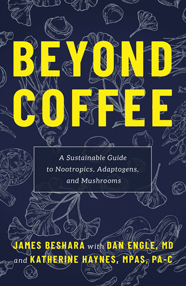
[0:00:25] NVN: In 2013, James Beshara got a big wake-up call when he found himself in the hospital with a heart condition that had been exacerbated by excess coffee consumption. This turned out to be a turning point in James’s life. Since then, he has discovered caffeine alternatives and supplements that not only increase energy, but also boost productivity and performance. In this new book Beyond Coffee, James teams up with peak performance expert Dr. Dan Engle and medical researcher Katherine Haynes to explain why there are far better alternatives to coffee, what specific nootropics, adaptogens and mushrooms can do, and how you can begin to look at energy and productivity in an exciting and sustainable new way.
[0:01:11] James Beshara: Thank you for having me on the show, Nikki. Yeah where to start, because it’s – I guess I can start with the bad, until it got better. That was about six years ago when I was running a company of about 50 employees and it was a company that I had started in what worked really well in the early days of just chugging coffee throughout the day and just brute-forcing through all the things I needed to do in starting the company and building it. It was a godsend. So much so that I was drinking four cups a day, then five cups a day, then six cups a day, then seven cups a day. Then about three years into starting out a company, I found myself at the doctor’s office and subsequently the ER. I had a heartbeat of around a 170 beats per minute for about three weeks. I developed a heart condition. Then my doctor pinpointed stress and over-caffeination. I want to be super upfront and say that there's also a likely predisposition, or a potential predisposition for it. So it's not all at the feet of coffee. But what wasn't ambiguous, and now after six years of knowing the science and the research, what wasn't ambiguous was that that amount of caffeine consumption was contributing heavily to that heart condition. So that was the bad. Then fast forward six years and a thousand plus hours of research and iteration of making one cup of coffee last the entire day and still being productive. This morning I had a cup of coffee and then about 12 other little supplements or herbs and compounds that I mix with my coffee and that's today. At least outside of the nerves from the interview, I think my heart rate’s pretty steady.
[0:03:01] NVN: Wow. It sounds a little bit shocking to hear someone say, “I drank six cups of coffee a day.” It sounds a little excessive. However, I feel the reality is a lot of us, in the course of working life, you just get into autopilot with coffee. This is something that a lot of people do. I know, I certainly have done that.
[0:03:24] James Beshara: I mean, it's one of the last remaining chemical addictions that we as a society collectively encourage and are okay with, but the damage it's doing, for me, it was the catalyst for looking into this was my heart condition. But for everyone out there, you have two or three cups of coffee. Everyone has their own baseline of what's okay and what gives them the jitters, but everybody is getting coffee. For anyone, doesn't matter who you are, it affects your adrenal glands, where adrenaline and where cortisol, stress hormones, come from. It will affect our adrenal glands like a huge dramatic swerving of your car to avoid an accident. It is like that type of acute stress on our system. That cortisol will spike once you drink your coffee, or you kick back your espresso. It will spike and you'll have elevated stress levels throughout the day from that coffee habit. That isn't the case with teas. That isn't the case with other herbs, compounds, plants, other things that can give you energy. Coffee is uniquely destructive to your cortisol and adrenal systems for your – the stress levels that you'll experience each day. I think that that is something that I don't think we fully understand as a society and every one of us knows the people around us that love their coffee and talk about how every morning they need their coffee to get up and going. None of us ever really talk about the long-term effects on our physiology, that it's this massive American addiction. Now global, but certainly it's become a mainstream American addiction over the last 30 years with things like Starbucks. We're not really talking about this medium and long-term effects on our body.
[0:05:14] NVN: I want to get into some of the effects and alternatives, but I think at the forefront of every coffee drinkers’ mind is this idea of how much it sucks to cut down on your coffee consumption. Can you talk to me a little bit about your experience with that?
[0:05:33] James Beshara: Yeah, sure. I talked about my one cup of coffee that I had this morning that I have each day. I think it's really important just to zoom out and though the book is called Beyond Coffee and is all about going beyond just that one simple drink that we've been consuming for a couple of 100 years and tapping into the – now we have amazing access to different global ingredients. The thing that I will say is these things, including coffee, should be last on the list of things that you're really taking an inventory of personally. I tell this to each friend, family, listener of my podcast. It's something that I think is really important and try to – and I try to mention it at the top of every conversation about this stuff is that – think of it like a pyramid. At the bottom of the pyramid, sleep is by far the most important thing to pay attention to. If you get three hours of sleep for three nights, it doesn't matter what your morning routine is, or how much you exercise, what you eat, how right you're eating, it's – you are not going to be able to get into a productive flow and it really is unsustainable. Just the first thing is sleep. You can think of a pro tip around sleep to being seven to eight hours every night and waking up every morning at the same time, if you can, because that will set your 24-hour circadian rhythm. That is the most important thing for – 30 minutes into your morning, into your day, you're hitting a productive flow and getting into your daily rhythm. Sleep way before coffee, or any number of the 50-plus things that we talk about in the book. The second thing that also is – just has nothing to do with these exogenous, or external compounds, the second thing would be diet and eating healthy, eating right. That can mean so many different things to so many people. I'd say the pro tip there is limiting and being very aware of how much alcohol one is consuming. Anything over four drinks a week is going to really affect your sleep. Anything over two or three drinks a night – everyone knows that with their own experience, you have too many drinks and you just get terrible sleep. If you make it a habit three, four, five nights a week and you're having two or three drinks that feel fine and you feel fine as you go to bed – it is messing with your sleep. You can buy any one of the numerous sleep trackers, just to see how drastic – it’s actually quite helpful for people to see how dramatic the change is with sleep on just two or three drinks. That would be diet. That's the second thing. That really just is destructive to that foundational element, sleep. The third thing is, I know this book covers all these different compounds, but I think it's just super important to take this slight diversion on the things that the book also mentions is really important for getting into productive flow. The third thing is exercise two to three times a week. Strenuous aerobic exercise. In terms of creativity of getting into that creative flow, there's nothing in the book, coffee or Adderall. There's nothing as helpful getting into productive creative flow and getting into that really amazing rhythm in your day like exercise. It is the body's detoxification and it can be 15, 20 minutes of strenuous aerobic. You can run up a hill four times, two to three times a week and that's going to have a great impact on your cognitive capability throughout the week. The fourth thing, it's fourth on the pyramid, but I think it's growing in terms of its mainstream adoption and that's just being aware of how you mitigate stress. That could be through meditation, it could be through breath work, it could be through just looking at your calendar and realizing, “I'm committing to too many things.” And it’s, my favorite one is – I know this has nothing to do with coffee, but my favorite one is being radically honest throughout your entire day. It's extremely difficult to be honest in every conversation. If you do that, that is probably the most powerful stress mitigator out there. It's something that I think is, just in terms of stress mitigation – we don't talk enough about the culture and society. Then last, at least and the point of this book and the point of this podcast episode and happy to focus on this the rest the episode would be these exogenous compounds, whether it's coffee, or what I really love as a replacement for coffee is matcha tea. Green tea is a great replacement, because it has things like L-Theanine and catechins in it that will help extend your absorption of that caffeine content over a longer period of the day than a cup of coffee. Or whether it's any number of the weird-sounding things in the book, like CDP-Choline or Alpha-Gpc. Things that have two to three, four decades of amazing research behind them that support their efficacy and safety. You mention that to anyone on the street, they've never heard of it. They try it in the morning and they have this really creative three, four, five, six hours spent. That's fifth on the list. You can start asking me questions about all of them now that I've given that preface.
[0:10:39] NVN: Yeah, absolutely. I love that you've laid that all out too. I know for me, I have a tendency to hear about new solutions and get really excited and then ignore those very foundational things that we have to do. That's a great reminder for all of us.
[0:10:55] James Beshara: I wrote this book, because I had personally just gone down the rabbit hole and like I said, probably 1 to 2,000 hours of personal research into this side of things, because I found it so fascinating. It became a passion project, but then friends and co-workers, people that worked for me then would ask, “What are you taking? What are these pills on your desk? Why are you making your coffee in such a weird way? Or why have you switched to tea in the afternoons?” I just wanted to be informed to give great information to people. You fast forward six years of that, I felt like, “Okay, instead of writing this one person back,” this book started with a potential reply to an e-mail where I was going to list everything out. I was like, “All right, I'm just going to write a blog post. Do this once. I'm not going to write – one-to-one e-mails just are – they take forever. I'm going to write a blog post.” Then that blog post became a five-part blog post. After I got done writing it all I was like, “All right, I'm just going to do this right. I'm going to get all of the scientific citations behind all of these compounds, which the book has hundreds of them, over 240 of them. I'm going to bring on two experts that I look to for guidance in this, Dr. Dan Engle, who's a psychiatrist and neurologist, and medical researcher friend, Katherine Haynes.” That e-mail started it and then the blog post started in the exact same way this book and this interview starts with saying, “Okay, these are really interesting, they're exotic. You haven't heard about many of them before, but they should be fifth on the list of things that you think about.” Whether you're my best friend, or whether you're someone interested in these things that wants to read the book, I really implore people to take an inventory and audit of those first four things before going on Amazon and buying up 10 different things to add to your morning coffee.
[0:12:48] NVN: I also just have to comment here on how that is the true definition of a rabbit hole, starting at an e-mail and ending up at a book.
[0:12:57] James Beshara: Yes. It was equal parts excitement to educate friends and wider network around this stuff that really is just online, but it's very piecemeal. There's not one single guidebook that you can just hold in your hand that gives someone a very plain English and science-backed guide to this. Yeah, it’s equal parts frustration, because I had done that over and over again for six years. I was ready to say, “Okay, I'm going to do this once and for all, so I could send people a link to a blog post and now, a link to buy the book when people lob their questions my way.”
[0:13:31] NVN: To feel that passionate about this topic, I'm guessing that you must have seen some significant transformations in your own life.
[0:13:42] James Beshara: I mean, it's incalculable transformations, as well as – just it was so clear. It's so interesting, because when I think back six years ago, I thought, “Well, if there's anything better than coffee then we'd know about it. It would be obvious with 7 billion people on the planet, we would just know. This has to be the best, because everyone drinks it every morning.” But when you zoom out and think about it, we don't do anything that we did 200, 300 years ago when it comes to productivity. We send e-mails instead of mail. We drive cars instead of horse-drawn carriages. We look up stuff on our phones instead of traveling a 100 miles to the nearest library if you lived in a remote part of the world. We have all of this advancement when it comes to productively moving through the world. Yet, we still drink this same black soup that we drank 400 years ago. I think that coupled with now six years later, I have the exact opposite viewpoint, which is, it seems obvious that the 21st century is going to give us something much better than just this stuff that we discovered a few 100 years ago and took to culturally about 200 years ago. I think this book and all of the work that's being done, especially in the last 30, 40 years around these cognitive enhancing compounds, I think is going to culminate into 10, 20, 30 years from now, we’re all going to be drinking something that maybe is coffee at the base, or maybe it's matcha green tea, but it's going to be something at the base along with a handful of these compounds that are known to be safe and known to – Bacopa Monnieri will increase your memory up to 25%. We got 30 years of research on that. Phosphatidylserine; these compounds have not been branded for mass consumption. Phosphatidylserine will increase your arithmetic reaction speed. You can do math in your head 20% faster. CDP-Choline will improve your creativity, your lateral thinking, being able to connect things from seemingly orthogonal places in your mind. All of these things you can add together and that's what my morning ritual consists of. If you can be 30% more productive each day, compound that over a year, much less five years, do the math on that 30% or even a 3% incremental compounding of your cognition each day, your jaw will drop with how much more productive one becomes. I mean, this year I wrote this book and it was – an e-mail to it becoming a book was – it was actually, when I look back, it was a pretty smooth transition. I just don't think six years ago, I would have thought about that task and felt like, “Oh, my God. I just have way too much on my plate.” I would have been way too stressed, focused on way too many things, and I just would not have had the energy. Now I look back at this year and it was – I wrote the book at the beginning of the year in a few weeks span. It was actually pretty straightforward. Pretty smooth sailing.
[0:16:40] NVN: Wow. You can't see me. I'm sitting here with my jaw dropped. This is amazing to me. So compelling. I'm especially drawn to the fact that it sounds like some of these compounds do such specific things, like enhancing creativity. It almost sounds like through these, we can begin to target the way that – we can get into the nuances of how we want our brain to function in those productive ways, as opposed to just chugging down coffee generally and getting jittery and then crashing after that.
[0:17:13] James Beshara: It's interesting. I think it's tied to that question, or to that observation earlier of six years ago I thought it would be – just if there was anything better than coffee, it would be obvious, and six years later, now it's the opposite. I think it's obvious, we're going to come up with something better and perhaps personalized for each individual that is optimized for your personal makeup and the task at hand, whether it's you create art, or whether you need to finish a book. I think it's this brand new world that we're entering. Similarly, I would have thought, “Well, it should have been obvious that we should have been looking at this stuff 50 years ago, or a 100 years ago.” But we didn't have the – one, a 100 years ago it's like, “Let's just get through the day.” And if you can get coffee in a given morning, then that's great. You fast forward a 100 years now, you have coffee shops in every corner and it's so readily available. Similarly, 50 years ago, being able to study these things – there just wasn't the appetite to study it. We didn't have a culture that was dominated by work that is for the most part behind a keyboard and driven just based on your cognition. 50 years ago if you were a cab driver, or if you were a manufacturer at a manufacturing plant, what you needed was energy. You just needed to put caps on the bottle that you're bottling as someone in a factory, that was a very different world than we live in now. You combine the trend of our work, which is very cognitively taxing, along with the fact that we now have the science, the appetite for these kinds of compounds, started about 50 years ago. In the 70s the term nootropics, or nootropics was coined. Cognitive enhancing compounds is what nootropics are. You fast-forward the last 50 years, if you actually look at the science and it's like, “Dang, there's actually a lot of science behind these. These things have been studied quite a bit and it's a brand-new frontier and it’s – supplements in general 50, 60 years ago started with diet supplementation, then about 30 years ago with muscle building supplementation. But at least in the supplement world, the last 10 years have been heavily dominated by cognitive improving supplementation. It just has been in this weird corner of the world that people have been looking at this stuff. I think over the next 10 years, it's going to start to become really mainstream.
[0:19:33] NVN: When you put it that way, it absolutely makes perfect sense. Let's talk a little bit about some of these sources. The subtitle to this book is A Sustainable Guide to Nootropics, Adaptogens and Mushrooms. You just touched on nootropics. Talk to listeners a little bit about adaptogens and mushrooms and how they come into play here.
[0:19:54] James Beshara: Yeah, the book has three components to it. It also goes into coffee alternatives and anti-inflammatories. The book’s premise and the real insight years ago was that productivity is more than just energy. When I'm having my morning ritual drink, I need more than just wakefulness or alertness that comes with coffee. I actually really want these other things, like creativity, or improved memory, essentially enhanced cognition And in addition to that second component, a third component is I really want balance. I mean, this was probably three or four years before I even had this terminology and this understanding that, “Oh, what I'm really going for and what I was going for with those multiple cups of coffee was productivity and not just wakefulness.” Anyone knows after they have one too many cups of coffee, they know that that is actually destructive to their productivity when you're jittery or anxious, because of one too many cups of coffee. It works in the opposite direction. That was the key insight and – in what the book discusses, which is productivity is energy, it’s cognition and it’s balance. You have that with nootropics, adaptogens and mushrooms. A mushroom like lion's mane; phenomenal, or cordyceps mushrooms, which are – caffeine is one source of energy that nature gives us but lion's mane mushrooms, which doesn't utilize caffeine, which is a neurotransmitter. Caffeine works on your adenosine system and it blocks your adenosine receptor, so that your body doesn't know that you're tired. That's one way of feeling energized. There's about a dozen other ways that nature gives us energy. In lion's mane mushrooms – and the book does it far better justice than I would verbally, or cordyceps. Mushrooms can be an additional source of energy and not have the crash that coffee has. You have adaptogens that will de-stress you, things like ashwagandha and rhodiola, that are clinically proven to de-stress you and counteract the spike in cortisol that can come from caffeine and your coffee. You have caffeine alternatives, like matcha, which has naturally occurring L-Theanine, which helps keep you calm, also regulates your adrenal glands. Matcha also – the research is not conclusive on this and the book doesn't talk about it, because I wish we had the research on this, but it is hypothesized – the reason you have a much more balanced caffeine absorption from matcha or green tea in general, and matcha is just ground up green tea leaves. The reason it's more balanced of a caffeine absorption, they believe is because the caffeine will bind to what – these things called catechins, which are really complex molecules. Because they're bound to these complex molecules, they're digested much more slowly. It's almost like a time release of your caffeine, versus you take a shot of espresso and they're digested quite quickly. The energy from the caffeine might be in your system for six hours, but the energy from it could be gone within 45 minutes for some people with high metabolic rates. I just threw a lot at you, a lot of words. I'm trying to keep this in layperson’s terms but that is an example where you can have caffeine, but you have the synergistic effect of something else like L-Theanine which will help calm you down and down-regulate the cortisol that the caffeine will spike if it's just coffee. Also, you have this potential, and this is the hypothesis, that caffeine will bind to something larger and it would be nature's – basically, nature's time-release caffeine. You have mushrooms, you have adaptogens, you have alternatives to caffeine, to coffee. Then nootropics which is the biggest section of the book, these are the cognitive enhancing elements. Things that will increase creativity, things that will increase memory, reaction speed. The book gives the breakdown of the two buckets of nootropics that I think is really important and I felt was missing from the literature, which is a sustainable bucket, things that you could take every morning and hit right at the intersection of safety and efficacy. Then you have another bucket that is either – it's just unsustainable. Meaning, you might have a short-term gain for the next eight hours, but you'd pay for it the next day, like Modafinil. That is a very popular nootropic, but one that our research would say is very unsustainable, because it'll really mess with your sleep patterns. Ultimately, I would just tell friends and it's exactly what I put the book that the research shows that it's not only unsustainable, but I think destructive to even medium-term productivity. The book breaks down sustainable versus unsustainable approaches to all of these things, but the biggest bucket being nootropics.
[0:24:46] NVN: I can't wait to do a deep dive into this. Seriously, it's so awesome to have all of this information in one place. I've already spoken to this, but the big revelation to me here is I know about some of these alternatives, but I was always under the assumption that they just mimicked coffee. I didn't understand that there were so many additional benefits. That's fascinating to me.
[0:25:10] James Beshara: It makes complete sense. I think a lot of people just think, “Okay, if it's in a mug, it's like choosing different colors as you're painting a canvas. It's all different.” It's more like, “All right, I'm going to create something and do I do a sculpture? Do I do woodblock print? Do I do a painting?” They work completely differently on our bio-physiology. Finding the right mix, I mean, it is finding the right way to unlock your creative flow throughout the day. I think the biggest revelation for people when they read the book and it's a 40-minute read; it’s no Great Gatsby. It's meant to be just a very simple guide for people. I think the biggest revelation for people is just how much science backs – these really big and bold claims that science has backed around these compounds. Something like turmeric, which is Indian spice and it's super common. Turmeric has been found to be just as effective as Prozac in improving mood.
[0:26:09] NVN: Wow.
[0:26:10] James Beshara: And incredibly safe. You could order turmeric and the book will go into detail for what type of turmeric. You also need black pepper, or piperine, an ingredient within black pepper to increase the bioavailability of the turmeric that you consume. You can buy turmeric on Amazon today and have a lift in your mood the day that you take it, as well as its anti-inflammatory properties that are really great for people with arthritis, or lower back pain. I think it blows people's minds when they hear this spice they've heard of maybe their entire lives, can be just as effective as Prozac in improving your mood. That's obviously just one example of what is in the book.
[0:26:51] NVN: Speaking of Amazon, do people have to go on a hunt for these items? I'm guessing that not all of these is that simple.
[0:27:00] James Beshara: Yeah. Go to beyondcoffeebook.com and you can see what I take in the morning and what the authors – what we all take in the morning. You can see what our synthesis of all of this information has become. Yeah, there are resources at the back of the book for the best places to buy and which suppliers are reputable. Yeah, that's in the book for that reason. People read through the book and then their next step is, “Okay, what do I buy and where do I go buy it?” Yeah, that's at the end of the book, as well as for free, you can go to beyondcoffeebook.com, get the first two chapters for free, as well as just what I take every morning. There's no affiliate fee. I'm not making any money off of these things. You can see what I take each morning and order it for yourself, or get it piecemeal and try out a few of the things and add or switch as you desire.
[0:27:48] NVN: For you personally, do you switch up your program frequently? Or have you found a system that works for you and now you just go with it?
[0:27:56] James Beshara: I lost count of just the iterations that I made to my morning ritual, but I don't switch it up. The reason is I want to keep things simple. My day and my life as an investor, as a podcaster, as an author of this book and another one down the road, my days are pretty full, and so I want to keep it really simple. That was part of the missing literature was, what is the sustainable approach? Because I've dabbled with the things that will give you a block of eight hours of going a 110 miles. That feels great for those eight hours and you feel terrible the next day. What I really wanted and what all of us as authors felt was missing was a list of things that people can take every morning. People will talk about things like cycling, meaning three days on, four days off, or five days on, two days off, or a month on and then two months off of these things, because many of them you can build habituation, or they'll build up pretty significant withdrawal symptoms. I just wanted to get rid of anything that would do that. Not have anything under the bucket of sustainable that has any addictive qualities or anything that – not to bore you with too many details, but that can result in what's called up-regulation or down-regulation. Meaning, your brain will eventually start to counteract the effects. I just didn't want to mess with anything that then would require that added complexity of, “Okay, I take these three things for five days and these six things for 30 days.” I really just wanted a list of things that I could take every morning, that would get me into flow, as well as just a pretty deep understanding of the more important things, like sleep, diet, exercise, stress management and then this fifth component of these exogenous compounds. And yeah, I think about all five of these every day, from waking up at the same time every morning to – I don't really drink much alcohol. It really goes back to I just love feeling great in the morning. Third is exercising three times. I love our Peloton cycling bike. Then I'll go on runs at – I live in San Francisco. A 20 minute run up the hills here is pretty taxing on the system. I'm not a workout nut by any stretch of the term. Then fourth, the stress management. Meditate each morning. I try to practice the art of under-committing to things in a world where just anyone can text you or e-mail you to get you to commit to something. Just being really conscious of under-committing. Being really honest in every conversation, especially when it comes to business where it just can be so tempting to bend things one way or the other and then that adds a whole lot of conscious and unconscious stress and then the 12 things that I take each morning. Some of them are completely innocuous, like vitamin D, Omega 3s, vitamin C, things that we know should be a part of everyone's morning routine. We've known those things for decades as well. Fast fact on that, about 40% of Americans are deficient in vitamin D, because we're inside all the time, not outdoors getting enough sunlight. In fact, a study came out today that said the vitamin D levels are linked to a 75% lower risk of depression. This is following almost 4,000 individuals for the study for four years. That's something that you mention to someone, not only is that brand-new information and mind-blowing information, 75% linked, but it also just – it seems too good to be true, something as simple as vitamin D can be that powerful. I think the next 10 years of this space is actually going to be much like this, both mind-blowing and very vanilla things that you can add to your morning routine that can have this big of an effect.
[0:31:34] NVN: To close the loop here, let's talk about your health now as compared to where you were at in 2013.
[0:31:42] James Beshara: Sure. I'd like to tweak health and productivity. Ultimately, I think our life's purpose is to be useful to those around us. I think maintaining good health is foundational for that, but then there's going above and beyond just being healthy and not contributing. Yeah, my health is pretty stellar. In California, we have this thing called Wellness FX, where you can get just almost endless number of biomarkers checked in. I do that on a regular basis. My heart condition has gone away. I think I'm probably sitting here about 60 beats, maybe 70 beats a minute, maybe 80 because of the interview. It's great. I think that is a great foundation. The productivity side of things – I mean, every morning within about 30 minutes of waking up, I feel like I'm getting into this rhythm and this groove for the day. Whether it's helping invest in about 40 startups after being a founder myself and after we sold our company to Airbnb and I was there for two years, then started to invest full-time in other startups and helping other founders through the journey that just took its toll on my mind and body beyond just the coffee, of building a startup and helping those 40-plus founders. That is my day-to-day work. I started a podcast earlier this year that's about to pass a 100,000 downloads called Below The Line, which I really, really love, which it's focused on the psychological aspect of creation. I wrote this book, which was a lot of fun. I'm working on the second book that – the podcast is in that realm, the psychological side of creation and I create music pretty much every day. That's my hobby of choice. I'll probably finish an album, probably the next four or five weeks just for fun, just to put it out there. It's been a really productive last few years from this switch. I've got a two-year-old and I work from home. I'm with them three meals a day and help where I can. Tonight right after this, I'm going to go and take over for my wife who is going out with friends and I'm more present than I have ever been when it comes to family and really on a larger scale when it comes to life. I'm really thankful that I had that run-in with the health scare. It really woke me up to some really bad habits that were having a pretty destructive cost to my life and well-being.
[0:34:07] NVN: It is incredible how those things that appear to be crises in the moment often end up being just these profound turning points. That certainly sounds like one of them.
[0:34:17] James Beshara: It's so true. If it had not been as dramatic as it was in 2013 then one, we wouldn't be sitting here but I think so many of us – my dad is 73 and he drinks seven cups of coffee every day. That’s literally what was in my mind when I was drinking it, I was like, “Well, my dad does it all the time. He’s mid-sixties.” I thought, “Well, if he's mid-60s and he’s in great shape running his own business.” I've been able to get my dad onto this regimen. He drinks less coffee now. He takes the exact same supplements that I take each morning. He has remarked at 73 how much less stress he has each day. Really highlighted conversationally for the first time – him admitting how much stress he had been through for the last 60 plus years, or at least 50 years of running his own business. I feel really fortunate that I had this scare early on in my career, rather than a revelation when I was in my 70s, that just because I was able to grin and bear the amount of caffeine, it doesn't mean it wasn't having its toll or taking its toll on someone like my dad.
[0:35:20] NVN: Absolutely. Well, I am very grateful that this e-mail turned into a book. I can't wait to really dig into this. Let's give listeners just one more round up. The book is Beyond Coffee. Where else can they find you?
[0:35:33] James Beshara: Beyondcoffeebook.com. I'm on Twitter @JamesBeshara. Yeah, they can read more about me or my background at jjbeshara.com. That’s J-J-B-E-S-H-A-R-A.com. I'll even add up a link for people to see some of the music I've been making, just for fun. I think the most relevant place is beyondcoffeebook.com for folks.
[0:35:55] NVN: Excellent. You are firing on all cylinders.
[0:35:57] James Beshara: I really appreciate you taking the time to chat with me about the book.
[0:36:00] NVN: Thanks for joining us, James.
[0:36:02] James Beshara: Take care, Nikki.
[0:36:03] NVN: You too. Thanks for joining us for this episode of Author Hour. You can find Beyond Coffee on Amazon. For more Author Hour, hit the subscribe button on your favorite podcast service. Thanks for joining us. We'll see you next time, same place, different author.
Want to Write Your Own Book?
Scribe has helped over 2,000 authors turn their expertise into published books.
Schedule a Free Consult