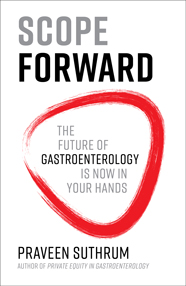
Praveen Suthrum: Scope Forward: The Future of Gastroenterology is Now in Your Hands
Read the full transcriptPraveen Suthrum
Praveen Suthrum is an entrepreneur and healthcare futurist who co-founded NextServices, a company that brings AI-based solutions and digital innovation to gastroenterology practices, labs, surgery centers, and healthcare companies. He hosts the GI Mastermind leadership program and The Scope Forward Show podcast. In his book Scope Forward, a follow-up to Private Equity in Gastroenterology, he draws on expert interviews to examine the structural shift underway in gastroenterology and offers practical advice for the industry to thrive in the coming decade.
★ Scribe Case Study
Praveen Suthrum’s Book is Improving the Lives of GI Doctors Worldwide (and Landed Him a Seat Inside a Million-Dollar Startup)
Praveen Suthrum loves working in healthcare, where he's improving the lives of others. Now, his book is too. Read more on the Scribe blog.
📚 Books by Praveen Suthrum
Transcript
[0:00:25] MR: No one in the medical field is free from the impact of COVID-19, including gastroenterologists. But the pandemic has only accelerated trends that started years ago. Health systems and insurance companies have become more powerful. Colon cancer screening options have expanded due to exponential technology. Artificial intelligence has embedded itself into healthcare, and even Amazon and Walmart are breaking into the healthcare industry, all while patients have become more knowledgeable and demanding consumers. It’s clear that GI can no longer rely on pre-COVID business models for survival. In his timely new book, Scope Forward, Praveen Suthrum provides deeper insights into the structural shift underway in GI. In today’s podcast, Praveen walks us through how the GI industry is being disrupted, what to expect, and how we can align these changes to build a bright future for gastroenterology. Enjoy. Hey everyone, my name is Miles Rote and I’m excited to be here today with Praveen Suthrum, author of Scope Forward: The Future of Gastroenterology is Now in Your Hands. Praveen, I’m excited you’re here, welcome to the author hour podcast.
[0:01:48] Praveen Suthrum: Thank you Miles and thank you for having me.
[0:01:51] MR: Yeah, you’re calling in from Mumbai today, isn’t that right?
[0:01:54] Praveen Suthrum: That’s correct.
[0:01:55] MR: Beautiful, tell us a little bit about just your background, and what inspired you to write this book?
[0:02:01] Praveen Suthrum: I am from a technology background originally, and then I did my MBA from the University of Michigan. Then, for the past 15 plus years, I ran a company called NextServices. Now, the company largely works with gastroenterologists on a variety of services and software products. That gave me a direct perspective of the problems associated with the industry and then, at some point during this journey, I started thinking, “What would it be like to actually answer the questions that my clients had, and to actually speak to a broader audience to the entire industry,” and that’s how Scope Forward happened. I actually wrote it on the momentum of a previous book that I had written on Private Equity in Gastroenterology, that was a big success. I started talking to different people on what they wanted to read about, and it became very clear that there was a lot of uncertainty about the future, and there was no clear direction. There was a lot of fear in the market, in the industry, so I wanted a tool or a manner to communicate and answer for people, and that’s how I began writing the book.
[0:03:20] MR: You actually wrote this book pre-COVID-19, and then the pandemic hits and now, it seems as though your book is even more useful and necessary. How has COVID in general impacted the GI industry and what does that look like?
[0:03:39] Praveen Suthrum: You know, as with the rest of the healthcare industry, gastroenterology got disrupted because – for several reasons. One is the specialty is dependent on elective procedures, largely colonoscopies, endoscopies and so on. Then, the specialty, like other specialties, is habituated to seeing a patient in person. The way the pre-COVID model worked is doctors would see patients in the office, then they would see them in the surgery center, they do procedures, then they see them back at the office, and then patients go home, and then they come back either a few months later or few years later, and then they see them again, and the cycle repeats. But then, when you look on the outside, there were several trends that was surfacing, and a lot of it have to do with exponential technologies. For example, there were options for DNA testing for colon cancer screening. The primary reason why gastroenterologists do screening colonoscopy, they look for cancerous polyps in the colon. Now, imagine the future when DNA testing is telling you not one but multiple types of cancer, it is able to detect. What happens to specialty that is depend on a procedure to detect cancer when there are newer means of detecting cancer on the outside, and not just one but many? I saw this coming from the distance. Let’s take artificial intelligence, you know? Another area. Right now, the insurances reimburse gastroenterologist based on what procedure they do, based on location, and the plans that a patient has, and so on. But now, think about the future where, say the insurance company mandates payments based on the quality of the procedure, or the exact number of polyps that they’re able to detect in patient’s gut, and then the reimburse you for that. Somewhere, there were payments could be tied to quality. Now, without the aid of a technology tool like say for example, AIM, getting into artificial intelligence and endoscopy now, then you have AI through computer vision. The AI could actually not only identify, but there’s enough technology in the works right now, where a polyp could also be classified. It can tell you exactly which polyp is cancerous and, you know, which is not. Imagine that context or scenario where say, an insurance company might mandate quality and if you detect – there’s a thing called the adenoma detection rate. It’s a metric that you track for endoscopy procedures. If they mandate payments based on a certain adenoma-detection rate, then again, the field gets disrupted because you know, not every endoscopist is able to perform at that level. That is where it’s becoming increasingly important that we use AI in order to perform what we used to do earlier. That’s all on the technology side but then again, you know, like with my previous book on private equity, I also saw business disruption. That was coming in in the form of groups consolidating with the aid of private equity funding. Then I saw that there were several big brothers in the industry, health systems, large health systems were consolidating. Big retailers like Walmart, were getting into healthcare. Then you have big technology companies like, you know, pretty much everybody, all the big tech, Google, Amazon, Microsoft, Facebook, all of them have a very strong healthcare play today. Who stops anybody from disrupting GI or all of healthcare? I saw these trends coming and then I finished writing the book and then COVID hit, we were not sure whether to complete it and launch it, or wait for the COVID disruption to be over. Then we figured that you know, it’s going to be longer, and it’s going to take a longer time, and what we ended up doing was to just simply start talking about the book. Then I saw that, when people were responding, that whatever I had already written was very – someone said it’s like a had a crystal ball and I pretty much saw the future. What exactly happened was all these trends that I outlined, got accelerated during the COVID period. Like telemedicine for example got accelerated, even DNA testing companies, for example, offered, started offering telemedicine, saying that, “Look, you don’t have to go to a surgery center for the procedure, you can safely detect whether you have cancer or not at home.” All these trends started accelerating and what I see happened going forward is that it’s just going to keep on gaining momentum. All the trends, both on the technology side as well as the business side.
[0:08:41] MR: Yeah, there’s so much here in the sense of just this industry hinging on so many different things. From – just to kind of zoom back out a little bit, there are several different exponential technologies that essentially could completely disrupt this industry and then, on top of that, the way that this industry is being run and the players that are starting to come into the game, like Walmart and Amazon, and these companies that have big data. As these technologies and as the industry shifts towards more data-driven, then it seems like you know, it brings in just a whole new business where it could be much more data-driven and not even, you know, through doctors and everything in the same way that it has been. There’s so many things at play and then as you mentioned with COVID, it’s like if all got accelerated forward because everything is more remote. Let’s back up to even just the technology side. You mentioned AI and you mentioned a couple of other things as far as disruptive technology, like the ability to detect DNA in stool samples. But what else as far as in technology, in gastroenterology, right now that is on the precipice of essentially disrupting the industry?
[0:09:59] Praveen Suthrum: Well, the microbiome. It’s been in the works for several years now, what’s happening on that side is 90% of our DNA is not even human DNA. It has the microbiome, it’s microorganisms, and in an earlier era of medicine, you know, all we wanted to do was gulp antibiotics and then destroy microorganisms in our gut. But newer research has been moving this in a different direction where we are learning on how the microbiome can actually either cause or help our condition, the condition of our body. Like for example, from obesity to certain GI diseases like IBS and so on. Several things are linked to the microbiome. Even the state of mind is linked to the microbiome. There’s a lot of research that’s happening on the microbiome and you know, that’s important. There are ingestibles, there’s a lot of technology that can be actually placed inside your gut so that’s coming. Robotics is coming, what happens is, some of these procedures like, let’s take endoscopy for example, right? The way the field is going is that what used to be advanced a few years ago is slowly becoming the norm now. The way advanced endoscopy itself is moving, is that you're able to do more complicated and more sophisticated procedures, you don’t really have to do a surgery, so you can go inside the gut, and be able to do procedures that were unthinkable before. For example, for the book, I had interviewed an advanced endoscopist. He is very well known for taking dead pancreas out using the endoscopy procedure and it’s a very complicated procedure. Without cutting. He’s doing an advanced endoscopy procedure. Now if you think how is all that possible? It’s possible because the sensors that are becoming more and more nuanced, and robotics that are becoming more and more nuanced, so there are several procedures in the future that will be able to do because of this new technology, exponential technology, that’s coming our way. Imaging is another, is playing a big role. Virtual reality, augmented reality is playing a big role, and the most obvious, which is in the news pretty much every day since COVID began is telemedicine. You know, pre-COVID, one research that I quoted in the book was that gastroenterologists use – only 7.9% of gastroenterologist have reported using telemedicine. Now if you repeat the survey, pretty much, everybody uses telemedicine. That’s changing, food is changing, prescribing food as medicine, there are GI startups that are working on food as medicine, specific diets being prescribed, then there’s 3D printing. I could go on but, you know, there is plenty of technologies that are in the works. The big takeaway for exponential technologies, Miles is, it’s just not, you know, DNA testing, AI, 3D printing, or drones or apps, or what have you, working in isolation, that’s not the point. That is going to happen anyways. There’s doubling happening, at an individual technology level, but what is also happening is combined multiplication of technologies. One is multiplying the other and the whole field is rising up, is growing and changing exponentially.
[0:13:32] MR: Yeah, and correct me if I am wrong, but from my perspective just – this isn’t an area that I know much about, but I personally even have become much more knowledgeable with the gut and microbiome for myself. From kombucha and probiotics taking off, to understanding how much of our gut bacteria actually affects how we think. It seems like there is a culture of really starting to pay attention to this more. Do you find that, and as you mentioned food, and people changing how they eat, based on their gut biome, do you find that important too? Or do you find that as a catalyst for this industry in general?
[0:14:19] Praveen Suthrum: You know that is a very interesting question that you asked Miles. You’re talking from the standpoint of a patient and that naturally segues into one of the chapters in the book, on changing patient behavior, right? So patients in the earlier days used to interact with doctors very differently. Doctors would prescribe or say something they would go back home and listen, but today, you know patients are way more avert than they have ever been. Like talking about the microbiome so there are people out there who are hacking their own microbiome. There is a procedure in GI called a fecal transplant. You know you are taking healthy gut from a donor and then you know your transplanting that microbiome into a patient who has other conditions or illnesses, and when the new bacteria starts finding home in the patient’s gut, soon the bacteria multiplies and then there is a natural healing that takes place. For my research for the book and on the chapter on changes in patient behavior, I found hackers who are hacking into their own microbiome. So they are cutting out the doctor altogether, and I am not even arguing whether that is right or wrong. I am just saying what is happening. So they are doing it on their own. So there was this individual who checked into a hotel room and he had taken the sample, fecal sample, put it into a pill, created the pill. Then the takes it, and he is documenting all of these data, and then he is doing it live, and sharing it with the world as it happens. So all of this is new to healthcare. You know healthcare industry is not used to these things and GI doctors have not trained to handle patients like this individual that I talked about. So yet another trend for example, which is interconnected, is while we worry about – like in the GI industry, you know, the role of private equity is a big deal, and then what evaluations are going on occupies prime real estate in everybody’s mind. Because it is very, very active in the space but then when you look from the patient side, there are certain GI conditions that are connected with the mind. Many of the patients are taking to for example, mindfulness apps and if you take one example Calm. It is a unicorn in that is valued more than a $1 billion. So, when I look at that so in a very crooked way Calm app, through its meditation, is probably healing IBS patients, who have probably got the condition because of certain behavioral issues and so on. So here I am thinking, you know how is all of this going to play out? Because if the GI industry does not wake up to this, then someone else from outside of the healthcare industry is going to take care of patients like these. That is a whole window of opportunity that is going to close. So therefore I thought it was important to bring it up in the book. So that we pay attention to the societal trends, which are happening.
[0:17:28] MR: Yes and how are GI doctors responding to this? It seems like you are very keen as to all of these changes as though you have this overview, and can see all of these happening in real time, and what’s coming as well. Are other doctors doing that as well? What’s their take? Are they staying old school with things and really not thinking about the future? Are they able to move as fast as we do in the modern day with things? What does that look like?
[0:17:57] Praveen Suthrum: So you know it is like with any industry that has been around for a long time, think of it like a bell curve. There will be people who are ahead of the curve. You know they’re experimenting, they are doing new things, they are open to change, and they know all this is coming. Then at the other end of the bell curve is a group, and in healthcare not just GI, the group could be you know large. So it is not a small percentage. It could be a decent slice but that group is denying everything. So they may deny it and say that, “Look, you know it is in the distant horizon,” and all of this stuff maybe 10 years out or even longer. When I hear that I am thinking you know that is exactly how linear thinking works because our minds are tuned to thinking in a linear fashion. So we see what is happening around us. GI doctors are thinking, “Hey, you know my patient volumes are full,” and I am talking pre-COVID. Like COVID has disrupted patient volumes. But pre-COVID, like, so they are thinking, “My patient volumes are full, my calendar is full, I am so busy," and I constantly hear this like, “I am really so busy. What could possibly go wrong?” and that is classic linear thinking that is exactly why Kodak got disrupted, right? So they created the digital camera but then they couldn’t take advantage of it because they refused to see what was coming and they denied it. So you see that, like you see a range. I gave a talk last year, while I was writing Scope Forward, on these ideas and when I actually made an announcement about the talk, some doctors even got back and said, “Hey this is all fear and it is not real,” and so on. You know that view changed after the talk and I think leading up to now, I do see the industry being a lot more open to embracing change but I see wide spread confusion because they understand, like, they got the change, and nothing is set in stone, and that is exactly what COVID did. So if it was anywhere, if it was set in stone, it completely disrupted the entire mindset about, “Nothing is going to happen, and nothing is going to change” and all of that. So you know we are here now like so the industry is a lot more open but the question that they have now is, “Okay, how exactly do we do this?”
[0:20:21] MR: Right, and that is what your book helps to really align these different things, and help doctors see all of this, and what is coming, and ways to get these things aligned. But what still is so I don’t want to say confusing, I guess, interesting to me, is how much the healthcare industry is changing, and how insurance companies are buying medical practices, which feels counterintuitive in some ways. How big tech wants to use their data to create algorithms around healthcare, and Walmart getting into healthcare, where is all of that going?
[0:21:00] Praveen Suthrum: Interesting question Miles. So to answer that – so I had this question myself and I was writing the book right? So, all you have to do is put yourself in their shoes, and it is not very difficult to do. If you think like a retailer, and this is how Walmart is thinking, right? Walmart is thinking that, “Hey, I have so many footfalls, every single day, all over the country, and so many millions of people are passing through our doors. The biggest growing industry right now, that requires change and disruption, is healthcare. Here I have so many patients who are walking into our door. Why can’t we do something for them?” My thinking is that’s how they got into healthcare, and they are experimenting with this. They have started with clinics and they are seeing patients for a variety of reasons. Now into the question that I have asked in the book is what stops them from bringing everyday low prices to GI procedures or services that the average gastroenterologist provides? When you think like that you can easily see there is big disruption coming. Let us talk about big insurance companies, right? So big insurance companies again are thinking – so they have actively acquired companies on the provider side frankly because you know there is growth on the provider side. One of the large insurance companies in the country has acquired – the fastest growing division is on the provider side not the insurance itself and from the outset you wouldn’t even know this. So when they are seeing that, we’re thinking that, “Hey, we can come at the industry from both sides. So if we control the beginning and the end, then somewhere those benefits are going to add up.” So you know I have talked a lot about these big companies influencing the direction of healthcare in a chapter called Big Brothers. The reason I called that chapter as Big Brothers is exactly this, like, is that – you know they are so large that they are going to watch pretty much every single thing that is going to happen from beginning to end. It is going to be difficult, increasingly difficult, to be out of that purview, especially with big technology companies coming into healthcare. Now imagine like you are part of the Amazon network that currently, they have virtual clinics for their employees. After they achieve success, they are going to go live across the country for other people. They know your shopping behavior, they track you constantly on your behavior on the internet. They know what conditions – probably, right? Google knows at least, you know they know what conditions you are searching for, what you are interested in, what you are worried about. They probably also know your emotional state, and then now they also have you visiting them. Imagine the power of that data? So, I think we have barely scratched the surface of what all of this could mean. In the coming years, there is going to be so much disruption that healthcare is going to look fundamentally different than what we are doing in 2020 will look really, really old.
[0:24:08] MR: Yes, and that is one of the best things about your book is really identifying all of these different things, and how much the industry can change. I highly recommend people check it out just in that sense of having a bigger understanding of what is coming. So congrats on writing the book. I know it is not easy. If readers can take away one or two things, what would they be?
[0:24:33] Praveen Suthrum: There is disruption coming and that is not going to stop based on how they feel about it. If I end up getting worried about disruption, then I am not going to inspire action, neither in myself nor in my business or organization, leave alone the industry, but there is a completely different way to look at the same thing. You can look at disruption and you can say that this stuff is exciting and think of it like an adventure. Say that, “I am going to ride this wave and I am going to use disruption as the very tool to propel me forward." If there is one message that is what I like people to take away.
[0:25:19] MR: I love it and there is a whole chapter on your book on create your own adventure. You help people – guide them essentially through creating their own adventure. It is pretty great. So Praveen, this has been such a pleasure. I am so excited for people to check out the book. Everyone, the book is called, Scope Forward: The Future of Gastroenterology is Now in Your Hands, and you can find it on Amazon. Besides checking out the book, where can people find you?
[0:25:45] Praveen Suthrum: The best way to find me is through the Scope Forward website and that is scope-forward.com.
[0:25:52] MR: Perfect. Everyone, check it out. Praveen, thank you so much and I hope you stay safe out in Mumbai.
[0:25:59] Praveen Suthrum: Thank you Miles and thank you for doing this.
Want to Write Your Own Book?
Scribe has helped over 2,000 authors turn their expertise into published books.
Schedule a Free Consult