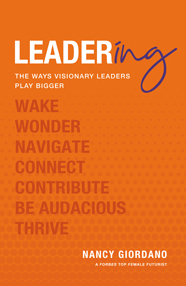
Nancy Giordano: Leadering: The Ways Visionary Leaders Play Bigger
Read the full transcript
Nancy Giordano
Nancy Giordano is a strategic futurist, global keynote speaker, corporate strategist, and gatherer with a drive to help enterprise organizations and visionary leaders transform to meet escalating expectations. With more than eighty keynote talks and recognized as one of the world’s top female futurists, she has worked with many leading companies to evolve over $50 billion worth of business. The first TEDx licensee and guest lecturer with Singularity University, Nancy is currently advising a second artificial intelligence startup and advancing two horizon efforts that will dramatically reshape the ways we recognize, create, and exchange value with each other in the decades ahead.
📚 Books by Nancy Giordano
Transcript
[0:00:24] MR: The concept of leadership is woefully out of date in the 21st century and the old playbook is dead. It’s time to usher in a new era. How? Well, it starts with leaders and where leadership is built on yesterday, leadering confidently and thoughtfully anticipates tomorrow. In the new book, Leadering, Nancy Giordano, the first TEDx licensee, guest lecturer with Singularity University and one of the world’s top female futurists, provides clarity and urgency around what modern stewardship demands as exponential technologies and changing societal expectations converge to shape a new tomorrow. This transformative new era requires a radically different approach to leadership, while ditching the last century’s industrial playbook so we can focus on building new, more expansive practices, committed to human-centric innovation, regenerative solutions and the creation of long-term value. In today’s episode, Nancy challenges us to shift our outdated thinking and adopt new mindsets that can enable us to build the future we all want, enjoy. Hey everyone, my name is Miles Rote and I’m excited to be here today with Nancy Giordano, author of Leadering: The Ways Visionary Leaders Play Bigger. Nancy, I’m excited you’re here. Welcome to The Author Hour Podcast.
[0:02:03] Nancy Giordano: Thanks so much, I’m excited too.
[0:02:06] MR: I’m so excited about this subject, we’ve already kind of been talking off air about it but before we dive in, tell us a little bit about your background, aren’t you actually the first TEDx licensee also?
[0:02:20] Nancy Giordano: Technically, I am the very first licensee in the world to license a TEDx event, I was one of about 10, that was one of the first producers of it. The idea was that I had gone to TED or at the time, it was called TED Active which was a simulcast event and it was extraordinary and you get to meet amazing people but you met them from all over the world and so I have friends now from London and from South Africa and from wherever but you weren’t going to be able to stay in conversation with them. What you really wanted to do is be able to share this kind of content and this kind of experience with the people in your own community. The people you work with and play with and plot with every day. I thought, well, if we’re going to do a simulcast anyway, “Can I do it in Austin?” I would love to be able to just have another version of this and bring it to Austin and build a community around it. They were like, “Well, you know, as a matter of fact, we’re thinking about starting this new program called TEDx. Would you like to be the first licensee?” We signed up and said yes, but we didn’t really know what we were getting into yet and again, there was appetite. It wasn’t just me who had that idea, there were several others who wanted to bring it to their communities in the same way but what was interesting is I think at the time, TED thought that maybe 50 of us would go through the trouble of doing this and look at where we are now.
[0:03:23] MR: Right, now it’s spread everywhere and TEDx is a goal oftentimes for authors to speak on. Tell us a bit about your background, as far as the content of this book and what inspired you really to write this book, based on the career that you’ve had?
[0:03:39] Nancy Giordano: Yeah, I’ll just back up really quickly and say, I started my career in advertising. Loved that but I saw a giant sea change happening in that industry at some point and I realized that the way that we were communicating ideas, building brands, was going to radically change as technology came in and radically changed the landscape. I realized that we needed to go further upstream and really think more about the values that a brand had and the way that it fit into the context of our lives so that we were able to better understand how things were shifting and changing all around us. I shifted my work to that and as I started doing that more and more, I would go in and help organizations figure out how to be able to build a more sustainable map to the future. What we saw is a giant, again, change in 2007, not just because an iPhone came out but because it enabled a whole bunch of other technologies that were convergent at the same time to be possible. After the 2008 recession, when everyone came back and tried to sort of regen the old operating system, it didn’t work anymore and they couldn’t figure out why. We went through and did a bunch of work with organizations but what was really fascinating to see was the ones that had a culture that was able to absorb and respond to new information and the ones that did not. Because the answer is there, we knew clearly how to help everyone of this legacy, iconic, fortune, whatever, brands or companies, be able to build a much more relevant and sustainable path moving forward but they’re often rejected what it is that we had to say because it just didn’t make sense to them, it didn’t fit their world view. Some were successful, some were less successful so it was really fascinating to be able to see, working directly with the leaders who are trying to navigate change, who was able to do it and who wasn’t. Not just again individually but organizationally. At some point, I just got frustrated and I went into the tech world and I helped start an artificial intelligence company and so all of a sudden, here I am learning startup, AI, software and this whole conversation around culture and talent and the experience of supporting people in the adoption of new ideas and new practices. We ended up not getting funded but it was a phenomenal experience for a year, I built a conference set on the seven most disruptive technologies and what I saw really clearly is how unprepared we are for how quickly things are going to change and how convergent these things will be and really radically transform everything about our lives. I became kind of more on a mission to help people understand that and started giving keynote talks over the country and then all over the world and with every kind of audience, right? The questions are the same, the issues are the same. One of the most fascinating audiences was dentists who were trying to figure out whether or not they should buy a 3D printer for their office and whether or not they should do it now or they should wait till the price comes down or the new model comes out. When do you bank a $300,000 investment for a business like that? That’s the same question that everyone has, whether it's a digital printer for your dentistry or whether it’s something else. Also, to see how they were building cultures in different [inaudible 0:06:16] of the organizations and so, I had this amazingly privileged position to be able to go to organization after organization and company after company who downloaded from me what was going on for them, why was it so important to have this conversation with this audience and what they were hoping to achieve within just an hour of me on stage and you start to see again, the same pattern over and over again. Over the time, it sort of coalesced into a pretty tight arc of a talk and it just seemed time to be able to share that more with others. The other tricky part of this was, what I learned three years ago is not any less relevant than what I’m learning today and I just kept adding and adding content and the talks became either too long or too fast. I was like, okay, if I put it all in a book, then at least I can do a talk that is of a reasonable length and still get people a place to go find the rest of the information.
[0:07:05] MR: Right, which is a challenging thing because as you write about the future and the culture of change that we're in, I’m sure as you’re writing it, things are changing so much that you constantly had to go back and keep adding things that are changing. You mentioned different businesses that maybe they were struggling to change and to change course and to adapt. Do you find that their inability to change is holding on to the way things have always been and the way that they were doing things and not really forseeing the future and really what’s to come?
[0:07:39] Nancy Giordano: Well yeah, I mean yes, obviously the answer to that is yes but the question is why, right? Why would it be in their best interest to do that when the best interest is actually to evolve and to adapt and to move forward so I spent a lot of time trying to figure out what the hurdles were. What is getting in the way? And again, part of it is just not having built in any way a culture that was designed to absorb and respond to new information. That’s why really, Leadering, the name of the book, is so important. Leadership is a practice that I have defined as a noun that was intentionally created to root out variability and to root out the new, right? It was designed to be able to ensure that we are closed and hierarchical and static and able to consistently deliver short-term profitability and consistent scalability, right? It was consistent growth, whether it’s month over month or quarter after quarter or scaling around the world but with a very, very clear mandate. In the 20th century, business, if you look at the industrial ways that arose, that first, second and third revolutions, that it was exactly what it was designed to do and why it was useful and why it was helpful, [inaudible 0:08:40] really successful. Lifted billions out of poverty, grew huge brands around the world. But, as two things have come to bear, one is the price of that, there are huge externalities that we actually paid for that growth and that way of doing business that are now coming to root. Whether it’s environmental instability or even ecological degradation as it continues to get worse and worse with plastics and electronics and everything else. It’s also growing inequality, which we have been talking about for years but never really been able to wrap our arms around, certainly systemic biases and all that but also, just a decline in physical health, emotional health, mental health, right now we’re seeing. The question is, how do we take this great force that is business and, what I argue, a beautiful technology called tech capitalism and put it to work in a different way and better way. Why that is so important, it’s not just because we have a bunch of things we’re trying to clean up from the 20th century but we’re heading into the 21st with really potent technologies. If we do not change the way we think, two things will happen, one, we’ll miss opportunities because we’ll drag this too slow, a mechanical mindset into an exponential technology future but will also then bring a way of thinking that creates even bigger externalities moving forward, which I think are really dangerous, right? Wholesale, we need to shift and change. Not only how quickly we adapt but our orientation toward what it is we’re trying to build.
[0:10:01] MR: Yeah, I completely agree and my favorite thing about your book is really how you take on all of these different mindsets and talk about all these different mindsets that are important to adapt now versus maybe in the past but before we dive into those, I just want to read an excerpt from your introduction that kind of set the able for listeners to maybe they don’t have a full understanding of how much things you’re going to change in the future because it is a hard thing to wrap our heads around. I’m just going to read a quick excerpt from your introduction here. You say here, “The future will look very different from the way things have operated until now. Some have declared that retail will change more in the next five years than it has in the past 50 and society will change more in the next 50 years than it has in the last 300. A recent headline declared that we are approaching the fastest, deepest, most consequential technological disruption in history.” This is not a small thing, we’re talking about the world continually changing over and you mentioned in 2007 how much things changed with the iPhone and the new technologies that brought on and opportunities. It seems to me that with COVID and the pandemic in this last year, sort of new – it’s happening again in its own way where this is getting kind of pressed down, the gas is getting pressed down and all of these technologies now are moving faster. So what is this now with COVID and these businesses and these ideas, how much more is this necessary to change our mindset?
[0:11:38] Nancy Giordano: Yeah, so, let me unpack that a little bit so there’s three stats that you gave, right? The first is that retail will change more. That came from a Walmart executive with which it is, I do work on a council called Retail Tomorrow where we really think a lot about the future of retail. That was much prior to the pandemic, that was probably two or three years ago when he made that declaration. The second is from a futurist named Gerd Leonhard and the way I always talk about that is, you know, he says, society will change more in the next 50 than it has in the last 300. First of all, just wrap your head around that, think about what the world looked like 300 years ago. Even if he’s off by a hundred years or 200 years, right? The fact that it could change that fast. I was lucky enough to be in London with my daughter once, we went to the museum of wardrobe, whatever it was, museum of fashion and you saw these big bulky dresses that these women wore, right? The ones that didn’t have a lot of money only had a couple of the dresses and they washed them, god knows how infrequently and then some of the really elaborate ones. They only had, even the richest person only had a handful of dresses, right? You step out of that and you’re on the street now and there’s Top Shop and there’s H&M and there’s Zara and there’s just like fast fashion all over. Try explain to somebody a hundred or 200 or three years ago what this was going to look like, it’s impossible to have imagined that what – just clothing, how much that would have shifted and changed around. Again, when Gerard says, it will change that must in the next 50 years, he is not exaggerating. It can be that dramatic about how much that will change. When you start to imagine again that all these technologies are going to come to bear in a way that they will create, I mean we’re seeing it in the food industry. I would argue, the food industry is going through one of the biggest disruptions it’s had since refrigeration came, refrigerated trains came and were able to move meat from one farm to another. That had a huge, huge change in our life and so will these technologies as we’re thinking about not just artificial intelligence but certainly AR/VR, bio engineering and on and on and on. You then go to COVID, but COVID just was, was I think a moment in which all those things became illuminated, I don’t think that they actually accelerated. When you talk to the technologists, the scientists, the designers, the entrepreneurs who are building the future and you ask them how far along we are, they will say 1%, right? That was 1% and that was part of the pandemic. Now you could say okay, maybe a little bit further along but I would argue the pandemic really deepened penetration of the current technologies, it didn’t create the innovation that we’re going to see coming out of the pandemic. We’re going to see so much that is explosive around what we’re realizing, you know, a video conference call is great but gosh, wouldn’t it be better if we had a way to be able to project it in some way or be able to be in a shared environment or be able to share files differently or be able to see emotions differently? Or people somehow communicate, we need to communicate in a really different way. We’re going to think about work so differently, right? We have, again, there’s not a futurist on the planet who hasn’t been talking about the fact that we are going to more remote work and more distributed work and that we’re going to have to have more reliance on digital technologies. What we’ve really just seen is a breakdown in the resistance, we were always told, “Too hard, too expensive, too disruptive.” All the reasons why these things couldn’t happen and now, because they had to, suddenly telemedicine becomes a viable option, right? Suddenly remote learning does become a viable option, suddenly distributed work does become viable. What we saw now is less resistance around the technology that already existed. What we’re heading into is a world in which those technologies will continue to again, evolve and to innovate and to radically change that we do everything.
[0:14:58] MR: That’s really exactly what your book steps in and helps, where it’s sort of like, “Okay, that’s what we have to do, this is where we’re at. How do we do it?” What you propose is we need to change the way we’re thinking about all of these things and how the old playbook on how we would go about these things is dead and we have to create new ways of thinking about these things. Tell us a little bit about what inspired that framework?
[0:15:25] Nancy Giordano: This goes to the passion I have, first of all, why do we want to hold on to that which was in the past? A, we just talk about all the breakdowns that already existed, that we need to figure out how to fix. Even on top of that, Gallup has been studying for decades, whether or not people feel engaged and satisfied with their work and it hovered between 70 or 80% of the people don’t feel engaged with their work, right? That’s a humongous number, that takes a big toll on people’s lives, it's why I would argue, it relates to many other epidemics that we got going on where people don’t feel very well held by themselves or by their work or probably the lives that they lead. Why don’t we want to make it better? Would be my first question. If we have this once in a generation opportunity to rebuild or rethink everything from higher education to again, to food and finance and our environments and the way we build things, you know, the way we distribute things, wouldn’t we want to design it in a way that we take really good care of people and think about it differently. Part of it is again, back to, the orientation needs to shift. One of the things that I think is really fundamental in this mindset piece and why I go to mindset is because again, these things are all available to us, it’s just whether or not we embrace them and how we embrace them. One of the things I think that often gets in the way for people is when they think about risk and change. I would argue that so many of the things that were put in place in the 20th century to keep us safe, to reduce risk, are now the things that are creating vulnerability in the 21st. It just doesn’t hold up anymore. Things like silos, right? They were designed to contain things and make things more efficient but what we’re seeing now is there is no exchange of information between the two and if anything, that there’s protectionism across them and so, it thwarts the ability to be able to innovate and it thwarts the ability to be able to move quickly. It thwarts the ability to be able to meet the needs of a customer or a market that’s now available to you. Then in the world of artificial intelligence, which I do spend a lot of time with, it becomes even more dire that we break those things down. That they can’t be held in these information silos and in these PNL silos anymore. That’s just one, right? Another really big one is the fact that we decided that the person that has the most experience, the most tenure, is a person who has the most decision-making power. I would argue that’s actually not very useful anymore, right? Having boards that come together once every quarter because they happen to be really great at what they did 10 years ago or 20 years ago, maybe not as relevant for an organization that is learning every single day how to meet the needs of their customers more effectively. But the people on the frontline –
[0:17:45] MR: Yeah, I think it’s so important to talk about how you’re not, you know, trying to say how all of the things that we were doing were wrong, it’s just that they’re not nearly as relevant today and given all of the change we need to adapt to the change and take on –
[0:18:00] Nancy Giordano: Well, I’m trying to break down why we’re stuck, right? Why we can’t move forward with as much confidence as we want to and I think it’s because we’re held to systems that we thought kept us safe. What I’m trying to help illuminate is those are the systems that now create vulnerability. Safe is actually moving to something that feels less familiar but is actually much more adaptive. Back to, you asked me about the playbook, why the playbook? Because it literally, I have literally had clients say to me, “What is the next chapter of the playbook? Tell me how to do artificial intelligence on Monday.” I’m like, “That’s just not how it works, right?” That of all the technologies is a probabilistic technology, it takes time to learn, it takes information in, it, you know, it does it very differently, which means everything from procurement to contracts, to the way we set-up our teams, to the way we do everything has to change as you bring in this kind of technology. You just cannot do it that same way anymore. The playbook which was a prescription about how to manage customer service and how to handle such and such was designed again, for efficiency and scalability. Now, we’re in an era where it is all about innovation and experimentation. That doesn’t work so what replaces it is a compass and a North Star and an ability to navigate new terrain.
[0:19:10] MR: Right and one of your first mindsets that you bring up, which I love, that fits exactly what you’re speaking to is “wonder versus resist” and this idea that just as you’re saying now, that old way of sticking to things no longer works. With so much change and everything now today, we need to be in the state more of wondering and more curiosity as opposed to being concretized in certain ways of doing things.
[0:19:36] Nancy Giordano: Yeah, and feel this need to be able to master what it is that we’re done. There was an interview I did last week with someone who was like well, “You know, what advice would you give to people who are trying to master blah-blah-blah,” and I said, “First of all, I don’t think mastery is the goal anymore. Humility is the goal,” right? Learning is the goal, being in a place where you can constantly take new information. Again, as an individual and as an organization and frankly, I would argue as a society, to get better at being able to take in new information, be discriminating about it, understand how it connects to other things, synthesize and be able to figure out what to do with that and then it becomes a really important part. It becomes a really important capacity, being able to navigate forward with confidence and we’ve often decided that that is nice-to-have. It is not a must-have, right? “I’ll read that book when I get to it or I’ll encourage people to think more innovatively and imaginatively when, you know, on Fridays at 2:00,” but we are not building that into our businesses as a really important part of how we do it but again, if you talk to anyone in the world of technology and you ask about what the number one capacity is for being able to adapt and navigate successfully, they will tell you curiosity. The question then becomes, how do we incentivize that? How do we ensure, inside our organizations, that we are just telling people that we want them to be curious but then we're shutting it down when it starts to become, in any way, exercised, right? Because people, once they become curious about something, they want to be able to put it into action. Then it becomes, “Well, how do we learn to build more experiments and do it in a way that we constrain risk and then don’t take a lot of time and effort or money but that we can continuously learn from them?” Whether that’s like again, doing a small artificial intelligence project or whether that is doing something new in a way that we hire or whether that is doing something in the way that we change a material or anything about what it is that we do but we are constantly in the mindset then of learning. So wonder is not just listening to a podcast, as exciting as it is or is intriguing as it might be, but it’s learning to get in there and really play with the ideas and think of each one that we – This idea of failure, right? That is hopefully an old word now, hopefully we don’t use that one anymore and we are all realizing that it is learning, that it really is again that mindset that says that each time that we are exposed to something, and whether it meets our expectations or doesn’t, we are learning something from that and we can continue to build with that.
[0:21:45] MR: Right and this brings us to your next mindset that we have in your book, which is “navigate versus replicate” and really, you discuss how in an environment demands this continuous innovation and on-demand delivery, how we need to really build the capacity to redesign things and test things and iterate and these things aren’t failures, they are things that we discover and then can pivot from.
[0:22:11] Nancy Giordano: A hundred percent and that goes back to again, a big mindset thing. Again, what I was raised to do was to replicate and become more and more efficient. Six Sigma, right?
[0:22:20] MR: Right.
[0:22:20] Nancy Giordano: I remember when Six Sigma came out, again, I worked in a creative agency so Six Sigma was never a big friend of ours because we knew what creativity, it went against creativity and innovation but, at least as I saw it, maybe I didn’t fully understand it and get my full belts worked out there. But that mindset that was driven toward efficiency flies directly in the face of the idea of experimentation and learning because it isn’t efficient, necessarily to do that, but it makes you much more prepared, to do that. To be in the position of either jumping onto a big opportunity and I think a lot about recently how Walmart and Microsoft jumped into – I’m sorry, Walmart and Oracle jumped in together to put a bid together for TikTok in a matter of days and weeks, like these are the kinds of investments that would have been made over like much longer periods of time. It would have been shocking to see two companies like that come together to do it, right? But they were prepared. When the opportunity rose, with all the craziness that’s happening in the world of regulation and, you know, international policy, they struck. And so how do you put yourself in a position to be able to take advantage of an opportunity, not just defend against the thing that’s going to shift and change and hope that you can stay alive, but how do you want to build something so that you can really thrive into the future? That’s what we’re trying to do. This idea that you are not really here to replicate the path of past and make it better and better and better and more and more efficient, you are here now to learn the capacities to navigate new terrain and take advantage of wholesale new opportunities in ways of doing things and even if you don’t, somebody else is going to. They can see the gap, right? The idea is, don’t you want to be a part of that as opposed to becoming irrelevant? What’s been really fascinating again in the automobile industry or the transportation industry, right? Who are the competitor to an [inaudible 0:23:59]? It is not necessarily an electric car maker. It is not necessarily even Lyft and Uber. It is not just a scooter, it is also Instacart. It’s DoorDash. It’s Amazon Prime. I have a 20-year-old son who still doesn’t have a driver’s license and you know what? He doesn’t care, he doesn’t need one. He is able to get all of his needs met without owning a car or having a license. Those are the kinds of things where again, we need to become more curious and we need to learn to navigate new solutions to meeting the needs of a person or a market.
[0:24:26] MR: Which it brings us to another one of your mindsets, which is “connected versus alone.” We are in a global world now. We are not living, you know, 200 years ago where mastery was important and you needed to become skilled in a specific trade, work alone, develop that trade and then sell that and you’re a master of one craft. It is about navigating and connecting with different people, so tell us about that mindset of connecting. Just like Walmart and Oracle coming together for TikTok is a perfect example and how we need to really work with external partners and internal teams to really, you know, navigate this environment.
[0:25:06] Nancy Giordano: Well, I think again, you know a fundamental part of where the book starts is that all of these things apply to us as professionals, as humans and as members of society, like this gets scaled across all of those ways and so when you think about this idea of connection, it is all of those things. Yes, I want to be able to make sure that I understand my peers, I am not siloed inside an organization and that we are able to work more fluidly across it. It's also about building my own ecosystem of people that I learned with and that I can turn to and you know, I think a lot about again, at the beginning of the pandemic, there was a hospital in Italy that was running out of a particular part that they needed for ventilators and they went to their supplier and their supplier wasn’t able to create them and so they went to through 3D printers and had them 3D print that particular piece. Now, why were they able to do that? Because A, they were curious enough to have learned something about 3D printing on the way but they also already had some of those relationships in place. They’d invested in the, you know, in knowing who those people were and who they could turn to in that moment and quickly and adaptively fix the problem, right? There is a whole other intellectual property issue that came through as a result of that but that is part of where regulation needs to keep up with our ability to be able to adapt. I think it is about recognizing and investing in these relationships to be able to learn together or grow together or invest together or build together are really, really critical and again, these are not just nice-to-haves. This is a critical business function and so one of the again, another phenomenal example that I often talk about is collaborating with your competitor. The ecosystem is not just all these other people outside or thinking about your vendor actually as someone who can build with, which is another big portion of the mindset. It is also about thinking about your competitors and think of this as retail competitors and innovation collaborators. One of the great examples of that was General Motors who created their autonomous driving unit called Cruise, and Honda invested 2.75 billion dollars in that so they, together, could fend off whoever else, Apple and Google and whoever else is out there building autonomous vehicles and just recently now, apparently they’re also navigating with Microsoft, inviting Microsoft into that. These are the kinds, like when you take on these really big infrastructure changes you are going to need to do it with more than just you, right? It is impossible. I mean some people are able to do it I guess within Google, they can do it by themselves but other people are realizing that it is much more effective and it spreads the risk. It shares the learning, right? There ‘s so much more potential that comes out of it and being able to meet the needs again of the future if you are able to do it with others. Again, the reason I’m able to be as confident as I am in a podcast with you or writing a book or on stage in front of, you know, a couple thousand people, is because I have been learning with a whole bunch of other people in my network. I have spent time investing both from a curiosity perspective and a relationship perspective and understanding what it is that is happening around me so that I can make sense of it and bring it to somebody else with confidence.
[0:27:50] MR: I think another reason why “connection versus alone” is so important, especially in today’s world, which you’ve already alluded to, is the fact that you know, we have made a lot of progress in the last 100 years but it’s come with its own problems, right? There’s been a lot of degradation and now we need to come together and we actually need to “contribute versus extract”, which is another mindset that you have. And I think what you’re speaking to really alludes to that, where we have to work together here, this isn’t working the way that we’ve been doing things. It has gotten us here, great, but now, as you point out in your book, with Leadering, we need to pivot. Tell us a little bit about, just the value of contribution, instead of trying to extract more out of everything. You can also see this marketing now, marketing has moved much more to value-base where you provide value first and then you make the ask, which is very different.
[0:28:42] Nancy Giordano: Exactly, a hundred percent.
[0:28:44] MR: Than how marketing is in the past, so walk us through that a little bit.
[0:28:47] Nancy Giordano: Well, you know again, just starting with, just backtrack for one second, we did a whole project called The Wonder Project, where we worked with this group of clients to go out and see how the world was shifting and changing and be able to then be more prepared for it and so much of what we are seeing now we saw in that work seven years ago and one of those things that, exactly what you just said about marketing. Marketing has to be a utility. Marketing has to actually offer value. You can’t just keep promising it because, and why? Because trust is down and choice is up and there’s a lot of reasons why we need to navigate into that place and so what we are finding is the only way that you really have the guts to jump over what we call the liminal gap, this gap between the way that things were and the way that things are going to shape up to be, there is this gap in between, right? There is this learning gap and there is sort of a time and maturity gap. To get through this liminal gap, you need to have something that propels you and purpose becomes a part of it. A drive to being able to meet a much bigger need is how you actually are able to pull talent towards you. It’s how you’re able to pull ecosystem partners to you. It’s how you’re able to again justify investing in, you know, different types of learning and experimenting. It gives you a drive to move ahead. And we’re also just seeing that customers are building – that they want to make choices and they want to support the things that support their values and what they think is important, particularly as we see the breakdowns around us, certainly around climate change. You know, anyone under 25, that is the number one existential threat in their world right now and they want to be able to make choices that support that, not in any way continue to contribute to that. There are literally kids, a mother told me this this past weekend, we did an event for middle school and high school kids in Costa Rica, that her kids, that literally her 14-year-olds says, “Why should we even be on the planet? Because we are using too many resources, we’re killing the planet. I don’t know if I should be here,” right? If that’s what they are thinking then you better believe they are going to make choices around shopping, around that value, if they are going to shop at all, right? Which is why you see H&M then do a wholesale change and commit to circular supply chain because they are realizing that their customers don’t want necessarily disposable, throw-away fast fashion that, you know, doesn’t take care of resources in a very thoughtful way. Partly, there is a business mandate to it and a market driver mandate to it. We’re certainly all seeing it around us. We want to contribute versus add to the problem. We are also seeing again, it gives you confidence to move ahead. One of the stories I talk about in the book is the difference between, the contrast between Nokia and Apple back in the smartphone revolution. Nokia has access to all of the same technological insight that Apple was given. The same suppliers came to them and talked to them about the screens and about the processors and about all the ways in which this technology could be built. They could have also foreseen that the smartphone would probably usurp our need for computers quite the same way but instead of being motivated to the bigger purpose, which Apple does have, right, to inspire around creativity and productivity, they were so locked into their own, you know, just ROI and afraid to cannibalize and just didn’t know how to strategically assess such a giant change and in a desire again, to keep safe, is where I go back to the risk thing, in a desire to stay safe, they strangled all possibility of innovation and instead ended up having to lay off 10,000 people and lost a $1 billion worth of shareholder revenue, right? Staying safe was absolutely the wrong, wrong thing to do but they weren’t driven by a bigger purpose or a bigger sense of mission in order to be able to make that leap and so I think the companies that have that mission and that have that sense of purpose not only are drawing again, talent to them and partners to them and investment to them and customers to them but it also gives them the courage to take the bigger leaps.
[0:32:07] MR: This is so aligned with your last mindset that you bring up and I am skipping over quite a bit just because of time, but really, “thrive versus die.” That’s the difference, right? I think you are speaking directly to that where, when companies that align themselves with the idea of thriving, of growing, of becoming greater, especially in today’s world, they’re the ones that are thriving today. The old ones like Kodak and like Nokia that hold on to these old ways of doing things because they’re trying to survive, they end up dying as opposed to running a company trying to thrive.
[0:32:44] Nancy Giordano: Right, totally and the one that we skipped over, which I will jump back to for one second because it ties to this, which is this idea of being “audacious versus incremental.” Because again, I think normally, to try and stay safe, we take teeny-tiny little baby steps and hope that that will somehow shift it and [inaudible 0:32:57] is that, you know, going from a phone that had a keyboard to a phone that with no keyboard was not an incremental shift. It was a paradigm shift and being able to make that leap and being able to be that bold is part of what makes it so — Thrive really is a culmination of all of these practices, it’s the ability to put wonder into action and contribution in action and connection into action, learning to navigate with confidence and learning to be building again that confidence and that capacity to think, to recognize an audacious opportunity when it comes to you so that you are in this ability to thrive. Thrive also means putting humans at the center. It isn’t just designed so that we can survive and just make sure that we make it to the next quarter but that we are actually creating long-term value. I think a lot about growth versus value, I want to be in a place of sustainable value creation. Year over year, decade after decade, I’m going to argue, generation over generation. One of the examples that we give in the close of the book about a company that thrives is the postal service of Norway. It is a 400-year-old organization that just won most innovative organization in Norway.
[0:33:57] MR: Wow.
[0:33:58] Nancy Giordano: Right? So it is totally possible to do this with whatever legacy, you know, infrastructure/legacy, mindset/government, whatever, and still be able to pull it together. The question is, what makes the difference between Posten Nord and an organization that can’t seem to get out of its own way? And this is what we are trying to break down in the book and what we are trying to give people both inspiration and confidence to do and just in closing, you know you, said something earlier about writing a static artifact in a dynamic world is really hard. It wasn’t even so much that I wanted to go back and change the thinking. I think the thinking in the book is really solid but you keep on adding new examples, right? A new story, new ways of being able to show how this is possible and so we hope to continue that conversation on leadering.us. It will be the website that accompanies this book, that is going to be slow at the beginning. We are going to need to spend some time adding that content but the hope is that we create a conversation where we get to see more and more of these examples and we get to share them with each other so that we can see this in action and we can learn from one another about how to build those capacities.
[0:34:57] MR: I love it so much and I highly recommend everyone check out the book. It is full of such incredible visionary material, knowledge and it is backed up with such great science and research but so approachable, so practical and so well-written. Thank you for putting this out there Nancy and if readers could take away just one or two things from your book, what might they be?
[0:35:19] Nancy Giordano: Well, I think that we are 1% into the future that’s about to happen. We are not just in an industrial era, we are moving into a productivity era and a productivity era requires a completely different set of approaches and physics that just works really differently. An exponential productivity revolution is really different than an industrial one so understand and spend some time learning about the differences between the two. Then in order to be able to ensure that we all thrive in that kind of future, we need to make it inclusive, we need to make it safe, we need to make it accessible and so this idea of putting humans at the center of everything that we do is so important. I talk a lot about that we are moving from winning to caring. Caring is really important and that’s caring for ourselves, it is caring for our teammates, it is caring for our society, it is caring for each other. To your point across the world, building that mindset, when we put caring into our work, allows us to build not only, you know, companies that hopefully thrive but people who are really thriving in it.
[0:36:12] MR: Caring instead of winning. I love it. Nancy, this has been such a pleasure. I am so excited for people to check the book out. Everyone, the book is called, Leadering: The Ways Visionary Leaders Play Bigger, and you can find it on Amazon. Besides checking out the book Nancy, where can people find you? You mentioned leadering.us.
[0:36:29] Nancy Giordano: Yep, intentionally leadering.us because it is a global movement but it is spelled with the letter U and S and nancygiordano.com and then LinkedIn. I spend a lot of time on LinkedIn sharing what it is that we’re seeing and hopefully having more engaged conversations with folks there about what they are building as well.
[0:36:47] MR: Well Nancy, thank you so much for helping us think about the future, prepare about the future and think more exponentially instead of linearly.
[0:36:54] Nancy Giordano: Perfect, that’s a great summary. Thank you so much Miles, I appreciate it.
[0:36:59] MR: Thanks again for joining us for this episode of the Author Hour Podcast. You can get Nancy Giordano’s book, Leadering: The Ways Visionary Leaders Play Bigger, on Amazon. You can also find a transcript of this episode as well as our previous episodes on our website at authorhour.co. For more Author Hour, subscribe to this podcast and thanks again for joining us. We’ll see you next time, same place, different author.
Want to Write Your Own Book?
Scribe has helped over 2,000 authors turn their expertise into published books.
Schedule a Free Consult