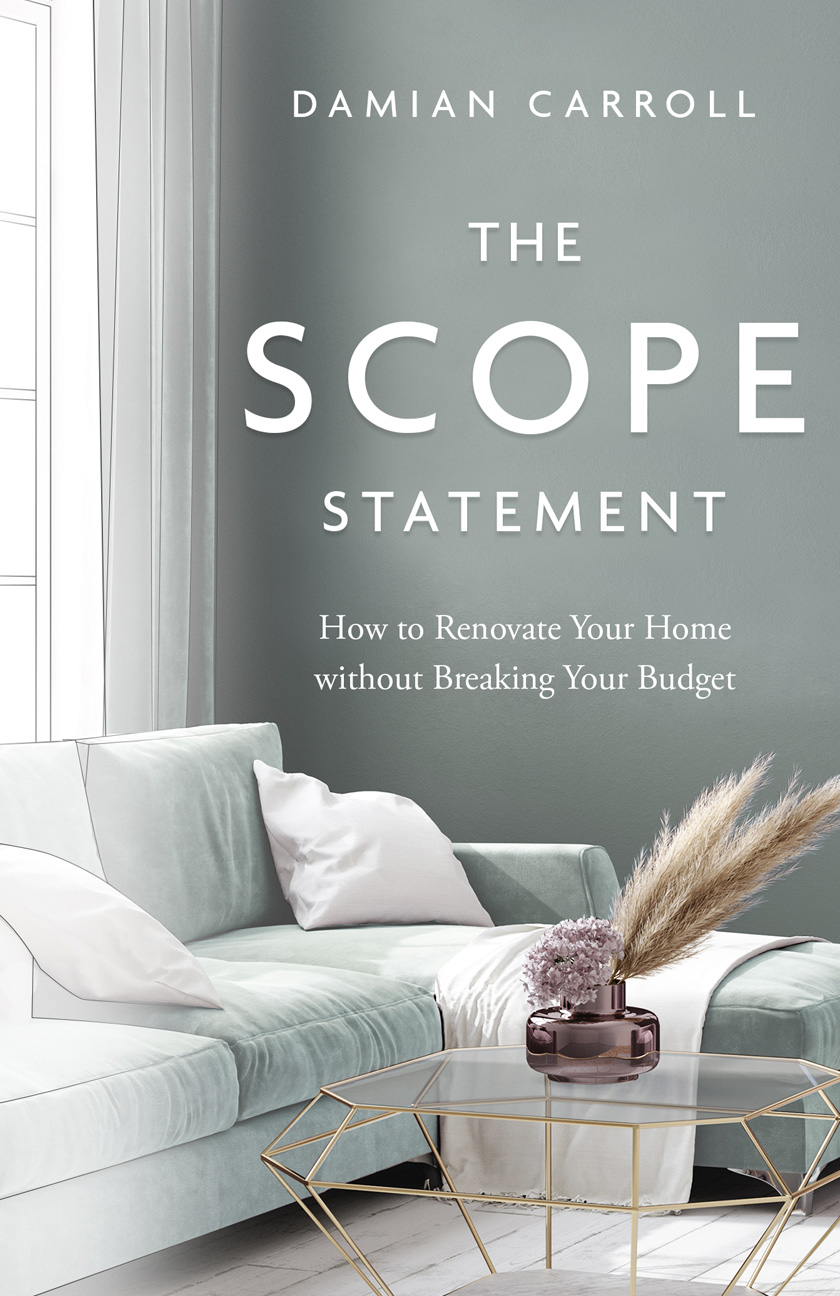
Damian Carroll: The Scope Statement: How to Renovate Your Home Without Breaking Your Budget
Read the full transcript
Damian Carroll
Damian Carroll has worked in the construction industry for over 15 years and written hundreds of scopes. After seeing how often a good scope statement can save your skin and how wrong things can go without one, he wrote this book to help inexperienced homeowners create the home of their dreams at a fair and reasonable price.
To learn more and connect with Damian, please visit or
📚 Books by Damian Carroll
Transcript
[0:00:22] JB: Home renovation shows have proliferated on television because people are interested in renovation and also because they make for good drama, but it’s much better to keep the drama on the screen and out of, say, your kitchen. Far too many customers, says Damian Carroll, veteran of the construction industry, become dissatisfied with renovation projects at some point in the process and almost always either because the project doesn’t go as planned or the budget balloons. Carroll says a proper scope statement can solve both of those problems as well as a lot of angst. On Author Hour today, he discusses his new book, The Scope Statement: How to Renovate Your Home Without Breaking Your Budget, and shares advice about how property owners can be as prepared as possible to enter and navigate the renovation process. Hi, Author Hour listeners. I’m here today with Damian Carroll, author of The Scope Statement: How to Renovate Your Home Without Breaking Your Budget. Damian, thank you so much for being with us today.
[0:01:31] Damian Carroll: Thank you, Jane, for having me.
[0:01:33] JB: First off, can you just tell our listeners a little bit about who you are and how this book came to be?
[0:01:41] Damian Carroll: I started working in the construction industry in a formal way, let’s call it that, 15, 16, 17 years ago. I was fortunate enough to come across a gentleman over there in Australia who taught me the PMBOK system, which is a project management body of knowledge and that’s nine functions and how it applies to the construction industry. Steve was terrific at teaching me that and so I began my journey in the construction game in a formal sense that way and I was working for the clients, the client side of the table in Australia until I ended up moving to America nine or so years ago and was working for a general contractor. What struck me as being consistent all the way through was that clients everywhere always tended to have a bad experience when it came to construction projects. And so it got me thinking, “Well, why is that?” And the experiences I’ve had on both sides of the table, dealing with both sets of people on there and their various sets of issues in terms on their own side of the equation, led me to believe that it’s the planning process that needs to be refined and what Steve did teach me was that he said, “I don’t care how big or small the job is, you need to do a scope statement upfront.” What that does, it lays out all the deliverables in a project and ties it all together, it’s all the individual task but then it ties everything together. Then, when someone reads it, they understand what the client wants and what each trade or each deliverable is required to perform and undertake and deliver and hand over to the client.
[0:03:49] JB: Tell us a little bit more about what the scope statement is, it’s literally just a list of everything the client wants?
[0:03:58] Damian Carroll: It peels back the layers of a job. I’ll give an example, replacing tile, okay? Well, that’s a very generic statement. What sort of tile do you want, what color of grout, what color tile, how much are you prepared to pay, what else is going in the bathroom, I’m using the bathroom as an example here of course because that’s the example in the book. It forces you to peel back the layers, do you want it to go all the way the ceiling? Do you want it to go a foot off the floor, do you want it to go six foot off the floor? How does it tie in with the remainder of the décor of the bathroom? Are you installing a vanity, what infrastructure is behind the wall in terms of your studs and your existing drywall, does it all have to get replaced? What this does is it fleshes out all the insularly tasks in a job that in the client’s mind, let’s put this where the client doesn’t know it needs to be done, the industry does and then the client and the supplies are lagger hedge because the client doesn’t understand why it takes so long or why the cost is so high when the industry says, “Well, you have to do all these things.” It’s an attempt to try and reduce that expectation gap between the two parties.
[0:05:23] JB: Tell me if this is right, a scope statement is something that industry professionals have been doing and now you're saying actually, the client needs to do some of this work in advance?
[0:05:34] Damian Carroll: Well, in my experience, they’re more common in Australia. In America, I’ve not seen them. It doesn’t mean they’re not being done or I just haven’t seen them. What I’m trying to put out in the world is that the clients need to help themselves and the industry, the construction industry by putting these together because the client then tells the world, “Well, what do they want?” Then it allows the industry to price it in a sensible and fair and reasonable way so that there’s less of a gap between the expectations of the client and the suppliers.
[0:06:09] JB: Yeah. We’ve all just kind of been flying by the seat of our pants. I mean –
[0:06:15] Damian Carroll: Well, yes. Every construction project, no matter how big or small, will have a problem and anyone who tells you otherwise is not being very truthful with you and so, the idea of this is to take away a lot of the angst that happens because of the lack of planning upfront.
[0:06:33] JB: I see. I mean, I have not done a home renovation project. I have one I’d like to do and, in my head, my first step was just going to be to call a professional and kind of put it all in their hands and so looking through your book, I’m seeing now that there would have been a big expectation gap, planning and preparation is really important.
[0:06:58] Damian Carroll: Yes, the key to this is to get safe, which is self that did the bathroom or a kitchen is to get you to think about well what do you want? A lot of the times, the general contractor or builder or suppliers, they’re trying to guess, even they’ll ask you questions they’ll guess. They don’t really know and you’re entitled to change your mind every day, no problem at all. What this does is it forces you to look at the end, stop with the end in mind. What do you want this to look like, how do you want it to feel and then work your way back and that sort of gives you then a chance – writing a scope allows you then to do that process, is to work your way back. “Well okay, what do I want? What’s currently there now and how do we go from A to B and finish the job?”
[0:07:48] JB: We should tell listeners that you give examples as you mentioned in the book of what a scope statement looks like and all the different elements. It’s a real education for a homeowner to learn about all this and it seems like one of the biggest things they’ll learn is that, it’s all going to cost a lot more than they think and the sooner they get used to that, the better.
[0:08:12] Damian Carroll: Look, it’s unfortunate that that is the reality is, yes. Labor is your biggest cost component in doing any construction job and it’s trying to get people’s minds realigned to how long it takes to do something, try this typically only work eight-hour days, plus or minus, depending on what jurisdiction you’re in. They also have kids that get sick, there’s transport problems, there’s all sorts of things just like clients have. Clients have those problems just like traders do. Everyone has those problems. All those things have to get factored into not just the cost but the schedule. It’s trying to get people just to realign their thinking to what really happens when a job gets done. This is not just residential, this is also commercial. Most of my experiences in commercial and it’s all about setting the expectations with the client and discussing it with them and telling them what’s happening and what’s going on and keeping them up to date.
[0:09:17] JB: I imagine that because you’ve been doing scope statements and helping clients understand them and really doing that leg work at the start, the prep and planning, I imagine you’ve seen some good results as far as expectations are concerned and had fewer problems down the line when things don’t always go to plan or if they do go to plan and the cost is what the client expected it to be. Can you tell us some stories about how the scope statement has helped?
[0:09:49] Damian Carroll: I’ve done a number of projects, particularly in Australia when I was working on the client side for the tax office over there. We would do data centers, we would do brand new offices, we would do restack of an entire building based on the scope statement and how we would do it is the client would come to us and say, “I have a need” so we’ll go down the path of establishing, well, what are they trying to achieve, what do they want, et cetera, et cetera. We would then go off and write the scope statement and put it together, look at all the trades involved, look at what’s required and you know, if there’s movers involved, et cetera, et cetera and put it all together and title together and then get back and talk to the client and say, “Is this what you want?” Then they would think about it, they would come back and change this sale, “This is great but I want this, I want to change this” et cetera and we get it right and they sign off on it and then we would go to the industry and start pricing it. We would get consultant fees included. We would get an estimate done by a corner lease surveyor. Corner lease surveyors are not really that prevalent in the US but they are in the UK and Australia. We would then present it to the client to have them sign off on a budget and this is how we did it every time. I can give you specific examples but it probably doesn’t help too much but this is the process that we did, the client work. We would add contingency and the client was fully visible with it and they’d sign off from the budget and off we go and we’re going to hire and fire all the people that needed to be included on the project, go entertain that and we’d have documents produced and have the job done and then signed off. Now, you know the budgets were probably kept I would say 90% of the time. There were times that went over but that was typically because of all lighting conditions or client specific request. You know, that was certainly kept I was believed with all of that and so it took away the angst of the client coming back saying, “You know, why is this costing it more?” and you know, I’ve found a lot working as a builder in the US that because there is not as much planning done upfront, as a general contractor we were reacting to the documents placed in front of us and unfortunately those documents weren’t complete. What happened was I was in a competitive environment where we would have to price the documents, knowing that they were incomplete and then having to get back to the client for variations and change orders when they weren’t expecting it because you know the process was incomplete from the start and that is not a pleasant experience. I never like doing it but I had to because that’s what the client wants and so I am trying to change the thinking by saying, “Well, let’s do the legwork upfront. It might get easier for yourself.” “Yes, your budget will be more than you think it is but it’s more real and therefore, you can either say no to the job, it’s fine.” I’ve had recommended other clients, if your budget is not enough then don’t do the job because there is room for error from anyone and that’s happened in the past before and it’s okay to say no to doing a job. The experience that I’ve had has said that this doing a sky piece is absolutely invaluable. Now, does it capture every single thing? No, it does not. It’s not designed to do that but it paints a real picture of what’s got to happen on a job. I had managed to have a couple of clients in the US pay me to do this and they’ve been thrilled with them. Now, a quiet complex, a quiet complex scoped. One was for a building infrastructure, so chillers, crawling towers, boilers, change over in an existing working building and another one was for water proofing the existing façade and they were thrilled with the outcome, so they are worthwhile doing and spending the time upfront. The problem is that it’s just – it’s hard to get a mindset change, so I thought, “Well, you know, at least if I conversely in the residential area, I mean how many people have…” you know, probably you’ve spoken to people in parties, they might not know that my wife’s network of friends here have complained about all of the issues they’ve had with the construction jobs at home and I go, “Well okay, there’s a reason for that and this is the reason why in my view.”
[0:14:33] JB: Yeah, measure twice cut once, right?
[0:14:36] Damian Carroll: That’s what the entire industry will say. I mean, all the old time superintendent encampments that I’ve come across is just they always just say, “Take your time getting it right up front.” Do it properly, do your homework, do your research up front and then execute once and that’s exactly the right analogy.
[0:14:59] JB: You also have some advice in the book about how to choose a builder. Can we talk about that a little bit?
[0:15:08] Damian Carroll: Sure. There is a number of ways of doing this and I could potentially write a book on this on its own. It’s dependent on the – let’s just talk on a residential center, it is dependent on the people involved, of the client, the owner and what relationships they already have with people and so you could do it a number of ways. You can go and talk to your favorite builder that you’ve dealt with before or that someone’s recommended that’s fine or you can go down the path of soliciting bids or soliciting tenders off of people. There is different ways you can go about this. It all leads to different types of contracts and types of relationships and types of fees and it is sort of, I am not giving a vague answer because I deliberately want to do that. It’s just that if someone wants to engage a builder directly that’s one way of doing it. The builder is still going to want to know what you want and so if you do these scopes time, you can go to the builder and I’ve shown also how to price it and how to put a number to it, so that then it gives you a bit more of a sense of what to think about cost. If you didn’t go to your local builder that you’ve dealt with before or you’ve had recommended, then you and her can start talking and start figuring out, “Well, what’s the real cost?” et cetera and come to an agreement that way and then work at his fee. Now, there is different ways you can do it with him going down that path. Another way is you can do a scope, price it yourself and then go and solicit two or three bids from people in the area and you can do it that way and there is pros and cons of both. Now, I am happy to go into the depths and the details of the pros and cons of both but people might fall asleep to start listing that.
[0:17:04] JB: It really is a relationship. I mean, it is so much like a relationship especially once you – I mean, it is a kind of relationship but I think you know the analogy I’m getting at especially once you’re really in it. There is also advice about how to manage that once it all started, which tell me if this is right, I feel like it basically boils down to do your homework and don’t be a jerk, which is –
[0:17:29] Damian Carroll: Well yeah and so often and this does work both ways, you know, from the suppliers and the clients is that if someone has done the work, pay them and don’t string them out and don’t play funny buggers with them. If they have done the work and it’s legitimate, then pay them quickly and I’ll guarantee anyone that does a job with a contractor of any description, if you pay them promptly and you treat them with respect and you do it the right way, you will get more back than you think you will. They will help you in more ways than you think you – than you think. Most people, not all because I mean, they like you and I, they just want to be treated with respect and be paid a fair and reasonable amount of money to do a job, they are entitled to make a profit. They’re not entitled to gouge you, there is no question about that and that’s where your relationships come into play but you know, we’ve always maintained wherever I’ve worked and I’ll thump the table on this wherever I go, is you’ve got to pay people when they have done the job and pay them quickly because you’ve got supplies they got to pay and they’ve got a staff they got to pay and it goes on and on and on. Don’t not have the money with you. Have the money to start in cash and in credit card and treat them with respect and I’ll guarantee you’ll get more back than you think you will.
[0:18:55] JB: Yeah, I feel like there is this expectation culturally here that these sort of home renovation projects are somewhat adversarial and it doesn’t need to be that way, does it?
[0:19:11] Damian Carroll: Well, look, some are not, you know? But some definitely are and you know, I don’t have any anecdotal evidences to what percentages of either but if clients think of it this way that this is a significant impost not only on your financial situation but also your life for a period of weeks or months and so you’ve got to work with these people to make it less painful for you because if your bathroom or your kitchen is out of action, where are you going to come up with alternatives? Most people have kids, a lot of people have kids when they do these jobs and so they’ve got to work around that too but guess what? A lot of suppliers have kids as well, they understand. They get it so it’s just a case of treat – if everyone treats everyone with respect and yes, things will get hairy at times and frustrating and all that sort of stuff and it is okay to vent your anger but then you calm down and you say, “Right, okay. Let’s figure this out” and most people will do that. You know, you’ll occasionally get the odd rogue in the industry that will not do that. You know, it’s unfortunate that happens but it happens in any industry no matter what you talk about.
[0:20:23] JB: Well, thank you, Damian. It’s been a pleasure speaking with you. Again, listeners, the book is, The Scope Statement: How to Renovate Your Home Without Breaking Your Budget. Damian, in addition to reading the book, where can people go to learn more about you and your work?
[0:20:36] Damian Carroll: I have a website setup, it’s my name. It’s damiancarroll.com or they could go to thescopestatement.com, either them are interact with each other and there is a little bit more about me there and a bit more about the book. I got an excerpt in there, I posted some blogs and I am going to add more blogs over the next few weeks and yeah, so people can go there and if they want to get a free half an hour consultation, residential or commercial, there is a way that you can go in there and book some time with me and I am happy to talk to people and go from there. If they want to hire me to help them do things, it’s all there and we can certainly talk about it and I’ll be happy to help people out.
[0:21:16] JB: Great and that is Damian with A’s, Damian and Carroll with two R’s and two L’s.
[0:21:24] Damian Carroll: Yes and it is just damiancarroll.com.
[0:21:26] JB: Great, thank you so much.
[0:21:28] Damian Carroll: Thank you, Jane.
[0:21:33] JB: Thanks for joining us for this episode of The Author Hour Podcast. You can get Damian Carroll’s book, The Scope Statement: How to Renovate Your Home Without Breaking Your Budget, on Amazon. You can also find a transcript of this episode as well as previous episodes on our website, authorhour.co. Make sure to subscribe to The Author Hour Podcast for more interviews and insights into life-changing books.
Want to Write Your Own Book?
Scribe has helped over 2,000 authors turn their expertise into published books.
Schedule a Free Consult