Brand Currency: Steve Susi on Taste, Time, and Why a Human Should Write the Book
✨ Episode Summary
Steve Susi was the first executive creative director in Amazon history, and the four currencies he watched brands and customers trade in there — money, information, loyalty, and time — became Brand Currency in 2019. The thesis arrived on a stage at Dentsu headquarters in Tokyo, in front of a room that needed about 30 translators to follow him. “And I thought, wow, there’s something universal here. We all share these ancient traits. What matters most to all people? Money, information, loyalty, and time. And it seems like Amazon seems to traffic in those better than most. So let me write a book.”
Seven years on, the book has had a second life he did not plan for. It landed just before COVID, and “the book actually sold pretty well. And I got a lot of fan interaction, which was unexpected.” It was picked up for Korean translation, which confirmed something the four currencies had only implied. “That brought us to those moments where we realized we’re not so different around the world.”
Book number two is already underway, and Susi is direct about the one job he will not hand to AI. He uses it every day to challenge his own assumptions, but “it is simply not going to write my book” — because a model without his own enterprise-level instruction “does not come with encoded discernment, judgment, or taste.” His case for the printed book is simpler. “And now when someone walks into a home and sees a bookcase full of books, it says, I’ve invested in this piece of physical matter because it really matters.”
⭐ Top Moments
- The one job he will not hand to AI. Susi uses AI every day as a thought partner, and it will play a sizable role in book number two. He drew the line anyway. “So now I use it to challenge me. And it knows enough about me to challenge me so that it’s not writing, as the podcast guest mentioned, it is simply not going to write my book. I am not interested in it. You want to know why? Because without system prompt or enterprise, myself being the enterprise, enterprise-level instruction, it does not come with encoded discernment, judgment, or taste.” The argument has a name. “Taste is the New Oil is an article I wrote recently, and it got a lot of attention because what we’re seeing is everybody has the same answers or access to the same PhD-level intelligence. It’s what we do with it and the discernment that comes out of it.”
- The second life a 2019 book found in 2020, and then in Korean. Asked what unexpected things came out of the book, Susi went to the timing he could not have planned. “I hate to say it this way, but the book coming out right before covid did two things.” Readers suddenly had the time. “And so the book actually sold pretty well. And I got a lot of fan interaction, which was unexpected.” Then it travelled. “The book got picked up for Korean translation. And when I saw that other folks halfway around the world were dealing with self-same issues that we were here or I was in my own household was really enlightening.”
- The ovation in Tokyo that became the book. Amazon had moved him from New York to London as its first executive creative director, and a large part of the job was flying around the world telling Amazon sellers how to think about brand. “And so I went to Dentsu headquarters in Tokyo, and it was a jammed house. I couldn’t believe it. There were probably 30 translators on hand. And when I took the stage, it was held at rapt attention.” It landed. “And evidently, it worked. And the translators must have done a fantastic job because it was left with a rousing ovation.” That was the moment the book existed. “And I thought, wow, there’s something universal here. We all share these ancient traits. What matters most to all people? Money, information, loyalty, and time. And it seems like Amazon seems to traffic in those better than most. So let me write a book.”

Steve Susi
Steve Susi spent sixteen years with New York's digital advertising agencies before joining Amazon Advertising as its New York creative director in 2012. He became its first group creative director in 2014 and, two years later, its first executive creative director, moving to London to lead creative operations across Europe, Asia, and Canada. In 2016, he received the first Amazon Inventor Award granted to Advertising outside the United States. Over his career he has directed teams handling brands including Mercedes-Benz, Gucci, Rolex, American Express, and AT&T. Today he is a founding partner at KANE Creative Group, a creative network founded by former Amazon Advertising creative leads. A native of Columbus, Ohio, he is a graduate of Subiaco Academy and Miami University, and the author of Brand Currency.
★ Scribe Case Study
Amazon’s First Creative Director Turned a Tokyo Ovation Into Brand Currency
Amazon’s first executive creative director, Steve Susi, turned a Tokyo standing ovation into Brand Currency, which found a second life in COVID and a Korean translation.
📚 Books by Steve Susi
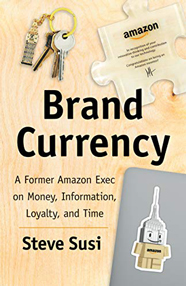
In this episode of Author Hour, Travis Stoliker sits down with Steve Susi, author of Brand Currency and the first executive creative director in Amazon history, to talk about the ovation in Tokyo that became a book, the second life the book found when it launched just before COVID, why he will not let AI write book number two, and what a full bookcase says about the person who owns it.
Transcript
Travis Stoliker: Steve, thank you for joining me.
Steve Susi: Travis, thanks for having me. This is fantastic.
Travis Stoliker: So we have a lot to talk about. For one thing, we need to talk about the Bee, but the other thing is that you wrote a book with Scribe back in 2019 called Brand Currency. And I believe you had three goals in life.
Live in London, become an executive creative director, and publish a book. So you've done all three now, right?
And I believe you had a life philosophy that you should always have a big goal or a few big goals. So my big question is, since you've achieved all three, what's the next big goal?
Steve Susi: The next big goal, by the way, when I worked at Amazon, we had this big book room and we were encouraged to go in and take whatever we wanted because it was expensive for the company to recycle or donate. And one book that I grabbed out of the thousands was The Happiness of Pursuit. And these are big, multi-decade goals.
And I thought one to start with is to visit every single museum in Italy. So we are well on our way there. Now in contrast with, say, Germany, with more than 2,000 state-recognized museums, Italy has fewer than 700.
So it's doable. It's manageable. It's just going to take many trips and many years.
That's what's coming up next after I finish book number two.
Travis Stoliker: Excellent. Excellent. So you were talking to [a colleague at Scribe] and you mentioned that you were using the Bee device to capture some of your thoughts as you were thinking about them.
And I was thinking about this. So I recall that you said something in your book about how Amazon was one of the model companies. And now if I recall, I think Bee got purchased by Amazon.
So you are almost literally your partner in writing your book is Amazon with Bee. And then obviously the sales channel will be Amazon too, right? So like this is a huge full circle moment, I feel like.
Steve Susi: It is. When I first acquired a Bee, it had not been purchased by Amazon as a company. And so that enterprise has since gone the way of so many others.
And it's an outstanding $50 purchase. It's a one-time shot. You don't pay for model access.
And the ability for it to transcribe, even for folks whose first language isn't English, so they may come with a heavy accent, the high definition microphones are incredible. And the summaries it generates, takeaways, key events, key actions, it's just beyond. And then what I was telling [a colleague at Scribe] was that at the end of every day, when you use it, it comes to you with a summary of your day.
And it captures both of those in separate folder and subfolder constructs, which means you can use them in your AI to build whole compendia about your thoughts around certain subject matters, different work dynamics. It's really taken my work and my personal life, actually, to an incredibly new and higher level because of the ability to access and analyze thoughts that were once fleeting, and they no longer are. They're almost permanent.
Travis Stoliker: [A colleague at Scribe] sold me on it after your call. So I bought one immediately. And I wasn't using it as a book writing partner.
But you summed up one of the things that I just love about it. So I have a seven-year-old, now eight, but we would go on these bike rides at the time that I had received it and what it would capture about my interactions with my son and then being able to go back and forth with it and say, hey, for instance, one that I recall is like we were approaching this intersection and I was talking about, you know, this is where things could be really dangerous because that car doesn't actually see you.
They're not looking this way. And I would just ask it, like, how could I be a better father in that moment? Like, what could I have done better there?
Was I too impatient? Was I present in that moment? Having an AI like sitting on your shoulder for those moments, it was so powerful.
So thank you for that recommendation. My only the only sad part is I don't think it's waterproof. And I took it swimming and it didn't survive.
Steve Susi: Oh, well, we need the aquatic version. I'm sure Amazon's quickly on its way to developing that product. That's unfortunate.
But you're right, just that what was once considered ephemera in our lifetimes, fleeting moments we can now use to to look back thoughtfully on and hopefully make the future a little bit better. So those those those moments are no longer disposable. They can be permanent.
Travis Stoliker: Yes, absolutely. So one of the favorite points that we have or the lessons that we try to to encapsulate in the author hour is what were some of the unexpected great things that happened from your your book back in 2019? Because you were writing about the four currencies and then covid happened, too.
So there were a lot of unexpected things during that time. So can you kind of take us back to that?
Steve Susi: I can. And the four currencies really occurred to me during my time at Amazon, where I watched that money, information, loyalty and time were what brands and customers traded in. And the great insight from that era was that whoever mastered all four of those currencies at once was like in the movies when four ancient stones were brought together and it imbued the owner with unspeakable magic powers.
And I was firmly convinced in that thesis in 2019. Shortly thereafter, covid hit now. I mean, I hate to say it this way, but the book coming out right before covid did two things.
Number one, a lot of folks learn to take some downtime, settle, possibly not just work on their mental health, but also catch up on things that they didn't otherwise have time to do, spent commuting, et cetera. And so the book actually sold pretty well. And I got a lot of fan interaction, which was unexpected.
And so sometimes a silver lining comes out of something tragic like a pandemic. And then the second thing that, you know, it's related to that is the book got picked up for Korean translation. And when I saw that other folks halfway around the world were dealing with self-same issues that we were here or I was in my own household was really enlightening.
But so much has changed since then. That brought us to those moments where we realized we're not so different around the world. We're all the same and we all suffered some of the same setbacks during the covid era.
And then, of course, covid settles and right on the heels of it comes AI, which was yet the next great, I would say, progenitor. And that's what caused me to start book number two, which is already underway. But the four currencies made a sense for a lot of folks at that time.
And then you fast forward to just five years later with the with the I'd say three years later with the release of the mainstream GPT. And it's all yet changed again.
Travis Stoliker: And how are I was fascinated of how you're using AI as a thought partner, you know, because that's something we hear all the time since we're in a creative business. And Naval said something on a podcast yesterday that I thought was great. He said, if AI is going to write your thoughts, then my AI is just going to read it.
If you want me to read it, then a human should write it. But I love how you're using AI as a thought companion is from my understanding. You're going back and forth with AI.
You're shaping your thoughts. You're capturing it, obviously. Can you talk to me about how you're using AI?
Steve Susi: First, we started with our training wheels on and started using it as a sort of an A, B message receiver response model, because that's what we've been conditioned to over the decades with search. And over time, I started to realize that the smarter it got about me, the more accurate its responses were to it. I'm not saying that it started to appease me.
I am saying, though, that it started to respond with, say, syntax or presentation in ways that it knew would resonate with me. So what does that tell us about the AI? It's not necessarily about the instructions within the prompt.
It's your system instructions or system prompts. So now I use it to challenge me. And it knows enough about me to challenge me so that it's not writing, as the podcast guest mentioned, it is simply not going to write my book.
I am not interested in it. You want to know why? Because without system prompt or enterprise, myself being the enterprise, enterprise-level instruction, it does not come with encoded discernment, judgment, or taste.
And so that's the difference. It's going to play a pretty sizable role in book number two. I can't give you the title because it gives it all away.
But Taste is the New Oil is an article I wrote recently, and it got a lot of attention because what we're seeing is everybody has the same answers or access to the same PhD-level intelligence. It's what we do with it and the discernment that comes out of it. And so that's where I'm using AI most, is to challenge my assumptions and really ensure that I'm hard-coding taste into everything that I do.
Travis Stoliker: That's fantastic. And you're absolutely right. It's that discernment, the editing, the making what humans do even more human, and that taste, you summed it up perfectly.
Please send me that article because I want to read it. I'm embarrassed I haven't read it yet. That sounds perfect.
I also wondered about that story. My understanding is back in 2016, you were in Tokyo, end up getting a standing ovation. And that was the moment I went back to your podcast that you had done back.
I think it was 2020. And I think you said at that moment, I'm writing the book like when you were walking off stage.
Steve Susi: Yeah, there was a metaphysical mic drop moment there. So I was in London. I was the first executive creative director in Amazon history.
And so they moved me from the New York office to London for a few years where I got to oversee creative operations around the world outside the US. And part of my job, a pretty sizable chunk of my remit was to basically fly around the world and sell brand to our Amazon customers who are simply taking advantage of the Amazon universe to sell products, not to be able to tell brand level stories. And so I went to Dentsu headquarters in Tokyo, and it was a jammed house.
I couldn't believe it. There were probably 30 translators on hand. And when I took the stage, it was held at rapt attention.
And I tried to make sure that I spoke pretty methodically so that I didn't go into New York slang and all of a sudden mess things up for the audience. And evidently, it worked. And the translators must have done a fantastic job because it was left with a rousing ovation.
And I went, wow, these folks are coming to us from agency holding company number four on earth handling quite a few major clients. We don't at Amazon, yet it still got through to them. And I thought, wow, there's something universal here.
We all share these ancient traits. What matters most to all people? Money, information, loyalty, and time.
And it seems like Amazon seems to traffic in those better than most. So let me write a book. So Tokyo was kind of that moment.
Yeah.
Travis Stoliker: Yeah, that's amazing. How has social media affected loyalty?
Steve Susi: You know, it's interesting. The other day, my brother and I had this great conversation about how the word brand and ambassador are starting to fuse together. And we know that the rise of the influencer has changed media buying and the media industry.
I think it's altered it inextricably simply because we used to be able to go ahead and find placements and publisher inventory and place our media spend there. And now we're putting our brands in the hands of influencers and their currency is social. And so social media, I honestly did not.
I knew it would be powerful, but I had no idea the impact it would have on brand level communications and the loyalty downstream from those communications. So now brands are actually hitching their wagons. Multi-billion dollar multinational brands are hitching their wagons to somebody who comes up with snarky one liners and talks about the latest hair curling device.
And so without social, we wouldn't see this backing up or this reversal of the two way construct that the web always promised. But now it's most forcefully experienced in social because now I'm in control, buddy. And if you can even place paid media in a social environment and get 0.3% click through, you may as well have won the Olympics. It's impossible. And that's where the customer really runs everything. I'm not telling your audience anything, understand.
And that's really the heart of the four currencies. I'm going to spend my time consuming and sharing the kind of information I find valuable. And I may very well spend my money, but my loyalty is going to go to those folks who give me value for the time that I'm spending in social.
And that's buying large influencers.
Travis Stoliker: Yeah, that's so right. And that's such a good insight too. And it's that trust too, which is about that loyalty too.
Like these, especially the younger generation, but really all generations now have those particular influencers that they trust more than particular brands. And then the brands need to associate themselves with the individuals. We're almost back to like personal brands.
You know, you're right.
Steve Susi: And the other day, you may have seen this, it captured the attention of editors and some pretty major outlets. Tom Brady, what are you doing with your brand? Where he's done some stunts in the last few weeks, namely smacking a UFC fighter across the face on camera.
And I'm pretty sure that was a stunt because that guy probably can wipe the floor with Tom Brady. But it's funny is that now folks that are media personalities or that have large followings, and I'm not even talking about the bots that already have large followings, is that they're becoming just as important in the brand value chain as Procter & Gamble is. And so Tom Brady, what are you doing with your brand?
Are you hurting your brand? Because now we're looking at Tom Brady as an enterprise.
Travis Stoliker: That is, yeah, that's very insightful. And, you know, my wife was way earlier into the Kardashian following. And now I look at them as just brilliant how they associate their loyalty that they have with their following.
And they've been able to translate that into all sorts of different business ventures. Now you're seeing people like Tom Brady even kind of follow that model that it seems like they were a little early on.
Steve Susi: Yeah, exactly. I mean, you know, he pulls in $250 million a year for his Fox NFL contract. Does he need to be doing that?
I suppose he should. Yeah, the Kardashians, again, I'll stand here and say without hesitation, I didn't even come close to recognizing the sheer enormity of their impact.
Travis Stoliker: Right, right. And it is that, you know, even like right now, we're seeing that it's very difficult to get people to recognize a particular brand logo, a company logo or a company social media. But as soon as you switch that and you even start having the CEO or the founder talk about it, it's way different.
It's more personal. It's more relatable. You know, consumers especially want that direct personal connection with the person that's actually behind it, not just a logo.
Steve Susi: Exactly. And you're going to see flesh tone and fingerprints on things more than you ever have, because watch what happens now when someone asks an AI, what's the best mattress for a bat back? And the model is just going to generate its answer.
No search results and no comparison shopping. And most of the time, no brand names, no logos. So one question, one answer, purchase intent captured, decision made three seconds.
And that interaction just spent all four currencies, money, information, loyalty and time in a prompt. And so if we're going to go to that extreme with a prompt that's going to deliver an answer to a query, and it's going to drive me to the product and or service, and there is no flesh tone involved, the influencer may come out on this even more powerful than before, simply because we're going to find ways to combine AI with the influencer. I'm sure that somebody somewhere is already well underway in building an influencer driven AI platform that's going to be able to make tailored recommendations, not just for the mattress for the person with the bad back, but everything from cars to relationship advice.
Travis Stoliker: Oh, man, that is brilliant. That is brilliant. Yeah, because I mean, you could see, for instance, my kid loves Mr. Beast. If there was a search engine where he could just ask, what Nerf gun does Mr. Beast recommend? That is the first AI that he would look to.
Steve Susi: You better believe it. I mean, you think about it, and that's what I didn't see in 2019. Gosh, I would like to be able to meet the person who did, is that AI didn't add a fifth currency.
It just compressed the original four into a moment. And whoever owns that moment, Mr. Beast, is the model, the platform, the interface, owns everything downstream. We're talking in orders of magnitude, the power of a Mr. Beast. I mean, that person's already a billionaire, but to own the moment in time, those three or four seconds when that machine is exercising brand memory, whatever brands that model trusts wins downstream. And if Mr. Beast is performing the training on those models, game over.
Travis Stoliker: Man, and you are a quote machine too. There are so many things that is perfect. Well, I'm looking forward to your book.
Also, how does a book relate to these four things? How does it relate to these? Because I love the Lindy effect that Nassim Taleb talks about.
The things that have been around for 100 years tend to go on for another 100 years. And we still read books from the old. So how does this all fit in?
How does the book fit in to all this?
Steve Susi: I think we look at these now almost as they're now outward status symbols, whereas before there was something to kill time on the train and to work. And now when someone walks into a home and sees a bookcase full of books, it says, I've invested in this piece of physical matter because it really matters. And so it's not something that I can go ahead and just store in a D-base somewhere or because no one can see that.
I look at these things with pride, and I'm going to hold on to this and hopefully get it signed someday by the author. And so I do believe it's going to stick with us for a while. I don't think it's going to be forever.
I don't think during the Star Trek days in 2099, we'll be seeing a lot of these. But I think it's going to be hard to kill. We love touching things.
Travis Stoliker: Yeah, that's right. Well, Steve, thank you so much. And we got to do this again.
And I'm excited to buy your book when it comes out, your second book when it comes out. So thanks so much for joining me today.
Steve Susi: Thanks for having me, Travis. Have a fantastic day. We'll see you soon.
Want to Write Your Own Book?
Scribe has helped over 2,000 authors turn their expertise into published books.
Schedule a Free Consult