Deep Tech: Eric Redmond on Innovation and the Book That Kept Opening Doors
✨ Episode Summary
Eric Redmond spent about 10 years at Nike, where he co-founded and led the technology innovation office, and today runs Permeta, a company that uses technology to streamline energy permitting. His book Deep Tech: Demystifying the Breakthrough Technologies That Will Revolutionize Everything came out with Scribe Media in 2021. It started as a series of internal memos he wrote to help non-technical colleagues understand AI, 3D printing, the Internet of Things, and quantum computing.
In this episode of Author Hour, Eric tells host Travis Stoliker how the book was a big driver of his promotion to the executive level at Nike, how it became part of his pitch to MIT Sloan, and how that road led to Halliburton and then to his own startup. He also explains why, after publishing with traditional publishers, he wanted the control Scribe gave him, and how owning his rights let him sell Korean, German, and Russian editions.
“When you hand somebody a business card, it gets thrown in a pile. When you hand somebody a book, they tend to remember that.”
⭐ Top Moments
- The book makes you the expert. “I used to joke that when you write a book, you're now an expert. Not because you necessarily know anything more, but because everybody assumes, oh, the one who wrote the book is the expert.”
- The promotion the book drove. “I do believe that the book inside the company gave me the visibility that actually was a big driver of the promotion that I got, the final promotion. Put me in the kind of executive level, so that was fantastic.”
- Owning the rights, selling the translations. “Owning the book rights has been fantastic because I've sold the rights to foreign language rights to other publishers in other countries. So there's like a Korean version of my book. There's a German version. There's a Russian version.”

Eric Redmond
Eric Redmond is the Forrest Gump of technology: a twenty-year veteran technologist who always happens to show up wherever deep tech history is being made, from the first iPhone apps to big data to Bitcoin. He has advised state and national governments, Fortune 100 companies, and groups as varied as the World Economic Forum and MIT Media Lab. He has also authored half a dozen technology books (including two tech books for babies) and spoken on every continent except Antarctica. Today, he’s a husband, a dad, and the leader of a global tech innovation team.
★ Scribe Case Study
Eric Redmond's Deep Tech Opened the Door to a Nike Executive Role, MIT, and His Own Startup
Eric Redmond published Deep Tech with Scribe and watched it compound: a Nike executive promotion, admission to MIT Sloan, a project that earned him millions, and the star…
📚 Books by Eric Redmond
Transcript
Travis Stoliker: I'm so glad to be joined by Eric Redmond. He is one of our Scribe authors that published about five years ago, and he is a tech guy, and I love the way he describes himself, the Forrest Gump of tech. So Eric, could you introduce yourself and tell us about your book and give us a little introduction?
Eric Redmond: Yeah, thanks, Travis. Actually, the Forrest Gump of tech thing isn't mine. It was a friend of mine, always used to joke how, you know, if you ever watch the movie Forrest Gump, there are all these big world events, and then there was just this guy kind of standing in the background off to the side, and he's like, that's you. Because anytime there was some new tech, I'd be like, oh, yeah, no, here's how I was involved in that. And virtual reality, Bitcoin, I mean, I was one of the, you know, first Bitcoin miners at some, at one point in the past, I had thousands of them that ended up on hard drives that are long gone. And it's stuff like that, where, yeah, that kind of that, that name stuck.
Travis Stoliker: Oh, my God, well, I'm sorry, I had that, had that incorrect there. And I need to know, you had hard drives that have Bitcoin, and where are we getting the metal detectors and going looking?
Eric Redmond: Yeah, yeah, unfortunately, I'm too paranoid. I just, I destroy all my drives before I'm done with them. But no, my background in digital technologies, largely big data, databases, things like that. And, you know, funny enough, in school, I graduated in the early 2000s. So I was in school in the 90s. I wanted to study AI, but nobody was doing AI. And so I just had this crazy idea that, hey, someday when we have AI, it's going to need to know a lot of data. It's going to have to know a lot of information. So I pivoted into big data analysis. And then I did a couple of startups in those, almost everything was data related. I did data in heavily regulated industries like healthcare, and I worked for the USDA for a while. So it's just always been a focus area of mine. And so for me, it all comes back to data, whether all technology is about like data inputs and data output, and it's shifting atoms or shifting bits. But that kind of collection over time is what became this book that the various technical domains that I was working in.
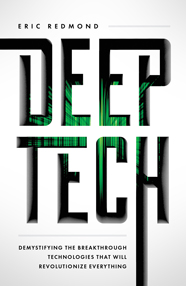
Travis Stoliker: So your book is Deep Tech, Demystifying the Breakthrough Technologies that Will Revolutionize Everything, came out in 2021.
Eric Redmond: Available at Fine Mixtures everywhere.
Travis Stoliker: Sorry. Man, I love that cover. No, that's perfect.
Eric Redmond: And what, how did that all come about? For about 10 years, I was working at Nike, and I co-founded and led the technology innovation office. And so our job was, I mean, Nike was too big of a company to not have a point of view on all emerging technologies. That was kind of our thesis. And so rather than going external and getting reports from management consulting companies of, okay, what this technology is coming down the pipe. Instead, the idea of the group was see if there was a use case for that technology within the company that's going to solve actual business problems at scale. And so the book actually really started off as just a series of internal memos of, hey, there's this thing called AI that I was writing about in, I think, 2016, 2017, and just sharing this around. And this article kind of grew into a monograph about here's different kinds of AI technologies. Here's the good, the bad, and the ugly, and just helping non-technical people really wrap their head around it. And I had similar memos for 3D printing, and I had ones for Internet of Things, and up to and including quantum computing. And so as I kind of worked with this and polished them, I started publishing some online and somebody said, hey, you should write this into a book. And I thought that was a really good idea. So that's kind of the genesis of what became Deep Tech.
Travis Stoliker: That's amazing. And I'm just kind of wondering, since you have such a background with Nike and were, like, I don't know how much you can say. I don't work there anymore, so I can say anything I want. Okay, perfect. That's what I was hoping. I mean, they had bought some great tech products and you guys were making great tech. And it kind of seems like they abandoned it all. Was that around when you left?
Eric Redmond: It was around when I left.
Travis Stoliker: Sometimes they're way like that.
Eric Redmond: It was around that. Now I was just a casualty. I mean, it always happens, right? Like, you can't take it personally. Innovation is often the first to get cut in any company. I always used to say innovation is like diet and exercise. Like, everybody knows they should do it every day. But when things start getting hard, it's often the first thing you stop doing, right? It's like, well, I'd love to go for a run today, but I got a lot of work to do. And companies are the same way. Companies will invest in innovation when times are good. But when times start getting tough, it's the first thing they cut. It should really be the last thing you cut because when you come out of those tough times, you're going to really wish you had kept that innovation muscle going. And what's interesting is if you, you know, not to pick on Nike because a lot of companies are in the same boat. But if you read any of the investor analysis of Nike, innovation is often one of the top reasons that they list for why the stock's not doing well. They say, look, they're not innovating. Now, I think there's sort of product innovation, but there's all kinds of forms that innovation can take. Supply chain innovation, operations innovation, on and on and on. And that was kind of what our remit was. And I'm not saying that Nike's not innovative. There's a lot of great people working. They're still doing different kinds of innovation and research. But I would say that Nike is doing what a lot of companies are, is just unfortunately not investing enough in it.
Travis Stoliker: Yeah, that makes sense. And I mean, they were just delisted off the Fortune 100, right?
Eric Redmond: Yeah, yeah. Now, when around the time I left, I think the stock was around 170, 160, something like that. And it's now in the 30s. I'm still a shareholder, so it still hurts to see that. I mean, I don't say that with any kind of joy. Anyway, long story short, I guess, put a positive spin on it. We actually did quite a lot of really cool things while we were there. I mean, I'll give an example. One of the things that Pratim did related to the book, there's a whole IoT chapter on the Internet of Things. And one of the ways you Internet things is you can put sensors on. And one kind of sensor is RFID, radio frequency ID tags. If you buy any Nike product now, there'll be a little RFID tag in the label for all kinds of benefits for it, for visibility, supply chain, gray market, black market mitigation, all these kinds of things. Relatively low cost, but huge payoff in a lot of different ways. And that's something that our team did. And that's kind of, I mean, literally at night, we were at a local Nike store in the back room, you know, tagging everything, this technology to prove that it was valuable. And once we were able to prove that, you know, there was a whole multi-year project to get it through, all the way from the factory, all the way through to retail and to consumer sales.
Travis Stoliker: What was that like? I mean, if you're in the back of the shoe store doing that, like, I can't imagine. I mean, this behemoth of Nike, were you guys like a little skunkworks inside able to do really cool things?
Eric Redmond: We had a very small team of like five people in my team. We're, I mean, up in, is scan, scan, encoding. I've personally encoded about 30,000 t-shirts. It's not fast, but I mean, that's just what innovation is. I mean, innovation is, and I try to make this distinction in the book, invention is inventing something new that's never existed before. Innovation is applying that in a way that it's never been applied before and also adopted. So in a real way, real sense, innovation is a go-to-market exercise. And so how do you go to market? I mean, the same way you run a startup is like you try it out. You try to get traction. You try to get believers. You try to get funding and then, you know, and you get the support and then you can start scaling it out. That was kind of the way we operated. We operated almost like an internal startup where we would experiment with some things and then try to get a budget and then try to scale it out.
Travis Stoliker: And that had to be so much fun. That's like a, that's like a dream job for a kid growing up to being able to innovate with technology inside of an iconic brand like that.
Eric Redmond: Yeah, yeah, it was, it was, it was a lot of fun. It's different from anything else that I had done in my career. I mean, I, like I said, I, I, my very first job at a school that wasn't playing poker professionally, which is really what I was doing, I was working in healthcare software. And the healthcare is a heavily, heavily regulated industry. And, and yeah, I started getting into big data. I did a bunch of startups with some folks and we were doing video game technologies and then ended up working in the USDA for a while, helping them streamline their process, get a little faster leveraging technologies. And yeah, I mean, every, and now, now what I do is permitting software for the energy industry. That's what we built. And again, I don't see these as fundamentally different career moves. I think of the fact is there's some emerging technology. You need to experiment with it. You need to turn people into believers. You need to prove that it's valuable. And that's the part I like is that go to market side with some new technology to solve a big complex problem.
Travis Stoliker: So my background before Scribe, I did a chain of restaurants for 10 years. And then before that, data centers. And we grew that to 480 employees and five data centers across the world and then sold those in 2015. And where you're at now with permitting energy, that's gotta be where all the sparks are flying right now, right? I mean, that's, cause like, that's, that's one of the holdups right now, right? Yeah, it is.
Eric Redmond: I mean, 1.5 trillion capital is tied up in projects or at some phase of the permitting life cycle. And then when you consider the secondary and tertiary effects of that, of work not happening, jobs not being, McKinsey actually says it's more like a $2.4 trillion drag in the US economy, which is about 7% GDP. And yeah, so this is why there's always talk. I mean, there's another bill in the Senate still talking about we're going to streamline permitting. There have been permitting bills, you know, since the nineties. There's like, okay, this time we're going to fix that. I mean, there was fast 41 and the speed act and on and on and on. And so now there's yet another one, which is great. But our hypothesis is that no amount of legislation is going to fix this problem. And that really the solution is leveraging the technology and tools that we've built to help fix this problem.
Travis Stoliker: How do you apply innovation to something that seems so kind of, I don't know, archaic, I guess, if that's the right word, of something like permitting? Like, how do you apply your expertise to a space like permitting?
Eric Redmond: Yeah, it's all about adoption, right? I mean, the tech is there. And yeah, we've got some secret sauces that we've created. I mean, we've got patent pending, some of the tech, a lot of data, things like that. But really, I'm a big believer in what's called calm technology, which is technology that gets out of your way. I don't like technology that fights for your attention. It's like, oh, God, all right, I got to respond to this message. Oh, I've got to fill out this form. That's kind of how almost everything operates right now. It competes for your attention or forces you into a workflow that's not comfortable for individuals. So for us, it's not just about the technology, it's about how do you create a process and an experience where it doesn't require a lot of effort to use? Because that's the one thing I learned at Nike is the key to adoption is any new technology has to be 10 times better than the alternative or require me to change nothing about how I work. And if you can do one or two, one is great, two is really what you should be aiming for.
Travis Stoliker: That's amazing. If you don't mind, I'd love to pivot to the book now. So I'm wondering, were you at Nike when you decided to do the book?
Eric Redmond: Well, this is actually my eighth book, and so I've written several before, a couple were bestsellers, but I had gone through a publisher, like went through O'Reilly for two of my books, and I went through another publisher for some of my other tech books, and I never really considered self-publishing at all, mostly because I wanted the support that, you know, I can't design a cover, I can't do a blurb, I can't do the marketing, I can't do any of the things that a publisher would normally do for you, but I really liked the control. I'll give an example. So one of the last books I had written, the publisher reads it. I mean, you've got this series of editors, and finally the publisher, and was like, well, I don't like this and this and this because it doesn't fit in with the voice of our publication, and I'm like, but this is my voice. Like, I don't necessarily care what the voice of your publication is. I want to communicate this. I just wanted a lot more control over the final product, and so when I ran across Scribe, I was like, this kind of is perfect, solves my problems, and it gave me a lot of opportunity to steer the narrative in the direction that I wanted to go.
Travis Stoliker: That's amazing. I'm so glad that you came to us, and how was that whole process, working with Scribe versus working with your other publishers?
Eric Redmond: It was actually about the same, other than the fact that with Scribe, I think I had a lot more of a say. Again, the fact that I had published multiple books before, I already kind of had an idea of how I wanted to work, and I think Scribe was pretty flexible in letting me work the way I wanted to work, but I still had all the benefits. I mean, marketers and PR and editors were great and type layout and deploying it into stores and all of that. I mean, for a while, like when it first came out, I mean, we were in Barnes & Noble, and physically, my book was everywhere, which was fantastic, so it wasn't just a digital virtual book. We also did an audio book, which was the first time I'd ever done that, and that was a lot of fun. Actually, I often recommend that people listen to the audio book instead because the voice actor, the guy that actually read the book, did a phenomenal job.
Travis Stoliker: I'm so glad to hear that, and it's one of the things that authors neglect that we try to talk them out of. It's so hard to get data on this, but some of the data suggests that it's like 40% of people that read frequently only use audible or audio book. They just won't pick up a physical copy, and you're just missing that audience completely.
Eric Redmond: And I'm not sure if that stat was the same when I did it five years ago. I think audio books were still fairly decent because I remember it was in the low teens or something like that at the time, but my eyes aren't great, and so I'm like, I listen to audio books constantly, so I just kind of wanted it for myself. But at the same time, I didn't want to narrate it. I don't think I could tolerate hearing myself talk for eight hours. The process was totally new for me, and you guys walked me through it. We had multiple actors kind of reading the same paragraph, and the one we ended up picking, I remember this because I had a Martin Heidegger quote in my book, and he read it with a German accent, and I was like, this is the guy. This is fantastic. That's awesome.
Travis Stoliker: The favorite question that we've historically asked on Author Hour that I just love the most is, what is the unexpected great thing that happened as the result of this book?
Eric Redmond: A domino effect of great things. Nike, like any big company, I mean, they've got promotion ladders and all of this, and I'd already worked there for several years by the time this book came out, and I do believe that the book inside the company gave me the visibility that actually was a big driver of the promotion that I got, the final promotion. Put me in the kind of executive level, so that was fantastic. I mean, it was nice to get a promotion. I got a little more responsibility, a little bigger team, a little bigger budget. That was great. A little more authority to make decisions, do what I want. Where that then led, and this is where things get a little unexpected, it was interesting is, I decided I wanted to go back to school and get an MBA because I didn't really understand the business side as well, because I'm a tech guy, and I had been working with some MIT professors on technology research, and they had recommended, why don't you come to MIT for an MBA? And I was like, you're a tech school, do you even have a business program? It turns out they do. It's called Sloan, and actually it's the number one ranked MBA in the world right now, which was all news to me. So I thought, you know what, I've never been good at school. I think I'll apply, but the odds of me getting in are probably pretty abysmal. But now with my new position in a company that was doing really well and was at the time a big cultural touchstone, and then also I have this book, so that was just part of my pit to get into that program, and I was accepted into Sloan, which has a really, really low acceptance rate. And then from there, I got through the program at MIT, and while I was there, I got to meet a lot of folks in the energy industry, and so that was how I ended up working with Halliburton after Nike, and so that kind of got me into the energy space, and I really liked that work, and I said, wow, energy is super important, and so that was when I started the company that I'm currently running, which is called Permetta, and we just focus on using technology to streamline energy permitting, but I do think that looking back, there was a pretty clear road that kind of started the book.
Travis Stoliker: That's absolutely incredible. I just love hearing those stories. That's why it's my favorite question of all of the questions that we ask. How have you used the book? Is this something that you're using to get more speaking engagements? Is it something that you're really actively selling? Are you pushing it in bookstores, doing signings? How have you leveraged the book?
Eric Redmond: I did. I did all that. I mean, I did the podcast circuit when we were marketing it. I wrote a lot of articles and blogs and things like that. So while actively marketing, yeah, I'd say the thing I use it for now is almost like a business card because when you hand somebody a business card, it gets thrown in a pile. When you hand somebody a book, they tend to remember that. I've made a lot of great connections, a lot of great friends and customers and investors and mentors. And it all started with me just handing them a book and they're like, great. I don't know how many even read it, truth be told. But I don't think that that matters. I think it's just, oh, you wrote a book, you know, and you signed it. Thank you. And because I can buy them at cost, it's a pretty good investment still.
Travis Stoliker: And how does that compare to your traditionally published books? Are you using those in the same way or, you know, are you giving those books out or is it main?
Eric Redmond: No, not really. I don't really use them. I mean, different audiences too. I mean, I did use my book for years. My other previous companies I worked at and I would travel around and give talks. And I used to joke that when you write a book, you're now an expert. Not because you necessarily know anything more, but because everybody assumes, oh, the one who wrote the book is the expert. Like, I'm the deep tech guy now. Like, oh, you wrote the book, deep tech. And it's like, yes. And that really helps open doors. It still opens doors. And at a certain point, I think as your book is read more and your name is out there more, it starts preceding you. And there have been quite a few cases where I'll just run into somebody at a conference or some other event and people will be like, oh, I read your book. I really liked it. And I'm like, it's great. It's like being a celebrity for five seconds.
Travis Stoliker: That's like an advertisement for why business owners and experts like you should write a book. It's so hard to communicate that to people that, you know, think they don't have that. The one that we encounter the most is probably, I'm a busy guy. I don't have the time. How am I going to use this? I don't think I can sell a million copies. And we just try to tell them over and over again. Like, it is such a rare feat to be able to complete a book. There's the Lindy effect. These things have been around for a long time. There's the prestige and the authority that you get by actually putting down on paper all of your thoughts and standing behind it and having that be out there for years and years and years. So that is like the perfect advertisement for why people in your position should write the book.
Eric Redmond: Yeah, yeah, yeah. Totally agree. And I think that anybody can write a book. What's hard is rewriting it five times before to get it to the point where it's publishable and something you're proud of and you want people to read. And I think that's where the trick happens. And again, whether it's Scribe or the other publishers, that's the best thing about having a team behind you is because they can take you from the draft to something that's actually more of a finished product. And I think in a lot of folks' mind, they think, oh, just writing the draft is the hard part. It's like, it's really not. That's the start. It's like, but there's, you know, a massive amount of work beyond that.
Travis Stoliker: We just had yesterday an author that we just adore and got his first edit back. And his feedback was basically, hey, you could have been a little nicer. Like, you know, I put so much time into this. Like, you hurt my feelings a little bit.
Eric Redmond: And, you know, one of our principles is I think that's a rite of passage. And I have said this to quite a few folks too, that an amateur writer, until you've had your heart ripped out by an editor, because they'll find the thing you love, the line you're proudest of, the topic that is sacred to you, and they'll just be like, red line, red line, red line. But, you know, if you trust the, if you have a good team and you trust the process, you're gonna have a much better product. It doesn't even faze me anymore when people are like, oh, like everything you wrote, I don't like it. Like, okay, great. Like, let's improve it. Like, I just take it as a challenge to get better. But it did, it does hurt.
Travis Stoliker: Right. One of our core principles is we will hurt your feelings before we'll let you publish a bad book.
Eric Redmond: I like it. Yeah. No, it's fair. And, I mean, you just, you just get toughened up. Well, and the other thing too, is it's better to do it now, early on, than after it's published. Because guess what? When it's public, people are gonna write about you and they're gonna write about it. And I, you know, you're never, no one on earth is gonna get a 100% glowing review. And if you're anything like me, you'll ignore the 50 reviews that are great. And then you'll just fixate on the one that's like, oh man, that, that one.
Travis Stoliker: Boy, that's true.
Eric Redmond: Especially if it's true, it hurts even more. And so, I always think when I write, I always have like the angel devil shoulder debate where it's like, all right, I wrote this paragraph. It's like, you know, is someone who legitimately wants to learn gonna learn something from this paragraph? And then the other thing is like, what lines of attack is somebody that just is against this going to say too? And I find that if you kind of write for those both, both of those audiences on every paragraph you write, you're gonna end up with, with something you can at least be proud of. I mean, you're not necessarily gonna get out in front of every piece of criticism nor should you.
Travis Stoliker: Yeah. For, you know, I don't know if you've ever been in this position since you've published so many times, but for, for an author or somebody that even doesn't consider themselves an author, but has been told multiple times by their colleagues and peers that they should write the book and they're interested in it, but they have that fear. You know, that's the biggest thing that we encounter with people in this position is that, you know, what if, what if the person that I told that story about is mad that I told that story? What if nobody shows up on launch day? What if I make a big mistake? What if one of the stats that I put in the book is outdated when it launches? Do you have any advice for somebody?
Eric Redmond: I would, I would, I would help those people by saying that every single one of those things will happen. It just will. And that's okay. That's, that's, that's fine. I mean, you know, everything has a shelf life and a half life. I mean, the funny thing about this book in particular is I literally write it, I say, this is the technology that I believed at the time in 2020 that will be valuable this decade or make the biggest impact. So, some of them, AI, I called, right? IoT, you know, huge, being used increasingly in the business world. Self-driving cars, I kind of figured we'd have them by now. So that whole chapter, it's not wrong. It's probably just premature. But six out of seven, ain't bad.
Travis Stoliker: We've had Teslas now for 10 years and holy moly, it is, it is perfect now. I mean, it's 98% of our drives are perfect. So I think you probably got that one right too.
Eric Redmond: Here's hoping, I think I got another five years to find out, four years on how, how, how accurate my predictions were. But I mean, you know, the funny thing is even though the title is Deep Tech, the original title I wanted to call it was the $50 trillion opportunity. And, and actually I got quite a lot of pushback from folks being, well, this sounds pretty crazy. But now if you look at some of like the AI and other technologies that are out there, it's like that might actually end up being an accurate number.
Travis Stoliker: Yeah, I think it looks like you were right on that one too. Well, Eric, what is in store for your next book?
Eric Redmond: I've got 50,000 words of notes that, this kind of my process of how I write books is just like, just keep taking notes until something feels book shaped. But this one is, there's a Christopher Hitchens book I always liked. It's called Letters to a Young Contrarian. And he's basically acting like this older mentor pretending to write to someone and saying, hey, here's what I think living the life of a contrarian is. And so, yeah, this book that I've been working on is Letters to a Young Innovator. So, it's like, hey, you want to get into innovation. It's a lot more complex and nuanced of a special, I mean, it's a skill that you have to learn. Like people think, there's an innovation mindset. Anybody can be an innovator. Anybody can learn it. But it's not probably what you think. It's not sitting in a lab and inventing things all day long. That's not what innovation is. It's an ingredient of it. But it's also the adoption. It's the go to market. It's the getting people on your side to experiment and explore. Most people are very comfortable with the status quo. And so, they have to have a reason and an incentive to try new things and adopt and vouch for it. So anyway, that's kind of the next book I want to write. I love that. I feel like I'm not quite old enough. I think I need to be maybe a decade older before I can start talking to kids. But it's there somewhere.
Travis Stoliker: Who would you recommend to publish with Scribe? If they're looking, especially from somebody with your experience of working with multiple publisher. Do you have, would you recommend somebody work with Scribe? And what type of author do you think should work with Scribe if you would recommend Scribe?
Eric Redmond: Oh yeah, I would. I mean, like I said, I enjoyed the experience. I found it very nice. And also, owning the book rights has been fantastic because I've sold the rights to foreign language rights to other publishers in other countries. So there's like a Korean version of my book. There's a German version. There's a Russian version. I mean, so they just are out there and it's like, that's great. I got to make the decision to sell the rights for those. And I would say that one is if you want more control over your final product, your output, your voice, you have a lot more flexibility with someone like Scribe. For me, it was super valuable. Anybody who is just kind of wanted to write a book, like, do it. Like, it's, it's, you gotta, you know, it's like a marathon. Like, everybody starts a marathon the same, which is one step and then two steps and then three steps and eventually you're at the end. And that's what writing a book is. It's a marathon, not a sprint. But just like, so for example, Eli Kipchoge is a marathoner who was part of the Breaking Two project, which was, can we run a sub two hour marathon? And the part of how that worked was he had a running team with him that kept pace. So they were pacers that would kind of run. They would also block the wind and all this. They were, they were really with him to get him across that finish line sub two hours. And I think that's probably a good analog for what a business like yours can do is just be those, those, those runners that can block some of the wind, keep you on pace and then eventually you're going to reach that finish line.
Travis Stoliker: Wow. That is a perfect analogy and great way to, to conclude here. Eric, thank you so much for publishing this and putting your thoughts out there in so many different formats. And I'm just cheering for our next conversation to hear all the next cool things that you got up to. And I still want to hear more about your start when you were a professional poker player on our next interview.
Eric Redmond: Yeah. Happy to. I would say the thing I learned in that is just, you know, resilience and play the hand you've got. And, you know, multiple bets are how you win, not just one big one. And it's kind of, I'd say it's kind of the same thing with writing a book. It's like just writing a bunch of chapters, string them together and now you've got a book. Don't think about the whole thing. Just play by play by play. So appreciate the time, appreciate the conversation. And all best of luck. I'm a big Scribe fan.
Travis Stoliker: Thank you so much. And we're big fans of yours. And looking forward to our next conversation.
Want to Write Your Own Book?
Scribe has helped over 2,000 authors turn their expertise into published books.
Schedule a Free Consult