Jatin Patro: Episode 277
Read the full transcript
Jatin Patro
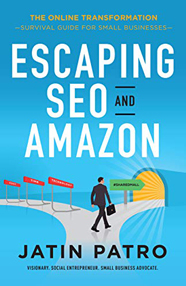
Jatin Patro is a social entrepreneur, small business advocate, and the author of the Amazon bestseller Escaping SEO and Amazon. He is the founder of SharedMall, a community-centric online search and shopping platform for small businesses, and the owner of CatanDog's Global. He holds master's degrees in computer science and in environmental engineering, and spent seventeen years in the corporate world leading IT and e-commerce initiatives at FedEx and Intel. He has volunteered as a mentor and board member with SCORE. In his book he examines the challenges small businesses face online and offers practical solutions for them to thrive.
📚 Books by Jatin Patro
Transcript
[0:00:23] RW: Hi everyone, it’s Rae Williams, host of author hour where I interview authors about their new books. Online technology has revolutionized commerce, but if independent businesses want to overcome current challenges and threats, they need to innovate, adapt and collaborate online and that’s what our next guest Jatin Patro is here to talk about. He is a business owner and pioneer of the next generation website, ecommerce and community platform, sharedmall.com. He has an innovative prescription for independent proprietors looking to grow online. He’s sharing that insight with us today as well as in his book, Escaping SEO and Amazon and it’s so incredible. Here is our conversation with Jatin Patro.
[0:01:11] Jatin Patro: I’ve spent about 10 years studying the bi-local philosophy and the impact of technology to small businesses and all. In these years, I’ve never thought of writing a book, right? But what I’ve experienced is then I go talk to some people who are influencers, who are community leaders. They just don’t get it on what needs to change because it’s one, it is technology and they don’t have as much of the background and I have the technology background with my education and everything. I had to find a better way to communicate to the masses that we need to change and the reason we need a change and what is the change we need. All of that, it doesn’t happen in a conversation. I’ve even gone to some crowds and pitched the idea of what needs to happen and you know, there, you get a one minute pitch time or 10 seconds and all in, that just doesn’t do it because the bigger the change, the longer it’s going to take to get people to understand it. This last year, when I started volunteering at Score which is a government funded organization to kind of counsel small businesses, there, I met a connection who actually just mentioned about this company who can help me with writing a book, if you have ideas. That’s how I got started. I had never thought about writing a book but I had a need to communicate with the masses, to let them know, to educate them that you know, this is a situation and this is where we need to be heading. That sounded like the best path for me to kind of get out there with my message. That’s how I got started on the book.
[0:02:57] RW: All right, what would you say is the key message or the key call to action in this book?
[0:03:02] Jatin Patro: I talk about many different perspectives in the book because you talk about a whole online transformation. The message actually depends on what perspective, small business is a perspective, right? Then community leaders another the perspective. For small businesses, the message I would say is we need to start challenging the status quo on the way we are doing things and why we are doing certain things that are dictated on us by Google for example. Why are we doing optimization? We should be focusing on our business not on what Google wants. Things have gone in a direction that has become normal and nobody is questioning these and everybody is investing more and more time and money into these. For a small business, I would say, you need to start questioning why are we even doing this and why not something better? Then if I look at the community perspective like chambers of commerce for example, they are innovation on the software side, on the online side has stagnated for several years. They’re competing, they’re basically presenting a business directory like a yellow pages and that is the best they got against Amazon and the Google directories and Google search and all. They need to in a way, they are dependent on their service providers from where they get the software for the website and all. Those service providers have stagnated, they have not evolved in being able to facilitate the better competition for these chambers as a community of businesses. That tis their perspective, they’re in to question, why are we not innovating? You know, how far behind are we right now and what can we do? Then, from the consumer side, that’s another perspective, they need to be asking, “hey, why it’s not easier for us to just shop local from our local business, why do we have to go to Google and then land on 10 different websites to figure out what we want to get? Why can’t Google show us all those from all those websites and let us make the decision right within Google?” There’s many things. Why are we having to log in to every single website and try to remember all these passwords? There’s all leaves problems that you know, we have gotten used to, we don’t question these. From a consumer side, you know, or a shopper or a searcher, how can we make thing better or how can things get better for us where we can still keep our money local and help our local state with the economy and you know, get better conveniences online? All of those, you know, there’s lots of different perspectives and I touch on each of these in the book and you know, there’s web masters, there’s startups, there’s all these perspectives, but yeah, again, that question depend on what perspective and hopefully, I answered some of those.
[0:05:43] RW: Yeah. If we are a small business or a startup or just an entrepreneur. How do we begin to get into our business without kind of going down the Google SEO search engine route> Just in general, because I know for a one perspective is that a lot of people are already kind of involved in that but if we’re just starting out, how do we take steps to avoid getting caught in that track because you’re right, we don’t question it?
[0:06:10] Jatin Patro: Yeah, again, it all depends on what kind of business, right? The strategy for each industry is different. Just yesterday I was counseling an individual who wanted to start a business and we were talking about different kind of products, right? They had some ideas and we discussed how are they going to do the marketing, you can have a website, but again, it all comes down to if you’re going to make spaghetti sauce, then just launching a website, nobody’s going to even care about you because they don’t know you. You got to build your reputation, you know, offline, locally through trade shows, markets, you know, whatever the fares and all those. Then, you build on that reputation and then you get your traffic on the website. SEO, somehow has become the default. Everybody’s saying that we need to do SEO. Not that why do we need to do SEO? Not that, even going to get me the results? Even with SEO, the search engine optimization, people need to do a research before they even get into it. A lot of people who spend a lot of time blogging, saying that if I write content, people will find me, that’s great. It’s a good idea, but you need to know what you're going to write about. If nobody’s even searching about it, then you’re wasting your time writing about it. You need to do the research and there are some tools that are pretty complicated that not everybody has the time or the energy to actually go try to learn those tools to figure out what should my content be about, what are people searching for? Again, it all depends on the industry and bakery in Vermont, they don’t even do SEO. They have pretty good, they just expanded last week, the Southern Pie Company, husband and wife and have known them because they have been a client and also know them through a chamber of commerce but they do not do any SEO. Their promotion is through Facebook, right? If they have got last with all these chatter that you need to do SEO, they won’t be where they are today. They would have wasted a lot of money and time on the website. They’re all succeeding, they all expanded with a café and all. Again, it all depend on the industry. Now, in the past there was a lady in California who would bring produce from many different farmers, small farmers and sell them through her website. Her strategy, again, was not SEO because she needed the community relationships, she needed the recurring customers. Hers was more on the service, right? It was a startup but she basically delivered produce, took home delivery orders, picked up orders at some workout places at office, she would go, scheduled pickup. She had to go take that approach and again, she did not do SEO. Then there’s another retailer Ann N Eve, who makes these, for 40 years, s he’s been doing this designer western clothes and she was doing great before Google and all that came out and now she is like competing globally and she doesn’t even know technology. She had a website built by somebody else, until she came over to SharedMall, but she is at a situation now where she needs to focus on making her designs and not doing SEO. Not focusing on SEO, but she is dependent on SEO because without that, she cannot survive, right? In that case, if you’re selling clothes and all, because people are searching on the internet, you are going to have to go SEO. Then the challenge for her is, even with the SEO, she is not prioritized Google search because Google cares about showing the best results and just because she’s a startup, and not many people know the brand, not startup, but she’s small and not many people know the brand. Google decides to show some other more established brands ahead of her search results. See all the challenges that’s faced with every business needs to have their own strategy and that should not be SEO by default. SEO should be if it is a necessity, but SEO should not be it either.
[0:10:16] RW: Right. Okay, let’s move over a little bit from SEO to Amazon. If you could touch on Amazon a little bit and in the same vein as not having SEO as our default, what about putting our products in Amazon, selling on Amazon that kind of thing?
[0:10:31] Jatin Patro: Yeah, selling on Amazon, again, the problem with Google and Amazon is that they’re global. Whatever we do there, we are competing globally, it doesn’t matter what we’re selling, whether it’s we’re targeting the local audience and not, we are competing globally. The lady that I mentioned though, designer western ware, Ann N Eve. She has tried Amazon several times. It had been a roller coaster for her in the past couple of decades, but she’s tried Amazon, but the problem was, she didn’t get enough sales, right? It might seem like hey, we put it, - we put our products on Amazon and people are going to come and buy it. But that’s not the reality because just like us, there’s people around the world, everybody who had the same thought process that let’s go put our products on Amazon, people will buy it. Reality is, most of the one that I’ve talked to, the businesses, they have not had the sales. And then there’s an example in Texas, there’s this guy who found me on the internet and he wanted just some free counseling. He had a business where he makes his little toy cars and trucks and he sells that on Amazon, he doesn’t not have a website because Amazon is his website, right? He has a few products and he’s been selling it for a couple of years and he get some sales, but it’s not good enough. What did he end up doing? He started investing on ads on Amazon. He’s paying a percentage of his sales to Amazon for his products. He’s paying a membership to Amazon for using Amazon and on top of that, he’s paying for ads to Amazon to just have his products show up. I ask him, what’s your profit margin and he said that it’s a couple of percentage, that’s it, right? That’s Amazon’s story for that particular business, but he’s not alone.
[0:12:16] RW: Tell us a little bit more about Amazon and just how to use it because I think most people think that even if you’re promoting your business locally. If you’re not having it on Amazon, you almost don’t have a present and you're definitely telling us that that is not true, right?
[0:12:31] Jatin Patro: Yeah, I mean, take my example, right? I have the book coming up and I’m going to sell it on Amazon, right? Amazon is not necessarily bad, it’s another choice we have but it should not be the only platform we rely on just because of the challenges that I mentioned. In my case, I was just reading up today that there’s a lot of stories about Amazon where they push you down if you’re against them and I was reading up on some books that were anti-Amazon and there’s some articles, I don’t know how reliable they are, but it relates to me because my book Is also the title, Escaping SEO and Amazon. It may be interpreted as something that’s against Amazon, but the reality is, I, in the end say that Amazon is good for the purpose that it serves. We need to coexist with Amazon, but what we need changed there is we need to be able to tell that who we are buying from. On Amazon, there’s no indication of that, right? Even if I’m buying from my neighbor, I’m actually paying for shipping and waiting for a couple of days before I even get it, even in reality, I could have just gone, walked down to my neighbor’s store and picked it up from there the same day. There’s those kind of limitations in Amazon that need to be addressed, I don’t know, did I answer the question or did I just deviate from that?
[0:13:51] RW: You did. I think it’s important for us to clarify too that just because your book is Escaping SEO and Amazon, that does not mean you're anti-Amazon because I think at first, when people see that, they’re just like, okay, “I can escape Amazon all together.” But it’s more about using Amazon as a tool secondary to a larger business practice.
[0:14:11] Jatin Patro: Yeah, basically, you know, you have to think of the perspective when you look at the book. That perspective is for small businesses and how can they escape the threats and the growing impact of Amazon on their business, right? It’s a small business perspective to escape. From a shopper perspective, I love Amazon, right? Again, from a shopper perspective, you read the title, Escaping SEO and Amazon. Why would I even need to escape that? I love Amazon, that’s true, right? I personally shop in Amazon and just about every day, there’s a package at the door. What I’m trying to say is, for businesses, Amazon’s current model and even SEO, they are becoming a threat because of the direction that they are going. They’re kind of prioritizing the bigger businesses, they’re prioritizing themselves, even Senator Warren, she proposed a plan on breaking up Google and Amazon and Facebook because they’ve grown big and they’re kind of pushing down the small businesses on their own platform and they’re kind of prioritizing their own interests. That’s all fine, that’s all true to some extent and I write about the same problem. But the solution that she’s saying that we need to break down Google and Amazon because they’re big and because they’re using it for their own sake to benefit their own purpose. I don’t agree with that solution because I say that you know, they succeeded the right way legally, their current position without breaking any laws and all we need to do is give the tools and help the small businesses succeed, you know, within the same guidelines. Where that’s lacking is the innovation is lacking for small businesses, they don’t have the technology accessible today. It is expensive, it’s lacking and that is where we need to put our focus on rather than breaking down the business as we were successful. So, I say that to Amazon or Google are great where they are but for us to survive in the long term, when I say I am referring to small businesses, we need to have a third option and that third option co-exists with Amazon and Google and that third option is where people can shop local first, not just local. They can shop local first and they can even shop within that third platform globally if they need to be, but we need that third option. A third option that level the playing field that is currently not level because Google and Amazon are favoring the bigger business. So, we need the third platform that favors the small businesses that is designed to help them.
[0:16:49] RW: All right, so let us dig a little bit deeper into that shared platform because as you have expressed, you know if we just break down Google, Amazon and Facebook, one I think in my opinion is going to be difficult just in general, but two it is also a bit of a way of life for people. So, introducing a third platform and another alternative would seem to even that out instead of eliminating them and that is what you’re saying. So, tell us a little bit more about this third platform.
[0:17:18] Jatin Patro: Yeah, that’s right because my vision is that Google, Amazon and this third platform co-exists and that third platform I prescribe the whole architecture for it in the book and SharedMall is the name, right? That is a platform that got a French architecture, but there are many, many limitations today in all of the website and ecommerce platforms that is available today for small businesses and the biggest common gaps in all the platforms is one, they have ignored community aspect. So, when a website is launched for a business that business website is standalone. It is not part of any community. Let’s say it is an organic farm. They may be a member of an organic farm association in the US, but online they are independent. There is no community where the website is a part of by default. If they want to be a part of the community online, then all they have is a directory from their organization of organic farm association and they have to go duplicate their business, address and contact information and all. They have to duplicate it. Now if they are part of some other organization, they have to go duplicate all the data everywhere and the reason for this is the organizations that they are a part of they lack the software that can pull all of this information from the website of the business. So, imagine we have the next generation architecture that I talk about, the platform that is presented in the book what it says is a business should only be focusing on their website. Any data, anywhere else outside of the website should be coming from their website. So, the alternative to Amazon and Google that I talk about, so let us talk about Maryland where we are going to do the pilot of the first taught alternative to Google and Amazon. If we have a 100 business in Maryland that are using this standardized platform, the next generation platform, all of those 100 businesses should automatically have all their products and pages searchable in Maryland search engine and Amazon alternative, their marketplace. They should automatically show up in the Amazon alternative. They shouldn’t have to go and duplicate the product listing on that marketplace. Now within Maryland maybe the Rockwell City, every business in that city, they should automatically be in that marketplace for the Rockwell City as well, in addition to Maryland’s marketplace and for all of this to happen automatically, which means the business is not doing any additional effort, there is additional overhead for them to go duplicate the data or create another membership with the marketplace, they should not have to be doing all of that. All of that should come directly from the website real time and for this to happen, we need the next generation architecture, the platform for websites, for ecommerce, for search engine, for marketplaces, all of them. There are a lot of gaps that prevent this from happening where businesses today are forced to go list their business listing again in yellow pages, in YELP. They’re listing it over and over and overtime it all gets outdated and it also adds to the overhead that they have to now maintain all the different listings of the exact same thing, in all of the different websites. So that is one of the example of the gaps that we have and the transformation that needs to happen. So, I prescribe the architect, the online architecture and in addition to the online architecture, even the infrastructure where each state can have their own alternatives to Google and Amazon. That gets all the data from businesses and if I go back to the SEO, if you make an update on your website today, Google may take a few weeks to even show that update on a search engine. So, you already lost so many. I mean this is an update on a business website. They make an update they want everybody to know, let’s say it’s an event that they have next week. They listed it on the website, but Google is not going to even show it. The week is gone, the event has past, but Google does not show it and that is another issue where it is not real time. The search engine is not real time and we need to fix that as well. As soon as the business goes into the website and changes the price of a product instantly, in real time, it should show up in the search engine, right? So, these are the things, the challenges that I talk about that need to be addressed and these can only happen if we adopt the next generation architecture that I prescribe in the book.
[0:21:53] RW: What is the cost on the end of the business owner or entrepreneur to go this alternative route? Because it is very clear from what you said that they are actually losing business a little bit by investing solely and wholly in Google and Amazon and SEO. So, is there an additional cost to doing it the alternative way?
[0:22:13] Jatin Patro: Yeah, so for any, the bigger the chain the more we need to accommodate. So there are three hurdles, three factors that are the primary hurdle for any business to succeed online. One is cost, the solution that they need maybe costing more than what they can afford. Then there’s technology, they may not have the background on the technology to be able to make the right choice or even if they have paid for the technology, now there is a learning curve. And then third one is time; every business is busy running their business. They don’t have time to go learn new things and do all of these extra stuff on SEO at all and they go hire somebody else to do that and overtime, they realize maybe they didn’t get the value. So cost, technology and time. One of the things is platform that needs to do, the next generation platform is to accommodate every single business for these three hurdles. So that these hurdles are no longer there or they’re minimized and to do that, the platform should not be dictating the cost. The platform like today if you go use WordPress or Shopify or one of those platforms, even Amazon, they dictate that on a monthly basis you have to pay this much for the package. They are dictating, they are not flexible, they are not accommodating the interests or the limitations of each business. So, this platform that I prescribe, one of the cool things for it to allow businesses to overcome those three hurdles, the technology, time and costs, is it has to work with them on a cost that is affordable by the business and it is also reasonable from the platform perspective, right? And for that to happen there has to be the business model that is associated with this next generation platform that also has to be changed. It has to be a shared model where we don’t create another Amazon. Where all money is coming in and accumulating onto one business and everybody is paying and Amazon is getting richer. We don’t want that model. What the model that I prescribe is every state owns the platform, so a shared model, even though it is one platform at the national level or even the global, each state gets to call it their own. They get to deploy it; they get to keep the money that comes in from that. They offer the website and ecommerce services to their local businesses. That local money stays in the state, so that goes back to the state in terms of tax money and all of that. So, the whole collaboration even in the revenue model that is going to facilitate and when we do that, now we have the masses showing interest in the platform because it is local to the state. It is going to help the economy; the government is going to be interested. Everybody who is a community advocate is going to want this to happen and now, we can reduce the cost on the actual businesses who are using the platform. So SharedMall the platform that I prescribe it is designed to not dictate the costs. It is designed to work with each business and accommodate whatever the cost may be that they are able to afford and one recent example is a lady who wanted to start selling jewelry and she didn’t have that much money. She is borrowing from her family. So, she asks and this is just last week, she ask what can you do? So, we negotiated and she needed a website set up. She needed a domain and everything, she has nothing, right? No knowledge at all on how to build a website. Typically, she would have gone and hired a web master and paid a couple of thousand dollars upfront and then a monthly or whatever she would pay for the platform. So, we decided that let us do this at a monthly flat rate that is pretty low and a mix of a percentage of whatever sale you can have in the future. So, now she is not paying thousands up front to have a website. She gets the domain and everything taken care of, she doesn’t need to learn the technology and the pricing structure now incorporates a percentage of sale and she feels good that we have a vested interest as a platform provider to see her grow because her growth also means more revenue for us, right? So, that is an example of where we don’t dictate. We should not be dictating, the platform should not be dictating the cost, but rather accommodating the business wherever they are.
[0:26:31] RW: All right, awesome. Thank you. So, what I would love for you to do right now is issue a challenge to people who are going to read your book, entrepreneurs out there, our listeners, what is one thing that you’d challenge them to do that is going to help to propel this forward and change the way we view Amazon, SEO, all of that?
[0:26:49] Jatin Patro: There is a few things that is prescribed there for small businesses. In terms of challenging them, I think one of the biggest gaps outside of technology is in the community advocates, like Chambers of Commerce for example. They lack the tool, they lack the innovation, they lack the ability to bring their community together online. What I would challenge the small businesses is together, you are much more powerful and for you to come together online, you need to demand more from all of those communities that you are a member of. And the Chamber of Commerce is an example, right? So, you need to demand them to innovate. You need to demand that they bring you together in an Amazon like marketplace because you are paying them money to help you grow, but there are so many behind in innovation and technology online that they need to start taking a step back and thinking how can they actually address the problem and what are the problems. So, the book basically gives them the background, gives businesses the background on what to ask and it also gives the community leaders the background on where they’re lacking and how they can overcome it. So, the challenge would be to get the small businesses to demand change from their own local community advocates that we need you to do more because without it and only if we collaborate and through collaboration only can all the small businesses across the country come together as one. And now you are way bigger than Amazon and Google, right? So we need to come together. The prescription is there in the book, you now have to follow it.
[0:28:29] RW: All right, awesome. So how can people contact you if they want to know more?
[0:28:33] Jatin Patro: I have my personal website, jatinpatro.com but LinkedIn is where I professionally connect and between these two, the platform SharedMall has its own website, sharedmall.com, but jatinpatro.com is where I have started blogging about these things and I will continue that and LinkedIn is where I make announcements about the book and the collaborations and where we’re piloting in Maryland and the progress there. So, I think between those, jatinpatro.com and LinkedIn, there is Twitter and all of that too, but basically LinkedIn is the primary one from a business perspective.
[0:29:11] RW: All right, awesome. Thank you so much.
[0:29:14] Jatin Patro: Thank you.
[0:29:14] RW: Jatin Patro is available on his platform, sharedmall.com as well as amazon.com, showing you how you can make an impact on both. Check it out and join us next time on Author Hour.
Want to Write Your Own Book?
Scribe has helped over 2,000 authors turn their expertise into published books.
Schedule a Free Consult