Josh Rovner: Unbreak The System
Read the full transcript
Josh Rovner
Josh Rovner has more than twenty years of experience as a leader and consultant, working with small to large corporations to grow revenue and improve performance. His background spans management and leadership, learning and development, organizational effectiveness, and process improvement, and he helps businesses transform by designing effective processes and coaching people. He earned a bachelor of science in communications, summa cum laude, from Boston University and a master of management in hospitality from Cornell University, and lives in Dallas, Texas. Rovner is the author of the number one bestselling business book Unbreak the System: Diagnosing and Curing the Ten Critical Flaws in Your Company.
📚 Books by Josh Rovner
Transcript
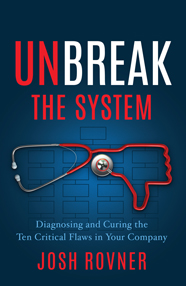
[0:00:18] NVN: As the son of parents who work in the medical field, it’s probably not surprising that today’s author, Josh Rovner, has figured out a way to look at business through a diagnostic lens. In his new book, Unbreak The System. Josh walks executives through a framework for looking at the 10 fatal flaws that plague every business in such a way that executives can understand and cure what’s really not working, rather than falling into the misdiagnosis trap that so many businesses do today. I am happy to introduce Josh Rovner, author of Unbreak The System. Diagnosing and Curing The 10 Critical Flaws in Your Company. Josh, thank you for joining us today.
[0:01:01] Josh Rovner: Thanks Nikki, it’s great to be here.
[0:01:03] NVN: Let’s start by letting listeners know a little bit about you. Start by telling me about your background?
[0:01:10] Josh Rovner: Sure, yeah. I’ve been in corporate America for 20 plus years. I’ve held a lot of different positions at a lot of different companies at all levels, everything from unpaid intern, to middle management, to senior leadership. That is what has really given me the background and the ability to come up with this book.
[0:01:32] NVN: Let’s give listeners an overview of what this book is about exactly?
[0:01:37] Josh Rovner: Yeah, it’s really about teaching and showing high level executives, people that really run companies, where their companies are going to be held back. What it is that’s the real root cause of why their companies aren’t performing well financially or otherwise. But a lot of times it comes out with money and the company’s not making the amount of money that it should. There’s always going to be a point where as soon as that happens, you know, they are looking to the numbers right away and trying to fix the numbers. When really, it’s what’s underneath those numbers and it’s what’s inside the organization that is causing all the problems. Yet, it’s something that people don’t really think about.
[0:02:23] NVN: Yeah, I think that this is so interesting that you’re talking about how there are these 10 critical flaws but that most businesses overlook these flaws. Why do you think there is that tendency to overlook these things that you’ve been able to identify?
[0:02:41] Josh Rovner: Yeah, I mean, I think that first of all, no one has really articulated them in this way before. It took me a lot of time to figure them out, a full career and a lot of research and reading. I think part of it is just that no one has really thought of them in this way, but I also think that people tend to gravitate towards stuff that’s obvious and these things are not obvious. There’s a lot of complexity to these critical flaws. I think that’s really the big reason why. That and sometimes, you know, there may be cases where people know about these flaws, but they don’t want to address them, for whatever reason.
[0:03:27] NVN: I’m curious about what led you on this hunt. Is this something that you’re innately curious about or did you have some sort of crisis point in your past where you were trying to seek these answers for your own business?
[0:03:40] Josh Rovner: Honestly, it’s something that I’ve been thinking about for a while and finally, it just kind of came to a head where after all the reading and research that I’d done and all the experiences that I’ve had in my career and talking to friends and colleagues and everything like that. It just like, it was like one day, it just clicked. I sort of started to write a couple of short parts and short articles. I thought, you know, “Maybe there’s a book here, I don’t know.” Then, as I went through the writing process and went through the process of deciding to write the book and then really fleshing out the ideas and fleshing out what it might be, that’s when I came to the concept of the critical flaws and then there was the question of like how many flaws is it going to be and you know, it worked out that it’s 10 but I didn’t really set out to have it be 10.
[0:04:42] NVN: It’s nice that they just happen to be a nice round number, thank you fate.
[0:04:46] Josh Rovner: Yeah, no doubt. Again, you know, I think that speaks to what I was talking about earlier that most people, even high-level executives that have a lot of experience, don’t think about these flaws in this way. They think a lot about what they need to do to fix things, how can we fix things, and they’ll wrack their brains about, “How do we get better.” But what they don’t really do is think about, “Well, let’s really focus directly on what’s wrong and what’s flawed and what can we do to fix that?” That’s the way to get better, rather than just trying to come up with random ideas that might improve things, right? I think that’s where a lot of companies spin their wheels, a lot of executives spin their wheels. Then naturally for me, the diagnosing and curing metaphor came about. I think that’s probably in my background. My father was a doctor, was in the medical industry for many years, still is, not only is he a doctor, he’s a hospital administrator and lots of other things, so that metaphor kind of came in there as well. I thought, gosh, this really has parallels to the doctor patient relationship. If you’re sick, you go to the doctor, you got to tell the doctor exactly what’s wrong with you and you’re going to give the doctor details about what you're feeling and what you're symptoms are and what’s wrong. And then the doctor’s going to use that to make a diagnosis and they’re going to prescribe the particular treatment to help you get better. I thought, this is exactly what needs to happen with many corporations who aren’t performing well financially or in other ways, right? Like I said, a lot of it is initially driven by finance and money and not getting the market share profit, revenue, whatever it might be.
[0:06:40] NVN: I feel like we built up a lot of suspense here. Let’s talk about what these 10 flaws are that people should be on the lookout for?
[0:06:49] Josh Rovner: Yeah, okay, there’s 10 of them and this is the order that they are in the book, it’s politics, blind spots, scapegoating, unclear goals, doing too much, dysfunctional infrastructure, no SOP’s, fixing the unfixable, legacy technology, and chasing shiny objects.
[0:07:11] NVN: That’s interesting. Hearing those, I can see how people could easily be looking in the wrong places. When these are really chronic things that are – in a lot of instances, I would imagine, are just so built into and engrained in companies that they’re sort of taken for the way things are and become easy to overlook, is that correct?
[0:07:33] Josh Rovner: That is spot on. Actually, it’s funny, as I was taking a walk today, thinking about talking to you, that was one of the things that just popped into my head, right? Was that it really is all these flaws are under the surface and you just don’t think about them because they’re part of what you take for granted in a company. That it just is that way. It doesn’t have to be that way. These flaws are the real root causes, but they’re stuff that people take for granted but you can‘t take them for granted because they’re there and if you do take them for granted, they’ll take your company down.
[0:08:07] NVN: What can people do to start to look at these issues and at their companies with greater clarity so that they can diagnose these issues in the first place?
[0:08:18] Josh Rovner: Yeah, I think first and foremost, just be aware of the flaws, understand how they work and acknowledge that they exist and then the second thing I’d say is, be very intentional about treating them. The good thing is, once you know what the flaws are, you can be intentional about treating them and you can do things that treat them preventatively, right? I talk about in the book, we think nothing about going to the doctor once a year for annual checkup, we think nothing about scanning our computers for viruses regularly, best thing to do I would say, is preventative medicine with the flaws once you figure out what they are. If you don’t – you know, if you’re not in an acute crisis where you need to treat specific flaws that are really a problem for you, right? If you’re just thinking generally speaking, you can do it in a very intentional way and I would recommend that just like with medicine, if you are in an acute episode where you got critical flaws that are really causing a problem and you’ve got to treat them, you’ll do it and you’ll apply the treatments and you know, work with who you need to work with to apply the treatments and then once you’ve treated them, then you move into the maintenance and then once you’ve treated them, then you move into maintenance mode and preventative medicine. Just like in life.
[0:09:33] NVN: You know, it strikes me as I sort of sift through these 10 different flaws, not all of them. Legacy technology for example does not fit under this umbrella but so many of them do fit under really the human umbrella.
[0:09:50] Josh Rovner: Yeah, that’s right and what’s funny about legacy technology, although, it doesn’t seem to fit under the human umbrella because it is technology and that’s not human. In reality, this is something that I talk about in the book. Legacy technology, the critical flaw of legacy technology is really driven by humans because what it really involves is executives’ reluctance to replace their legacy technology for a variety of reasons. But you're right, yeah. I mean, these are very human flaws. But, it’s also really important, and this is a big theme of the book, not to only treat the humans and not to say that the people are the problem because that is not the case. While certainly, a lot of these flaws are very human, it’s all of them working together that create a situation that is a problem. It’s not the people that are the problem. In fact, one of the critical flaws of scapegoating, it is something that people do but I also say that people are the most common scapegoat. That comes from something called the fundamental attribution error, which I didn’t make up, but it’s talked about a lot in a lot of places. I learned about it in a book called Switch, which is written by the Heath brothers, it’s a great book. They say, what looks like a people problem is often a situation problem. That was another inspiration for my book is like, let’s look at the corporate situation. It’s a great point that you make that these very individually human umbrella flaws add up to something that’s a system that kind of lives on its own and is not human but it requires human intervention to change and humans can change it, they just have to make the decision to.
[0:11:40] NVN: That’s really interesting. Let’s land on scapegoating for a second. Tell me what that could potentially look like in practice where it can look like a human problem but is actually more systematic?
[0:11:53] Josh Rovner: You’ll see something like… there’s a bunch of examples. It could be something like, the numbers are down, you know, sales isn’t making their numbers, “Well, you know? We just don’t have the right people in sales. We need to get new people, our salespeople suck,” right? That’s why we’re not making sales. When in reality, it could be that the product or service doesn’t really add value for customers, there’s no great value proposition there. Could be that there aren’t clear processes for how to sell effectively. Could be that the infrastructure of the company is not set up to enable the salespeople to close sales, right? Maybe they’ve got to get everything approved by a finance person and the finance people are not particularly fast at approving things and yet salespeople, in order to close business, need to close quickly, right? That’s an example of executives that look at the result, a number, sales aren’t high enough and automatically, just quickly default to “Well, we must have shitty salespeople or bad salespeople.” But very often, that’s not the case. There’s another quote that is a real theme of my book that actually inspired the title. This quote comes from a guy named Geary Rummler. He wrote a number of books years ago that are really great books and he had a great quote, which is, “When you put good people up against a broken system, the broken system wins almost every time.” That quote, I just love and that’s been an inspiration to me ever since I learned about it and that’s really what inspired the title of my book, which is Unbreak the System.
[0:13:30] NVN: I love that.
[0:13:31] Josh Rovner: Because we know we’re dealing with a broken system.
[0:13:33] NVN: Well yeah and I mean that quote is kind of tragic actually. So, I like that you have a cure for that.
[0:13:40] Josh Rovner: Thanks.
[0:13:40] NVN: We can stick with scapegoating or if there is another example here that is perhaps particularly prominent and often overlooked. Let us walk listeners through this process of diagnosing and curing.
[0:13:55] Josh Rovner: Okay, yeah, I mean I think you know one of the things that they can do will be up on my website once the book is launched. It is a good companion to the book. It is a questionnaire. It will be www.joshrovner.com. So, it is what I call a company symptom questionnaire. So if you have ever been to the doctor, what is one of the first things you have to do when you get into the doctor’s office after you have given your insurance information of course? You’ve got to fill out the questionnaire that says, “How are you feeling today?” Basically. Or, “What are your symptoms today?” I don’t know if you’ve had this experience, but you know you go in and the questionnaire has all the different systems of your body, right? So it is your muscles and your eyes and your ears and your bones and all of that, you know, all of your different systems and they list all the different symptoms that you might feel and then you check yes, no or how severe are they. And that’s what you fill out and then your doctor looks at that and goes, “Oh okay, you know I see this pattern of symptoms and so this is what I think we need to do to treat you,” based on the diagnosis I am going to make. So, it is very much of a similar thing here and I’ve got a company symptom questionnaire that they can use, they can access it on the website. They can work with me to work through it and it can be an executive or a small group of executives that wants to do it just quietly or individually. But the neat thing about it is that once they do that, then that helps us to identify what flaws are happening in their company and then we work to create a treatment plan based on that. Then from that it is good to start with one or a few executives because they’re at top. They’re the ones that know what the real problems are that they need to fix, but then looking layers down in the organization, that company symptom questionnaire can actually be given to the employees. And you just can’t give it to them sight and seen. There’s got to be a lot of preparation and explanation around it because otherwise it can be very scary for employees, multiple levels down to fill out, right? Because it is going to be exposing all of the symptoms that are in the organization but eventually, I call it an employee disengagement survey. Lots of companies have employee engagement surveys, right? I am sure you probably have heard about lots of those or been in companies that have had them. And they are very common these days but a lot of times they’re really, I don’t want to say valueless, but they’re really tough, and not as effective as they should be or could be because they don’t focus on what the problems are. It would be like going to the doctor and most employee engagement surveys it’s generic stuff like, “Oh you know how satisfied are you with your job on a scale of one to ten?” Or whatever it might be and so if you pick a seven or an eight then people know. “Okay, well you picked a seven or an eight that is not a nine or a ten so you must be somewhat unhappy.” But if you don’t provide any specifics as to why then executives are left wondering what they are supposed to do with that right? And that affects all levels of the organization so that’s where this concept of the company symptom questionnaire, if it is used as an employee disengagement survey. The point is to get all of this stuff out in the open, right? If you are going to the doctor, you are not just going to tell the doctor, “Oh yeah, I feel seven out of 10 today,” right? And your doctor is not going to say that to you either. Your doctor is not going to say to you, “Oh gee, your health is a seven out of 10 today.” How silly would that be? You’d go nowhere. That is laughable, right? And that is where, amazingly, in the corporate world that’s what commonly we do. We dance around these issues and there is no outlet for getting them out in the open. So, to me that’s the way to really diagnose and cure the critical flaws in your company. It’s you’ve got a first fill out the company symptom questionnaire, or at least look at it or think about it. Then think about is it something that you want to address, focus on it and if so, then prepare your employees. Again, you’ve got to do that right, but once you do then you’d turn that questionnaire loose on them and you let them tell you that God’s honest truth, and then you deal with the God’s honest truth, and that’s how you do it.
[0:18:42] NVN: I am wondering if you have any examples of how curing one of these flaws can then create healthier system in such a way that those things that executives generally try and fix in the first place, such as financial issues or whatever it may be. How curing these systematic things actually rises up to resolve the other financial issues, does that make sense?
[0:19:10] Josh Rovner: Yeah definitely. Boy, there is a lot of examples. I think there is a big one with one of the critical flaws, no SOP’s. No standard operating procedures. That I think tends to be a really big one. I’ve got lots of examples where people, you have a bunch of people in a role, that everybody’s doing something differently. They are not all achieving the same results because there is no clear process for how to do it and so that’s where you find that the numbers aren’t good. I work with a lot of companies aren’t good and that’s the real root, that is a big root cause that we work on, fixing their standard operating procedures. Not only putting it in place but making sure they’re the best they can be. Making sure that the standard operating procedures are based on the top performers and not just anybody, and also making sure that the standard operating procedures are in place. I mean, I tell the story in the book of one department that I work with that this was a real problem for them. The leader was very reluctant to implement standard operating procedures because he was – there had been a previous leader who had had standard operating procedures, but they weren’t really done in the right way. They were just general check lists without all the details that need to go into a standard operating procedure. So, he was naturally skeptical about it but finally, we were able to work through and come to a point where he realized that that’s what he needed. Once we got those standard operating procedures in place, I mean you could just see things change, right? Everybody was able to do their work so much more effectively and efficiently and then, it wasn’t perfect, but things were dramatically improved. This organization had an element of consulting to it and so the folks became much better consultants. They became much more trusted advisers to the clients that they worked with and that really helped to bring in more clients, you know, which is what this organization was going for.
[0:21:18] NVN: Perfect and I love that example too because I feel like it is so relatable where we can conflate a bad set of SOP’s with SOP’s just don’t work.
[0:21:30] Josh Rovner: Yep.
[0:21:30] NVN: You know, across the board. If you could have readers take away one thing from this book at the end of the day, what would it be?
[0:21:41] Josh Rovner: It would be make sure you pay attention to the critical flaws, learn about them, and be intentional in constantly treating them and constantly preventing them in your company and that is really going to lead you to do great things and all of the things. All of the things you are trying to do to get your company to grow and thrive will be achieved by keeping the focus on treating the critical flaws.
[0:22:16] NVN: You’re right, it is so much like health care.
[0:22:18] Josh Rovner: Yeah, it really is. It is a lot like health care, yeah. I mean, it’s a lot like health care because you think about what’s a healthy person, right? Well the healthy person is someone who feels good and you feel good in life because you either have no pain or you are not sick and there is also the element of joy. I mean it’s like Marie Condo with her spark joy, right? That is the opposite of pain, right? And I talk about that in the book too. That what you are trying to do and a big way to treat some of these flaws, particularly blind spots around customers, customer-focused blind spots are one of the big critical flaws and the way in which you treat that is to eliminate pain and spark joy in the lives of your customers. Again, if you are doing that it is that sparking of joy and that eliminating of pain in their lives that is going to endear your customers to you. It is going to make them loyal. It is going to make them buy your products and services because they will see that you are solving one of their problems. You are anticipating their needs. You are eliminating their pain or at least mitigating it and or you are sparking joy in their life, and joy being the opposite of pain. So, that is what’s going to make them healthy to go back to the health care metaphor and if you can genuinely help your customers lead healthy lives, and happy lives, that are free from pain – In this case in the corporate world sometimes pain isn’t like physical pain, but it is more annoyance. The stuff I don’t want to deal with, right? The stuff that is a pain in the ass that’s what creates lasting value and as long as you constantly keep that focus, that’s treating a critical flaw, that is treating your critical flaws and that’s what enables scalable sustainable growth, happy customers, engaged employees, and all the financial metrics that go along with that.
[0:24:21] NVN: Excellent. All right Josh, the book again is Unbreak the System. You mentioned your website, where else can listeners find you?
[0:24:30] Josh Rovner: They can connect with me on LinkedIn, that is a great place to connect with me. That’s primarily for now where I am focused, although that certainly may be changing in the future as things grow.
[0:24:41] NVN: Thank you for joining us today Josh.
[0:24:43] Josh Rovner: Yeah, you are so welcome. Thank you for having me. It’s great to be here.
[0:24:46] NVN: Thanks for joining us for this episode of Author Hour. You can find Unbreak the System, on Amazon. For more Author Hour, hit the subscribe button on your favorite podcast service. Thanks for joining us, we’ll see you next time. Same place, different author.
Want to Write Your Own Book?
Scribe has helped over 2,000 authors turn their expertise into published books.
Schedule a Free Consult