Pam Marmon: Episode 435
Read the full transcript
Pam Marmon
BCC Draft: Pam Marmon is a forward-thinking change management expert with Fortune 500 experience leading transformational initiatives in the aerospace, technology, bio tech, insurance, healthcare, nonprofit, financial, banking, corporate retail, consumer packaged goods, engineering, manufacturing, and professional services industries. Pam is also the best-selling author of “No One’s Listening and it’s Your Fault,” a book focused on how leaders can get their message heard during organizational transformations. She is also the creator of the L.E.S.S.® change management framework that brings precision planning and execution to effective organizational transformations. Pam earned her MBA from Seattle Pacific University and an undergraduate degree in Business Administration from Calvin University. Pam and her family live in Franklin, TN.
Book description: (will need to be polished)
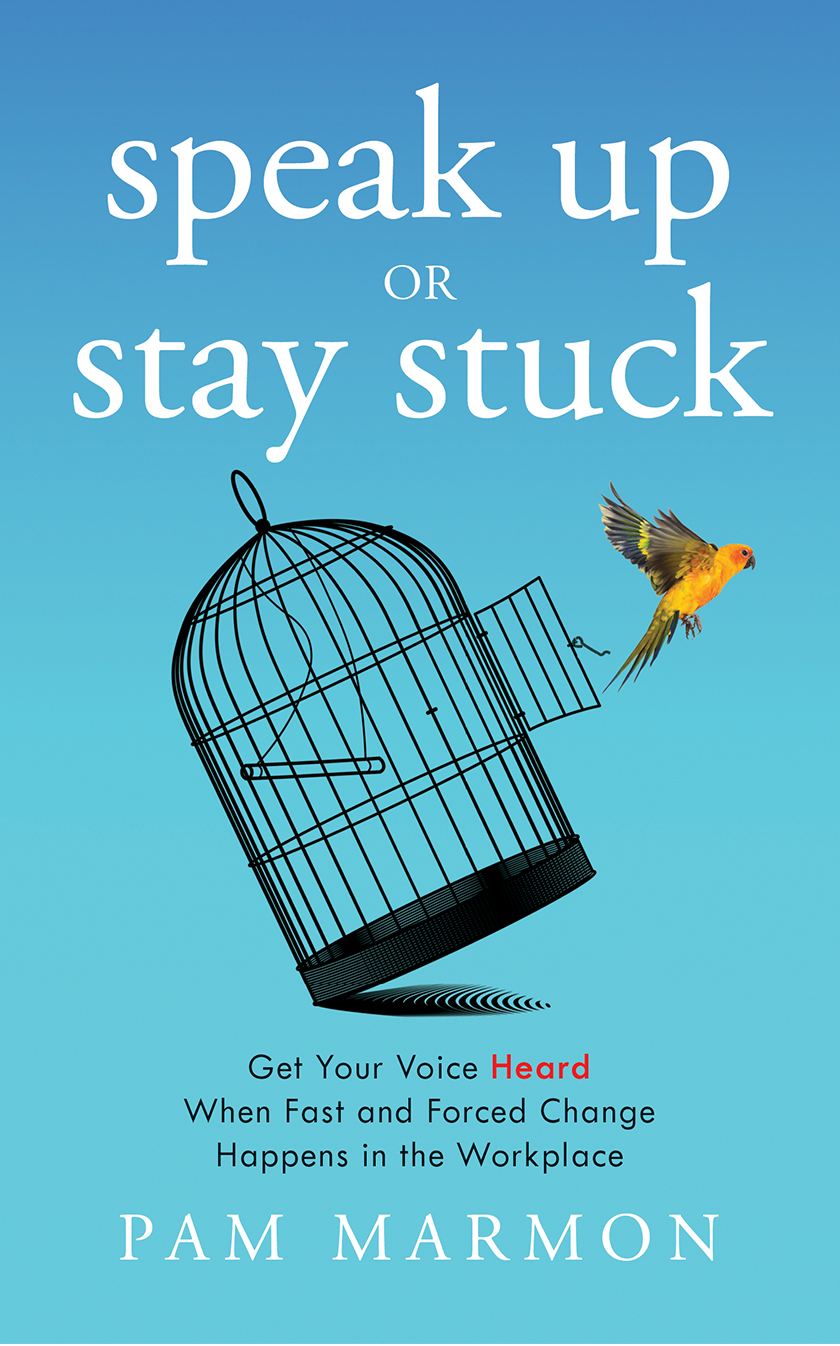
As a leader in your organization, have you been tasked to 'go make change happen' yet you feel voiceless, unrepresented, and stuck? This book will teach you how to approach your senior leaders during an organizational change and advocate for yourself and others without getting fired. Pam Marmon shares a refreshing and radical truth: Change is not happening to you; change is happening for you.
You will learn how to thrive when fast and forced change happens in your workplace by:
1. Identifying your new change growth mindsets
2. Determining appropriate ways to advocate for what you need
3. Discerning what you can control and influence
4. Enlarging your change capacity
5. Discovering a sense of control and ownership of your work
In Speak Up or Stay Stuck, forward-thinking change leader and entrepreneur Pam Marmon unpacks the practical framework for managers to implement change while getting their voice heard during organizational transformations. As a change leader, you will learn how to reset your mindset and get results, communicate effectively with your senior leaders while navigating organizational change, and grow your personal change resilience to embrace future changes.
"
Pam Marmon is a forward-thinking change management expert with Fortune 500 experience leading transformational initiatives in the aerospace, technology, bio tech, insurance, healthcare, nonprofit, financial, banking, corporate retail, consumer packaged goods, engineering, manufacturing, and professional services industries. Pam is also the best-selling author of “No One’s Listening and it’s Your Fault,” a book focused on how leaders can get their message heard during organizational transformations. She is also the creator of the L.E.S.S.® change management framework that brings precision planning and execution to effective organizational transformations. Pam earned her MBA from Seattle Pacific University and an undergraduate degree in Business Administration from Calvin University. Pam and her family live in Franklin, TN.
★ Scribe Case Study
Pam Marmon’s Book Helped Her Become the Woman She’d Always Dreamed of Being—And Quadrupled Her Revenue
With Scribe's help, Pam Marmon wrote a book that helped her become the woman she'd always dreamed of being...and quadrupled her revenue. Read more on Scribe.
📚 Books by Pam Marmon
Transcript
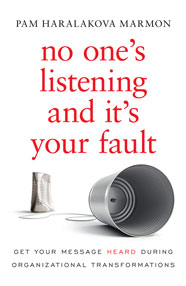
[0:00:35] NVN: Pam Marmon’s new book. No One’s Listening and it’s Your Fault was always scheduled to release on March 24th. But little did she know that the timing for this book about leading companies through periods of transformation would be so uncanny. Suddenly, we all find ourselves living in a new world where business leaders are being forced to look at their companies from a new perspective. This is sure to be a time of change and transformation. One that none of us were anticipating but that we are all experiencing. In this podcast, Pam has a message of hope and also some practical advice for successfully navigating what’s ahead and for coming out of this time not only intact but also stronger than ever. Pam Marmon, thank you so much for joining us today. We are here to talk about your new book, No One’s Listening and It’s Your Fault.
[0:01:27] Pam Marmon: Thank you for having me Nikki, it’s a pleasure to be speaking with you.
[0:01:31] NVN: Absolutely. In this book, you’re talking about a very specific scenario which is how leaders can make themselves heard during organizational transformations. Talk to me about why you want to discuss this particular topic?
[0:01:48] Pam Marmon: Absolutely. I have been leading organizational transformations for about a decade and one thing that I realize with every single project and every company, in every industry, was that oftentimes, leaders would spend a lot of money and a lot of resources to launch very big initiatives and would fail to get their message heard. And this frustration was very evident to me as a consultant, helping them and coaching them through the process and I sensed that they were doing everything that they thought was necessary for the communications, for the messaging to get out there so for people would transform their behavior but they were falling short. I set out to change that, I realized that from a change management perspective as a consultant, I realized that people often perceived change as difficult and leaders behaved like it was difficult and they send this message into their organization and so I decided to just put an end to that and transform the way we think about change and the way we communicate it and the way we engage our people. I just wanted to share this message of hope with the leaders so that they can be more effective in a workplace.
[0:02:55] NVN: That’s such an interesting point that a lot of this is about perception and our reaction to that, it makes perfect sense. With that in mind, we are recording this podcast a couple of weeks before your book launches and as we’re recording it, we are all in a state of pretty much lockdown due to the virus sweeping America, we’ve all seen the markets fluctuate vastly in the last few days and we’re coming into a period where it looks like a lot of businesses are going to be faced with a period that is going to push them into transformations that perhaps they didn’t see coming. More recently than the last couple of weeks. Your book seems very timely for that reason and I’d love you to talk to leaders who are perhaps facing that down right now and starting to think about how they’re going to lead their companies through this.
[0:03:51] Pam Marmon: Absolutely. It’s funny you say that because when the corona virus was announced, I thought, "My goodness, I’m launching this book at the most inopportune time." And then I had to stand back and actually realize, that this is the most opportune time to send a message of hope to leaders who are facing transformation, who are thinking about the future of their businesses, the future of their employees. Need a message of hope and need some encouragement to come alongside of them and just to think strategically and think differently about how to transform their companies and so from a tiny perspective, I am delighted to be able to share that message right now because it is so relevant and on the minds of so many leaders as they’re looking at all of the options. How they can perform different services, how they can adapt to the markets, this is extremely relevant and so I’m delighted to be able to get that message out now.
[0:04:42] NVN: Absolutely, it’s funny how the timing of these things happen so often. Especially because books do – the production period is so extended, you never know exactly when it’s going to land so I agree that the timing is sort of uncanny here.
[0:04:56] Pam Marmon: Yeah, even conferences that I’ve been asked to speak at were looking at different models and different methods using technology and so, everybody is having to be creative and to innovate and this is the part that’s exciting to me. I actually am thrilled of the innovation that’s going to bubble up as a result of this change. Now, granted the circumstances are quite unpleasant and we wish that it wasn’t in the case but on the silver lining, I think that we’ll see a lot of creativity come up as a result.
[0:05:25] NVN: Talk to me about why this general idea of change is so important to you?
[0:05:31] Pam Marmon: One thing that I talk about in the book is that I grew up in Bulgaria, a former communist country and we moved to America. Change has been part of my life’s story and leading organizational change and transformation started in my early 20s when I started to work with a Fortune 50 client, technology client that was leading an acquisition. Initially, at that stage of my life, I was fascinated by leadership and fascinated by the influenced leaders had. But as I started to progress in my career and I realized, this is actually foundational to the life of an organization, it’s not just about leadership, it’s about livelihood and so this passion developed and evolved and it shifted the way I thought about change myself, personally. But it also shifted the way I perceived leaders and their role and how to really equip them and empower them to be successful in the future. From a personal change perspective, it’s something that I have been able to navigate both in my personal life but also professionally to help leaders transform organizations and thrive. Not just for the sake of leadership but for the sake of the good of all humanity. Because one thing that I realized was that when leaders are successful at leading transformation, they have healthy teams, they have employees that are satisfied, they go home to their families that have good relationships with their families and that trickles into health communities. But when leaders fail to lead change successfully, you have unhealthy teams with employees that are dissatisfied, that take that dissatisfaction, frustration home and create stressful environments for their families and that stressful environment trickles communities that are negatively impacted. And so I was on a mission to change the community, that is my end goal. Because I know that if I help one leader transform the way they lead, the impact is for generations to come.
[0:07:34] NVN: I love — especially during this period that you have used the word hope at least two or three times already in the course of this podcast. Let’s talk a little bit about some of the things that leaders do have to be hopeful about right now.
[0:07:49] Pam Marmon: Absolutely. Leaders can feel hopeful that people are listening. Now is the prime time for you to share a message about the future because people are in tune, they are listening, they are wanting it, they’re expecting it from you and they’re more likely to join you and really link hands and link forces and create that alignment across organizations because we as a nation, we as people, we as organizations have to come together. There is no other way, we just have to bring all of our resources together, all of our best thinking together. Now is the time to share that vision and to share that transformational message and have it land on fertile soil so that people can take it and run with it.
[0:08:34] NVN: Beautiful. Let’s tether this down in practice a little bit. This applies obviously to leaders as we begin to come out of this time in the next few weeks and months and then also more generally. For leaders who are navigating their companies through transformations, in your experience what sort of behaviors or circumstances have you seen leaders become in meshed in, that can make change and transformation more difficult than it actually means to be in companies.
[0:09:06] Pam Marmon: yeah, the behaviors that often times I see that can be corrected and with not a lot of effort, it can be corrected so it’s quick, easy wins is to engage people along the journey, oftentimes what happens is we have large transformations, project teams, lots of people who are involved from a project management perspective getting the work out or the technology put in place or the design or whatever the product is and we forget to engage people who are going to be impacted by the change and we forget to bring them on this journey. What I coach my leaders to do and our listeners to do is to think about the change from beginning to end, what would that experience look like for the people who are on the receiving end. It may be your customers, it may be your employees and may be your business partners across your industry, what would that change look like and how can you engage them throughout the duration of the work so they feel connected, so they feel like they have an opportunity for input, they can be part of that design process and also ultimately, that leads to a common ability. Oftentimes, leaders expect people to be accountable for something that they didn’t create, they didn’t have an ability to provide input, and this is where we fail to recognize that people will be accountable to the things that they themselves added value to. To me, that’s one of those quick wins that we as leaders can engage people along the journey, in order to obtain that approval and that buy-in and that engagement throughout the duration of the projects. So that when we do go live with whatever, that change itself is. We already have an audience that’s hungry, that’s ready, that’s prepared and that’s ready to be engaged and successful in the future.
[0:10:43] NVN: That’s a great point and I especially liked what you said about this ideal that employees can be expected to assume accountability for processes and changes that they are not necessarily sold on, in the first place, as the person who is ultimately really owning that on a day to day basis.
[0:11:04] Pam Marmon: Right and that is where I think a lot of leaders that I’ve worked with have come to that realization that we can invite people in that process and that journey. Now I do need to make a broader statement that healthy high functioning organizations are not run like a democracy and so you can’t expect that every single person will have a say and have a voice and a choice and a voting ability. That is not what a successful organization is. There is a reason why we have leaders and decision making rights and all of these wonderful things. But what we can give people is the ability to provide choice and input as appropriate in the most appropriate places where there is engagement and there’s ability to provide that feedback and also we are listening to that feedback. We are asking but we are also doing something with it, in order to be successful.
[0:11:54] NVN: So let’s tether that down into real life a little bit, what might that engagement look like as an example when a company is going through a time of transformation?
[0:12:04] Pam Marmon: Oftentimes what I coach my leaders to do is to select a group of people who we call the change champions. These are people who are influencers in the organization, they’re well connected. They’re well respected with their peers and what we would do is schedule periodic touch points with them and we present different content, different communications or different ways to engage with them to learn about the experience and also the experience of their peers. So this is one wonderful way to connect with people, give them some talking points, ask them for feedback, adjust the change pieces as needed so that we can be successful in the future. That is one. Another one you could do is a focus group where you invite a certain number of people that represent the employees in the organization, you can ask for a specific items and take a pulse on the organization. You can do branding campaigns where you’re proposing different ideas and you are asking people to vote on their favorite one. Those are just some of the creative things that you can do and each culture is going to be unique and so if you look at your organizational culture, what are the nuances that you can tap into to engage people and get them excited early on and raise that awareness, it is coming without necessarily giving your voting rights away and the entire project. Obviously that is reserved for the leader that is where it is expected to be but you can think of creative ways to get people engaged.
[0:13:23] NVN: You know what came to mind as you were talking about that is that by cultivating greater engagement it seems to me like there is the additional win of just getting more idea generation from the collective consciousness and perhaps stumbling into ideas, both big and small, that leaders may not have come across otherwise.
[0:13:45] Pam Marmon: Absolutely. One of the chapters in my book is titled 'You Don’t Know it All.' And it sounds funny to say it but it takes a lot of humility for a leader to recognize that I may not have all the right ideas or all the best ideas. Even people outside of the project may be the ones that have those ideas. One activity that I do at the beginning of every large transformation is called 'The Readiness Assessment Activity' and I interview a set number of people to understand. Is the organization ready for this change? What we learn through that process is quite insightful and the amount of ideas that come through it are when we apply them the right way, we are really able to integrate within the culture and the context of the change how people are going to perceive it and how they’re going to react to it but certainly this humility to come alongside people and say, “I don’t know it all. I’d love to learn more. What do you think?” Gives people the chance to participate and be engaged.
[0:14:39] NVN: Excellent. So in the book, you’ve really divided this into four separate steps if you will for leaders and obviously, you go into them in great detail in the book but I just would like you to speak briefly to each of them. So those four steps for listeners are to listen, empower, speak and solve. Can you talk to me a little bit about each of those elements?
[0:15:08] Pam Marmon: Absolutely. So the acronym is LESS. The first one is listen and listen is all about being able to have a solid vision and that you can articulate why this change is important and why it matters to the organization. Within the context, you also need to create the alignment. So understanding what other departments and other parts of the organization are doing on how do they align to the organizations strategic priorities. And also that you can empower others to be successful within their context of that. And then the feedback part. Incredibly important as we think of the impact that stakeholders that need to provide feedback in terms of how this is going to change their world and their reality of what they are dealing with and so being able to integrate that is very important. So that is under listen. The second phase is the empower. Empowering is all about identifying the influencers and the change champions within your group and being able to give them the talking points and the ability to share the message. So oftentimes that comes under the umbrella of influencers, change champions but the MVP’s that I call out in the book are your middle managers and oftentimes they are overlooked because we kind of expect people to just cascade information throughout their organization. The research done in the change management space is that in many organizations this is where communications is blocked and so having strategic engagement with middle managers is critical and letting them know what needs to be communicated before this transformation, during the transformation and then after we go live, is going to be really important. So that is under the empower. The next phase is speak. Speak is all about understanding what are your communication channels. What are the preferred ways that people want to be communicated within your organization knowing that you are not going to be sending out messages in all of them, so you just need to be strategic about the most important ones for your work, your project as you’re leading them and then what is the story that you want to tell people. What mindsets and behaviors do you want people to display as a result? How can you make people feel like they are the heroes and not the project itself or the technology but how can people become the heroes of that story? And also think about the control, what are they in control of doing and how can they navigate this change based on what you shared with them? So that is under the speak umbrella. And then the last one is solve. I absolutely love solve because it is about metrics. We are looking at what we can measure, what progress are we making, how can we identify those results, how can we celebrate the success that we’ve encountered and also I am looking at the incentives. What incentives are structured within the organization that are going to be reinforcing this change going forward that are going to support the momentum that you created. So that you don’t go live and then three months later everything is back to the way it used to be. So it is really important to understand the organizational incentives and how you align within the culture of your company to be able to sustain the change longterm.
[0:18:05] NVN: Beautiful and changing gears here a little bit but I look at a lot of book titles obviously in my job and so I am acutely aware of it when one stands out to me and your title is one of those. Again, it’s No One’s Listening and it’s Your Fault and I understand there is a bit of a story behind that. Can you share that with us?
[0:18:26] Pam Marmon: There is a story. I was meeting with my mentor who every few weeks, we had a regular scheduled call and I would get together with him and share a little bit about my work and what I am up to and so on one particular day we met and I just happened to ask, “How’s it going? How’s your work going?” And he said, “Well, I am really frustrated. We have this very large initiative taking place. We sent out the emails, we’ve told people what to do and nobody is doing anything and I am so frustrated I don’t know what else to do about this.” And without taking a breath, it just came out of my mouth, “No one is listening and it’s your fault.” And now you have to understand this mentor of mine is a brilliant man who has a history in the Army and the military and so he’s very well decorated, very experienced and he stared at me and I stared at him and I thought for a second, “Oh no, I can’t believe I just said that to him” and then he smiled and he said, “Tell me more,” and he leaned in and I leaned in and I started to share. A little bit about what it takes to lead a message of hope within an organization to really help people understand what is expected of them and oftentimes email is the last resort. Because we receive so much email and a lot of it goes unread or straight into the garbage and so how do you engage people early on to understand what’s expected of them, what they need to share and so when I was thinking about the book and what do I call it and you know that was one of those stories that really stood out to me. And actually it was one of the early stages where I realized I need to write a book because there is so many great leaders like my mentor who are frustrated, who are doing such an amazing job leading companies through massive change yet they feel like their message is not being heard and I wanted to change that for them and so that is how the title came about, No One Is Listening and It’s Your Fault.
[0:20:13] NVN: What a great vision of that just sort of spitting out of your mouth. I love that story. Okay Pam, thank you again so much for joining us today and again, to speak about what has become such a timely topic. Again, the book is, No One is Listening and it’s Your Fault — Get Your Message Heard During Organizational Transformations. Pam, is there anywhere aside from the book that listeners can find you?
[0:20:39] Pam Marmon: Absolutely, listeners can visit my marmonconsulting.com and I have a lot of free resources available, questionnaires, all kinds of checklists, change journals for leaders, you are all welcome to visit the website, marmonconsulting.com and download all of the free materials.
[0:20:56] NVN: Excellent. Thank you so much for joining us today Pam and best of luck with the book.
[0:21:00] Pam Marmon: Thank you.
[0:21:01] NVN: Thanks for joining us for this episode of Author Hour. You can find No One is Listening and It’s Your Fault, on Amazon. For more Author Hour, hit the subscribe button on your favorite podcast service. Thanks for joining us, we’ll see you next time. Same place, different author.
Want to Write Your Own Book?
Scribe has helped over 2,000 authors turn their expertise into published books.
Schedule a Free Consult