Ben Woodward: The Empowerment Paradox
Read the full transcript
Ben Woodward
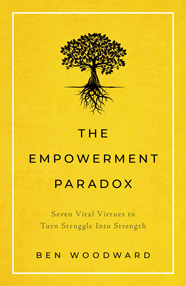
Ben Woodward is a business executive, entrepreneur, and keynote speaker who has risen to senior leadership in multibillion-dollar companies, including serving as the global president of a multinational corporation. He has served on the boards of trade associations and has spoken in roughly thirty countries. Drawing on personal experience with family trauma, chronic illness, and corporate crisis, he wrote The Empowerment Paradox: Seven Vital Virtues to Turn Struggle Into Strength.
★ Scribe Case Study
Ben Woodward’s Book Gives People the Inspiration They Need to Confront Adversity Head-On
Amidst loss and grief, Ben Woodward was diagnosed with bipolar disorder. Rather than rejecting adversity, he's now using it to his advantage.
📚 Books by Ben Woodward
Transcript
[0:00:18] NVN: I’ve heard many amazing stories of people making meaning through adversity. But I don’t think I’ve heard anyone speak as eloquently to those lessons as Ben Woodward does. In his book, the Empowerment Paradox, Ben lays out seven virtues that have helped him take on life’s challenges and respond with patience, strength and hope. In our conversation, Ben describes some of the circumstances that informed his practices for dealing with life’s complexity. I took away some incredible life lessons from our conversation and I know you will too. Today, I’m sitting down with Ben Woodward who is the author of The Empowerment Paradox. Ben, welcome to Author Hour, it’s so great to have you.
[0:00:58] Ben Woodward: Thank you very much, it’s a pleasure to be here.
[0:01:01] NVN: I have been loving checking out your book. How would you describe your book actually? I’ll let you dive into that.
[0:01:07] Ben Woodward: It’s really designed to explore first of all, the important role that adversity or suffering or struggle plays in life. In a general context to begin with and what our response to that should be. Not just to deal with it and compartmentalize or put it in a box but so that we can be empowered by it, transformed by it and become the best version of ourselves because of it.
[0:01:31] NVN: What life experience brought you to develop this body of knowledge and write this book?
[0:01:36] Ben Woodward: It was a collection of different experiences that really brought me to this point. A number of years ago, I had the very unfortunate circumstance where it was brought to my attention that my father had done some very wrong things that really required the law to be involved. And I was brought to this complex kind of situation where — what do I do about that? Do I just let him get away with his criminal activity or do I initiate some legal process? The right thing to do was not necessarily what my heart wanted to see happen but was what was necessary. I initiated a police investigation against my own father which was heartbreaking and horrible. It led to his arrest, it led to a court case so I had to testify against him in court and it led to his incarceration and he was in jail for quite some time. That was really quite a traumatic experience but I noticed something interesting as a result of that, as a consequence of what that life experience demanded of me. I found, as my career developed and I moved into leadership responsibilities that leadership required as well, difficult things, challenging things for me that sometimes it would require me to do what was right versus what was easy or what was popular. That wasn’t always comfortable. But that experience, it actually tutored me on that and it equipped me with a set of skills to respond better than perhaps my age or commercial experience would have justified. And so I saw the benefit that came out from that. Another thing that really influenced it a lot as well was I got diagnosed with bipolar disorder a number of years ago and it’s interesting, at the time of diagnosis, I was actually thrilled. It sounds kind of paradoxical in itself to be thrilled to be diagnosed with something like that but it gave relief because it gave context to what I was working with. The journey that I’ve gone through in grappling with that, understanding it, embracing it, accepting it, and then allowing myself to be transformed by it has been revolutionary as well. And again, ironically, the fruits of that have filtered out into other areas of my life. It’s seen me become a better husband and focused father as I respond well and it’s also improved my sensitivities with other people that’s led me to be more compassionate and more tolerant and more empathetic, more understanding, more patient, more kind. I wouldn’t trade those benefits that it’s brought for anything. But, the price was a degree of suffering. Coming back to your question about, you know, how did this kind of come about? I’d actually kept quiet about my bipolar disorder and I haven’t talked about it with many people and there’s going to be a lot of people that know me that will read the book and perhaps be even be surprised that I’ve privately quietly struggled with that. But I kind of tested the waters a little bit, I do a lot of speaking, workshops, trainings, events and so on as a part of my — the work that I do and I was at an event in the south of England a couple of years back and I was asked to cover two subjects. One was kind of the role of what success as an entrepreneur can look like and what people can look forward to and how they can prepare and plan for that. And it was a group of very enthusiastic business owners that were keen to learn how to be more successful. I was talking about that but the other subject that I had on the second day of the event was how to deal with adversity and the roadblock, the barriers. I thought, I’m going to test this out here and see what happens. For the first time in my life, I opened up to a live audience and explained. I said, “I think I might even have an advantage over some of you in dealing with adversity here and understanding the roadblocks. I’ve got something of a superpower that you guys don’t have. I’ve got bipolar disorder.” And I positioned it as something of a super power because it had given me an advantage I felt because it took my emotions, the pendulum that everyone has but it had stretched out far and wide. Of necessity, because it is a chronic situation, it has forced me to really interrogate myself and understand myself and learn and be more self-aware and more cognizant than ever before — in order to respond effectively and with power. Those lessons that I applied from that, into their situation was overwhelmingly relevant for them and I got more response from them in that moment, on that day, teary-eyed people coming up afterwards just kind of moved and grateful for the vulnerability. People that were inspired and enthusiastic and grateful for the insights, and that they related, they didn’t necessarily have what I was dealing with but they could still relate with some of the struggle and the challenge in their own circumstances and saw the lessons that were applicable. It was just an eye-opener that life is hard. I think almost everyone relates to that. I just made a commitment, I’m going to be more open about this because I think people will respond well to someone that says life is hard, I get it, this has been my journey, we’ve all got our own but there are some good lessons we can come through with this that can help us not just deal with it but actually be better because of it. Have greater hope because of it. I heard this ‘virtue cycle’ —for want of a better phrase, that’s been taught for a very long time that adversity or suffering can build patience and with that patience, we gained experience. And with that experience, we develop an increase of hope but I’ve also seen the opposite happen where people experience struggle or adversity or suffering and then they interpret that as bad experience which leads to impatience which diminishes or compromises hope. I thought, well, the two coexist, how does that work? And it really comes down to our approach and response. That’s really where the book jumps in, let’s understand the nature of it, let’s understand why it exists, what bounties and benefits can come from it. But critically, it’s not something we just have to ride out, we can actually be transformed by it in a way that it gives us a greater sense of hope than childhood innocence gives us in our youth.
[0:07:48] NVN: That’s’ incredible. I’m so struck by the conviction that you display in being able to find the benefit of your struggle. And yet, I’m sure that the process of becoming more aware of that and helping yourself see the benefit was not an easy one, what was that like?
[0:08:06] Ben Woodward: Yeah, the conviction really has been given birth out of — from necessity. Because it’s not been an easy process and the keyword there is process. It’s not an event. When things happen to us or maybe when we have self-inflicted injuries in life, and I think I’ve kind of had my fair share of both, the choice is, “What am I going to do with this?” I can just allow myself to be kicked around and beaten by things or I’m going to take a stand and do something about it. With something like bipolar disorder or maybe when the journey of someone going to prison like my father did. That’s long and drawn out, they don’t get arrested and then go on court the next week and then incarcerated the next day. that just dragged on for a couple of years. That was painful. That was just persistent. Likewise, we will have struggles that we face in life that are persistent. Where seasons are longer than we want them to be and the responsibility that comes to us then is we need these virtues that I talk about in the book that enable us and empower us to deal with persistent challenge. I’m talking there about you know, we need to accept and embrace our struggles or the adversity that we’re confronted with. What that really means, is we need to be willing to let go of the illusions that we’ve created, that allow them to exist without our own personal effective intervention. Too many times, things happen to us or we blow things up on our own face and our own backyard and things go wrong and we don’t want to deal with it or don’t know how to deal with it so we don’t and we hope that maybe it just goes away. What I found in this process — was that just doesn’t work. Especially like I said, some of my health conditions, that really is a less effective solution. That just creates more problems than it’s worth. Necessity gave birth to that conviction and now, coming through the other side where you go, “I’m in a position of strength now, I feel stronger that I’ve embraced it, that I’ve let go of my illusions, that I acknowledge where I feel vulnerable and how I can be strengthened.” When I accept all of that, now all of a sudden, I’m starting to feel liberated, now all of a sudden, power is coming into my life that I didn’t have before. That’s great. It’s refreshing and invigorating and inspiring.
[0:10:28] NVN: Power in what ways? What are some illustrations of that? From your life?
[0:10:32] Ben Woodward: Power that comes within. Internal power. That’s the critical, I guess, essence of what we talk about in the book, or what I talk about in the book, it’s responsibility that we each have for our own lives that we need to take responsibility and that requires earning the good stuff and the bad and even when I talk about owning it, that also means the stuff that happens to us, yeah? Someone might offend me or hurt me or I might have a circumstance in my life that I wasn’t prepared for because someone else did something that influences or impacts me directly. I own my response to it and what happens as a consequence of that response is on me. That’s where the power comes in. We have more power that way. And, in addition to that, the greatest lesson that I got in this journey was recognizing that my source of power isn’t in me independently. I think, in some degree, the world is getting this point wrong, they’re teaching, you can have power, you can be everything you want to be, you are entitled to this or that. I don’t believe we’re entitled to much actually, the world has been around a lot longer than we have, the world expects something of us, it’s not what the world can do for me. It’s what I might need, what the world demands of me. We’re going to shift our mindset there a little bit but where I see the strength coming in is one, owning my own responsibility to react and to respond to life and whatever it throws at me with integrity, with honesty and with authenticity. The second part of that — and that’s empowering in itself but the second part of it is, we don’t always have the whole power base. It doesn’t always reside exclusively in me. There are times where I won’t know enough, where my faith in my future isn’t strong enough. Where my patience is vulnerable or inadequate. Where my resources internally are compromised and then what? What do I do then? It’s at that point that we understand, we’ve got to be willing enough, humble enough, courageous enough to reach out to others and ask for help. When we’re willing to do that, we actually find that we are stronger as a collective, as a human race. If we could all do that — can you imagine what the world would be like if collectively, we were all humble enough to reach out and ask for help. Offer it to others when they need it, the collective outcome of that would be an increase in power, an increase in strength, and an increase of output in a positive way. More than we’ve ever seen. But so often when we struggle, we self-isolate, we cut ourselves off from the rest of the world. “I don’t want to tell you what my problems are because that makes me look weak or it makes me feel vulnerable or it might change your interpretation of who I am,” or what have you. We feel nervous and apprehensive and a host of other reasons, we cut that off. And then what happens? Now I’m left to my own strength, now I have to be everything. I’ve got no room for error because it’s all on me now. We need to be able to ask for help. The power base comes in two ways, externally and internally but they complement and strengthen and support each other.
[0:13:45] NVN: That’s wonderful. In your book, you lay out seven principles that allow us to step into this more conscious response to the world. I’m curious, how did you land on these seven virtues?
[0:14:00] Ben Woodward: Practice. The book itself is not designed to be a memoir and anyone that reads it will see that that’s not the case. However, on a subconscious level, it is somewhat autobiographical in a sense of — this is what I’ve learned through trial and error and in the extremity of my own suffering and my own adversity, this is where I found answers. And It’s been maybe to my own experience and also through the experience of others that have been able to work with or help and support and what have you and others that I’ve read about as well. But it has been — I’ve had to apply these, again, out of necessity and this one example that I have given there, of, I used to lead an addiction recovery program for a family charity organization in the UK a few years back. A lady came in once — I share this example because again, in extreme examples the lesson is more obvious. In the subtlety of day to day challenge, it’s more obscured, isn’t it? So I use this as an extreme example but this lady came into the meeting one day and she wasn’t liberated and she desperately wanted help but the rules of the program of the meeting that I had been asked to lead was if you’re under the influence of anything that you are not allowed to be in the meeting. You will not get any benefit from yourself and you will compromise or make others feel uncomfortable that are there. The challenge was she looked like an emotional wreck. Her eyes were red with tears, her cheeks puffed, she’d been crying a lot, her neck, she was — her head was so sunken down into the cavity of her chest with shame and just self-loathing. It was just tragic to see and I had to ask her to leave, which was heartbreaking. It’s like, “How do I do this?” She looks like she desperately needs help and she’s taken so much courage to get here and here she is now, I’ve got to ask her to go. So I ran over and sat next to her put my arm around her shoulder so that I could with as much kindness and compassion explain to her that she needed to go and as I looked under the scars going all up her forearms, both arms, yeah, which represented that whatever is going on that you can see clearly in her face is something much deeper and more dangerous that she’s been dealing with overtime. I asked her to go and I explained the reasons. I said, “Look, well you’ve got something in your system here. This isn’t going to help you,” I said, “However please, please just promise me that you’ll come back next week. You know every Wednesday at 7:00, we’re here. Please come and make me that promise.” She couldn’t do it. She said, “I can’t make that promise” — and she had made and broken so many promises that she couldn’t even make a promise to walk to a meeting that was walking distance from where she lived. That would take all of 45 minutes to an hour that had the potential to keep her safe and well maybe even save her life. She couldn’t make that promise and in that moment, I realized I got the promise wrong. I got it all back to front. And I said, “Wait a second,” I said. And I apologized and I said, “I got that wrong. Let me make a promise to you,” I said, “I want to promise you that no matter what every Wednesday at 7:00 even if it’s Christmas’ Day,” I said, “We’re here for you.” I said, “So whatever is going on in your life, you know at 7:00, on Wednesday night here, this time and this place, we’re here for you, whatever is going on. Remember that and we love you. We want you to be helped, we are here for you.” The next week she came and it wasn’t because she had the belief in herself that she could do it. She came because she knew someone else believed in her and cared enough to be there for her and that was the starting point. What I get to in the book is with these virtues, one of the great challenges, especially, you know, if it is on the subject of self-help, one of the great challenges that people talk about is well, have a better attitude or work harder. What if you don’t have a better attitude? What if you don’t believe enough? What if you don’t hope enough? What if you feel hopeless? What if you are absolutely despairing? What if you don’t feel like you can try anymore? Then what do you do, then how do you move forward? And I want to get to that level where there are solutions. So yes, we need to have a disciplined heart. What if your heart is broken and you don’t feel that you can have the strength to move forward? What if yes, I need to have patience in my own suffering right now but what if I don’t? I know I need to cognitively but it is easier to say that isn’t it? We’ll just be patient, this will pass. What if I don’t have that patience? How do I get it if I don’t have any? Okay, let go of the past. Don’t worry about that, just think about the future, look at what the future holds for you. Now, let go of that. Forget about it. What if I can’t? What if I don’t know how? How do I forgive if I don’t feel like I have the capacity to do that? And so I take those virtues and those qualities because out of necessity from my own experience and working with my relationship with my father and dealing with my own mental wellbeing and managing my own relationships and my own home life. And striving to be the best that I can and even remarkably in my career, you know as the president of a global multi-million dollar business. I’ve been able to look at these virtues and see them in play commercially and see them in play relationship wise and also at a deep personal level for personal transformation but that is where it comes from. It’s all the necessity at a very basic lower-level.
[0:19:21] NVN: Yeah and that story is incredible and your explanation. What strikes me most is that these virtues are obviously not hard and fast rules that we get right or wrong. You know they are continual practices and they take practice. They take daily practice, which one of the virtues or maybe there were several, which did you find most difficult to start practicing?
[0:19:45] Ben Woodward: The first one, which is a disciplined heart because I do think it starts there. We need to be willing at the front-end of any change. What we do is the fruit, isn’t it? Of what we think, feel, and believe. So if my belief is off-center, if my feelings, which are governed by my emotions, my emotions are governed by my desires in some way, if they are out of filter then I am not going to be able to get the results that I seek. So at a starting point is the responsibility to train my desires. And not to be a victim of them or just be blown about by the winds of whatever my mood might be but to learn how to be self-aware, mindful of what my desires are and then be able to change them. So training our desires I think is one that is critical for all of us as a starting point because what we achieve in life and who we become is essentially the outcome of what we desire overtime. You know someone once said, “Tell me what you think about when you don’t have to think and I will tell you what kind of person you are.” It starts right there.
[0:20:47] NVN: That story of dealing with the legal case and the charges with your father sounds like a pretty pivotal illustration of training the desire, which was to not persecute your father and yet, you know, as you said, it was the right thing to do.
[0:21:02] Ben Woodward: Yeah. It’s — the challenge with that one was there were so many conflicting emotions. You’ve got the natural unconditional love of a son for his dad but the hatred of the actions that he has been involved in. And the knock-on effect of that and all of the hurt that comes. There is a whole mixture of different emotions and the challenge with that was what are my desires? I didn’t even know really what I wanted out of that and so it really required a lot of introspection. A lot of understanding of what — there is a hierarchy of virtues, isn’t there? Some have more power in different circumstances than the others and they need to be prioritized and, in that instance, doing what was right had to trump doing what was comfortable or more pleasing and that meant repeatedly going back to this need to train my desires to stay the course and follow it through. So that right can prevail for everyone and ultimately, it’s right for him. It is not necessarily that people go there to be, they need to be punished but they also need to be reformed. That is not going to happen if we just bury our head in the sand and pretend that all is well when it isn’t.
[0:22:13] NVN: Yeah, absolutely. Which of the virtues do you focus on these days?
[0:22:18] Ben Woodward: I think all of them. One that is personal to me a lot really is patience. The role of patience is something that I need to perpetually be mindful of. They say, you know, “In patience possess yee your souls” — and I believe that the antithesis of that is also true. With impatience we could lose them. And so I think it is important that with any development of any virtue, we need to understand that one of the essential ingredients of life is time. You know, that’s one of the things that makes it up, doesn’t it? We all have that same thing but how that passage of time passes through us, how we allow ourselves to work with it I think is essential for any undertaking. You know we have talked a lot in this interview about the personal journey, emotional journey of dealing with these virtues and understanding them. We are dealing with adversity or have the ability — it applies in entrepreneurship. If I am running my own business, if I am a leader of an organization, our ability to have vision and see with our mind’s eye where our future can take us and then have the patience to follow whatever process is required to see that through to fruition is essential. Again, an essential role of developing that patience, it has been research on this, which has been fantastic to read about is the role of our imaginations. The more we can engage our imagination, the greater our ability to exercise patience. It moves us beyond leading to white-knuckle things or to rely exclusively on will power alone. So yes, we need a disciplined heart. Yes, we need to be willing to work hard but actually engaging our imagination with what we are working through, being able to see into the future in our mind’s eye a better state or a greater cause or a greater outcome actually enables us to work with patience and become more patient as an individual more than anything else. That is something that I need to completely consistently work with is engaging my imagination in my own future state, being patient when things get tough and just learning to have that even temperament as much as I can.
[0:24:27] NVN: I love this connection. You made this now between time being kind of the fabric of our lives and we can decide what we are doing with our time and patience being really a way to allow time to flex around what it is that we chose to do. Those obviously were not the words you used but wow, that is so beautiful.
[0:24:51] Ben Woodward: I guess that is the great challenge I think for all of us. So when I was younger, it seemed to me, and maybe this was just my own lack of observation, I don’t know, but when I was younger it seemed that if there was any challenge or struggle or bump in my road so to speak that it seemed to happen, you know, maybe one thing at a time. And it would bump and move on comfortably thereafter, they weren’t heavy bumps. They didn’t drag out for too long. And maybe that is a reflection of my journey going through childhood or my interpretation of it but as I have gotten older, it seems that the struggles that we face seemed to dig a deeper well within us and there is more depth to this struggle and it does seem to stretch out longer and then they overlap. You know you are dealing with one thing and it is going on longer than you hope. You go, “Oh I thought this problem would be solved by now and it is not.” Well I thought I’d be able to deal with this by now and I can’t. I keep on stumbling and falling over the same issue time and time again. And then you get an overlap with something else that happens in addition too. And life just seems to get complicated. I’ve asked this question hundreds of times. So I have travelled now to I think close to 30 countries around the world now speaking at events and seminars and workshops and what have you. And deliberately, because I have the opportunity to go to so many countries, it is nice to ask the question for the sake of personal research and insight from a — kind of a global human experience perspective. And I have asked this question all the time, “By a show of hands, how many of you feel like life has turned out for you exactly as you hoped it would.” And no one ever puts their hands up. No one. Regardless of age, regardless of country, regardless of gender, you name it no one has ever gone, “Yeah, it’s turned out exactly as I planned.” It doesn’t work that way. What do we do with that? Like I said these virtues come in at a great way to help us to interpret, to embrace, to understand and then be empowered to become transformed by all of these unexpected journeys and lessons that life throws at us and come out better for it and that is the ultimate goal is let’s come out better for it.
[0:27:02] NVN: I have loved this conversation so much. I’ve gotten a lot out of it and I’ll have to re-listen to these recordings over and over because you bring up so many wonderful pieces to apply to our own lives. In a very short summary, what are one or two things that you want people to take away from your book?
[0:27:24] Ben Woodward: One is — it will all work out in the end and if it is not working out, it’s because it’s not the end but there is a way through. We can’t wish our way through life, hoping that that will be the case. We need to work it through. My goal is to provide some framework for you that you can have built within yourself. A reservoir of your own personal strength that you can practice overtime that will ensure that that promise comes true — that things can work out in the end and together we can make that happen. That’s really, that would be my greatest wish.
[0:27:58] NVN: That’s incredible. The book again is called, The Empowerment Paradox. Ben it’s been such a pleasure to talk to you about your book and besides going to check it out, where can listeners find you?
[0:28:10] Ben Woodward: They can find me on my website, empowermentparadox.com. Again, empowermentparadox.com, you can find me there and on that website will be the links to all of my social media connections too.
[0:28:21] NVN: Beautiful. Well thank you so much for joining us.
[0:28:24] Ben Woodward: Thank you very much for having me. It’s been a pleasure.
[0:28:26] NVN: Thanks for joining us again for another episode of Author Hour. You can find, The Empowerment Paradox, on Amazon. A transcript of this episode as well as all of our other previous episodes is available at authorhour.co. For more Author Hour, subscribe to this podcast on your favorite subscription service and thanks for being here. We’ll see you next time, same place, different author.
Want to Write Your Own Book?
Scribe has helped over 2,000 authors turn their expertise into published books.
Schedule a Free Consult