Darius Mirshahzadeh: The Core Value Equation
Read the full transcript
Darius Mirshahzadeh
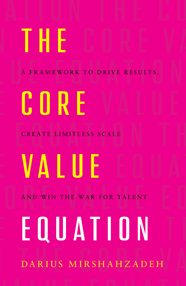
Darius Mirshahzadeh is a high-growth CEO, serial entrepreneur, and the host of The Greatness Machine podcast. He was ranked number nine on Glassdoor's list of top CEOs of small and medium companies in the United States, and the organizations he has led have won multiple Stevie Awards, been named a top workplace by the San Francisco Business Times, and landed at number forty on the Inc. 500 list of fastest-growing companies. A TEDx curator and graduate of programs including Birthing of Giants at MIT and the Stagen Integral Leadership Program, he wrote the bestselling book The Core Value Equation, which shows how core values can become an organization's decision-making engine and drive consistent results.
📚 Books by Darius Mirshahzadeh
Transcript
[0:00:22] DA: Darius Mirshahzadeh spent his childhood building businesses. From building a candy empire in the fourth grade to door to door sales, to creating an events promotion company in college to building his first legitimate company at the age of 25. Yet, in 2007, he sat in the office of his company, one of the fastest growing in the US and said to himself, “I hate this company, I can’t believe I created this.” By learning from his mistakes and if you ask him, he’ll say, he made every mistake. Darius went on to create companies nationally recognized as best places to work, built nationally recognized cultures and it’s recognized as one of the top CEO’s in the United States. In his new book, The Core Value Equation, Darius asks you to throw out all the notions you have on how to build a core value-driven organization and shows how core values create the ultimate decision-making engine for your organization that consistently produces spectacular results. Hey listeners, my name is Drew Applebaum and I’m excited to be here today with Darius Mirshahzadeh, the author of The Core Value Equation. Darius, I’m excited you’re here, welcome to the Author Hour podcast.
[0:01:27] Darius Mirshahzadeh: Yeah, thanks for having me. Happy to be here.
[0:01:29] DA: Great, first, tell us a bit about your background and then we’ll get into what inspired you to write this book?
[0:01:35] Darius Mirshahzadeh: I’m a serial entrepreneur. High-growth companies, my first company really cut me out — I’ve been an entrepreneur since I was a kid. But the first real success I had was when I was 25 years old, I built an Inc. 500 company between the year’s 2003 and 2006. It was actually number 40 in the Inc. 500 and you notice I didn’t say Inc. 5,000 because they didn’t even care if you were 501 after that, back then. We were the 40th fastest growing company in the United States. Then I got my head kicked in for a few years and I had the 40th fastest-shrinking company for a while. And then, I had my next big success which — it was a company by the name of the Money Source and it was a company that my business partner founded and I came into it. And there was a very small company, it was about 30 employees and we grew up to about a thousand employees in three years. Yeah, when you do stuff like that, you learn a lot about how to build high-growth businesses in a very short period of time. And when a company goes from using my first company for instance, one to 150 employees in three years, you’re building it, you’re really running a new company every couple of months In the case of my most recent company, when it grows from 30, 40, 50 people to a thousand people in three years, you’re almost running a new company every week or two. I got pretty obsessed about core values. I don’t know why, I mean, something that kind of stuck with me and what I ended up doing was figuring out that, in my humble opinion, that core values are the most valuable tool and asset that we have in organizations to build consistency, value, and profitability — when used properly. And I believe that most companies get that wrong. The book is really a playbook on, “How do you become a true core value-driven organization and use that to create really exponential value for you and your shareholders and stuff and stakeholders.”
[0:03:26] DA: Sure, moving along those lines, who is this book for, who should read this book?
[0:03:31] Darius Mirshahzadeh: I think there’s really two different constituents of the book it’s geared towards. Number one is if you are a leader or a manager and you want to improve the business you work at. That it’s a great book for people like that to bring it in the organization and really lobby you for it, maybe about at the sea-level or above. And you can even use a lot of the tools within your team. But I truly think it’s written for high-growth, entrepreneurs and CEOs and sea-level who are dealing with the pains of not having a core value-driven organization. From my measurement, that’s nine out of 10 companies are core value, you’d be like 9.99 out of 10. What it does is, is it really turbocharges the scale. And I say that the book really does four things. Number one, it creates a magnet for talent so you're able to marry out of your league, to bring in talent that you shouldn’t be able to get. Number two, it creates the ultimate decision-making engine that can answer any question within the organization. Now, mind you, half of the time you don’t want to do it besides the — if you do then it creates a lot of what I call invisible scale, which is number three. What that is, that’s frictionless growth, how do you grow faster than your competition or profitably and in a way that creates exponential value again, for shareholders and stockholders. Yeah, I really think it’s for leaders and CEOs and entrepreneurs that are trying to take their business to the next level and outperform the competition.
[0:04:51] DA: What do you think the main pain points are for CEOs today?
[0:04:55] Darius Mirshahzadeh: I think the main pain point — I think there’s many but you know, I think there’s three different areas. It depends on how, I like to say, how enlightened the organization is. Depending on how self-aware they are of their issues, there’s really, like, three different types of companies. There’s companies that are really in the mud, in the thick of it, dealing with a lot of pain because they’re growing too quickly. Or they just have a lot of misalignment in the organizations. I think that’s very common. The degree by which there’s misalignment might be a little bit or a lot, right? That’s a major pain point that I think everyone can benefit from. And what core values allow for is they allow for their values to become the language of their organization, which creates alignment in the organization. I think that’s — when I look at how I’ve been able to grow organizations quicker and faster and more profitably is by reducing friction. And if you think of any type of engine or machine when there’s friction, usually, that’s when things start to break. The same is true in organizations. My whole goal as a CEO and entrepreneur is, “How do I reduce friction in the organization?” And the inverse of that is how I create more consistency. When I do that, I can move faster, I can move more effectively, and I can move with more velocity towards the destination I’m trying to get to. Whether that’s, you know, creating more profitability, creating more impact. Depending on what the goals of the organization are, what I believe is that the more — the less friction, the more consistency, the faster we get to do things. And the faster we get to do things, the more we get to do them. The more we get to do them, the more value we could create. And then you get this really virtual cycle of growth, impact, profit, and that’s why we’re here as an entrepreneur.
[0:06:41] DA: Right, how could a company look internally to see if they’ve currently chosen the correct values?
[0:06:47] Darius Mirshahzadeh: The ‘correct values’ is a very subjective question and statement. It’s real simple. You know what you are. And if your actions don’t support what you are then you’re not living your values. The goal is — I say this in chapter three of my book, is core values don’t need to be nice. By the way, you know the company Enron, you know what their number two core value was?
[0:07:14] DA: Integrity.
[0:07:16] Darius Mirshahzadeh: It was integrity, yeah.
[0:07:18] DA: Okay.
[0:07:20] Darius Mirshahzadeh: They should have said fraud because I joked that the fact that they lied about their core values is actually them living their core values. Of course, if you’re a fraudulent company, you’d lie about your core values, that's the example we look at. So, it’s real simple, you know what you are and we know when we’re living outside of our values so there are no correct values, they’re just, is what is, right? Whatever’s — what a lot of organizations do is people say you have different ways of describing this, but most people will call it words on paper or words on the wall, a really less technical is bullshit — and so most companies, they have one of those three. Bullshit, words on the wall, words on paper. And they don’t serve any function and I can promise you, I could tell you that a really easy way to know if you need help in this area, want to know what that is?
[0:08:09] DA: Sure.
[0:08:11] Darius Mirshahzadeh: Grab three of your employees, make them close their eyes and say, “What are our core values?” If any of them get all of them right, then you’re kicking ass and you're doing a good job, I will bet you a hundred bucks that not all three of them will get it right and my guess is none of them. There’s a 90 plus percent chance that none of them know because that’s what I find when I do into that.
[0:08:32] DA: Now, is there a broader process to find your company’s core values and to find if they’re resonating with your employees?
[0:08:38] Darius Mirshahzadeh: I mean, the book is super granular, I got really nerdy about it. But the discovery of authentic core values is not a new concept, there’s the book Built to Last by Jim Collins and Jerry Porous. There’s the book Scaling Up where they talk about the discovery process. There’s a process called Mission to Mars — my book and I think it’s chapter four, we’re talking about how do you figure out your core value field, we have a worksheet for it. Discovering the core values is — there’s nothing new there. People actually doing the work because there’s a reason to do it beyond checking a box, their MBA program told them to do, is where I think there’s a lot of room for opportunities. Yeah, I don’t know if they’re correct or not. That’s to be determined. We can assume they are, we can assume they’re not but if you assume that they were correct, we can all — if they don’t nail them, we can assume that they’re not doing anything in the organization. Then the question is, “Why do you even care about this at all?” Right? Because when we run businesses, we have this thing called ‘business as usual’ which is, we show up everyday and do work. And usually it has nothing to do with designing organizational assets like core values, core purpose, vision, mission, all that stuff. That’s just more work that some consultant that we pay a lot of money to tells us we need to do. And we need to shake our head and go, “Well, I know what I’m doing right now isn’t the best so I’m just going to listen to this person.” What ends up happening is they half-heartedly walk into it because they’re head of HR people or they hire some organizational development consultant, who has — there’s probably a 99% chance they’d never actually built a real business themselves. Tell us that they need to do it, they half-heartedly do it but then they all enthusiastically do it and then they go back and they have — they start getting hammered in the head with real business. And it just goes on a piece of paper and it just goes into the drawer. Or on a spreadsheet in their computer and no one does anything anymore. The reality is, if I said you, I said hey, I have this asset that you have, it’s buried in your organization somewhere and maybe you did work to find it but you’re not doing anything with it. Let’s say it’s like having, I don’t know, let’s say you have a gold brick and you had it and you’re using it as a door stopper in your house. And I said, “Hey, I have an idea, why don’t we not use that as a door stopper and we use it for the hundreds of thousands of dollars that it’s worth to create tons of value. Would you A, leave it as a door stopper or B, use the gold brick to create tons of value.
[0:11:09] DA: I would create tons of value.
[0:11:11] Darius Mirshahzadeh: Right, every company out there has gold bricks that they’re using as door stoppers 99% of the time. What I’m telling them is there is a better way, which is, you have this gold brick that you're using as a door stopper and I can take that gold brick and create tons of value but you gotta do certain things that most companies aren’t doing. What it comes down to is if you have to create the values for high-utility functionality in the business and then do that with them.
[0:11:37] DA: Can you speak to some of the key design principles of creating well designed core values for the organization? And maybe go into what the core value equation is?
[0:11:47] Darius Mirshahzadeh: Yeah, really, there’s a five — the book really covers, a lot of people have told me, “Darius, my God, you’ve decoded core values,” which basically means that they’re no longer door stoppers, right? You actually could take them and go spend them. And I believe I have as well. There’s five parts to this, a typical organization that usually uses core values as a gold brick door stopper, does a weak discovery process, if not, maybe mediocre discovery process, then do at best, mediocre roll up process, and then they do at best, a mediocre implementation process. And what ends up happening is a documentation process, it goes in the drawer and they have a door stopper. I have a five part framework that I developed which is the discovery process ,which is not anything I did, that’s a well-worn path, like I said. But then there’s a really comprehensive design process. So think about like, I don’t know, let’s call it the difference between the 1999 Nokia cell phone and the iPhone. They both commit phone calls but one that’s way more and so the design process, I think about it, we use design thinking and we say “Okay, well, what’s the first thing that needs to happen in order for this asset to be highly used?” And the reality is going back to the question I said before, which is if I pull aside a hundred employees and 98 of them or 99 of them or 90 of them don’t know the core values. Well, it’s real simple, they got to remember that. What the book does and the thing called Miller’s Law which is the human brain has a capacity to remember seven minus, plus or minus two and we use that design methodology to then create a — what I call a header which is the anchor. And it’s in the tone of the organization and what it does is it creates a point of reference for people to then have a value that people will remember. We then, what we do is go and be descriptive. Which is, let’s say if the header was the 10, 30,000 foot level, that’s the high-level. What other things do we stand for, the 10,000 levels of the descriptive, what does it look like if it’s alive and well in the organization? What are the principles we’re going to hold each other accountable to? And then last but not least, we’ve designed core value policy procedure, standard operating procedures, all done in the language of the core values. When that happens, what we essentially do is we operationalize the core values. And we have now a product, a high-utility product, much like the iPhone, that’s easy to use. And we can now weave it through everything we do in the organization and when that happens, this really unique thing happens which is we create a language for the organization. Your second question was, what is a core value equation? And without giving away the book, essentially what it is, it’s an equation that I learned which is that every result that we have in our business and in our lives is based off of the language of our lives and our organization. And if we say that the core values can become the language of the organization, they can then become the results. Every single result we have, good or bad is a result of the language we’re using which in this case would be core values, does that make sense?
[0:14:45] DA: Yeah, absolutely. How long do you think it takes for a company to create a well-designed set of core values, what’s that building process like?
[0:14:57] Darius Mirshahzadeh: It depends on the size of the business, it depends on the age of the business, it depends on how enlightened the business is but what I tell people is, this is a one hour — if you commit one hour a week to this, it will completely revolutionize your business. And what I found is that you will be ‘10x in size’ with zero growing pains. It’s a one hour commitment that you can basically build into the processes you already have, whether you do weekly management meeting, team huddle — this can be a part of that. There’s some initial work that you may need to do on top of your daily work to the weekly huddles. So there may be an additional, “How are you doing,” to kick it off. But it is an hour a week that you need to commit to, forever. And when they do that, then you get this really valuable asset. So it is really like, “Would you?” I mean that’s really a simple question — “If you own a business or are a leader of business, would you commit 10 or assuming one hour a week, four hours a month, 52 hours a year to 10X your business with zero growing pains?”
[0:15:54] DA: It’s hard to think anyone would say no to that.
[0:15:57] Darius Mirshahzadeh: Right, so yeah because they would be an idiot. And look, they don’t do that. They don’t give it that hour and then they end up having a lot of different languages being spoken in their organization. And there is no center for expectation or there is no center for behavior. And they get what is called the consistency in their business and the answer to that is fairly simple. And what it does is going back to what I said earlier is that it creates invisible scale and invisible scale is where you 10x in size without your growing pains.
[0:16:23] DA: So going back to something that you mentioned earlier is, this company has taken their time, it’s created a set of core values they’d like to use moving forward but I know it has to be rolled out correctly to a company. Do you have a suggested road map to present this overall to a company?
[0:16:42] Darius Mirshahzadeh: Yeah, it is called The Core Value Equation, it is my book that is coming out in five weeks. So yeah, it’s a play-by. It is a step-by-step. I give it all away. There are no secrets. So chapter six in the book is what I call the core value onboarding and roll-out. Another name for it that I say — it’s like your core value wedding. And this is how do you introduce this to new employees and existing employees and there are tools that we give away in the book. Which is if you have a small organization, we do an interactive one on one that can be done with groups of three or less. If it is a group of four or more, then you want to do more of a group setting, kind of it is a one day onboarding. So it is really a celebration of the values. It is teaching them the immersive language of the values and that is part of the commitment is when you have new team members, you kind of have time to teach them the language of the organization. You are going to be holding them accountable to those standards and then it really comes down to that one hour a week of what are we going to do for implementation, ongoing support, core I call — there is a thing I call core value advertising and storytelling, how are we measuring new recruits against it. How are we recruiting with core values in mind and then how are we measuring for ROI. Why do any of this if you can’t prove that you are going to actually make money? And so I think core values have gotten a bad rep, which is people think of them as these fluffy cultural assets that don’t do anything except check a box in the HR department. And for most organizations, that’s what they are. I think of them the completely opposite way. They’re the biggest asset you have in your organization and they’re the most underutilized. So if they are the biggest asset and I am going to teach you how to fully utilize them to 10X the size of your business without your growing pains. We need to measure to make sure that we’re getting that ROI. So in the book, we outline three different tools we use and they are well-developed. One is through Gallup, it is called Q12, one is Bane’s tool for loyalty and engagement, that’s called NPS, and ENPS. And then one thing that we call core value, we do core value surveys, core value assessment. Which is, we ask teams how alive and well are their core values and we do these things on a consistent basis and then we measure them numerically. And then you can take those and triangulate those against more traditional vanity metrics like KPIs productivity, KPIs profitability, and stuff like that.
[0:18:56] DA: Now are there other processes to make sure that these values are sticking or is it just this constant feedback loop that will give your core values longevity?
[0:19:05] Darius Mirshahzadeh: Yeah, so in the book, chapter seven, we do core values implementation, which is — I say the three things every organization needs to do. And let me just back up by saying, if you don’t make it easy on yourself, it won’t stick. So it is like anything. If I said, “Hey, I have an idea. You want to get in shape?” so I am going to ask you, Drew, do you want to get in shape with me?
[0:19:25] DA: I sure do.
[0:19:26] Darius Mirshahzadeh: Yeah, great. I am going to be at your house, we’re going to work out three and a half hours a day and let’s get after it, you know?
[0:19:33] DA: Absolutely, let’s hit it.
[0:19:34] Darius Mirshahzadeh: Right and now we are on day five and you’re sore and you’re dying and I’m like, “I’ll see you on day six and seven and 21 and 22 and 23.
[0:19:42] DA: I might take a sick day.
[0:19:43] Darius Mirshahzadeh: Yeah you are going to do what most people do. You are going to quit and as am I. I am not going to work out three and a half hours a day unless I am training for something like a marathon, or I’m like a division one athlete or an Olympian or something like that. So what most people do is they do — they make the wrong mistake. So they hire these — essentially they hire these consultants who have never ran a company before and they say, “Hey, you need to devote all of this time and attention and money to these things.” And they’re like, “Yeah but I have an actual company to run,” which has real problems that have nothing to do with this. And so the book really outlines, “How do you make this easy, how do make it simple.” and this is why good design is super important. If they are easy to remember, sticking into the tone of the organization, it reduces the amount of work you need to do to make them come alive in the organization and then the onboarding. So you’re investing upfront and putting in the time to make sure that they are designed really well that is super high utility function and there is a really, really specific process that again, it is probably going to take 12 to 16 weeks, an hour a week to build really nice well-thought out, really high-utility values. And then I am going to put the time in, which is going to be probably around three to four hours per new employee to make sure they are getting onboarded properly with this new valuables way out. And then it is going to be an hour a week thereafter for the rest of the company. When I do those things, what ends up happening is, is it actually speeds up everything I’m doing. So yes, I got to put a little bit of an investment upfront but now I mean it probably weeds out 30 to 40% of the waste in the organization. And then what you’re doing is — “How do you know that’s true?” I want to look at employee engagement, how engaged are your employees? How loyal are they? Are we having higher or lower turnover? I want to look at these traditional metrics for am I getting ROI and I don’t know, are you default or Gallup at all, the Gallup Group?
[0:21:37] DA: I don’t.
[0:21:38] Darius Mirshahzadeh: So Gallop has this thing called the state of the American workplace where they survey about 500,000 employees per year. And one of the things they do is they do a Q12 and then they measure that against the productivity increases of those organizations. Well the number that they came out is actually 21%, right? And maybe for someone it’s 50. But 21% you know, we are talking 500,000 employees right? So maybe there are organizations that they can’t be 50% of because it’s in more of a commoditized industry. But 21% is the number. This is interviewing 500,000, this is a really large sample size. So if I were to go say, “Hey, I have an idea. I can increase your productivity, which is basically your profitability by 21%. But you’ve got to invest an hour a week to do it” Who would say no to that?
[0:22:23] DA: Yeah, exactly. And is this when you found, like, “Okay, now we found the formula.” When these feedback loops start coming back successful, when productivity starts to increase, and is that when you have your ‘aha’ moment? And is that when you stick to your guns or should this always be an evolving process?
[0:22:40] Darius Mirshahzadeh: You know, every organization is a little bit different and you know, Verne Harnish says, and he is one of my mentors, he says, “You know an organization is an organism. You know, it has — it’s living, breathing, and it is made up of people. And people, companies don’t have core values.” And this is a quote from another friend of mine — “These companies don’t have core values, people have core values.” So not every organization is going to be the same. I say the framework is the best practices. But you’ve gotta figure out what works for you and there are really three things that I think that every organization is a must have, because it is the easiest thing to do. Which has the highest ROI. Number one is you want to have the roll-out, that is assuming you designed them well. Number one, roll out. Number two, you want to view the advertising. Make sure they are on your website, make sure your customers can see them because there is a level of accountability around doing that. Make sure they are on the walls of the organization, make sure they are on your, maybe, in your virtual walls — if you like to have an intranet or something like that. Make sure that they are there for people to see. And last but not the least, you want to do core value storytelling. We want to really have people use the language. If I want you to learn a language like Spanish, I can’t just give you a book one day and then assume you learn the language. We have to practice. So with core value storytelling, I am going to say, “Hey Drew, can you name somebody at Scribe who lived one of the core values this week, what core value do they live and why do you think they lived this?” And that makes you as a person A, think about someone that’s living the core values. So now you have a context of what will work core values. So it is making you think about that then you are having to put in the context of action and behavior. Then you are actually having to then give credit. And what it does is — we started doing that organization — we ended up doing it twice a month, once it got really large. And operationalized it. In small organizations, you could do it at your weekly huddle or daily huddle, “Hey, anybody wants to tell their core value story?” Who wants to tell our core values? Again, we are practicing the language of core values. If any of those three things, which is not a lot of work, what ends up happening is people start picking up a language. The question you’re asking though is — how did I know? I didn’t know until I knew. I guess for some reason it was nerdy and these value things resonated with me but when we went from 30 to 300 employees in 18 months, this really amazing thing happened. Now let me rewind, in my previous business, I went from 30 to 60 employees and wanted to shoot myself. It was like pain like you have never felt. And then it went from 60 to 150 employees in 18 months and I literally almost quit as CEO. And it was my company. And I have this moment I am talking about in the book where I walk into my office, I said, “I hate this company” and then I said, “It is all my fault” and that is the beginning of steps to me really getting like starting to get really quiz know about how do you run a better company that doesn’t have that level of pain. But fast forward to when I had the moment when we had grown from 30 to 300, I have no growing pains. Like none. In fact, we started looking at these. You know, at this point, I was doing some of these measurements and one of the measurements I did at the time was ENPS, employee net promoter score, which is Bane’s tool for loyalty. And we had an 83% ENPS. And NPS was super high too, it was like 87%. So my outside and my customers were saying that we were amazing and my employees were saying that we were amazing. And yet, I had grown like you don’t grow from 30 to 300 and have those types of numbers unless you are doing something really, really right. And what I noticed was — I noticed people were speaking the same language and it was just this ‘aha’ moment where I’m like, “I’ve done something here with these core values that I didn’t expect.” I knew it was important but it all came together then and what was funny enough is I end up talking to a CEO that I have mentored. And I helped him grow his core values back in 2014 and we were having a conversation, I don’t know about three or four months ago and he had the exact same experience. He went from eight to 80 employees and he had zero growing pains and this is why I say you could 10X because I have three examples. I know I am not a consultant, right? So I don’t have a bunch of as we say like case studies because I was out there actually growing businesses not being a consultant who is not running the companies but every single person I have done this with has had the exact same results and so for me it motivated me because of people kept coming and then asking, “What are you doing?” How are you doing it? I keep on skimming on the answers and finally I did a talk in front of about 500 people and at the end of the talk I had a line of people and by the 5th or 6th person, they’d ask me, “Is there a book or a class or something I can learn this from?” And I got tired of saying no and I just said, “Yeah it is coming out on June” and then I started working on the book.
[0:27:08] DA: That is amazing. It is great how sometimes these books come completely organically where people have been asking you and you say, “Okay, I am going to take the time. I am going to put this down on paper.” Real quick, last question, is there any companies that folks can look to for guidance that you think are doing this really, really well right now?
[0:27:27] Darius Mirshahzadeh: It is a new thing. I do think there’s companies that are core value driven. I have critiqued on a lot of the ways they do their core values because the design is where I think there is a lot to be learned from. So I’d say look at my own company, The Money Source, so themoneysource.com. You can go to the ‘about us’ and look at our core values. I am no longer the CEO. I stepped away and exited the company but they are doing a great job there. And that company, you know that is all based on the work I did and built there. There is a company called Burkland and Associates, which is the company that I said that 10X-ed. They worked with VC funds and software companies. So you go to Burkland.com and look up their core values. Honestly, this is a new thing and so when people say, “Who is the competitor,” I say “There are none.” Because no one has done this yet, it is really just something that I kind of nerded out on until I created something that just doesn’t exist. So I would say the closest thing I could relate the book to is if you like Simon Sinek’s Start with Why, this is the core value version of that, except that it’s a really, really detailed playbook.
[0:28:30] DA: Awesome Darius, anything else you want to mention before we end here today?
[0:28:34] Darius Mirshahzadeh: I want to say this, I think the word ‘core values’ is completely misunderstood and most people think of culture, this is a culture book. And I am going to say that that’s not what this is. This is a framework for creating high-growth frictionless scale. And people mix up core values with culture and what I say is if you do core values right, you get a great culture for free. But what you don’t get for free is you get tons of high growth and you get tons of scale and you get tons of profitability and impact. And the culture, the great culture is just a free byproduct. It is kind of like, how do you create a profit, is by having a ton of revenue and a company that’s run really well with the least expenses. The profit is just the result. Great culture is a result of a well-run company that has great core values. But the great core values have the power to transform companies into their absolute highest potential. And I believe that the future leaders of every single industry will be core value mission and vision driven organizations and I am really excited to bring this all to the world to help create that.
[0:29:38] DA: Awesome. Well congratulations on writing your book. Writing a book is no joke and Darius, it has been such a pleasure to speak with you. I am really excited for people to check out this book. Everyone, the book is called The Core Value Equation. You can find it on Amazon and Darius before you go, besides checking out the book, where can people find you?
[0:29:56] Darius Mirshahzadeh: Yeah, we got it — it is obviously on Amazon, Audible, all of that stuff. So you can get it any which way you look at Just or In Just books but yeah, you can find me at www.therealdarius.com and check us out. We have a live stream podcast called The Greatness Machine and you can find us on social, on all the sites. So again, that’s therealdarius.com and that’s D-A-R-I-U-S.
[0:30:18] DA: Great, thank you so much for being on the show Darius.
[0:30:20] Darius Mirshahzadeh: Oh, thank you so much Drew. I appreciate it.
[0:30:23] DA: Thanks for joining us for this episode of Author Hour. You can get Darius Mirshahzadeh’s, The Core Value Equation, on Amazon. Also, you can also find a transcript of this episode and all of our other episodes on our website at authorhour.co. For more Author Hour, subscribe to this podcast on your favorite subscription service. Thank you for joining us, we’ll see you next time. Same place, different author.
Want to Write Your Own Book?
Scribe has helped over 2,000 authors turn their expertise into published books.
Schedule a Free Consult