Laura Calandrella: Episode 599
Read the full transcriptLaura Calandrella
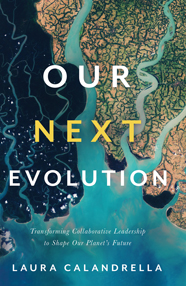
Laura Calandrella is a leadership strategist and consultant and the author of Our Next Evolution: Transforming Collaborative Leadership to Shape Our Planet's Future. For two decades she has worked with organizations across the environmental community to design collaborative approaches to pressing issues. She began her career as a conservation biologist and international development practitioner, experiences that gave her firsthand knowledge of the power of collaboration. Today she guides the growth of sustainability and conservation partnerships, teaching the practices of collaborative leadership. Her book offers a framework for twenty-first-century collaboration built on four leadership practices: cultivating presence, creating space, leveraging diversity, and sustaining dialogue.
📚 Books by Laura Calandrella
Transcript
[0:00:36] MR: The environmental crisis is advancing at an unprecedented pace and scale. The future of humanity is literally at risk. In order to create the change we need, we must work together. But our current approach to collaboration is outdated. To transform our world, we must transform the way we lead. We collectively share the power and responsibility for a more just, inclusive, and sustainable future. In the new book, Our Next Evolution, Laura Calandrella delivers a framework for 21st century collaboration through four interlinked leadership practices. Cultivating presence, creating space, leveraging diversity and sustaining dialogue. These four practices enable us to take collective action in new ways, carving a path forward, toward a future we crave but can’t yet see. In today’s podcast, Laura shares with us how she came to develop this framework, why leadership is so important in today’s world, and how, through collective action, we can consciously and collaboratively shape our planet’s future. Hey everyone, my name is Miles Rote and I’m excited to be here today with Laura Calandrella. Author of Our Next Evolution: Transforming collaborative leadership to shape our planet’s future. Laura, I’m excited you’re here, welcome to The Author Hour podcast.
[0:02:14] Laura Calandrella: Thank you so much, it’s a pleasure to be here.
[0:02:18] MR: Yeah, I’m so excited to talk about this topic. It’s so important and there’s so much to talk about. But before we jump in, let’s talk a little bit about your background and what inspired you to write this book in the first place.
[0:02:32] Laura Calandrella: Yeah, absolutely. My original background was in environmental sciences. I’m actually trained as a scientist and I started my career quite early when I was about 19, I had some amazing mentors that took me into their projects and their research projects. I began my work early in Mexico City, and looking at how the communities collaborated with other sectors to solve environmental issues, that was really my first exposure to working across perspectives to solve problems. I would then continue on to work on almost every continent, looking at the same thing and helping groups work together, often with different perspectives and on issues, environmental issues that were intersecting, social issues, economic issues, political issues. Later, then after my international career, I came back to the United States and started working with the US Forest Service, which is a federal agency that’s responsible for oversight and management of our national forest in the United States. Very quickly, my skills facilitating conversations, understanding the strategy design of bringing multiple perspectives together, multiple stakeholders together that was recognized by the agency. The Forest Service actually has a pretty strong history of collaboration, just because they are so embedded in the communities that they work in. They have some pretty contentious issues that they have to deal with. Over the course of the 10-year career, that was a lot of what I was doing and working on those projects, then kind of moved into wildfire management as well. Somewhere throughout that, I realized that there was something different, there was something that – it wasn’t just facilitating conversations, it wasn’t just bringing people together and working on strategy. There was something about leadership and something about personal leadership and then also group leadership. What I did, it felt like a left turn in my career. I dove right into leadership development training, executive coaching, adult development, positive psychology, anything that I could get my hands on that really talked about how we individually set purpose and vision, and then, how we collectively set purpose and vision to create change. It felt like a big divergence from what I was doing and I kind of felt schizophrenic at times because here I was dealing with environmental issues and then also really focusing on leadership development. I left to start my own consulting practice in 2015 because I wanted to bring those two worlds together and see how we could apply leadership development to environmental issues and what leaders needed to be learning. Yeah, that’s the career history that brought me here.
[0:05:24] MR: Wow, there’s so much to unpack there. Well, first of all, it’s amazing that you said you traveled to every continent really and worked on all of these different issues. What is it that to you, leadership was the thing that stood out and made you feel like you had to take that left turn and put all of your focus and attention there? Obviously, you were dealing with tons of different crisis around the world and you’ve seen so many different things. What was it that made leadership pop out and say, “You know what? This is the most important thing to focus on right now.”
[0:05:55] Laura Calandrella: How I view leadership, Miles, is really something that is both personal and professional and it’s rooted in purpose — the best leaders have an understanding of who they are and what they’re about and what their contribution is to the world. Leaders don’t have to be something within an organization, as I said, there is leadership that we exercise in our own life as well. What stood out to me was that the groups that were most able to create change and most able to create change at scale were those that were clear on what their purpose was individually and collectively and we’re working together in a way that honored all perspectives even when it was difficult. To me, they were operating at a higher level, in my book, I talk about how adults develop, that we do have a way that we progressed, I mean, there’s childhood development and we’re all really clear on what that looks like and what the stages of development are. But there’s actually something that we, as adults do, and to me, that’s leadership. It’s learning how to be more creative in our life to produce the outcomes that we want and that was kind of at the center of everything. How do we create change for ourselves for others and if leadership is the way, let me figure out how to apply that within these environmental issues that I’m working on?
[0:07:21] MR: I love that, yeah. There’s a quote in your book where you say, “The only way to create impact is to examine the issue holistically, systemically, and with the acceptance that the lasting solutions are multi-dimensional.” Just based on that quote, which I definitely resonate with, it sounds like really, in order to embark on those changes, we need people that can do those things, that can look at those problems from that holistic level and lead in a way that they’re able to bring solutions that are multi-dimensional. How can you have that change without leaders that can help instill that?
[0:07:56] Laura Calandrella: Absolutely. I think we’re seeing that right now all throughout our society. Mine, which is in the environmental issues and sustainability and conservation but take a look around at what’s happening in our world, never before have we seen such divisiveness. I mean, at least in my lifetime, never have we seen the kinds of issues rising to a level where there’s a consciousness of them, you know, particularly in 2020. We’re not doing such a great job at coming together to figure it out. We need people who are willing to work with others who they might not even like, which I know it’s a really hard thing to do but that’s how we create change. You have to see it from a 360-degree perspective and we need everyone to do that. That’s especially true I think with environmental issues, which you know, they’re connected to the natural world and the natural world changes all on its own so it’s out of pace and scale right now that we need one another to keep up with the change.
[0:09:01] MR: Yeah, there’s a theme that runs throughout your book. That’s sort of like the intersection between our evolving consciousness, which I’d love to talk a little bit about and then the idea of progress, right? What it means to progress and then, managing our finite resources on earth. That’s a tricky balance I feel like to hold. But tell us a little bit about evolving consciousness, it’s a theme throughout your book, you talk a lot about it. What does that term even mean and what has that look like over the past 50 or 60 years?
[0:09:33] Laura Calandrella: Yeah, the thing that I think is really central to that is that we have seen our natural world and related to our natural work in different ways over time. There’s always been this tension, this push-pull of being in relationship to it for its beauty and its value and also needing it for everything in our life. We depend on natural resources to live day to day and without sustainable use of them, we won’t persist into the future. Let’s go all the way back to the early 1900s, that was a time when we were starting to really protect nature. Seeing it for its intrinsic beauty, Teddy Roosevelt, which we can talk about his own adult development in many ways. But he did a lot to protect national parks, to create national parks, to create wildlife refuges, to create national forest and that moved a little bit into the 70s to really having a green revolution and really understanding the harm that we were doing, so science comes in as an evolution of our consciousness and how we relate to the natural world. Then I think we’ve seen a lot of what I would call conscious capitalism lately, that business has a role to play in influencing these of our natural resources. That started as social license to operate, that it projected values that society was starting to hold, but more and more businesses started to understand that they actually have a business case for using natural resources sustainably. That sort of the evolution of our understanding of the natural world but I think also, you can look around and see that some of the eastern philosophy of consciousness have really come into the west, rather. We’re becoming more aware of our role, our interconnectedness with one another and the world.
[0:11:26] MR: Yeah, so, it feels optimistic in that sense, right? It seems like we have more knowledge than we’ve ever had before, we have more resources. I mean, we, of course are always fighting against the limited resources that we have on earth but us far as the technology that we’ve created were able to do so many more things that we weren’t in the past. With all of that, knowing that and this evolution of our consciousness, do you feel optimistic about where we’re going?
[0:11:56] Laura Calandrella: I do, and I really wanted to keep the book focused on possibility and on optimism, there is a way that we can scare everyone into thinking that the environmental crisis, which it is a crisis in many ways. But that we have none of those resources. When you say resources, what I’m hearing or what I talk about in the book is our internal resources to be able to create change. I think that that consciousness that we’re in a place of really facing – we have a choice right now. We can either evolve, evolve in our leadership, figure out ways to work together in a collaborative manner, learn how to lead together or we don’t. My hope is that there are enough people in all sectors and government and non-profit and business that find that important enough and are committed enough to practicing a new way of being, practicing a new way of leadership and see themselves as creative, in finding new solutions by relying on one another.
[0:13:02] MR: Yeah, and by relying on one another, there is a term that you used for that and its collective action, which I really like and then you have for leadership practices around collective action. So, let’s talk about those and maybe we can shine some light on what it takes to become a better leader and what we need in the modern world. So, what are those four leadership practices that are really at the heart of our evolution?
[0:13:29] Laura Calandrella: Yes, I want to start before we dive into that talking about practices. I very intentionally named them practices. They are not skillsets, they are not capabilities, they are not things that we learned once and check off the list, okay? Now we’re leaders. They’re practices because we will be doing this our entire lives and we’ll be teaching this to one another our entire lives if we’re committed to that journey. That’s also the piece of optimism is that, you know we say practice makes perfect but it takes practice and it will take time, you’re not going to get it right immediately and that’s okay. So, I just want to point that out before I dive into them.
[0:14:13] MR: Yeah, of course. It’s more about the journey, right? Not the destination in that sense.
[0:14:18] Laura Calandrella: Absolutely, yep. So, the four practices, first is presence. So, I talk about cultivating presence and this goes back to something that I said earlier, which is what is our purpose, what are we here to do in the bigger sense of things but when we’re talking about leaders collaborating on this specific problem, it is asking the question what is the compelling reason for doing this work today? Why now? What are we here for? Really grounding into the present moment. The second one is about creating space and we can think about this in two ways. The first is thinking about our physical environment, so how do we create environments that foster inclusivity and build trust and that ultimately lead to engaged partnerships. We also need to create internal space. How do we open ourselves up to being receptive to other people that we may not see eye-to-eye with? And interestingly right, this is what we are facing in 2020. Not necessarily specifically to environmental issues but like we’ve all been impacted by space. We are all learning how to deal with space during COVID.
[0:15:32] MR: Yes, I think both physically space, you know that we’re competing with but then also just living in the attention economy and just having the space of our minds and space to be able to think through complex issues and to concentrate on things and have the space to concentrate on things because when we are living in such an attentional economy vying for attention in every moment, it is really hard to cultivate that space.
[0:15:58] Laura Calandrella: Yeah, so that’s why these practices are interlinked too. If you can, I present them in a linear fashion but they are quite cyclical. You just talked about attention economy and how do we create that internal space. Well, if you have learned or learning how to practice cultivating the presence, then that goes right back to it. So, it’s – these are interacting all of the time and we do have to continue to return to them as we ask ourselves these questions and how do we focus, how do we get present right now?
[0:16:28] MR: Okay, so we got cultivate presence that helps us of course then create the space and then what’s the third practice?
[0:16:36] Laura Calandrella: The third practice, this was maybe one of my favorite chapters to write and also one of the most difficult is leveraging diversity and I talk about diversity as loads experiences but the question that’s at the heart of that is, what are the barriers that we need to break that ensure that those lived experiences are the solution? Not just part of the solution but the solution. I was writing this, I live in Atlanta, I was writing about the structural dynamics that exists within the environmental community and specifically, I write about Robert Stanton who was the first black director of the National Park Service and it is not that I wasn’t aware that Black Lives Matter was happening but it was that that was the night that protests erupted in Atlanta and literally a mile from my house, some of the biggest protests. So, I wake up the next morning through shaken to my core asking myself, “Who am I to be writing about this?” and yet, it’s so important. We all need to be thinking about this especially again within the environmental community when so many lived experiences are — have not been at the table and are more impacted in a lot of ways. You know the use of our natural resources whether that is in the United States or abroad internationally there is a lot of – My early experiences were all working at the intersection of poverty and environmental issues and how do we start to link those and include those work in. So that’s the third one and then the last one is sustaining dialogue and this, so again if we go on linear order this is the last practice because if you have all of those first three practices in place, now you’re at a place of being able to really elevate communication and dialogue is different than discussion. Dialogue is generative, it is something that creates something new and that doesn’t necessarily have to lead to an answer. So, it is really about how do we courageously speak, authentically speak and also balance out group dynamics and pay attention to group dynamics that we’re all as collaborative leaders responsible for outcomes and responsible for one another too.
[0:18:56] MR: Right and by continuing to have that conversation, it allows for the space for things to continue to evolve as oppose to thinking that there is this one right way and it needs to remain that way. I really see now after talking to you really, how these all fold in on one another because as you create more presence, you’re able to then have the space and with that space of then being able to be more inclusive and trusting, you can better leverage that diversity that enables you to, you know figure out what barriers need to be broken that can then lead to that dialogue, right? Then of course, in having that dialogue can help you leverage that diversity and all the way back down. So, it is really interesting how you found a way to link all of these together and kind of build on one another.
[0:19:43] Laura Calandrella: Yeah, it took about 20 years Miles and I think you asked earlier and I didn’t answer the question, you know, what brought me to write this book. I have felt like I Trojan horsed my clients. You know they bring me in to talk about creating partnerships and help them to collaborate and underneath it all what they’re getting are these practices, are these leadership practices baked into the process that I use with them. We need to start talking about these though. We need to be thinking about it. We need to be conscious of it, we need to be conscious that this kind of evolution as leaders is necessary. So, I don’t want to be a Trojan horse anymore. I just want to solve, to know what’s happening and start, begin the process.
[0:20:28] MR: That’s beautiful. Yeah, it reminds me of another part of your book where you talk about the astronaut, Bill Anders and when he, you know, left earth for the first time and went into space, his quote is, “We came all this way to explore the moon and the most important thing is that we discovered the earth” and that’s another theme really throughout the book too and this idea that there’s so much more to still explore and discover and we’re able to do it through a practice like you created. It allows us to look at it through a different lens.
[0:20:59] Laura Calandrella: That quote and that story that he tells is beautiful and I mean he welled up with tears at seeing the earth from a different perspective and realizing the beauty of our home and I think a lot of people think, “Oh gosh, that’s cliché or maybe cheesy” but are you kidding? This planet is amazing, it is beautiful. It is our home and there’s just a deep connection that we can create with it, which we are part of that too. Humans are part of that too so how do we learn to interact in that way and see things holistically be part of a whole instead of these separate entities that creates these us-them or us-other viewpoint.
[0:21:45] MR: Yeah, I couldn’t agree more and I love that, you know after all of the work that you’ve done, all of the travelling, all of the different communities that you’ve worked with, being able to focus in on what’s most important, which you found to be leadership and really, you know, putting all of your work towards that effort. So, thank you in that regard and especially in a time where it seems to me and I would love to get your take on this that just leadership right now around the world. Although there is a lot more talk of conscious capitalism, which is amazing and we can see different businesses doing different things in the world become more green in a lot of ways, what is your take on the leadership around the world and is it of high quality? Are we starving for leaders right now? Are we just being led by the wrong leaders? Are we being led by the right leaders? What’s your take on all of that?
[0:22:36] Laura Calandrella: Gosh, I am sitting in Spain as we’re doing this interview and I was in Italy last week and it’s been good for me to be out of the United States and feel into different cultures. I don’t know that I have a good answer for you Miles. I think that judging leadership is good or bad, I’m not sure that it is helpful. I think that there are many leaders out there that are waiting to be called forward and called into action and I think that that’s just the point that we’re at. I’d say in the book that leadership, our evolution of leadership is not just for us. In fact, it is not even really for this generation. It’s to be able to model something for future generation so that they can step into things more readily and more easily. Again, we have the resources to be able to do this. You know it is not our ability to innovate. So, I struggle to answer that question because, the last few years have been I think really absent of leadership but I also think it’s possible.
[0:23:50] MR: I definitely agree and I think as you said, there are so many leaders waiting to be called forth and you know, given the right prompts and given the right space to do so I think that they will. So, I appreciate you coming out with a book that does that and really calls leaders to action. So, thank you for writing this book and congratulations because writing a book is no joke and I think you are creating something for future generations with it. So, if readers could take away one or two things from your book, what might they be?
[0:24:22] Laura Calandrella: Relationship matters, period, end of sentence. How we stay connected to the natural world, how we stay connected to ourselves, how we stay connected to one another that’s how we change things.
[0:24:37] MR: Collection action.
[0:24:38] Laura Calandrella: Yeah, collective action.
[0:24:40] MR: I love that. Laura, this has been such a pleasure. I’m so excited for people to check the book out. Everyone, the book is called, Our Next Evolution: Transforming collaborative leadership to shape our planet’s future. You can find it on Amazon. Laura, besides checking out the book, where can people find you?
[0:24:56] Laura Calandrella: You can find me on my website, lauracalandrella.com, I’m assuming there is going to be some podcast notes Miles or do I need to spell that?
[0:25:06] MR: No, no, no, we can put that in the notes for sure.
[0:25:09] Laura Calandrella: Okay, my last name is a little tricky.
[0:25:12] MR: It is, anywhere else on the socials as well?
[0:25:15] Laura Calandrella: Yeah, absolutely. LinkedIn is where you will find me more on the professional side of things and then I’m pretty active on Instagram @lcalandrella and that tends to blend some of my personal passions as well as professional but find me either place.
[0:25:32] MR: Laura, thank you for all of the work that you’re doing, all of the work that you’ve done. Enjoy the holidays in Spain and thanks again.
[0:25:40] Laura Calandrella: Thank you Miles, talk soon.
[0:25:43] MR: Thanks again for joining us for this episode of the Author Hour Podcast. You can get Laura Calandrella’s book, Our Next Evolution: Transforming collaborative leadership to shape our planet’s future, on Amazon. You can also find a transcript of this episode as well as our previous episodes on our website at authorhour.co. For more Author Hour, subscribe to this podcast and thanks again for joining us. We’ll see you next time, same place, different author.
Want to Write Your Own Book?
Scribe has helped over 2,000 authors turn their expertise into published books.
Schedule a Free Consult