Kara Yokley: Raising Gritty Kids
Read the full transcriptKara Yokley
Kara Yokley is a data science entrepreneur who balances motherhood and career. She holds a bachelor's degree in applied mathematics with economics from Harvard College and an MBA in finance from the Wharton School. With her mother, Constance Yokley, she co-authored Raising Gritty Kids: Your Guide to Parenting in Times of Uncertainty, which shares a framework for helping children build resilience and grit in uncertain times.
📚 Books by Kara Yokley
Transcript
[0:00:39] Jane Borden: Parenting is easy, said no one ever. And it is even more challenging today as kids face a world that's changing at lightning speed. How do we prepare kids for success when we can't predict what success will look like in the future? By teaching them to be adaptable and resilient, according to Kara Yokley and her mother, Constance Yokley. They have co-authored the new book, Raising Gritty Kids: Your Guide to Parenting in Times of Uncertainty. In it, they discuss the philosophy of organic parenting. And since that approach can sometimes feel a little loose, they also help readers create a framework around organic parenting, resulting in actionable steps toward achievable results. Kara is a data scientist and Connie is an educator. They bring an interesting dual perspective to their work. The book’s advice is informed by extensive research into psychology and social science, as well as loads of personal stories and anecdotes that serve as helpful examples. Kara Yokley joins us today on Author Hour to discuss how to raise resilient kids, why we need this book today, and the rewarding and sometimes revealing experience of working with your mother. I'm Jane Borden. Okay, welcome to Author Hour. I'm so happy to be here with Kara Yokley, author of Raising Gritty Kids. Hi, Kara.
[0:02:11] Kara Yokley: Hi, thank you. I'm so glad to be here.
[0:02:14] Jane Borden: So, first of all, I love this title, as a parent, particularly one parenting during a very trying year. Tell me a little bit more about the title and what it means to you.
[0:02:26] Kara Yokley: Sure. So, the title of the book is Raising Gritty Kids. And it was quite a process to get to this title. I mean, we batted around so many iterations. I mean, I can't tell you how many permutations of organic and resilience and just so many options. And we also workshopped it with friends and family and other people that we thought would have good insight. And we kept coming back to Raising Gritty Kids and for some people, when we would say, like, “What do you think of Raising Gritty Kids?” They would say, “Gritty kids? Who wants gritty, dirty kids?” And it's kind of funny. I mean, I feel like it's the title, perhaps, you either love it or you don't love it. But at the end of the day, I think the idea really of nurturing resilience is so important. And that's really what we wanted to capture. That at this moment in time, we really need our children to be gritty and resilient. And if, as parents, we're able to achieve that, then that should be considered a win.
[0:03:38] Jane Borden: And tell me more about resilience. Why is that an important attribute for a kid today?
[0:03:44] Kara Yokley: Well, so, you know, I feel like we have quite a few challenges that we're facing as a world, right? And the landscape is something we spend a fair amount of time talking about how, at this moment in time, we're existing in a shifting landscape. There are many different things that are changing, people's perspectives are changing, demographics are changing. You know, there's so many things. The emergence of robotics and AI, all these things that could be a little bit overwhelming. And so, in order to thrive in situations where you have so much shifting in a landscape, you really have to have skills and a toolkit that will allow you to take in information and pivot and take in more information and course-correct and all these things. That's really the foundation of resiliency. And if you can be flexible in your thinking and curious and embody these things, you're more likely to have success in an environment that is changing and changing rapidly.
[0:05:00] Jane Borden: Yes. And so, to write this book, you turned to your mother, an educator and a mother. Talk to me about the collaboration and why and how?
[0:05:13] Kara Yokley: Yeah, so it's kind of funny, because I feel like in my academic and professional career, my professional life, I've had fairly natural success. But when it came time to start a family, I felt so uncertain. And just asked myself, “Am I up for this challenge? I don't know.” And part of that was, there's this figure loomed large in my life and that figure is my mom, because she has a graduate degree in childhood psychology and she spent decades working with children and their families, exceptional children, all across the spectrum, and developed educational programs, and not to mention the work that she did with me and my siblings. So, many years ago, I actually asked my mom, like, “What is your philosophy?” And she even pushed back on the notion that she had a parenting philosophy like, “Oh, no. I don't have a parenting philosophy,” is what she told me. She said, “Here's the deal. Raise kids you can live with.” I'm like, “Thanks, Mom. That doesn't help. Really.” And so, this project was really an effort to, on my part, to kind of pin my mom down and say, “Okay, now you're going to tell me all of your parenting secrets.” And I think that I was semi successful in doing that. And I hope that, you know, everybody who reads the book comes away with that feeling as well.
[0:06:58] Jane Borden: And you brought an interesting outside perspective, as someone who works in data science. How did that inform the project?
[0:07:09] Kara Yokley: So, as a data scientist, you know, I spend my days working with massive amounts of information, and data and trying to extract insight and knowledge from that. So, this project was similar in a way. I went out and I read tons of research papers. I read all of these Maria Montessori books, and Suzuki books, and I just vacuumed up as much information as I could, and really tried to synthesize all that information for today's audience. And so, I feel like that's the parallel is, I brought the kind of view that I have, and the system that I approach my data science work with, to this project. And so, one of the things that we did in the book is actually develop a framework and that's also, that's a part of my entrepreneurial hat coming in. And the idea of the framework is basically to provide structure and kind of guidelines, but enough openness and flexibility for people to really customize their approach, and really do what's going to make the most sense for them. So, it's kind of the best of both worlds. And I feel like that's also like this notion of, here's a framework you can apply, is also something that I've brought over from this kind of like data science world. My mom and I did, fairly early in the process, was actually develop a framework. So, I definitely feel that my time as a quant and in working in quantitative fields, has made me structure my thinking along those lines. And so, I hope that as people read the book, that they're also able to use the framework that we've developed as a way to structure their thinking about parenting and also construct a style and method that's going to be unique to their situation. So, there's both the structure, but then also the possibility for really customizing your approach.
[0:09:21] Jane Borden: So, let me ask you, let's back up a minute. Tell me a little bit about what organic parenting means and what it means to have a framework around that?
[0:09:37] Kara Yokley: So, organic parenting is really this idea that parenting successfully involves being responsive. Responsive to your child's needs, responsive to their strengths, responsive to their challenges, responsive to the situations that you as a parent, find yourself in, that your child finds him or herself in. So, that's really the idea, is that no single approach is going to work for everybody. And so really, as a parent, you have to be prepared to course-correct and pivot a bit. And maybe what worked six months ago, you have to switch things up and do things a little bit differently. So, that was really the idea, like really trying to encourage people to embrace a certain amount of flexibility and creativity in their parenting.
[0:10:38] Jane Borden: And that sounds kind of daunting, I feel, the advice to like, pay attention to a child's specific needs, and then respond in the moment. For a parent, it can be frustrating to hear that. So, it's really helpful for you to say, “Okay, well, that doesn't have to be vague. This is what it can look like, and how it can work.”
[0:11:00] Kara Yokley: Yeah, I absolutely agree. And the thing is that, I feel like for so many of us, we have so many different responsibilities, and we're being pulled in many, many different directions. So, I absolutely understand how overwhelming the prospect of something like what we're proposing could be. But the really great news, and this is borne out by research, is that if you do this, not even half of the time, because what they found also is that children on balance are actually pretty forgiving of the times that maybe you're not being 100% the best parent ever. And so, there is some flexibility and if you're just really doing your best, and you're really observing, and you're saying like, “Oh, it seems like maybe this isn't working. And what can we do differently?” And really approaching it with some curiosity, and respect and love, and those are also threads that run through the book, that on balance, you're going to be just fine. And so, that was also really a message we wanted to convey to parents that you can do this, you are doing this.
[0:12:23] Jane Borden: And how beautiful to be writing that with your mother?
[0:12:29] Kara Yokley: Yeah, it really was an amazing project. One of the things that I'm most grateful for is that it really gave our entire family a chance to reconnect and think about all those years, many years ago, as we were growing up in the little house on the south side of Chicago. My mom contributed a number of vignettes from her childhood, we have some stories from my grandmother, who, you know, when she grew up, she was a child of the Great Depression. I talk about my husband's grandmother. So, this is very much one of the things that we really encourage also is this idea of sharing family history and giving children a sense of where they've come from, and the possibilities that may lay in front of them. And so, I feel like this project really embodied all of that. It was a great chance for my mom to go back and have discussions with my siblings, and we really learned so much and shared so much and that really was a gift.
[0:13:44] Jane Borden: Which pieces of advice are you finding are most resonating with early readers, or with friends who've helped you along the way?
[0:13:53] Kara Yokley: So, it's funny. I feel like it's different things for different people. Just to back up for a moment, like the structure of the book is, I mentioned the framework, but it's very much a very practical book. So, we've included what we're calling toolkits in practically every chapter of the book and these toolkits are designed to help take some of the legwork out of going out and finding resources and figuring out how to think about some of the ideas that we're presenting people with and really as a resource for people to go back and revisit down the road. So, it's really something you can go back and pick up later. So, one of the interesting things is that the feedback that we've gotten from people sometimes is very specific, like, “Oh, this specific tip that you mentioned in chapter three, I would have never imagined that I could do X, Y and Z and that's so great. I'm going to do that. I'm going to start doing that immediately.” So, we've gotten a lot of feedback like that, very specific, “Oh, this tip has really changed our bedtime routine.” Or, you know, something like that.
[0:15:04] Jane Borden: I'm interested in the fact, I was delighted to see that beyond the discussion of organic parenting and framework, you also dedicate an entire chapter to money, and another full chapter to parents and their experience in all of this. Do you want to talk a little bit about that choice and why those two topics are important?
[0:15:26] Kara Yokley: Well, so I come out of a business and finance background. So, I feel like, of course, there had to be a money chapter. And I feel like it's one of those things where it can be a really loaded topic and it can be incredibly complicated, because oftentimes, parents are maybe not on the same page when it comes to money or within the broader community, like the value system could be slightly different. And so, really, it's an area where there can be tremendous friction. So, the idea was, let's just put it out on the table, let's talk about it. And really, with this idea that, yes, like people have different values, and they can be equally acceptable. But the important thing is really understanding the values that you as a parent have, and what you're trying to convey to your children and understanding sometimes we have values that are not even necessarily explicit, that we're telegraphing to our children. So, to take a step back, a moment, to consider, “Is the way I'm acting and the way I'm being about money, and around money, the kind of value system that I want my child to have?” So, I felt like it was important to have that message definitely. And then, this idea of having a chapter around parenting and community, and also not losing yourself in parenting, I felt like was so important, because as parents, like I said earlier, that you really want the best for your children. And sometimes that can become all consuming. But the fact of the matter is, is that if you can be solid, whole, complete, healthy, balanced, your child will only benefit. And so, sometimes that requires taking some time for yourself, as well. So, just felt that was really important to make crystal clear, in case anybody is thinking that the route to the best parenting is to totally neglect yourself.
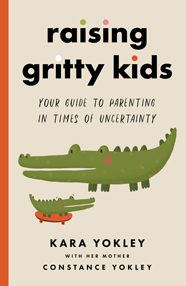
[0:17:35] Jane Borden: Amen. So, you write a lot about landscape, as a metaphor, and more literally, and I love the use of the crocodile, both as a metaphor and on the cover. Can you tell us a little bit more about that?
[0:17:54] Kara Yokley: Right. So, as I mentioned, I did a tremendous amount of research and learning and reading various academic papers, just to learn more about what experts were saying on the topic. And pretty early in the process, I actually came across this paper, it was not about human babies, but it was about crocodile and turtle babies. And we go into more depth in the book about this, but long story short, it turns out that actually crocodiles, they are kind of model parents. And for various reasons that we go into in the book. And so, we kind of say, a little tongue in cheek, but this idea that if you can embrace your inner crocodile, you'll be on the right path.
[0:18:48] Jane Borden: Embrace your inner crocodile. I love it. You also include a lot of personal stories throughout the book. Are those mostly from your mom?
[0:18:58] Kara Yokley: Yeah, so my mom provided a number of vignettes. There were some cases where we actually have perspective on both sides. Maybe, I think, there's a chapter where my mom talks about an experience, I had to spend nearly a month in the hospital when I was five years old. And so, we were able to talk about, we were able to see it both from her perspective, as well as mine, and how that shaped my worldview, et cetera. So, I feel like that was another thing that I really enjoyed about this project was this is a book about parenting, but you are able to get both the parent and the child's perspective at the same time, and I feel like this book is maybe a little bit unique in that regard.
[0:19:49] Jane Borden: Definitely, and they really help ground the advice and examples.
[0:19:55] Kara Yokley: Yeah, absolutely. I mean, I feel like the greatest testament to my mom's system and her way of thinking about parenting is exactly the fact that if you look at me and my siblings, so I have an older sister and a younger brother, we are very different. Our lives, possibly could not be more different. And we still have great relationships with one another and great relationships with our parents as well. And I feel like, especially at this moment in time, thinking about, how do you cultivate individuals who can get along with people who have different values, who have different priorities, who have different needs and challenges is so important. And so, I hope that out of this book, that that will be one consequence of people reading the book and taking some of our ideas.
[0:20:58] Jane Borden: What do you hope this book will achieve? What do you hope the effect will be on each reader?
[0:21:07] Kara Yokley: So, the dedication was, “To a better world.” And I absolutely mean that. I feel like a better world starts with parents making choices to parent their children in a very love forward fashion. We talk about being courageous in your compassion. And so that's what I'm hoping is that anybody who interacts with this book will feel inspired to make the kinds of choices so that future generations really approach the world with that kind of love and compassion.
[0:21:49] Jane Borden: Again, Amen. Let us all hope. Is there one parenting lesson you got from your mom that really informed your approach, or that was a big takeaway for you?
[0:22:06] Kara Yokley: So, I would say, absolutely, my mom is the embodiment of kind of, that responsive parenting. So, she really, for the three of us, her parenting style was a little bit different, actually. And she recognized like, “Oh, well, these are the kinds of characteristics that Kara has versus her brother versus her sister,” and kind of tailored her approach. I think that's what had us be okay, because she wasn't trying to force us into a particular mold or dictate, like, “This is the way it has to be.” And so, it was very much a give and take. We were constantly thriving, pushing boundaries, growing, along the areas that we were interested in, and that made it easier, I think, for her as well. Yes, we had some of the usual sibling blow ups and stuff like that. But I think for the most part, there wasn't a lot of pushing and making and like, “You will do this.” We didn’t have that kind of pressure and conflict in our house growing up.
[0:23:18] Jane Borden: You may not want to speak for her, but would you say that she learned something about parenting from you through the process of writing this book together that might have changed her perspective?
[0:23:29] Kara Yokley: Well, I think certainly, she learned some things about me that maybe she hadn't heard before. Because, I mean, look, this was our 2020 project and we spent a tremendous amount of time talking and working on things. So, I think maybe there were some stories that she hadn't heard before that were maybe a little surprising.
[0:23:57] Jane Borden: No need to say more about it. Kara Yokley, it has been such a pleasure speaking with you, and congratulations. The book is full of curiosity, compassion, and a lot of helpful advice. Again, listeners, the book is called Raising Gritty Kids: Your Guide to Parenting in Times of Uncertainty. Kara, besides checking out the book, where can people find out more about you and your work?
[0:24:25] Kara Yokley: So, the book is available on Amazon. And if you are in need of data science work and want to talk about AI and machine learning and logistics, optimization and problems like that, please find me on LinkedIn. I'd be happy to discuss those kinds of challenges as well.
[0:24:44] Jane Borden: Great, thank you so much.
[0:24:49] Kara Yokley: Okay, thank you. It's really a pleasure.
[0:24:51] Jane Borden: Thanks for joining us for this episode of the Author Hour Podcast. You can get Kara and Constance Yokley’s book, Raising Gritty Kids: Your Guide to Parenting in Times of Uncertainty on Amazon. You can also find the transcript of this episode as well as previous episodes on our website, authorhour.co. Make sure to subscribe to the Author Hour Podcast for more interviews and insights into life changing books. Thanks for joining us.
Want to Write Your Own Book?
Scribe has helped over 2,000 authors turn their expertise into published books.
Schedule a Free Consult