Don Wenner: Episode 645
Read the full transcript
Don Wenner
ORIGINAL
Don Wenner is the Founder and CEO of DLP Real Estate Capital, a leader in real estate investing, private direct lending, construction, management, and sales. DLP has been ranked as an Inc. 5,000 Fastest-Growing US company for eight consecutive years, with an average three-year-growth rate exceeding 400 percent and more than $1 billion in assets. Named one of the top fifteen real estate professionals by REAL Trends and The Wall Street Journal for seven years straight, Don has closed more than $4 billion in real estate transactions. He resides in St. Augustine, Florida, with his wife and two sons.
NEW
DON WENNER is the Founder and CEO of DLP Capital, a leading private real estate investment and financial services company. DLP has been ranked as an Inc. 5,000 Fastest-Growing US company for nine consecutive years, with an average three-year growth rate exceeding 400 percent and more than $1.5 billion in assets. Named one of the top fifteen real estate professionals by REAL Trends and The Wall Street Journal for eight years straight, Don has closed more than $5 billion in real estate transactions. He resides in St. Augustine, Florida, with his wife and two sons.
📚 Books by Don Wenner
Transcript
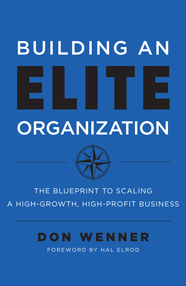
[0:00:38] DA: At the tail end of your company’s startup phase, the same opportunities that generate revenue and fuel growth also bring new challenges. You need to hire and train rock star team members, scale operations, prioritize opportunities and so much more all while bringing on new clients and driving profitability. You don’t have time for theory when you’re growing at break-neck speed. You need a blueprint for profitable scalability and a toolbox of plug and play tools and direction on how to maximize execution. That’s where Don Wenner’s new book, Building an Elite Organization comes in. In his new book, Don walks you through the elite execution system his company and other highly successful organizations used to drive growth and improve profitability. His system will give you the clarity on where you’re going, the insight to know if you’re on the right track and the discipline system needed to constantly leverage every opportunity. Learn how you could leave a legacy and make an enduring impact for decades to come. Hey Listeners, my name is Drew Applebaum and I’m excited to be here today with Don Wenner, author of Building an Elite Organization: The Blueprint to Scaling a High Growth, High Profit Business. Don, thank you for joining, welcome to The Author Hour Podcast.
[0:01:44] Don Wenner: Hey, thank you Drew so much for having me today.
[0:01:46] DA: Don, let’s kick this off, can you give us a rundown of your professional background?
[0:01:50] Don Wenner: Yeah, I’d love to. I entered, I guess the professional world in 2006. At that time, I lived in Bethlehem Pennsylvania, which for those of you who are not that familiar, is an hour north of Philadelphia and I entered the business kind of by mistake and I was a college student at Drexel University studying finance, had worked some internships to companies like Merrill Lynch and BlackRock and McGladrey & Pullen. I actually stumbled into kind of the professional world in a job of selling alarm systems. So, while I was in college and I was working at these various companies, I’d wait tables on the weekends and a gentleman who worked at – would come in to the restaurant I worked at the time, which was actually Texas Roadhouse, yes, I had to line dance, would come into the restaurant, asked me to come work for him and so one day, I sat down and I listened to him, his name was Nathan Robinson and he said I’d make $2,000 a week if I came to work for him selling alarm systems. I knew nothing about alarm systems but at 19, $2,000 a week sounded really good. I said all right, I’m going to give this a chance and basically, what my job consisted of every day was knocking on doors. Homes and residential homes and going door to door and by knocking on a lot of doors and I ended up selling in turn a lot of alarm systems and my first paycheck was $5,280, that was one of my worst paychecks. I was making, for a 19-year-old, a lot of money. Kind of funny story is later, I learned that nobody had ever even made a thousand dollars a week working for Nathan previous but because he gave me that expectation, that’s what I should earn, I think it set that bar that that’s what was normal. I had a lot of success with selling alarm systems, became top sales rep in the country for ADT Security and as great as I thought I was doing, Nathan, in addition to owning the security company was a real estate agent at Keller Williams Real Estate. He convinced me that if I could sell alarm systems, I could sell real estate and convinced me to get my real estate license and enter the world of real estate sales, which I quickly did and entered the real estate industry in October of 2006, which happened to be the peak of the real estate market and my marketing message from day one I entered the market and the real estate industry was, “Your home sold in 68 days guaranteed or I’ll buy it.” That was a great marketing message at the bottom of the market or I should say, when the market was turning and homes were taking longer to sell and things were shifting from a seller’s market to a buyer’s market. There were a lot of sellers who were worried they couldn’t sell their home. We started coming in, helping them sell their home, take away the risk and that quickly led to us stepping in and starting to buy homes and in turn, flip them. Basically, through the downturn of the market, from late 2006 through 2007 and 2008 and 2009, 2010, we helped motivate home sellers sell their home, we flipped homes, we ended up starting a construction company to handle all of our renovations and all of our own inhouse construction work. That grew really fast to the point that we were buying a couple of hundred homes a year that we were flipping and then the bottom of the market came or at least we were near it. The 2011/2012 timeframe, and we said, “This is a great time to build a real estate portfolio.” And up until that time, we were flipping everything and we weren’t holding the assets long term. We started building a portfolio of single-family rentals, multi-family rentals, we got all different types of commercial real estate. We started bringing in private capital that – investing into our investment funds and quickly, we started growing our portfolio, started doing property management and by 2014, we had a hundred team members or employees. We had grown every year by over 60% through our first eight years and we kind of looked up, I’d say, I’m simplifying of course, we kind of looked up in 2014 and said, “Wow, we’ve grown a lot and we are working really hard to put the right systems and structure to handle growth,” but we really realized, we needed to figure out what was the most scalable path forward. We knew we wanted to be focused on workforce housing and making an impact on the incredible crisis that has only grown since then of lack of affordable workforce housing. Affordable to the local workforce. We decided to do two things. One, we started buying larger rental communities and improving them. That brought us throughout the Sun Belt area, throughout much of the United States and then we started lending money to other real estate operators who were focused on workforce housing. We started lending to investors who were renovating homes for first time home buyers and flipping them to investors who were building portfolios of single-family homes or multi-family properties or new home builders. Those kind of investment strategies of buying and investing equity into larger real estate communities and lending to other great real estate operators and helping them scale their business through our elite execution system is really been the path we’ve been on and now, today, we are over 400 team members, 400 employees, we’ve grown every year for these 15 years now by 60% or more every year. We’re the fourth fastest growing company in America that’s been in the Inc. 5000 list five or more times ever, this is actually now our ninth straight year. I’ve had some great growth over the period of time and having a lot of fun at it.
[0:07:11] DA: Now, why was now the time to share the stories in the book? Did you have an “aha” moment, was there something inspiring or something as simple as you just had a lot more time on your hands because of COVID?
[0:07:21] Don Wenner: Certainly not the latter there, certainly not a lot more time on my hands but for those of you who had never written a book before, I didn’t just start this process of writing this book last week or last month. It’s quite an undertaking, this is being the first book I’ve personally written and just started down this path, probably close to three years ago and it really started before writing the book. It started on realizing that so many companies today struggle with growing. They struggle with growing consistently and profitably. I love the saying that, I don’t know who originally said it but Jim Collins says it in How the Mighty Fall that “more companies go bankrupt due to indigestion than starvation.” A lot of businesses find it, I won’t say easy, but find they’re able to grow but growing profitably is really, really hard and I’m going to guess, everybody who is listening to this podcast probably is similar to me and is constantly wanting to learn and gain information and knowledge and if you’re focused on trying to grow a business and you're looking for expertise and insight and guidance on how to do so, there’s so many great books out there and you’ll read one book that tells you the key to growing a successful business is leadership and if you just grow leadership, everything else will be easy and there’s other books that will tell you, it’s all about marketing or developing content or telling stories. Another book, it’s all about management, another book, it’s all about execution and it’s all about being able to run operations and all these great thought leaders out there and all these great books and insights and so forth. The reality is, there’s no one silver bullet and all of that information is – many of the great experts out there are 100% experts in their domain and give very valid feedback but what I found is that, in order to grow consistently and grow profitably, you need to think about your business as a whole and you need a system, you need a plan that ties in all the components of growing a business at the same time. The way we think about it is there’s four quadrants to a business, which are strategy, people, operations and acceleration, which is sales and marketing working together. All four of those quadrants have to grow together, a part of one plan, in order to grow profitably and consistently. That’s what we’ve developed out of necessity here, as we’ve grown, not just one business but we have 12 or 13 businesses here that make up DLP Capital. We’ve been able to grow each of those businesses successfully, growing by significant margins by most people’s standards on average, over 60% a year for 15 straight years and that came through a lot of effort to build the right systems and structure and we call it the elite execution system, which is a disciplined way to go about growing a high growth, high profit business. Since a big part of our world is around helping other real estate operators scale their business and we lend capital to them, we invest equity with them. What we learned over the years is that, when real estate investments go bad, just like most investments, they go bad not because there’s bad real estate. It was due to poor execution and really, because the operator, the owner struggled to handle growth. We set out and we’ve been teaching this elite execution system to top real estate operators for a number of years now, helping them scale. We’ve seen just absolutely tremendous success in doing so. Then also, we have a foundation that we run, called the DLP Positive Returns Foundation and as we support other non-profit organizations, other ministries, we find that they struggle even more so than for profit businesses. We’ve been able to put the right discipline and structure in place to grow and grow consistently. We’ve been teaching and helping a number of non-profits, we were passionate about growing as well and when it came to [inaudible 0:11:13], we needed to put this all together in an organized manner, into a book that could be read by any new team member that joins DLP, that could be read by any real estate operator or employee of the companies that are working with us and scaling their business or the non-profits that we’re working with. A kind of last note there, what led us to write this book is as I mentioned earlier, there’s this big crisis today of workforce, affordable housing, which is near and dear to my heart. The other major crisis that’s near and dear to us and a big focus of our foundation and us as an organization is the jobs crisis and the fact that more and more jobs are being deleted for a lack of a better word in America and around the world due to technology more so than anything else. I believe personally that the government can’t create jobs. There’s no way to create new jobs, especially in this changing environment, other than through small businesses. It’s very hard and we all hear and know the stats of the small percentage of small businesses that actually succeed but it’s a small percentage and that’s simply because there hasn’t been enough clear guidance, insight, direction, system out there to follow in order to grow and grow successfully and profitably. I find it a calling to go and help more companies be able to grow, grow successfully and make an impact on what their product specifically does or the service, but as well as being able to make an impact on their community and the country through being able to provide jobs and support families which this country needs now arguably more than ever.
[0:12:48] DA: In your mind when you were writing this book, who were you writing the book for? You just listed a bunch of companies and a bunch of people you worked with but in your mind, who’s reading this book? Is this for CEO’s only? Is this folks who are working at startups or elsewhere that can have takeaways from the book?
[0:13:03] Don Wenner: Yeah, great question and I’d say the answer to your question is yes. I mean certainly those in the startup situation they certainly can get some benefit from the book and probably anybody working in a business environment can gain some value from the book but the core audience of the book are those who are leaders, you know, executives or owners of high growth small businesses. It might be the owner himself, the CEO but anybody who’s part of the leadership team in an entrepreneurial business. I’d say to narrow that down a little bit more, generally our system, our elite execution system is for companies who already are doing a million or two million or five million in revenue. They’ve already – they have a product or service that the market wants. They’re past the stage of survival where all of their focus is just around surviving day to day and being able to make payroll each month. They have generated some success and now, they’re dealing with the challenges of success. As you start needing to grow, you start dealing with the challenges of communication, of choosing what to focus on, of prioritization, you start struggling with having a clear strategy. You are struggling with handling the growth operationally, needing to build the right systems and processes and instruction. You start struggling, how do you manage the need for communication and running meetings and all of the nuances that come when you start having success, when you now have 10 employees or 20 employees or 50 or a 100. Or system, the elite execution system, we believe, can take an organization from a million or two million in revenue up to hundreds of millions of dollars of revenue. It is probably not the book for somebody working at a Fortune 100 company today but for those in an entrepreneurial organization that’s already having success and is growing, this is the system that will help you help your organization get to the next level and get there faster and more profitably.
[0:14:50] DA: Now, a lot of authors have the idea of the book rattling around in their head sometimes for years even though they’ll even outline the book idea but then during the writing process and sometimes by digging deeper into some of the subjects, you come to some major breakthroughs and learnings. Did you have any of these along your writing journey?
[0:15:07] Don Wenner: The first surprise I had I guess was, in writing this book, is Jim Collins, who I’ve mentioned already once before. I’m a huge Jim Collins fan and Jim sets out, when he writes a book on a four-year research project to research a topic and then, you know, write about his findings, right? His process of writing a book is actually doing the research and figuring out what he is going to write about and what the conclusions are to his dilemma he’s trying to research or analyze such as how to build and maintain a great organization, right? Such as in his book, Great by Choice, which is my favorite Jim Collins book. For me though, when I started on this path of writing this book and I had already been on this journey for 12, 13 years. I’d already been running the elite execution system throughout all of our businesses for many years. It already helped many businesses implement the elite execution system into their organization. For me what actually was surprising is how quickly the information flowed and how much content there was to share and kind of be able to narrow that content down to be manageable in terms of density of content and being able to take somebody from at that stage of a 10-person company or a 20-person company to be able to really follow it as a blueprint because nothing that I talk about in building the organization is philosophical. It’s all very practical, truly as the subtitle says, it’s a blueprint. You can follow it, be highlighting it, going back, referencing and that will give you the guidance along with the free tools we write with the book to be able to truly put this is elite execution system into place. I can tell you that the most challenging part of writing the book, so I thought, you know, I went to this really cool process with the help of Scribe in writing this book and a lot of the content comes out via interviews over audio where I tell the content verbally and so I thought, “Man, it was a lot of work, a lot of effort recording all of this content.” You know, 20-plus hours doing that with my Scribe support and thought, “All right, great,” and then I got the manuscript back for the first time and I realized, “Wait a second, the process just started?” Now, I got to go back and kind of re-read it and edit it down and make sure it’s completely clear and impactful and I just found there’s so much more I wanted to say. So kind of an editing process and being able to make sure this information again is tactical and able to be implemented right away for those hearing it for the first time, I’d say was the biggest challenge.
[0:17:37] DA: Can you talk about – you have a ton of resources on your website and you give away your site in the book. Can you talk about what folks can find on your website in terms of resources helping out along the way in building an elite organization?
[0:17:50] Don Wenner: Yeah, absolutely. What I find is that the book itself is I said, if somebody can go and follow it and you’re going to – I think for anybody who is in the stage of growing a business, you’re going to just have an unbelievable number of nuggets and takeaways and be able to be, not only be able to but really have the desire to put these things in action. Some of the concepts and tools that we go through, they are going to make perfect sense right away. It is finally going to give you the structure to say, “Right now, I know how to go about running meetings or prioritizing or now I have the step-by-step process to go hire and attract the very best people that I need in my organization or to develop those people once they’re in my organization,” but we wanted to make sure that we didn’t just put you in a position where you say, “Alright, this makes great sense and now I can see the step-by-step process but now I need to create the checklist or the document or the tool ot the Excel spreadsheet or whatnot,” to be able to actually put it into your business. I find that that as much as the information is very easy to follow for many and be able to put it into action, just having to take a couple of hours and create a tool to actually make it actionable to put in place with your team can be the difference between you ever being able to do it or not because you never get the time to sit down and create that tool. Then even if you do create it probably you’ll have to go through a number of iterations to get to really where it’s going to drive results the way you want. So what we decided to do was let’s just provide all of the tools that we spent many, many years developing and tweaking and use every day right now in our organizations and so we provide them all for free. Go to dlpelite.com and click on the free resources and download a whole bunch of tools for managing your organization, for driving alignment and developing your people, to laying out clear strategy and direction to what we call the compass, which will help you drive the strategy and communicate that with your team. Many, many other tools. And then we’re also really excited that here within the next few weeks, our technology, which is dlptools.com is the technology, will be live as well and be an actual piece of technology that will allow you to run all of these tools. It is built specifically for running the lead execution system. Even if you choose not to go about using technology, we give you all of the tools that we’ve used for many years and constantly are using and developing right now and as we continue to develop those tools and tweak them, we continue to update and provide any additional tools out to help anybody whether you – frankly whether you’ve purchased the book or not, we want to be able to provide those tools to help make the book and the content most impactful. But any which way we can help somebody grow their business and provide more jobs, make an impact, is a win for us and a win for all of us.
[0:20:35] DA: Now, listeners out there right now who are like, “I’m in. I’m going to buy the book,” when they buy the book, can they expect, is it more of a step by step system that one chapter builds on another in terms of takeaways or is this something were you can read and find little nuggets all over the place but it doesn’t necessarily build throughout the book?
[0:20:55] Don Wenner: You know it’s a great question and I’d say both. I mean number one, the book certainly does build upon itself and that we kind of walk through the process as we see it of how you go about building an elite organization and starting with developing a clear strategy and developing your purpose and your mission and your core values and understanding who your core client is and laying out very measurable goals and growth to finding your big, very audacious goal. Then all the way through developing, attracting and hiring the right people. Developing those people, developing and building leadership within your organization, to then diving into the risks that come from growth and how to go about mitigating risk to then into the operational side of the tools you need in place to handle the growth from tools we call rocks, which are your individual top priorities to wildly important goals or wigs, which are your top goals as a team. Through how you run communications and meetings, all the way through then how you accelerate that process through marketing and sales. But as much as the book is designed as a blueprint of really all the pieces and all the information you need to scale a high growth, high profit business, certainly if you’re in a position right now in your business where you’re saying, “Hey, I really… my number one issue today is I need to be able to execute on our most important priorities or projects and that’s what’s holding us back. I understand I have good strategy and direction. I have the right people, we just are struggling to execute.” Yeah, you can jump right to that, to those chapters where you say, “Hey, we’re executing really great. I am just struggling with generating enough clients and struggling with marketing and sales.” Certainly, you can jump right there but if you are just looking for a piece melders, there’s great books out there on marketing and sales. There’s great books out there on execution. Great books out there on strategy. It is about being able to put all of these pieces together a part of one plan that’s going to generate the consistent growth profitability that if you are listening to this podcast, I am guessing that you are looking for.
[0:22:49] DA: Don, we just touched the surface of the book here today but I want to say just writing this book, which is really going to help a lot of business professionals, it’s no small feat so congratulations on being published.
[0:23:00] Don Wenner: Thank you Drew, I appreciate that very much.
[0:23:02] DA: This has been a pleasure and I am so excited for people to check out this book. Everyone, the book is called Building an Elite Organization and you can find it on Amazon. Don, you gave us your website earlier but besides that and besides checking out the book, where else can people connect with you?
[0:23:15] Don Wenner: Yeah, thank you Drew. I’d also mentioned you could find the book on Audible and I’m a huge Audible listener myself. I read two to three books every week, or I guess you’d say listen to them, on Audible and I always find it most impactful when the author actually recorded the book and you actually get their feel through the book so I did record the book and encourage you to make it actionable to actually listen to it and gain this knowledge to also download it on Audible. You can also go to dlpcapital.com, that’s our main company website and much of it becomes a great place for you to go to ss you go through the book as well because every single thing that we talk about doing in the book, every lesson, every bit of information, we’re actually doing and you can reference and check and use us as a reference guide. Such as, if we’re teaching on how to create compelling job ads, you know, you can go and look at our job ads on our website, how we actually write them and so forth. You can subscribe there to our news and our podcast as well, so you can go right to dlpcapital.com or dlpelite.com and get on our distribution list to see all of our upcoming information and webinars and our podcast to get all of the ongoing tools and knowledge that we put out in the days, weeks, months ahead.
[0:24:32] DA: Well Don, best of luck with the book and thank you so much for coming on the show today.
[0:24:36] Don Wenner: Thank you Drew. Thanks for having me.
[0:24:38] DA: Thanks for joining us for this episode of Author Hour. You can get Don Wenner’s new book, Building an Elite Organization, on Amazon. Also, you can also find a transcript of this episode and all of our other episodes on our website at authorhour.co. For more Author Hour, subscribe to this podcast on your favorite subscription service. Thank you for joining us, we’ll see you next time. Same place, different author.
Want to Write Your Own Book?
Scribe has helped over 2,000 authors turn their expertise into published books.
Schedule a Free Consult