
Jim Sholler's Solved in 7 Un-Retired Him and Helped a Reader Save a Life
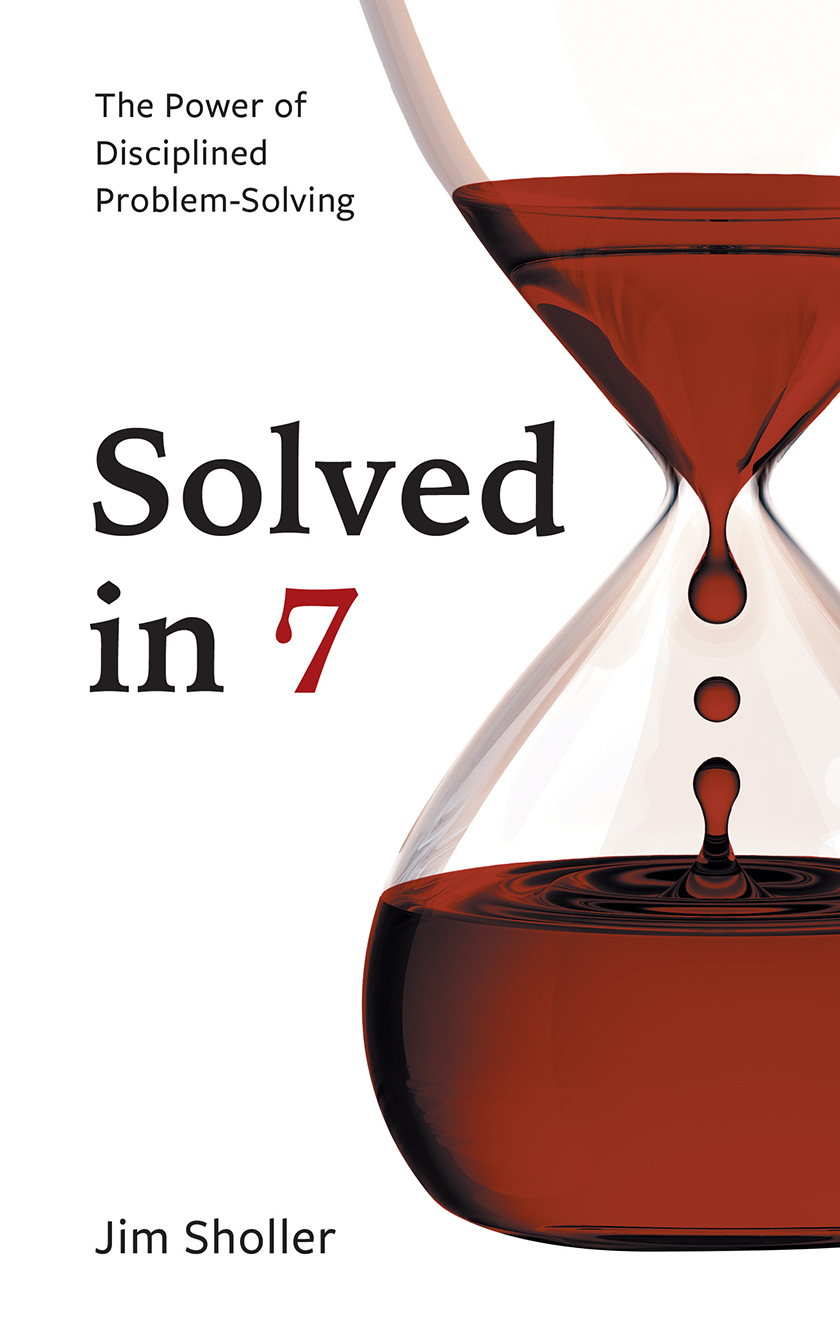

“The title of the book comes from the fact that after 13 years of failure, seven minutes into the discussion, we had a diagnosis.”
Jim Sholler
Jim Sholler spent twenty-seven years at Fidelity Investments as the person they called when something broke, whether or not he had any experience with it. Then he retired, wrote the method down with Scribe Media, and the book un-retired him. Four years after Solved in 7 came out, it has restarted his career, trained a team he was hired to build, and reached a reader who used it to save his father-in-law’s life.
Twenty-Seven Years as the Fixer
Clip · Jim Sholler on verifying the facts at Fidelity · 49s
Jim’s whole career ran on one question. As a kid he asked it so often it drove his mother crazy: how come? He carried it through school and into the workplace, where it turned into a habit of putting every card on the table, holding the emotion out of it, and refusing to move until the facts held up.
At Fidelity that habit became a brand. He was the fixer, and nobody cared whether the problem was in his domain. “When things broke, didn’t matter if I had experience in it or not, they would pull me over and say, this isn’t working. We need you to fix it.” He was not a developer. He earned it by asking questions until people much more technical than him watched a three-day problem fall apart in thirty minutes.
The clearest example is a dispute that had run for weeks. Ned Johnson, the founder of most of what Fidelity is known for, had supposedly decreed that one specific page be the locked-down homepage for every employee. Retail refused. Their 7,000 phone reps were trained so that hitting home returned them to the web application they worked in all day, not a welcome page. Jim was brought in to break the stalemate. He asked one question: did anyone have the request from Ned in writing?
Nobody did. Someone went digging, and what Ned had actually asked for was that every employee see the page at least once a day. Jim proposed a registry setting that opened the page first and let the reps click straight back to their application. Retail said yes, absolutely. He had been in the meeting about three minutes.
“Anywhere between 70 and 90% of problems are solved actually in the stage of verifying the facts, not even problem resolution, but verifying the facts.”
— Jim Sholler
Seven Minutes to a Diagnosis Thirteen Years of Specialists Had Missed
Clip · Jim Sholler on the seven-minute diagnosis · 53s
For thirteen years Jim’s wife lived with a very rare bleeding disorder nobody could name. Her doctors were the head of hematology at Dana-Farber and at Brigham and Women’s in Boston, two of the best hematologists in the world, and they could not figure out what it was. Then one night an ill-advised plasma transfusion caused her to flatline. She was resuscitated. Jim walked in the next morning and told them they had killed her last night, and fortunately brought her back, so now what do we do.
They said they were going to test for factor 13, which is hemophilia. That is when it landed for him.
“They’re trained in diagnosis, not problem solving.”
— Jim Sholler
He asked for a whiteboard and a marker and said he was taking over. They got him both. He built the team, trained them on how the process would work, and stated the problem. Then he drew a T and listed facts on one side and questions on the other: every surgery or major blunt trauma on the left, from his wife’s own meticulous records, and every episode of massive internal hemorrhaging on the right. He confirmed every expert in the room agreed those were facts. Then he did the math, because math is an acceptable fact. Every gap was two and a half to three months.
So he wrote a question on the board: what happens in month three of the healing process? Four minutes in, someone answered that in month three the body has to dissolve the clot, or you get strokes and clots in the lungs. Jim noted for the record that it was the first time in thirteen years anyone had said the word dissolving to him. He erased the board and started again with a new fact.
That question led to plasminogen activator and its inhibitor, then past what her doctors knew, then to a researcher in Michigan who had discovered all of it and had once interned under them. The diagnosis was a plasminogen activator inhibitor deficiency, known to exist only in the Amish and the Mennonites, traceable to the Swiss town her family had lived in generations earlier. Her medical bills in 2000 were over a million dollars. It is manageable rather than curable, and today she takes a certain number of pills when she needs them and Jim calls it a complete non-event. That story is chapter seven, and he put it there on purpose.
From Retired to Published in Nine Months
Clip · Jim Sholler on working with Scribe Media · 37s
The book existed because of that whiteboard. Standing in the hospital, Jim decided that at some point when he left Fidelity he had to document the process, for his own good and for others. Years later he took the early voluntary buyout, and a friend still at Fidelity asked what he was going to do. Jim said, apparently I have to write a book. The friend mentioned someone he knew who had worked with Scribe Media, and in Jim’s telling that friend “could not speak highly enough about it. You have to check them out.”
“I loved everything I saw, had my first meeting and it went from there. Nine months later, I was published.” Seven of those nine months were the actual writing.
He is precise about why it worked, and it starts with the same step one he uses on every problem: build a team. His team was his sister, some family, and Scribe Media. His sister read the first draft and asked whether he was writing a memoir or whether he wanted to train people. He said it was not a memoir. She said, all right, we have to start over.
“The quintessential plug for Scribe here is, I could not have done it. There’s just no way.”
— Jim Sholler
The part he expected to be hardest was not the hardest. Writing put him somewhere uncomfortable, which was the point, but the real work was reconstructing every move and every trick he had used for twenty-seven years without ever writing them down. “The writing part, with [Scribe] helping me, it was easy.”
One editorial note changed the book. The editor at Scribe told him to recap at the end of each chapter, which went against his instinct. As he puts it, he is verbose when he speaks but writes almost nothing, and recapping felt redundant to him. He did it anyway.
“I took [the Scribe editor’s] advice. I do this kind of recap. Then I step away for a day, I go back and read it. And I’m like, wow, this is really good.”
— Jim Sholler
A Thousand Words a Day and a Smoking Keyboard
Clip · Jim Sholler on a thousand words a day · 59s
Jim did not start by writing. He started by outlining. “I started outlining, and really doing an outline of how is this going to look? How is this going to flow? Then when I started to work with Scribe, it kind of, some of the training kicked in.” He also admits part of why the outline ran long was that he was afraid to start writing, until he told himself to stop and start.
Two rules got the manuscript out of him. The first was a hard ceiling of a thousand words a day, whatever state his head was in. The second was a warm-up ritual.
“Every day when I started, I started from the beginning of chapter and read all the way up to where I was. And by the time I got to where I last left off, my hands were just, the keyboard was smoking.”
— Jim Sholler
A thousand words took him an hour and a half or two hours that way. He tried it once, it worked, and he did it for seven months straight. Then he was done. It is the least glamorous productivity advice in the interview and the only one he says he ran literally every day.
The Book Un-Retired Him
Clip · Jim Sholler on the book and the job interview · 69s
Jim thought he was retired. Writing the book changed that.
“The book really forced me to put the process in place, tested. I actually went back to work afterward. I thought I was retired, but I went back to work because after writing the book, it was not only cathartic, but it kind of had me pumping to go back to work and prove that it actually works.”
— Jim Sholler
The plan was to start his own consulting business, which he had never done. His network was everyone he had known at Fidelity, so instead he looked for a company that needed a problem manager and applied through LinkedIn. Then he took a page from the Seinfeld episode where George Costanza decides to do the opposite of his instincts. At the end of the application he wrote that he really did not want the job, explained that he wanted to consult, and offered six months to hire the people, install the process, and stand up the technology. He hit submit and laughed, certain he would never hear back. They called the next morning.
The book came up in the hiring conversation.
“I mentioned the book in the interview process. I can’t say it got me the job, but it definitely helped, but that wasn’t really the biggest part.”
— Jim Sholler
The bigger part came after he started. He had the team read the book and built their training from it, and then the room turned around on him: “And now they’re looking at me to say, so you tell us, how are we implementing this?” He had never thought about the author credential that came with it. “To be able to write it, put it down and then to be able to use that as a leverage to go forward and build credibility was, I just had not really even thought about that.”
Six months became a year, a year became two and a half, and then he and his wife moved to Spain.
“We solved a significant number of major enterprise-wide issues affecting their global clients that people weren’t resolving for years. And in matters of minutes, we were knocking these things out. Very rewarding.”
— Jim Sholler
A Reader Used the Book to Save His Father-in-Law’s Life
Clip · Jim Sholler on his champagne moment · 38s
Scribe Media asks every author to name a champagne moment. Not dollars, not book sales. What would make you jump up and down? Jim says it was easy to answer.
“The thing that will make me jump up and down is the first person who contacts me to say, Hey, I read your book and it helped us solve this major medical issue. And I’m happy to say I’ve actually had that happen with someone who saved their father-in-law’s life.”
— Jim Sholler
That is the whole reason chapter seven is in a business method book. Jim put the most personal story he had in the middle of it because he wanted one chapter that would stop a reader cold and make them think of someone they know who is sick. “I want those people using this to help them.” Four years on, one of them did.
What He Tells Anyone Staring at a Six-Foot Hoagie
Clip · Jim Sholler on the six-foot hoagie · 45s
Jim’s advice for people who keep getting told they should write a book has nothing to do with writing. It is about the size of the thing in front of you.
“It’s kind of like someone walking into your kitchen with one of these super bowl, six foot long heroes or hoagies, depending on where you’re from. And you can look at that and go, Oh my God, I can’t eat that whole thing.”
— Jim Sholler
The answer is a methodology. Cut it into pieces. Invite some people over.
“Don’t get overwhelmed thinking about writing the book. Think about an outline. Think about your team.”
— Jim Sholler
Which is his own process turned on itself. Step one, build a team, and in this case the team was his sister, some family, and Scribe Media. Step two, educate the team, except here the team was educating him. Step three, write the problem statement, and for a book the problem statement is the outline. Give it however long it needs, he says, because working the outline keeps sending you back to find things you would otherwise have left out.
He is retired again, living in Spain, and he has read his own book more times than he would like: “I’ve read the book a painful number of times now.” But the process that took thirteen years down to seven minutes is on paper, where a stranger can find it and use it on the worst problem in their family. That was the point, and it has already happened once.
Ready to Write Your Success Story?
Join 1,600+ authors who have published with Scribe Media and transformed their careers.
Schedule a Consult
Course
Write and Publish Your Best Possible Book
Six modules. 28 lessons. Everything Scribe has learned helping 2,000+ authors, organized into the same process we use with our professional clients.
A Wall Street Journal Bestseller
The Scribe Method
No catch, just everything you need to write, publish, and own your book.