Doctor Incorporated: Tod Stillson on the Book That Catalyzed a 6,000-Member Community
✨ Episode Summary
⭐ Top Moments
- One book, three businesses, three years. A book Tod never expected to monetize catalyzed a 6,000-member physician community (the Physician Entrepreneur Academy), a six-figure coaching business, and ChatterX, a multi-million-dollar on-demand telemedicine company, all downstream of a book that launched in 2023.
- A book is an igniter, not a product. Tod reframes what a book even is: “It’s not just a product. It’s not just the endpoint. It’s almost like an igniter.” It is the peer-to-peer case for why an operator with a methodology should get it on paper.
- Perfection is the enemy. His advice to the doctors still on the fence, and the fear he says keeps most of them from ever writing: “Just don’t let perfection be the enemy of the production or contribution you wanna make.”

Tod Stillson
About the Author: Tod Stillson MD is a practicing family doctor in the midwest who loves his job. He operates his own PC through an employment lite agreement with his local hospital. You can follow him at www.doctorincorporated.com and subscribe to his regular YouTube and podcast episodes. You can also join his employed physician community on Facebook at “The Employed Physician’s World”
★ Scribe Case Study
Tod Stillson's Doctor Incorporated Catalyzed a 6,000-Member Community and a Multi-Million-Dollar Company
Family physician Dr. Tod Stillson wrote Doctor Incorporated to show doctors they could own their careers. It catalyzed a 6,000-member community, a six-figure coaching bus…
📚 Books by Tod Stillson
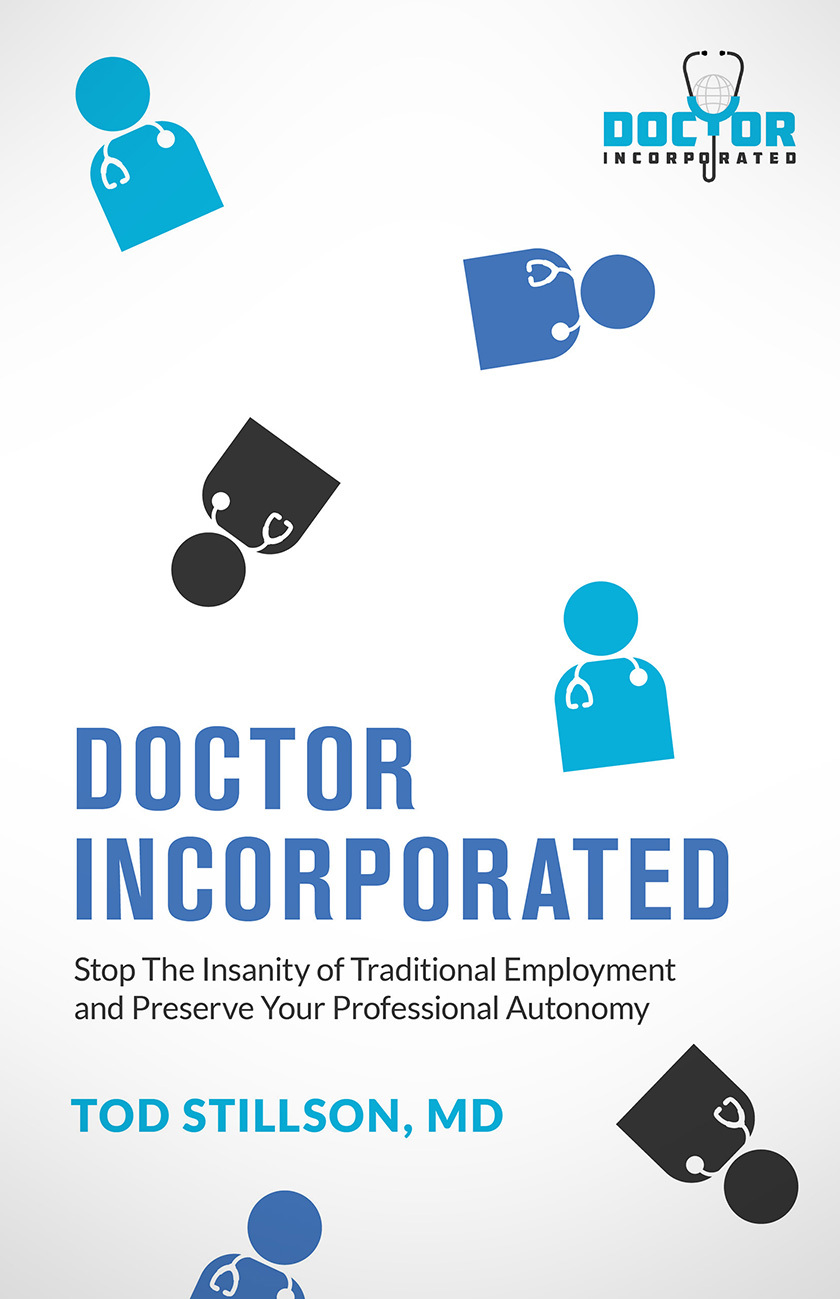
In this episode of Author Hour, Eric Jorgenson sits down with Dr. Tod Stillson, MD, a family physician in rural America and the author of Doctor Incorporated. Tod shares how a single book about transitioning from employed physician to independent contractor became a catalyst for the Physician Entrepreneur Academy, now nearly 6,000 members strong, a six-figure coaching business, and ChatterX, a multi-million dollar on-demand urgent care telemedicine company. Tod talks about working with the Scribe team, the perfectionism that keeps most doctors from writing, and why he sees a book less as a product and more as an igniter for everything that comes next.
Transcript
Doctor Incorporated: It just sort of compounds, you know, one person hears it, another person reads it, another person shares it, and it just sort of keeps rolling into a life of its own. It led to, I do some international speaking for some continuing medical education companies related to the work that I do. Physician Entrepreneur Academy related to writing the book, all of those things just bring credibility. It's just very interesting, Eric, how it all sort of grows and mushrooms and just sort of becomes a life of its own, honestly. I'm always humbled by the people that say, hey, I read your book. I'm like, really? You read my book? That's pretty cool. And if you're out there listening to this and you're on the edge and you're like, should I or shouldn't I go for it and let the scribe team help you? They really do a great job.
Eric Jorgenson: Todd, would you give us a little bit of a background on your career, your life that led you up to the moment of realizing you needed to write a book?
Doctor Incorporated: Yeah. So I have been a practicing physician in rural America for now 30 years, but back at the time that the idea of the book came about about a decade prior to that time, I transitioned to from traditional employment as a doctor to an independent contractor. And that journey was very beneficial to me because of how it reduced my own sense of burnout, my own sense of passion about the work I was doing. And I was working for the same hospital. I just wasn't working as an employee. I was now working for myself as a contractor for them. From the standpoint of the whole community, it looked like I was still wearing the team jersey. Everything was the same. All the work was the same. But now I was an owner rather than an employee. And that mindset shift dramatically changed my sense of well-being, my financial well-being, as well as improve my just general outlook about the marketplace for medicine. So I had this great positive experience and I thought to myself, there's a lot of physicians that don't know about this, that they're not aware that this is an option. They're just kind of blindly doing their work, got their head down, being the best employee they can be and burning out in the process. And so it just kind of was one of those moments where it's like, I need to tell the people about this in a book. I'm an avid reader. I've always been an avid reader for many, many, many all my life. And I just thought this is the moment to write something that I can share with my tribe that could potentially show them what I did and maybe it'll help them.
Eric Jorgenson: Interesting. How did you know that that was a good path for you? Did you have a mentor? Did you read a different book?
Doctor Incorporated: What was the inspiration? That's the whole point is that I didn't read a book because there are no books out there about it. I didn't have a mentor because there aren't a lot of business mentors for physicians out there today. There's a huge gap there. And so that really was the reason I wrote the book. I mean, I talked to physicians here and there, but I know, I knew that this was a book that could potentially change the life of a lot of physicians if they became more aware of it as an option, being independent in the marketplace during that swath of time. I mean, they're just, and it's still the case now, 80% of doctors are employed by large healthcare employers. Only 20% are independent. and that number is continuing to shift a little bit. There's a little pendulum swing back now towards independence because of books like I produce that now doctors are beginning to see, hey, this is an option. That leads me into what happened to me after I wrote the book, which I know will probably be a question downstream, but I created a whole business around that that has been quite successful because Really, I scratched an itch that existed and kind of grew out of that.
Eric Jorgenson: Yeah. What changes when you shift from employer to independent contractor, owner of a business that's sort of serving a hospital? What are the shifts that you found so beneficial?
Doctor Incorporated: There's two big shifts. One is your professional autonomy. Now you get to make the decisions about how care is delivered and you get to make the decisions about even the construction of how you work, where you work, what the call is and all the responsibilities. You're no longer a corporate citizen in the cog of their big wheel. you're an actual independent contractor that has chosen to sort of be a cog in their wheel, but you can engage in that on your terms, not on their terms, okay? And when you do that, there's a couple of things that happen. First, there is a mindset shift that happens, Eric, and you begin to think not like an employee any longer, you start to think like an owner. And when you start to think like an owner in the medical marketplace, you begin to see that the opportunities for doctors in an age and era when there's a doctor shortage, there are massive opportunities for doctors in the marketplace to take their professional skills and use them in a host of ways. And not just talking about your physical skills, like I deliver babies, you can't do that online. But now we have telemedicine, right? You have a host of knowledge base or KB based things that you can do. And I created a software company for medical software company out of all of the aftermath of this too, because you begin to see and have visibility of what the options are. So that was one. And then the second is financial. When you begin to understand what your real marketplace worth is in the marketplace, you begin to get paid really what you're worth. And when you become an independent contractor and an owner, you start to value yourself in a different way than corporate employers value you, okay? And you can actually earn a little bit more money. And then the third little sidebar of that, I don't know how you organize, Eric, but if you're an independent contractor, From a tax efficiency standpoint, as a high income earner like a physician is, you can do a whole lot better in reducing your taxes significantly as an independent contractor than as a W-2 employee. I always say if your W-2 employee is a doctor, you're a sitting duck, you're just kind of stuck and you're going to pay a lot of taxes that can range anywhere from 30 to 50 percent depending on the state you live in.
Eric Jorgenson: Yeah, that's a very, I was expecting, I was waiting for that shoe to fall because that is the one that I knew was coming at some point.
Doctor Incorporated: Yeah, it's a reality, okay?
Eric Jorgenson: Oh yeah, absolutely. So what were your expectations sort of going into as you were having this epiphany? Like, all right, I think there's no book about this exists. I've had a life transformation. I want to help my community. How did you arrive at book and what did you think that was going to be like?
Doctor Incorporated: Yeah, so if I were to kind of backtrack my journey, it kind of became almost like a diary first, a look, a journal, a cathartic journal, if you will, sort of, sort of outlined and just self reflection and thinking through and then it began to coalesce around concepts and ideas, i.e. chapters, right? And then I thought to myself, I need to share this with a larger audience. And I really thought about it just more, not even in a business sense, just in an altruistic sense. I just looked around and saw so many physicians just shoulders slumped, head down, doing their work on the hedonic treadmill and weren't enjoying medicine and thriving in it the way we should be thriving in it. And so altruistically, I thought I need to get this book out so people can know that there's another option, sort of a different space. And I was modestly thought it might help a lot of people. And that was the mission. It wasn't about making money. It wasn't about what I was going to pivot into. It was really just about helping my tribe.
Eric Jorgenson: And was the journey of writing easier or harder than you thought it was going to be?
Doctor Incorporated: A lot harder, much harder. Again, having been an avid reader and understanding how books are written and all that sort of stuff for a long time, it was hard because you kind of have to learn how to get rid of the catharsis and really build it into a story. And so I remember this vividly, Eric. I mean, I had my kind of my i would call it the cathartic manuscript written i thought it was really good you know like really this is great and then engage with scribe and you know you start to start the process with a real professional editor and somebody who just like a coach they're not always your best friend right because they're not going to say this is wonderful they're going to kind of come at you and ask critical questions And, you know, as you go through that process, you kind of begin to realize, oh, if I really want to write a book, I got to go about doing this a whole different way. And I got a lot of rewriting to do. And so that's what Scribe brought to that professional quality of coaching, support and process. that truly allowed me to walk through the tracks. And it took a lot of work on top of that. I remember my wife would say to me, because I would get out of work full day, I come home at work, and I'd really just go to work on this in the evenings. And I mean, it was very common, I worked till midnight, working on it. And she would always kind of say, man, I'm glad, I'll be glad when this book's done, because this thing is like a passion project for you. But it takes that sort of level of dedication to do it. And the Scribe team were just wonderful in walking you through the process.
Eric Jorgenson: That's fantastic. I'm glad to hear you had a good experience. And I wonder how you arrived at Scribe in the first place. There's a lot of
Doctor Incorporated: A lot of options out there. Yeah. Yeah.
Eric Jorgenson: So I did my research.
Doctor Incorporated: Yeah. I did my online research for that in terms of identifying and profiling what I thought would be a handful of options and then sort of did a little bit of reviews, you know, kind of checked in what other people said and what their experiences was, and then interviewed Scribe as part of the process. And I really liked how their process was laid out. I thought it was not sort of just the, not the cheap version of doing it, but not the high end version of doing it. It was kind of right in that sweet spot, a bit of for entrepreneurs, self, sort of people are used to do it yourselfers, but yet doing it with enough professional structural around it that you're just not going to go off the rails or get stuck somewhere. They were just right, honestly.
Eric Jorgenson: Awesome. Love to hear it. Tell me about some of the creative evolutions that the book went through as you worked. You come in with what we call a vomit draft, your first draft of just get it out of your head and then we have to do the hurt your feelings edit where we hurt your feelings before we let you publish a bad book. Did your vision for what the book was going to be change at all through the process?
Doctor Incorporated: Yeah, kind of did actually. And even I would say one of the questions that always comes up is like the title of the book, right? Like, what are you going to call your book? Because that kind of comes back to the very germane subject of like, what are you writing about? What is it that you're trying to communicate here, right? And the title, and I just wrestled and wrestled and wrestled and wrestled with that title. And mine was at the end of the day, now looking back a few years after I did it, I would have changed the title i like the main title doctor incorporated but then the subtitles too long my wife tried to warn me of that at the time and she was right and i was wrong. Is this often the case but but i want to explain explain what the book was about which is you know. It's all about autonomy and preserving your autonomy in today's marketplace. So I wanted if somebody looked at the book title, I wanted them to know what it's about, not just after incorporated. But nonetheless, yeah, that was that took a lot of effort and time with the team just to massage that out to ask those reflective questions and then tie that into. you know, each chapter, right, in terms of the theme progress and the arc of where this book is going and how it's being managed. And yeah, and so kind of reducing the volume of the book is another thing that, you know, you kind of get into with your editors, right? That sometimes they're like, this is too much. And you're like, but, but, but, but I like this. Like too much. What are you going to cut? Right?
Eric Jorgenson: Yep.
Doctor Incorporated: And, but it's good. At the end of the day, that process is really beneficial because the end product is much more professional, much better, much more readable and so forth. And I got to say, after I put it out, I got wonderful reviews and, and really, honestly, each physician, most physicians that read it, when I talk to them face to face, here's what they say. They say, this is one of the best books I've ever read. Now I say that not because I'm one of the greatest literists in the world, I say this because a physician reading a book from a physician about physician life, like they resonate with it. Like, boom, it just, it's like you're speaking into their life, right? So the non physician reading it might go, yeah, blah, blah, blah. But the physician, they're like, Oh man, you are right on target. And so I got there from the help of the scribe team. Okay.
Eric Jorgenson: It's always really powerful if you can make a book feel like a conversation. This is a great example of a book that I'm sure you had many dinnertime or coffee shop conversations with doctors in your life that were like, how did you do this? How are you so much better off? What are all the benefits you're getting? You've had this conversation so many times. You've seen the epiphanies people have. You've felt the relief. um you know wash over them as they feel recognized and seen and understood and that there's a solution to their problems and so if you can maintain that tone and that packaging and really like create that transformation to make it feel like a conversation that you can have you know thousands of times in parallel whenever the reader's ready for it that's a really powerful book and i think it makes a lot easier to to conceptualize the writing process rather than trying to you know, project something out into the, you know, for thousands of people.
Doctor Incorporated: Yeah. And the end result of that was, which I really didn't expect, but it's about the end result was because of the, after the publication and the continuous conversations, the book really became a catalyst. for the development of the Physician Entrepreneur Academy, which I started, as kind of the support structure then that was part of the ongoing conversations and the ongoing support structure that the physicians who are reading the book wanted to have. And that has grown tremendously over the last three years.
Eric Jorgenson: And did you anticipate, was that part of the plan? Was the book sort of born to grow this business or the business was an outcome of the book just existing and people asking for more help?
Doctor Incorporated: It's really the latter is more the outcome of the book. I had some idea. I think I had some idea that I probably have a website and just a simple sort of thing to do. But what I didn't realize is that physicians were going to want to meet with me talk to me get coaching from me have courses from me create content blog post each day from me all the stuff that kind of comes with operating an online business that supports physicians and you know it's grown to almost six thousand members now that i have in my physician community And, um, you know, I write, I write a blog every other day. I was doing it daily and cut back to every other day just cause doctors get too many things in their inbox. But anyhow, it's just grown tremendously and I continue to produce assets. And quite honestly, it's a six figure business for me that I didn't expect coming out of it.
Eric Jorgenson: That's incredible. And it's just, I mean, I normally ask like, what was the most surprising part of your book being out into the world? What unexplained good things have happened? And for you, a six figure business just sort of emerged from the problem that you identified and the book being out there to solve it.
Doctor Incorporated: It did, I mean, and it continues to happen. It just is very interesting, the swirl that happens, the validity, the sort of strength you have and authority you have as somebody who's written a book that, in the marketplace, is a little bit different. Just last night, I had somebody reach out to me on LinkedIn who said, hey, I read your book about a year ago. I saw some of the stuff you got going on, and you want to be a part of my podcast, right? And so those are examples of the networking and the relationships and the things that happen. And I don't know this position really well. I mean, not on a personal basis, but but because you write the book and because you have the other platform, all of a sudden, these doors of business growth and networking continue to develop. So I like to think of a book in that context. I'm sure you guys market it in this way as a catalyst. OK, it's not just a product. It's not just the endpoint. It's almost like an igniter. that happens. And I would say on the other end of that spectrum, Eric, I just want to bring forth, there's this thing that happened inside of me that I didn't expect to happen. As I continued to develop my own sense of awareness and authority and sort of eagerness about being an entrepreneur, just because of talking to doctors continuously about this, my own capacity to become an entrepreneur grew and my understanding of the marketplace grew. And that led to me to the to become a developer of a medtech product that's called ChatterX that is an on-demand urgent care product. Okay, very novel, very, very new to the marketplace. And I'm excited about that and sort of a new version of being a doctor, if you will, a more online and telemedicine version. But that all happened back to the seeds of the beginning of this. If you go all the way back, I was an employee doctor, just punching the time clock, doing my job, being a good doctor in a rural space. And then I transitioned into an owner, right? Then I'm like, I need to share this with people. And then I'm like, wow, there's a lot of opportunities here. And it just continues to mushroom and grow. And you know, Cheddar X multi-million dollar company that really is just the result of that origin story.
Eric Jorgenson: It's amazing when you, you know, once you find out you can, you can make money one way, you know, you realize you can make it a million ways and any sort of opportunity leads to the next.
Doctor Incorporated: I can't tell you, and I can't tell many doctors that I coach through the Physician Entrepreneur Academy, I call it the light bulb moment. It's the moment they transition to being an owner and they start thinking and looking at the marketplace and the business opportunities in a different view, in a different light. And I can't explain it any other way than when you become an owner, you start to look a little differently in the market. that that light bulb just ignites and they just start, it's like opportunities are everywhere. And it's like they were invisible to them when they were employees. Like they didn't even know they existed. But as soon as they exist and they begin to have that, man, it's exciting. I just love talking, just like we're doing, like just talking to them, coaching and just supporting them and watching them thrive. It's always been my philosophy and belief that thriving doctors make their communities better places. They just do. They're altruistic people. They tend to do a lot of good. They look for ways to do good. And so really every community is a better place. You have a thriving position, honestly.
Eric Jorgenson: I love it. And I have the same belief about entrepreneurship, just changing how you see the world. And for context, for people listening, your book is barely three years old. It launched in 2023. So all of these things that we're talking about have happened in the last three years. A six-figure business and a seven-figure business sort of downstream of the community that came out of this book being out in the world. Was the book you're sort of coming out of being like the first time you built reputation for expertise in this topic?
Doctor Incorporated: Yeah, yeah, I would say it was definitely my coming out in that context. And it was also, I guess, to be transparent. In the book, when you read it, I share some real numbers, some real life numbers of my economic changes. And there's some transparency that comes with, you know, sharing your financial life with the world, right? And so, but in that context, yeah, coming out party where it's like, I don't need to be ashamed to tell people that I did well, I succeeded, you know, as a primary care doctor, eventually earning a million dollars a year as a primary care doctor, which is unheard of. How does that happen? Right. Well, it happens because you pivot into ownership and you begin to see the value of your professional services. To be fair, I'm a We're a family doctor who's just a do-it-everything, you know, young call 24 hours a day, deliver babies, do surgeries, do all this stuff. But when you begin to monetize that and think about it and break it down into sections, the numbers add up pretty quickly in terms of your real value in the marketplace and it was it was a coming out party from the standpoint of being transparent about that okay i'm not somebody to kind of a lot being a quote millionaire earning lots of money i'm not motivated by that personally i'm a missional guy not a money guy okay and so that's what drives me But just exposing the way it can be done to people is really enlightening. And so that's kind of the purpose of the book was inspiration. And you can do this too.
Eric Jorgenson: Did you have any sort of platform when you launched the book? Had you been building a following on any platform or email list or anything like that?
Doctor Incorporated: friends and family, that's it. Just, hey, I'm gonna write a book, you know? And you just have friends and family that you just sort of gather. I remember my, this is part of the process, subscribe, right? Like, who are we gonna send this to? And I remember thinking to myself, wait a second, I'm writing a book, but. who's gonna really know I wrote a book unless I tell people that I wrote a book, right? And then they're like, well, you know, you gotta assemble people around you. We gotta send them emails. And so I did the best I could to gather all these people, friends and family, and there was about a hundred, a modest a hundred. And I'm like, well, I'm going to write a book that's going to end up in an echo chamber somewhere. And this is not going to go anywhere. Right. And so it really was a quite modest beginning, but one that was with enthusiastic passion for trying to get it out to people. And so it kind of mushroomed from there though.
Eric Jorgenson: And how many of those first hundred were physicians were in your sort of target readership?
Doctor Incorporated: Less than 10%.
Eric Jorgenson: Less than 10. OK, so 10. So you started you wrote a book and you handed it to 10 people in your target market. And yes. And what happened from there? I mean, at this point, it must be thousands of people have read it. How did you how did you keep it going?
Doctor Incorporated: I kept it going by just the good old handshaking network of, hey, you know, I wrote a book and, you know, this is kind of an interesting thing. You should check it out sometime. You know, I might text somebody or, and you also put it out on the web, right? That scribe helps you build a book landing page, right? And so you try and funnel people towards that and all that sort of business. And then it just sort of compounds, you know, one person hears it, another person reads it, another person shares it. And it just sort of keeps rolling into a life of its own. It led to, I do some international speaking for some continuing medical education companies related to the work that I do with Physician Entrepreneur Academy related to writing the book. All of those things just bring credibility. It's just very interesting, Eric, how it all sort of grows and mushrooms and just sort of becomes a life of its own, honestly. I'm always humbled by the people that say, hey, I read your book. I'm like, really? You read my book. That's pretty cool.
Eric Jorgenson: This is probably a great example also where, you know, I was talking about Amazon as a search engine. Like it is one of the top five search engines and people don't think of it that way, but they do often go there to try to find a book to solve their problem. Probably the way you did when you were sort of first wrestling with this, I don't feel great about employment. And you went looking for a mentor or something and you're like, no book exists about this. And so there's probably people having that epiphany, sort of searching for a book about this. And now there is one and you're the guy and they sort of find their way into their ecosystem, which is just a very interesting example of like, there's no niche to niche. And, you know, new people are being sort of born into your problem every day. This is David Ogilvie's thing of like, You're advertising to a marching parade, not a standing army. And so you can keep standing in the same place, saying the same thing, and new interested people will arrive every day. And you've been compounding that for only three years, I can't believe. The same problem will exist in 30, and you'll probably still be at it.
Doctor Incorporated: It's so true, and as I kind of mentioned to you, I can speak physician language here, right, and purpose. Again, it's kind of, employment's bubbled up to about 80% now of doctors are employed, traditionally employed. About 20% are sort of independent. And now the pendulum is starting to swing a little more back towards independent so it's very interesting as I continue to develop the physician entrepreneur academy more and more physicians are looking to enter the marketplace as independent doctors because they know it's possible there's been enough people like myself the book and others that are speaking to it that are like you know you don't have to sign up to be an employee and give your soul away you can you can do this in a different way and so that's even growing and that's why my blog in my community for PEA is growing every day, honestly.
Eric Jorgenson: Did I understand you that you have a different level of sort of autonomy around care decisions as an independent doctor?
Doctor Incorporated: So let me just back up and say, before you kind of go too far down that road, as a good physician, and I'm a family doctor, okay, and so we do everything, and especially in rural America, do everything. But I do guideline-based medicine, all right? So I mean, I practice at the highest level. I feel like if I were at the Mayo Clinic, Duke University, MD Anderson, SlumKettering, you name it, you're gonna get the same level of care for me in rural America as you're gonna get in those places because I follow the guidelines. However, when you work for an employer of a large hospital, they have their own sort of recipes, okay? And they have their own sort of ways that they want you to do things, which are not always, there can sometimes be at odds with how you deliver medicine to the individual basis, okay? And so when you're an employee, You don't have the latitude to make those decisions. You got to do what the team says. You got to follow what your employer says. That's part of the deal. They now own your decisions. Okay. And yes, in theory, we're all growing in the same direction, but when you get to do it as an independent contractor, you still are going to comply with those guidelines, but you get to have a little bit more power to color outside the line, so to speak, than what your employer's trying to get you to do.
Eric Jorgenson: Yeah, well, I asked, I just did an interview last week with another one of our authors who experienced a similar kind of itch. And his answer was to set up an independent direct primary care to sort of leave the hospital system entirely because he was, he was feeling pressured to make quotas to prescribe certain procedures or certain drugs. And he was like. F this like, this is not what I got into this for. This is ethically wrong. And he wouldn't be a part of it. And so it's interesting. I'm, I'm hearing, you know, sort of your, your solution of like, I still like being a hospital doctor, like these people in hospitals still need doctors, but I don't want to have to comply with this sort of machine. I want to go by my own internal compass within the guidelines of the practice.
Doctor Incorporated: Interestingly, one of my partners over the years, he chose to go the direct primary care route. So he's in our community, same little rural community, but he did his own direct primary care practice. That's one option. I chose the option of sort of the mechanics on the inside, which are how the contract is aligned being completely different in how I operate, having a little more autonomy, but on the outside to the community, to the clinic, to the patients feels the same. Hey, Dr. Sillson didn't change anything. I called the team Jersey. I'm still got the team Jersey on. I didn't change anything. And doctors don't even know that's an option to be very frank, Eric. They don't, they're just like, they think it is a sort of a, dichotomy of either, Hey, I'm going to go work for the hospital. I'm going to go work for myself independent out in the community, direct primary care, private practice, whatever you want to call it. What they don't know exists is what I did, which is you continue to work for the hospital, but you do it as a contractor, not as an employee, which it's not as visible as sort of it's not as visible system.
Eric Jorgenson: So yeah, it does take a
Doctor Incorporated: But from a mindset and mechanical, financial, all the other stuff, you kind of get the security of that job and you get the security of what you've poured into with patients for years, but yet you also gain the benefit of being independent.
Eric Jorgenson: Fantastic. Love that. Okay. Is there any other, so as you think of yourself, maybe four or five years ago, you were sort of considering heading off on this book writing journey or maybe in the early stages of flirting with it. What advice would you give somebody who's five years kind of up the road from you and just considering setting off?
Doctor Incorporated: Well, first of all, perfection can be your enemy. So if you're thinking about writing a book and you're like, I am not an author. I don't know how to do this. I'm not sure. And I can speak to physicians in particular. We tend to be very perfectionistic, right? That's the nature of the work we do. Exactly, I know, right? That's what you want to have. But that often, that fear of failure, that fear of not doing it exactly right, number one keeps doctors from going independent. They're afraid, oh, I don't have the business-savvier sense to do this. Can I do it? That's a big obstacle. It's the mindset. Same thing with writing a book. I think there's a lot of doctors that have much to contribute when it comes to the literature. Doctors are just amazing, fascinating people. and they have so much but yet that fear of perfection sort of blocks them and keeps them. And so that really comes back to a team like Scribe, right? You hire a team that walks you through the process, supports you when it makes it better, and helps you move that from an ideation into an actual structured product They're fantastic at it. And as you know, I mean, I don't have to advertise this for you. I mean, you can go anywhere from you're writing most of it and they're just coaching you to even a sort of called ghost writing feature. If you're like, I got the idea, I just can't get it down on paper. Well, let one of your team members help you do it, right? There's all menu of options. And so just don't let perfection be the enemy of kind of the production or contribution you wanna make. And, and for me, it turned out to be a pivot point to more business, right? Like that, that's kind of what the result was. Uh, it doesn't always have to be that way. I think, you know, a book is an investment and it takes money to do it. So it's not something to be done lightly. And so you can think about it as an ROI if you want. But from my story, I can tell you, I really wasn't thinking about it as an ROI and it sure did turn out to be a pretty good ROI.
Eric Jorgenson: Yeah. This is, this is a fantastic story. I think one that many authors will learn from and look up to and hope to emulate in their own way. I hope they do. I love that it was, you know, it's the reward for a leap of faith that you took of just trying to help the community. You know, this is a great exercise in karma of, I had no expectations, but I certainly saw a response once I, once you put yourself out there, like that's fantastic.
Doctor Incorporated: Yeah. Yeah. And I, yeah, that's just me. I'm a missional guy that way. So do it, do what's right. And you know, things will happen.
Eric Jorgenson: Love it. Thank you, Todd, for writing this, for leading by example, for taking the time and for offering some advice to all the authors out there. Appreciate you.
Doctor Incorporated: Yeah, Eric, thanks for having me on the show. And again, if you're out there listening to this and you're on the edge and you're like, should I or shouldn't I go forward and let the scribe team help you? They really do a great job.
Eric Jorgenson: Very kind. Thank you.
Want to Write Your Own Book?
Scribe has helped over 2,000 authors turn their expertise into published books.
Schedule a Free Consult