Empathy Is a Skill, Not a Personality Trait: What the Best Caregivers Do Differently

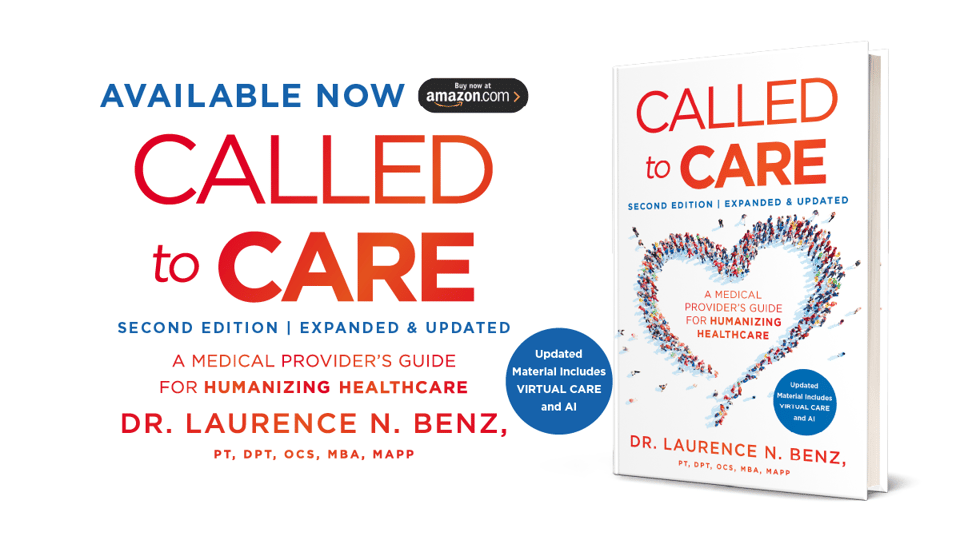
The following is adapted from Called to Care by Laurence N Benz.
Early in my career, I believed empathy was something you either had or you didn't. Years of leading physical therapists taught me the opposite. Empathy is a skill, and like any skill, it can be learned, practiced, and lost.
Consider Jane, an experienced therapist sitting through a lecture on emotional handling. She learns that empathy has four components, and one distinction stops her cold. Affective empathy means sharing a patient's emotion. Sympathy, by contrast, is feeling a different emotion, like pity, in response to their pain. When she pictures the patients who described symptoms that did not match her knowledge of anatomy, she realizes she often skipped ahead to the physical exam rather than sitting with what they felt. She had been solving problems instead of connecting.
That default is common, and it is costly. The best healthcare professionals build what I call a high-quality connection, or HQC. It rests on mutual positive regard, trust, and genuine engagement. Practitioners create it by handling emotions out loud, listening from the patient's perspective, staying mindful enough to resist first impressions, and approaching the patient with humility rather than authority. Power positions actually reduce the ability of our mirror neurons to sync, which quietly drains empathy from the room.
You can feel an HQC when it happens. It carries a sense of vitality, a positive energy shared between two people. It communicates positive regard, so the patient feels respected and cared for. And it holds mutuality, the sense that both people are fully engaged and a little vulnerable together. William James wrote that the deepest principle in human nature is the craving to be appreciated. Most patients have never once been told they are appreciated, even though they are the most important people in the room.
Touch matters more than we admit. As physical therapists, we are one of the few providers who actually examine and put hands on our patients, and that contact conveys care at a level words cannot reach. A 2024 meta-analysis of 137 studies found that touch produced measurable reductions in pain, anxiety, and depression. Too many patients tell me their provider ran tests and wrote prescriptions without ever touching them.
None of this drains the caregiver. In one study of mental health professionals, the clinicians most engaged with their patients had the lowest stress. Exquisite empathy, being present, attuned, and well boundaried, protects against burnout rather than causing it.
The system often pushes us the other way, toward compliance and productivity. Telehealth raises the stakes further, because on a screen every cue of empathy has to be made explicit and verbal. That is not a reason to retreat. It is the reason our skills matter more than ever.
…
For more advice on building high-quality connections with your patients, you can find Called to Care on Amazon.
Dr. Larry Benz, PT, DPT, FAPTA, MBA, OCS, MAPP, is the co-founder of Confluent Health and CEO of the Dental Care Alliance. A nationally recognized leader in private practice physical therapy and occupational medicine, he has received numerous industry honors and is a Catherine Worthingham Fellow. Dr. Benz serves as Chair of the University of Louisville Board of Trustees and sits on the boards of the University of Louisville Athletic Association and UofL Health. His service also includes time as a distinguished U.S. Army Captain in the Army Medical Specialist Corps, during which he was awarded the Meritorious Service Medal.

Lex Statzer
Lex Statzer, Publishing and Marketing Lead at Scribe Media
Ready to Write Your Book?
Scribe has helped 2,000+ authors turn their ideas into published books. Schedule a free consult to get started.
Schedule a Consult