When Work Loses Its Soul: What AI Reveals About Human Care

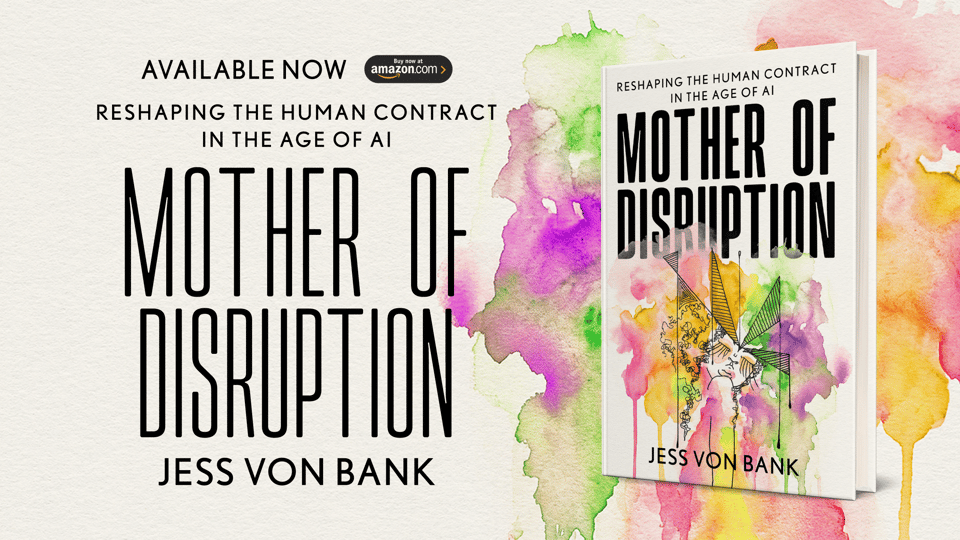
The following is adapted from Mother of Disruption by Jess Von Bank.
I’m a workout junkie. The gym is my sanctuary, and over the years, the people who move beside me there have become a real community.
One of my favorite gym friends is a spunky, fit retiree twenty years ahead of me. We have a running joke.
“I want to be you when I grow up,” I tell her.
“I miss being you when I was young,” she says.
One day in the parking lot, I realized I had never asked what she did before she retired. She was a postal worker. Then she added, with quiet certainty, “I was happy to be done; it was time.”
For decades, she carried the paper trail of an entire neighborhood’s life. She delivered birth announcements and smiled at the balloons tied to mailboxes. She knew every graduate because she carried their cards. She stopped on porches to visit, checked on the old folks living alone, and kept an eye out for wandering kids.
This was not time lost to the work. It was the holiest part of the work, the unseen stitching that held a neighborhood together.
By the end of her career, an algorithm had mapped her route turn by turn, calculating how many seconds she was allowed for every drop. And because modern systems have a perverse way of punishing excellence, the better she got, the longer her route became.
We called it efficiency. But let’s name the transaction honestly. We turned a human being into a cursor moving across a GPS map.
She didn’t retire because she was tired of walking. She retired because the job lost its soul.
What AI Brought Into the Light
In a weird way, I should be thanking AI for this moment. It arrived like a weather event, exposing whatever was buried under the sand.
Long before AI generated a single answer, thousands of people were doing quiet translation in their jobs every day. They smoothed tension, calibrated tone, repaired misunderstandings, and sensed collapse before any dashboard could. We dismissed these abilities as “soft skills,” a label that says more about who performed the labor than its value. Usually women. Usually mothers.
When AI automated the mechanical parts of work, it acted like a diagnostic dye, illuminating the relational scaffolding underneath. What we once called “extra” turned out to be the load-bearing wall.
Leadership’s Real Job
The skills of care are not feminine traits. They are human competencies the old system dismissed even as it depended on them.
The leaders who thrive now won’t be those who outperform the machine. They’ll be the ones who understand what the machine cannot do. That means regulating your own nervous system in chaos, saying “I don’t know yet,” and protecting people before performance. Call it softness if you will. I call it the new rigor.
Humanity is not a side effect of work. It is the point of it.
…
For more advice on leading with care in the age of AI, you can find Mother of Disruption on Amazon.
Jess Von Bank is a technology humanist, future-of-work advisor, and systems thinker. She is the co-founder of Now to Next, a transformation firm specializing in the human dimensions of enterprise AI. Raised in small-town North Dakota with shoulders that know how to lift, Jess has spent more than two decades working across talent, technology, and systems design. She is a mother to three daughters, the founder of a nonprofit for girls, and an endurance athlete. Jess measures every system by how well it serves the people inside it—and believes any future of work that fails its people is no future at all.

Lex Statzer
Lex Statzer, Publishing and Marketing Lead at Scribe Media
Ready to Write Your Book?
Scribe has helped 2,000+ authors turn their ideas into published books. Schedule a free consult to get started.
Schedule a Consult