Why Expertise Alone No Longer Sets Surgeons Apart

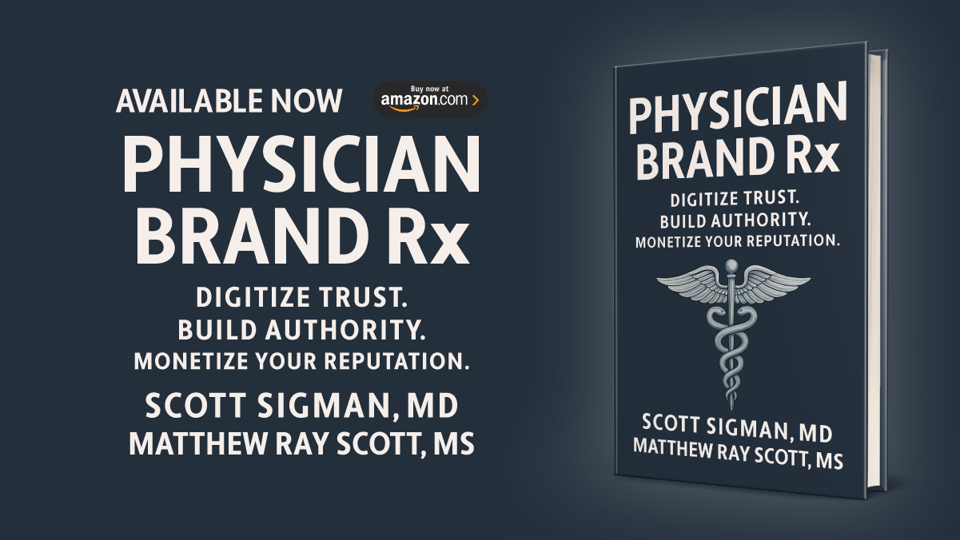
The following is adapted from Physician Brand Rx by Scott Sigman and Matthew Ray Scott.
Expertise once offered a unique advantage. A fellowship-trained surgeon in a midsize market could build a career on credentials alone. The degree, the institution, and the years of supervised precision communicated something that did not need to be explained.
That is still true, but it is no longer sufficient. Fellowship programs have expanded, training standards have risen, and metropolitan areas now host numerous surgeons in the same specialty with similar credentials and outcomes. Expertise has become a baseline expectation rather than a distinguishing feature. This is not a quality problem. It is a problem of clarity.
When five surgeons in the same city can all claim board certification, fellowship training, and strong outcomes, the patient's decision no longer turns on who is qualified. It turns on who they understand. And understanding requires perspective.
Perspective is how you think about the problem, not just how you treat it. Two surgeons can look at the same MRI and recommend the same procedure. But the one who can articulate why (what they weighed, what they set aside, what experience has taught them to watch for) creates a reason to choose.
This became clear to me when I began offering the BEAR ACL implant. I was not the only surgeon in the region who could reconstruct an ACL. But when I started talking publicly about the idea that a patient's own ligament could heal itself, something shifted. Patients were not choosing me because I had better hands. They chose me because they understood my perspective on their problem. The same thing happened with rotator cuff augmentation. The procedure was familiar, but the way I thought about recovery gave patients a lens. That lens was the differentiator, not the technique.
Reputation is capital, and most physicians spend it for attention instead of investing it for leverage. Spending looks like the conference talk that showcases the surgeon but teaches nothing memorable, or the social media post designed to impress peers rather than serve patients. Investing is quieter. It is publishing the same core idea from different angles over years until the market associates it with your name. It is declining invitations that don't align with your values.
I have done both. Early in my career, I said yes to everything. My name was circulating, but I couldn't tell you what it was circulating for. The shift came when I narrowed. Opioid-sparing surgery became my lens, and everything I did publicly reinforced it, from The Ortho Show to my TEDx talk. The invitations that followed asked for my specific point of view. Spending gets you in the room. Investing makes the room come to you.
Attention is fast. Leverage is slow. But leverage is the asset that works in your absence. Perspective does not replace clinical skill. It sits on top of it, turning expertise that is interchangeable on paper into something specific. And specific is what patients choose when they have options.
…
For more advice on building a physician brand patients choose, you can find Physician Brand Rx on Amazon.
Dr. Scott Sigman has championed his opioid-sparing orthopedic surgery from American operating rooms to remote Honduran clinics. He is a sports medicine surgeon, Chief Medical Officer of OrthoLazer Orthopedic Laser Centers, host of The Ortho Show and Smart Medicine podcasts, and a TEDx speaker.
Matthew Ray Scott once leapt from airplanes as a Captain in the 82nd Airborne Division and a Psychological Warfare Officer. He is a surgeon reputation architect, best-selling author, and founder of FEED, a healthcare brand agency named the Best Cause Agency by the American Marketing Association.

Lex Statzer
Lex Statzer, Publishing and Marketing Lead at Scribe Media
Ready to Write Your Book?
Scribe has helped 2,000+ authors turn their ideas into published books. Schedule a free consult to get started.
Schedule a Consult