Why the Best Brands Are Built on Intention, Not Just Business Logic

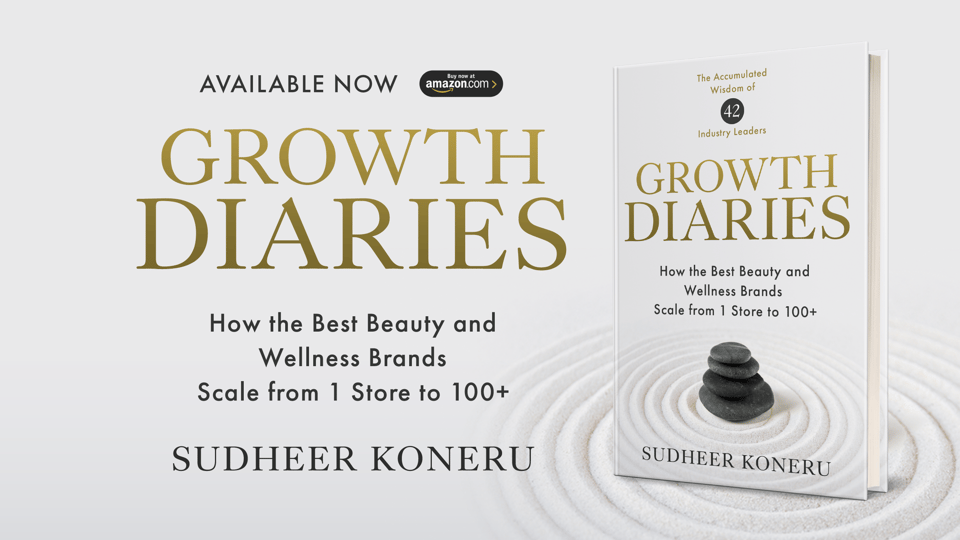
The following is adapted from Growth Diaries by Sudheer Koneru.
When I sat down for 42 interviews with founders in the beauty and wellness industry, I expected to hear about strategy, systems, and capital. Instead, I found something I didn't anticipate: the brands with the deepest emotional intention consistently outperformed the ones built primarily on business logic. Not in spite of their idealism, but because of it.
I want to be clear this isn't about positive thinking or manifesting. It's an empirical observation about how intention translates into real competitive advantage.
Melanie Gleeson of Endota Spa said it best. "If I just had thought, 'I want loads of spas and a gift voucher program,' without the right intention, it wouldn't have been as fun building it. But also, it wouldn't have been as rewarding." That sounds soft, but the evidence is hard. Endota performs 850,000 treatments a year across more than 100 locations, with franchisee retention among the highest in its category. Its investors, the founders of Rip Curl and Quiksilver, backed it because they recognized a values-driven movement that happened to be a business.
The pattern repeated everywhere I looked. Kyle Jones of iCRYO described going from a company to a brand to a movement. Vikram Bhatt built Enrich around the belief that love begins with you. Marilyne Gagné refuses to market to anyone under 35 because she believes aesthetics should help women look healthy, not younger.
So why does intention create advantage? I found four mechanisms. First, it attracts aligned talent, acting as a self-selecting filter so people who share your values apply and those who don't stay away. Second, it sustains founders through the hardest years, when the financial case for continuing is weak. Third, it creates brand coherence at scale, giving thousands of employees a single decision filter: does this serve our intention? Fourth, it's the one thing competitors cannot copy. They can match your pricing and your store design, but intention has to be genuine or it gets detected as false.
I also have to name the trap. Intention without execution is fantasy. Luca Boccia ran his salon on passion for more than 20 years at a 2.5% profit margin, barely above breakeven, until he learned the financial mechanics and jumped to 14.5%. Passion is necessary, but it isn't enough on its own.
Here's what I keep coming back to. A passion for making money will carry you through good years and abandon you in bad ones. A passion for making people feel better, for building something that matters beyond the balance sheet, will carry you through anything. In an industry where growing from one location to a hundred takes a decade of relentless work, that kind of sustainability isn't a luxury. It's the price of admission.
…
For more advice on building a purpose-driven brand that lasts,, you can find Growth Diaries on Amazon.
Sudheer Koneru is the founder and CEO of Zenoti, the technology platform powering more than 30,000 beauty, wellness, and fitness businesses worldwide. Before starting Zenoti, he ran a spa and salon chain, giving him a rare perspective that spans operations, technology, and the human side of service. Sudheer believes deeply in human potential and that every person has greatness within them. In his leadership, that belief is reflected in curiosity and empathy. In his personal life, it is expressed through yoga and spiritual exploration. He divides his time between Seattle, Hyderabad, and Bali.

Lex Statzer
Lex Statzer, Publishing and Marketing Lead at Scribe Media
Ready to Write Your Book?
Scribe has helped 2,000+ authors turn their ideas into published books. Schedule a free consult to get started.
Schedule a Consult