
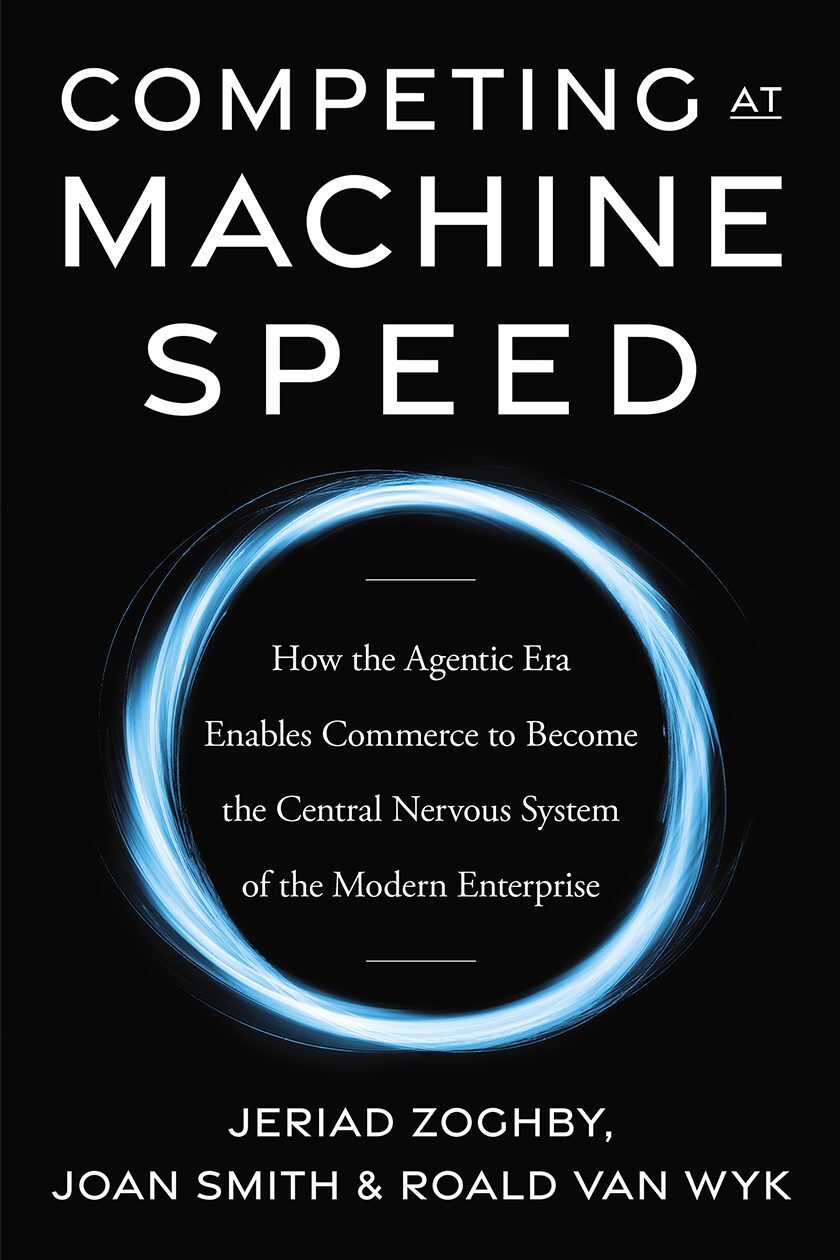
Roald van Wyk and Joan Smith Wrote Competing at Machine Speed for Big Brands That Need to Move Faster

“I think AI can make teams more connected, but AI is not going to solve your problems.”
Roald van Wyk, co-author of Competing at Machine Speed
Roald van Wyk spent nearly three decades helping the world’s largest consumer brands through every shift in commerce. Joan Smith spent more than twenty years leading operating model transformation at some of the world’s largest companies. With co-author Jared Zoghby, they wrote Competing at Machine Speed. It is a blueprint for big brands that need to move at the speed their shoppers, and their shoppers’ AI agents, already do.
Big brands were built like cruise ships
Clip · Joan Smith on why big brands are cruise ships · 32s
The book starts from a simple observation. The market now moves faster than most large companies can compete in, and the technology arriving with AI is only speeding it up.
“Think of them like a cruise ship, right? They’ve got lots of products and lots of people and lots of structure to make all that work. And so agility is sort of at the other end of that.”
— Joan Smith
One missing word, the wrong shelf
Clip · Roald van Wyk on brands on the wrong digital shelf · 63s
The book opens with a food brand whose products kept showing up next to pet food in search results, because the listing never said the food was for humans. Roald says that kind of miss is far more common than it sounds, because heritage brands have treated digital commerce as a place to put their catalog online while the real attention went to TV, print, and retail partners.
“So as ridiculous as it sounds, it’s actually quite common to discover that really big brands are in the wrong category or on the wrong kind of digital shelf.”
— Roald van Wyk
Joan puts it in terms anyone who has walked into a grocery store will recognize. In a store, the aisle tells you whether the food is for people or pets. Online, there are no aisles.
“And when we’re in a digital world, those aisles don’t exist.”
— Joan Smith
Every product now has two audiences
Clip · Roald van Wyk on the human and agentic audience · 47s
Shoppers increasingly click buy again instead of browsing, and AI agents now shop on their behalf, looking for price, features, and ingredients rather than beautiful brand stories. Discovery, meanwhile, has moved to influencers and social feeds.
“So the big fundamental split is you might have two audiences now, you have an audience, the human audience, and then you have an agentic audience that is looking for something completely different, but it’s the same product.”
— Roald van Wyk
Why more AI is not the answer
Clip · Roald van Wyk on why more AI is not the answer · 31s
The tempting fix is to add AI. The book calls that the augmentation trap. If a signal from the market already takes six months to reach the right team, a new tool does not change how the teams are built.
“If you add more lanes to a road, it’s been proven not to reduce traffic, right? It just creates more cars versus building faster trains and investing in better infrastructure.”
— Roald van Wyk
Clip · Joan Smith on the Yellow Pages moment · 37s
Joan’s example from the book is the Yellow Pages. When the internet arrived, the Yellow Pages put their book online.
“Google didn’t put a book online. Google changed how we search for things.”
— Joan Smith
What the authors propose instead is an operating system for commerce: technology that is always sensing and acting, with people above it supplying the judgment, and teams, incentives, and roles redesigned so the signals actually flow. Roald sees the payoff in speed.
“And I think there are things that took us six months that are now taking us seconds.”
— Roald van Wyk
The soul of the brand stays human
Clip · Joan Smith on the soul of the brand · 11s
The obvious worry is what is left for people to do. Joan’s answer is that people become the orchestrators, the ones who know what the machine cannot, like a corporate goal, an earnings announcement, or a weather anomaly coming next week.
“The soul of the brand remains with humans. The AI can never have that soul.”
— Joan Smith
Writing a book about a world that changes every week
Clip · Joan Smith on writing principles instead of a playbook · 52s
Asked about the hardest part of writing about something this fast-moving, Roald’s answer was that Claude went through five updates while they wrote it. Joan says they started turning the blueprint into a guidebook of what to do, and realized it would be out of date before it was published.
“So we, we pulled it back and looked at the patterns that we’d seen for years and went to this idea of the principles and sort of, this is a blueprint, an architectural blueprint that we’re hopeful that executives are going to look and like apply to their company.”
— Joan Smith
Three authors, one voice
Clip · Joan Smith on writing as three authors in one voice · 37s
Roald, Joan, and Jared met while working together as consultants, coming from creative, transformation, and systems and technology backgrounds. They spent a lot of time agreeing on the outline before writing a word.
“We spent a lot of time on the outline and really like aligning that we were all, we all aligned to the architecture of how we were going to write the book.”
— Joan Smith
A version of the book for your robot
Clip · Roald van Wyk on the machine version of the book · 16s
The book practices what it preaches. On the book’s website, the authors also posted a version written for AI agents to read.
“We also have a machine version that we’ve uploaded. So you can feed that to your robot.”
— Roald van Wyk
For Joan, success looks like an executive putting the book down and holding their own company up against it.
“We would be so thrilled if on Monday morning, somebody read the book and looked at it and said, I want to now see like, how does my company do against this?”
— Joan Smith
Ready to Write Your Success Story?
Join 1,600+ authors who have published with Scribe Media and transformed their careers.
Schedule a Consult
Course
Write and Publish Your Best Possible Book
Six modules. 28 lessons. Everything Scribe has learned helping 2,000+ authors, organized into the same process we use with our professional clients.
A Wall Street Journal Bestseller
The Scribe Method
No catch, just everything you need to write, publish, and own your book.