Five Players, One Song: The Hidden Music of Basketball

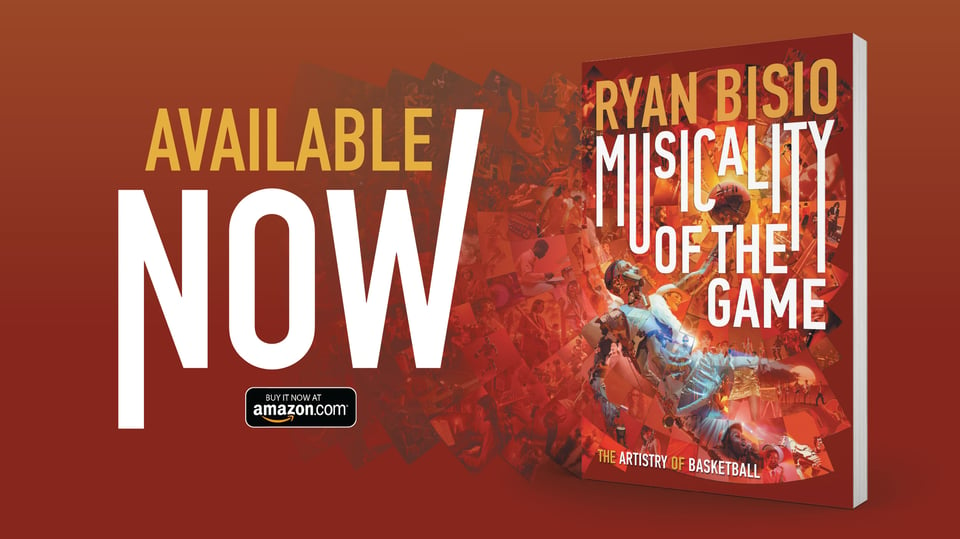
The following is adapted from Musicality of the Game by Ryan Bisio.
A basketball team is a band, playing the game’s music. And the beautiful thing about basketball is that every player can pick up any instrument at any time. It’s like musical chairs, except there’s always a seat. At any moment, a player can contribute rhythm, harmony, or melody.
To see how it works, imagine a five-piece band: the drummer (5), the bass player (4), the keyboardist (3), the guitarist (2), and the lead singer (1).
The Rhythm Section
The drummer and bassist form the rhythm section. On the court, that’s your center and your power or stretch forward, the anchors of the groove.
The center brings physicality, rebounding, rim protection, and trips to the free throw line. The forward works in tandem, defending the paint, screening with force, and lifting the tempo through effort plays. Together they operate in the low frequencies, establishing the pocket everyone else plays in.
The Harmony Section
Next come the keyboard and guitar: the small forward and shooting guard. They layer texture and depth over the groove. Their harmony shows up in spacing, cutting, shot selection, and defensive switchability, and it tells you how genre-fluid a team can be.
When harmony locks into rhythm, the performance gains color, dynamics, and emotion. The story deepens.
The Singer
Then there’s the point guard, the lead singer who guides the band through melody. The ball is in their hands more than anyone else’s. Their screening actions set the rhythm. Their pace shapes the groove. Their passing brings harmonic flow, and their ball handling and shooting carry the melody. Even their on-ball defense, with its intensity and urgency, has a sound.
Of course, any lineup can work. Maybe the guitarist sings. Maybe there’s no singer at all. The composer sets the genre, the conductor shapes how the instruments interact, and the players reveal the magic.
So what comes to mind when the rhythm is tight and the melody soars? The up-tempo funk of the Showtime Lakers? The classical symphony of the 2014 Spurs, with Gregg Popovich conducting? The new-age pop swagger of the 2015 Warriors?
The Ball Is a Note
A band can only sound as good as the notes it plays. In basketball, that note is the ball.
Every touch carries a rhythmic, harmonic, and tonal value shaped by what came before. Sometimes the note needs to be held a beat longer. Other times it’s tapped quickly, like a sixteenth note on a touch pass. Played without heart, it vanishes. Played with presence, it radiates.
The ball knows when it’s being honored. It rewards selflessness and pure intent. Analytics can’t measure the communal energy pulsing through it, but I’d bet my 1959 Gibson ES-125 that shooting percentages rise when the ball is alive. Assists increase. Loose balls bounce your way.
The objective: make the ball happy. The method: music.
Next time you touch the ball, listen. Let it flow through you the way music does, like a river finding its way home.
…
For more on unlocking the rhythm and flow of great basketball, you can find Musicality of the Game on Amazon.
Former collegiate and FIBA basketball player Ryan Bisio is a coach, athletic administrator, and accomplished musician. In 2023, he was named the California Community College Men’s Basketball Coaches Association State Coach of the Year. The four-time Golden Valley Conference Coach of the Year has led his teams to seven conference championships in the past nine seasons. A singer-songwriter (ASCAP), producer, and performer with nine studio releases, Bisio holds a bachelor’s in contemporary music from California State, Monterey Bay and a master’s in coaching and athletic administration from Concordia University Irvine. He resides in Eureka, CA, with his neighbor’s cat, Bill.

Lex Statzer
Lex Statzer, Publishing and Marketing Lead at Scribe Media
Ready to Write Your Book?
Scribe has helped 2,000+ authors turn their ideas into published books. Schedule a free consult to get started.
Schedule a Consult