The AGI Conversation Is the Most Sophisticated Distraction of All

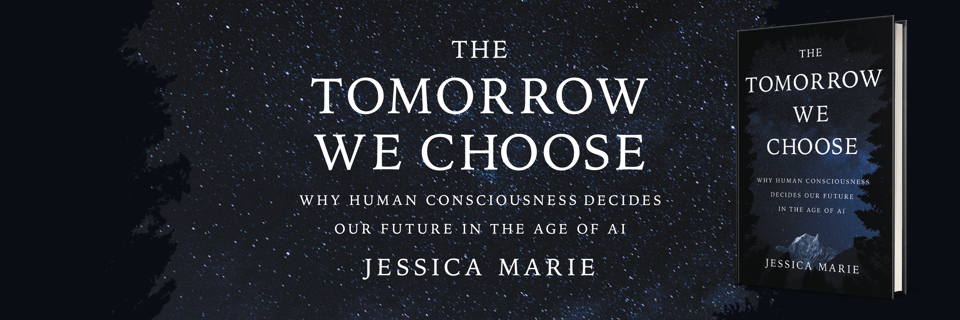
The following is adapted from The Tomorrow We Choose by Jessica Marie.
Will machines become conscious? Will they surpass us? These questions sound profound. Yet the conversation around artificial general intelligence treats consciousness as a computational problem to be engineered and benchmarked, never as something to examine in ourselves.
The term AGI drives hundreds of billions of dollars in investment. And almost no one stops to define it.
Seventy Years of “Almost There”
The AGI prediction has been made, in nearly identical form, for over seventy years. In 1965, Herbert Simon declared that machines would be capable of doing any work a human could do within twenty years. In 1970, Marvin Minsky told Life magazine we’d have a machine with general human intelligence within three to eight years. In January 2025, Sam Altman announced that OpenAI was “now confident we know how to build AGI.”
The timeline shifts, but the structure stays the same. Each prediction came at the peak of a narrow breakthrough that was then stretched into a claim about general intelligence. And each time, the prediction served a function that had nothing to do with accuracy. It attracted funding and positioned the person making it as a visionary.
Even those building toward powerful AI admit the destination is undefined. Dario Amodei of Anthropic, one of the most bullish voices on AI capabilities, has called AGI “a marketing term...something designed to activate people’s dopamine.”
Meanwhile, every time a milestone is reached, the definition of intelligence shifts to exclude it. Chess was the hallmark of machine thinking until Deep Blue beat Garry Kasparov. Then it was Go, then language. Now the goalposts sit at whatever hasn’t been achieved yet.
Why We Keep Feeding It
Capital explains how the cycle sustains itself. It doesn’t explain why we keep feeding it. I believe the fuel is psychological.
In 1966, Joseph Weizenbaum built ELIZA, a simple chatbot that reflected users’ words back at them. His own secretary, who had watched him build it line by line, asked him to leave the room so she could talk to it privately. We are wired to project consciousness onto anything that talks back.
The question “Will machines become conscious?” absorbs the anxiety that belongs to a harder, closer question: “Am I?” You can take positions, sign open letters, and post on social media without ever looking inward.
The Variable Nobody Is Working On
Most thinkers on AI risk treat the human element as a fixed input. I see it as the only variable that determines the outcome.
When AI is making triage decisions in emergency rooms, allocating water during droughts, or advising military commanders, the consciousness of the people setting its parameters becomes the most consequential factor in human civilization. A powerful system deployed by people who haven’t examined their own values will simply optimize for what already dominates: profit, control, speed, extraction.
Every year spent debating machine consciousness is a year we avoid asking about our own.
…
For more advice on examining the human side of artificial intelligence, you can find The Tomorrow We Choose on Amazon.
Jessica Marie has spent over twenty years on a lifelong inquiry through philosophy, psychology, spirituality, and technology. A self-described “recovering marketer,” this “philosopher in the wild” spent nearly fifteen years in enterprise technology, primarily in cybersecurity and SaaS. Her work questions the unseen forces that direct thought and behavior, and the way people experience reality. She believes AI could be one of the most transformative technologies we've ever built, and that belief is what drove her to write this book. She is on a mission to help humanity become more conscious of the forces that guide their choices, perceptions, and sense of what’s possible.

Lex Statzer
Lex Statzer, Publishing and Marketing Lead at Scribe Media
Ready to Write Your Book?
Scribe has helped 1,600+ authors turn their ideas into published books. Schedule a free consult to get started.
Schedule a Consult