A book is the fastest way onto a stage. This is the proven playbook for getting booked and getting paid, built from the framework Scribe's co-founder has taught for years, and proven step by step by Scribe authors who did it, in their own words and on camera.
The framework is adapted from Tucker Max, Scribe co-founder and a four-time New York Times bestselling author who has sold more than 5 million books. Every step below is backed by a Scribe author who used their book to get on stage.
Email me the free playbookThe full checklist PDF, plus the TEDx speaker scorecard. Free, sent to your inbox.
First, proof that a book gets you on stage
Before the how-to, here is what a book actually did for these Scribe authors. Every number is their own.
Raise your fee from $3K to $40K a talk
Cameron Herold was paid about $3,000 an event when he wrote his first book. Today it is $40,000 in person.
Cameron Herold
Make speaking your main source of income
85% of David Burkus’s revenue now comes from speaking.
David Burkus
Turn two talks into $200K of new work
Will Leach built both talks on one fresh angle from his book. He estimates they led to at least $200,000 in projects.
Will Leach
Get booked on stages around the world
Robin Farmanfarmaian has given 225+ keynotes in 16 countries. Her book was the price of entry.
Robin Farmanfarmaian
Earn back what the book cost, ten times over
“The speaking fees have paid for the book ten times over.”
Chris Dessi
Get invited instead of pitching
Google invited him to Talks at Google after his book hit #1 on Amazon. He never pitched it.
Dr. Robert Silverman
Want the exact steps these authors followed? Get the whole playbook as a free PDF checklist, emailed to you.
There is no right or wrong answer. It depends entirely on your goals. Before you wrote your book you set objectives: more clients, more sales, a bigger brand, more impact. Revisit them.
If speaking gets you in front of the people you need to reach, it is worth it. If your time is better spent on other marketing, it is not. Speaking is not mandatory. Plenty of authors hit their goals without ever setting foot on a stage.
If the answer is yes, here is the playbook.
The playbook: 7 steps to your first paid stage
Work them in order. Each step is the principle, then a Scribe author proving it.
1
Know exactly who you're talking to
The whole game is delivering content that helps a specific audience solve a real problem. Most authors go broad and chase the glitziest stage. Go niche instead. Pick the small, dedicated audience you can actually serve, and tie every stage back to your goals.
Dr. Robert Silverman
Author of Inside-Out Health
He did not chase the biggest stage. He wrote for a specific audience that needed functional-nutrition guidance. After the book became a #1 Amazon bestseller, Google reached out and invited him to the Talks at Google series. He never pitched it.
"I wanted to write a book to exponentially increase my voice. I wanted to get my knowledge out in a way that allowed people to learn from me even if I wasn't in the room."
Dr. Robert Silverman
Paul Hobby
Author of Glorious Tension · Founder, Genesis Park
Paul wrote his book for people who might not share his views. Clubs that would never have invited him read it, saw he was not throwing bombs or calling names, and asked him to speak. Write for a specific audience, and the book gets you into their rooms.
Clip · Paul Hobby on getting invited to new stages · 0:24
Read what Paul Hobby said
[I've been invited] to speak to some clubs that I wouldn't have otherwise been invited to speak to, because they don't think I'm part of their tribe. But somebody read the book and said, you know, the guy's positive, he's not throwing bombs or calling names. So I do think it's been a good thing in terms of people's willingness to hear the argument, without the reflexive defensiveness that we find all around us.
2
Pick the right stages, not the glamorous ones
Once you know your audience, target the events they actually attend. Pick 25 to 30 ideal people and ask which events they never miss. Keep expectations realistic: your first book will not land you on the TED main stage. If that is the goal, start with a TEDx and build. See how a TEDx team scores speakers.
Robin Farmanfarmaian
Professional speaker · 225+ keynotes, 16 countries
Robin has spoken at The White House, DARPA, and Stanford Healthcare. In the clip she says that the day she decided to become a professional speaker, she knew a book was a requirement, not an option.
Clip · Robin Farmanfarmaian on why a book was non-negotiable · 0:11
Read what Robin Farmanfarmaian said
I realized immediately, when I decided to become a professional speaker and thought leader, that I needed a book. It wasn't an option, it was a requirement.
Aiming for a TEDx stage? The free PDF includes the scorecard a TEDx team used to judge its speakers, so you can score your talk before you apply.
You already have the content: it is your book. The work is finding the angle where your expertise meets a trend that is fresh on everyone's mind. Get specific. Not “how to grow a business,” but “how to build your CPA practice to X revenue in five steps.” And do not just repeat one keynote forever.
Will Leach
Author of Marketing to Mindstates
Will posted a three-article series linking his book's idea to Game of Thrones characters. The organizers of a marketing conference invited him to present on that angle. A Merck rep in the audience booked him for a 60-minute talk to their team. He estimates those two talks led to at least $200,000 in new projects.
Ron Thurston
Author of Retail Pride & Human Pride
Ron never gives the same keynote twice. In the clip he explains why he rebuilds every talk around that company and that week's news: a fresh angle for each room is what keeps him relevant.
Clip · Ron Thurston on customizing every talk · 0:50
Read what Ron Thurston said
[There's a misnomer, like,] you build a keynote, you build 60 minutes of some great content and you're expert at it, and then you just repeat it. That has not been my experience, to be honest. Every single event that I have delivered, the keynotes or workshops, have been fully customized. And I think that's important in today's world. You can connect with an audience on that particular day, on that particular topic that's relevant today. That may not be relevant in six months. And that's a different mindset than any speaker that I've spoken to. You've got to move with the news. And you've got to move with the energy of what's happening inside that company, or at that conference, that makes you relevant today.
4
Build your proof: a page, a reel, and give it away
Event organizers need to see you can hold a room. Build a simple speaker page with testimonials and video, and a short reel that shows your stage presence. Capture footage at every talk. And do not hoard your best ideas: the author who gives everything away is the one people pay to hear in person.
Cameron Herold
Author of Vivid Vision · Founder, COO Alliance
Cameron lays out his exact starter system: a basic speaker page with testimonials and video, free talks to local groups like Rotary and the Chamber of Commerce in exchange for testimonials and footage, and someone with a camera to film every one.
Clip · Cameron Herold on building your speaker portfolio · 1:01
Read what Cameron Herold said
[How would you recommend somebody with a book] go about getting introduced to these conferences? One is to make sure you get a very, very basic speaker's page. Get a landing page built. You can get a 16-year-old to build you a speaker website that has some testimonials, some pictures of you speaking, some videos of you speaking. Every event that you do for free, add some testimonials, some videos. Just something basic that's there. So offer to speak for free to any groups in your city: the Chamber of Commerce, Rotary Clubs, Vistage or EO chapters, whatever your industry events are. Offer to speak for free in exchange for testimonials and video. Hire a 16-year-old to come in with a DJI or an iPhone and get some footage of you on stage. Just pull it together slowly. Don't worry about it being perfect. And then I would also come up with at least two speaking topics, so you give them option A or option B, not a yes or a no. That would be my starting point.
Cameron Herold
On giving your best material away
Cameron put every system and cheat sheet he uses into his book. In the clip he explains why giving it all away is what gets him hired: companies pay him to speak about the same ideas that are in a $25 book.
Clip · Cameron Herold on giving away the secret sauce · 0:46
Read what Cameron Herold said
I published with Scribe because I wanted to get the ideas out, to establish my credibility as a thought leader in the entrepreneur space, and then later in the COO space. And then I realized that the more information I gave to my audience, the more they would want to hire me to help them put the ideas in place that were even in the book. So when I wrote the book, I put everything there. I gave every system, every cheat sheet, everything that I've used over the years to coach and help companies. And what ended up happening is they end up hiring me to speak about the same content that's in a $25 book, or they end up paying me $50,000 a year to coach them on the same content that's in the $25 book. So even by giving away the secret sauce, they still ended up hiring me. I guess it just built that credibility.
David Burkus
Author of Best Team Ever · Keynote speaker
David's proof is not just stage footage. In the clip he explains how short YouTube videos that each solve one problem, like getting people to speak up in meetings, work as marketing that gets him found.
Clip · David Burkus on video-first speaker marketing · 0:42
Read what David Burkus said
[What we started] doing was creating an awful lot more content. Partly because I was at home during COVID like everybody else, but we started a YouTube channel in mid-2020, because we had nothing else to do. And a lot of those videos have become super essential to marketing a speaker. Not just videos on stage, but videos solving individual problems. Literally, right before we did this one, we were filming a video about getting people to speak up more in meetings and how to farm for dissent. Those little micro-videos are like little marketing pieces, solving individual problems that then get found. So think video-first in your marketing, and be willing to put out your own content.
Cameron Herold’s full get-booked system is in the free PDF, laid out step by step.
Skip the generic contact form. Find the actual event or program manager on LinkedIn. Then act like a human being: engage with them first, keep the pitch short and specific to their audience, and follow up a few times without hounding. Relationships book stages.
Rachel Williamson
Author · Retail leader
Rachel mails a free copy of her book to the specific people she wants to work with, as a warm, personal introduction instead of a cold pitch. Two of them booked her: one to speak at their event, one for a consulting project.
Clip · Rachel Williamson on mailing the book to get booked · 0:27
Read what Rachel Williamson said
[Now I've got people] I've mailed a free copy to. It's not that big of an investment. The shipping is twice the cost of the book itself, honestly. So there's a little bit of an investment there. But I've had a couple people I sent a free copy to who have booked me for two different things. One to talk at an event that they're hosting and giving away books and talking about retail. And the other is a consulting project that's coming up.
Matt Shoup
Author of Painted Baby · Speaker & entrepreneur
Matt found the right person to pitch for him: a speaking agent. In the clip he explains that she tested him with small gigs, then told him she would push him much harder once his book was out. She did.
Clip · Matt Shoup on signing with a speaking agent · 0:17
Read what Matt Shoup said
[I ended up] landing and working with a speaking agent. It was funny: she was booking me these small gigs, kind of testing me out, before I had Painted Baby, the book. I was speaking about it, and she said, Matt, once you land this book and it looks good, I'm going to put you out there more. And it did.
6
Make the ask, and set your fee
Expect the first gigs to be unpaid; treat them as your internship and build the portfolio. As demand grows, you charge. When you do, do not lead with your number: ask their budget first, and sell the whole experience, not just your hour. Fees rise with time, reputation, and reach.
Ron Thurston
On the money ask
Ron never names his fee first. In the clip he asks for the event's budget instead, and when there is no money for a speaker, he asks them to buy 100 copies of his book for the audience.
Clip · Ron Thurston on the money ask · 0:51
Read what Ron Thurston said
So I would say the reality and the execution can feel very different. It is a bold statement to say, I would love to be part of your events. Sounds fantastic. But before you even talk about money, I always say, tell me about your budget for the show or the conference. Tell me what your budget is, because the first thing they're going to ask you is, what's your fee? And so there are times when they say, you know what, we have no budget for a speaker, but we will pay for your travel. And I will come back and say, I understand that. Would it be possible for you to purchase 100 copies of one of my books, to give to maybe 100 people at a raffle?
Ron Thurston
On being worth the fee
Ron makes his fee easier to say yes to by offering more than an hour on stage: he stays all day, signs books, and helps present awards at the evening gala.
Clip · Ron Thurston on being part of the experience · 0:29
Read what Ron Thurston said
So you're working with event producers and leaders to say, let me be part of the experience. And so you're doing more than on stage for an hour. You are part of the experience of the event. So here's what I can do for you: I will come, I'll do 60, 90 minutes for you, but I'll stay for the day and I will sign books. If you're having a gala that night, I will help you present awards.
Cameron Herold
On raising your fee over time
Cameron's fee rose with his books. In the clip he walks through it: about $3,000 an event after his first book, then $10,000, then $15,000, and now $40,000 in person and $10,000 for a 60-minute keynote over Zoom.
Clip · Cameron Herold on his book raising his speaking fee · 0:13
Read what Cameron Herold said
[When I wrote my first] book, I was getting paid about $3,000 an event. I then went to 10, then to 15. And now I'm 40,000 for an in-person event, and $10,000 for a 60-minute keynote over Zoom.
Chris Dessi
Author of Remarkable You
Chris already spoke professionally, but the book raised both his reach and his fees, and gave him credibility that broke through with skeptical clients.
"The speaking fees have paid for the book ten times over."
Chris Dessi
Ron Thurston’s get-booked-and-paid system, including how he handles the fee conversation, is in the free PDF.
Not every great author is right for every stage, and that is fine. The topic, tone, and energy you bring on stage should match your book, your website, and your voice. When people hire you, they should know exactly what they are getting.
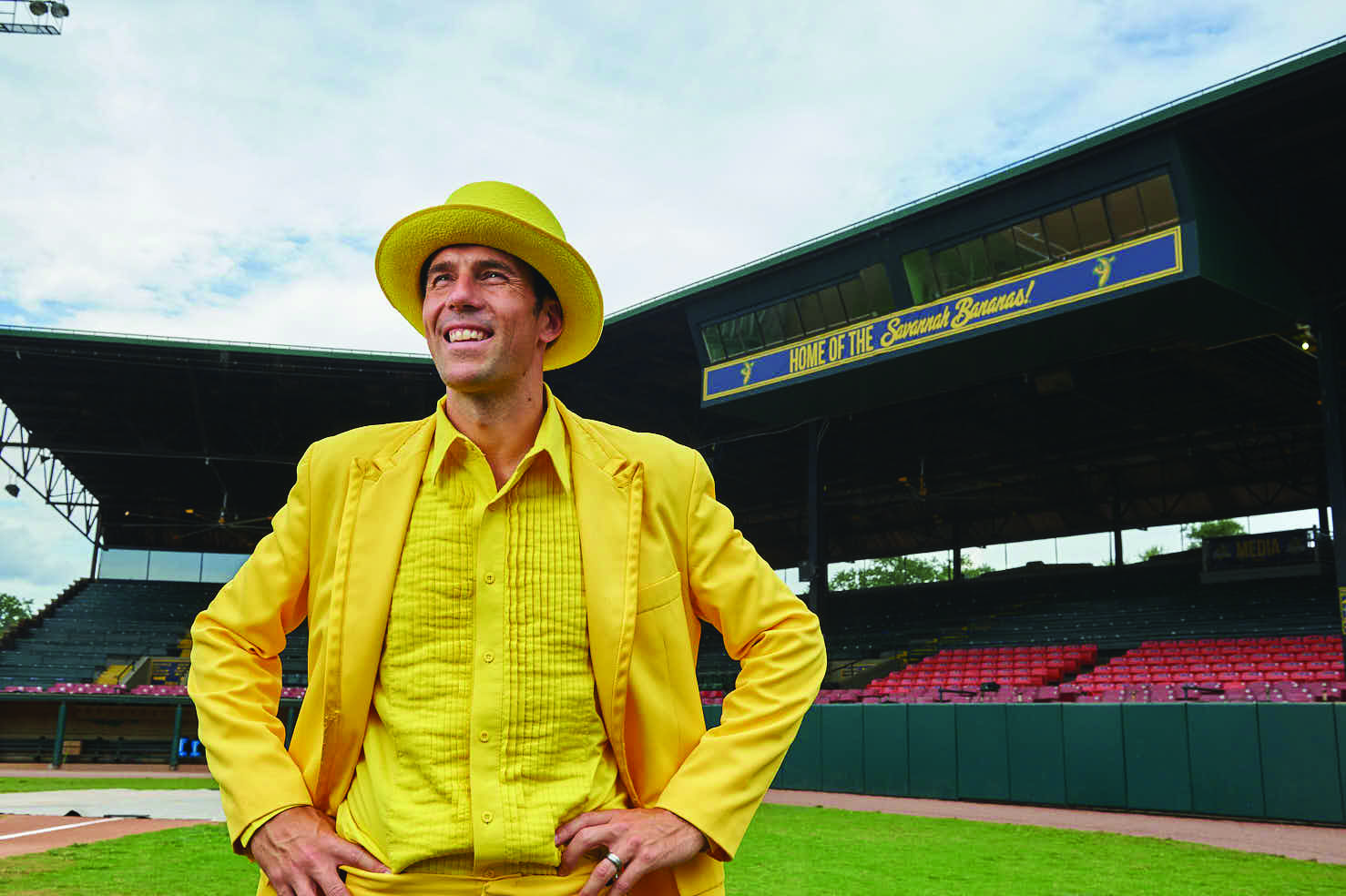
Jesse Cole
Author of Find Your Yellow Tux · Owner, Savannah Bananas
Jesse built the Savannah Bananas into a phenomenon and shows up in a yellow tuxedo. In 2015 he was asked to speak to a room of accountants and did not expect to win them over. He stayed completely on-brand, stuck to his strengths, and got a standing ovation.
The takeaway: your talk, your reel, and your topic should all match who you actually are. Do not become what you think organizers want. Show them who you are and let them book the right fit.
How a TEDx team scores your talk
Step 2 says start with a TEDx. Here is what the judges look at. This is adapted from a real speaker evaluation form a TEDx organizing team used to choose its speakers, with anything identifying the event removed.
Scott A. Martin
Author of Groundswell
A TEDx organizer read his book, found his podcast, and called him. When he missed the deadline, she offered him the last open speaking spot, one that about 30 people wanted.
Clip · Scott A. Martin on the book that got him on a TEDx stage · 1:22
Read what Scott A. Martin said
You want to get on one of the biggest stages, and one of the biggest stages and hardest stages to get on is TEDx, right? And I do public speaking and I too wanted that, but it's funny because I got a call from someone who read my book, and from the book, they went to my podcast, they listened to me, and they reached me and they said, I'm a big fan of yours. I run TEDx in … Ocala. There's going to be invites to speak. I'd like to make sure you sign up for speaking. … And I got busy with things and I didn't sign up. And I remember I missed the deadline. … She goes, listen, there's like, it's full, but one spot. And there's about 30 people that want that spot. I'm the organizer. I can get you into that spot. … She was already sold. So think of this one quote: people don't buy from you until they buy into you. She bought into me through the book and through the podcast. … I have a lot of my friends who are still trying to get TEDx talks, and it's not easy. And you have to have a book.
"I have a lot of my friends who are still trying to get TEDx talks, and it's not easy. And you have to have a book."
Scott A. Martin, on Author Hour
15
criteria, in four groups
1 to 5
on each one, from weak to outstanding
75
points possible
3 calls
advance, maybe, or do not advance
Content and message
1An idea worth spreadingOne central idea a listener could repeat in a single sentence.
2Clear takeawaysThe audience leaves knowing exactly what to remember.
3A call to actionA concrete next step, shift in thinking, or move to make.
4EvidenceClaims are backed by credible research, data, or studies.
5Fit with the event themeThe talk connects to the theme this event chose for the year.
6SignificanceThe idea matters to people well beyond the speaker's field.
Structure and storytelling
7FlowClear structure, steady pacing, ideas that connect.
8Story and personal connectionStories, examples, or lived experience make the idea land.
9Opening and closingA hook in the first moments and an ending that stays with people.
10TimingInside the time limit, without rushing or running over.
Delivery and impact
11Confidence and deliveryPresence, posture, voice, and connection with the room.
12OriginalityA perspective and approach the audience has not heard before.
13Emotional and intellectual impactIt inspires, challenges, or makes people think.
14CoachabilityWith coaching, could this speaker be stage-ready by event day?
Overall
15Overall impressionHow well the talk works, and the speaker's potential on a TEDx stage.
Where a book gives you a head start
Six of the 15 criteria are about the idea itself: one sentence a listener can repeat, clear takeaways, a call to action, evidence, fit with the theme, and why it matters beyond your field. That is the same work a book makes you do before a single chapter gets written. If you have written the book, that part is done before you audition.
Score yourself before you apply. Record a full run-through, score it on all 15, and ask two honest people to do the same. Judges also write three short notes: what worked, what did not, and what to improve. Anything the three of you put at 3 or below is where to work first.
TEDx is a trademark of TED Conferences, LLC. Scribe Media is not affiliated with TED or any TEDx event.
★ Free PDF Checklist
Get the whole playbook as a checklist
Every step on this page, plus the deeper how-to details, as a checklist you can actually work through. Includes the full playbooks from Tucker Max & Zach Obront, Cameron Herold, and Ron Thurston, plus the TEDx speaker scorecard.
The master checklist: every step on one page
Tucker Max & Zach Obront's founder system (9 steps)
Cameron Herold's get-booked system
Ron Thurston's get-booked-and-paid system
Bonus: the TEDx speaker scorecard (15 criteria, 75 points)
Where should we send it?
Enter your details and we'll email you the full checklist PDF right away.
We'll email it to your inbox. Unsubscribe anytime.
The authors behind this playbook
Real Scribe authors who turned a book into a stage. Explore their stories and books.
Every stage on this page traces back to one thing: a book that made the author the obvious expert. Scribe helps entrepreneurs, executives, and experts write, publish, and market the book that opens those doors.