Before It's Too Late: Eric Rozenberg
Read the full transcript
Eric Rozenberg
Eric Rozenberg is a Belgian-born American citizen, entrepreneur, author, speaker, and podcaster.
From organizing projects for Fortune 500 companies in over 50 countries in the world to volunteering to protect the Jewish Community in Brussels, Eric has developed an ability to connect the dots, to face reality, and to take action.
Fiercely independent, passionate about geopolitics, he is an avid reader and never shies away from expressing his opinion … even (or especially) if it is not politically correct.
He happily lives in South Florida with his wife, their three daughters, and their dog.
📚 Books by Eric Rozenberg
Transcript
Eric Rozenberg: But it doesn't mean that you have to cancel everyone or you have to shout at each other names because they're stupid or whatever. I really love the fact that you can bring people from different opinion and sit down. And that's what I'm seeing here and what I want to do really in America. I don't care if you're Democrat or Republican. I don't care if we agree on issues or not. We first are Americans and we first lucky to be living in the most amazing country in the world. And yes, there's a lot of things to be fixed. But first, let's focus on what are the commonalities and why we're living here.
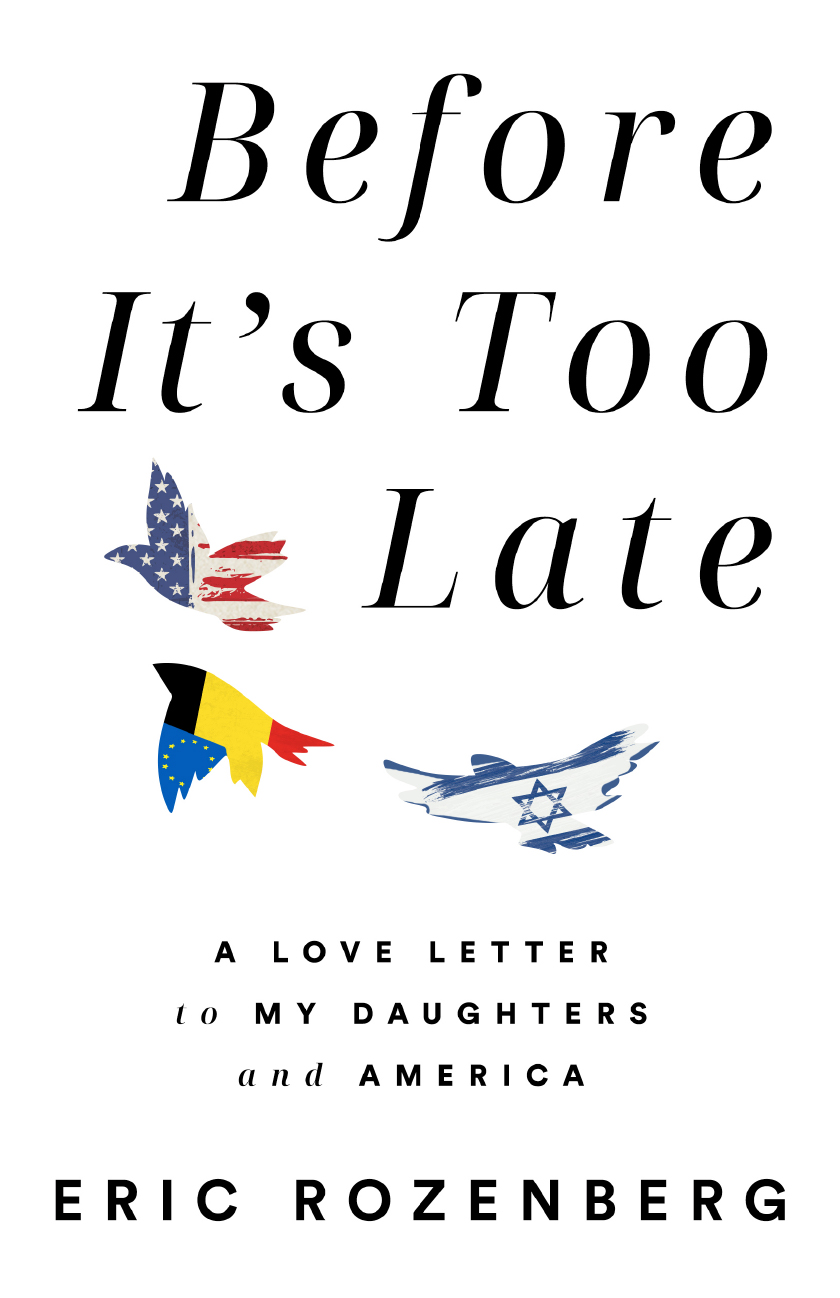
Host: Imagine having to leave the only home you've ever known because of rising prejudice against your ethnicity. Eric Rosenberg grew up in Belgium, surrounded by rising anti-Semitism. In 2013, fearing for the safety of their children, he and his wife Elsa chose to leave everything behind and immigrate to the United States. Before it's too late is Eric's love letter to his daughters. It details European events since the 1980s, the rise of anti-Semitism, the Rosenberg family's history, and how all of this led them to decide to leave Belgium for the future of their girls. It's also a love letter to America. Well researched, compelling, intimate, and moving, this legacy book shares why Eric and his family consider their adopted home the greatest country on earth and why they are concerned about what they are witnessing in the United States today. Here's my conversation with Eric Rosenberg. Welcome into the Author Hour podcast. I'm your host, Benji Block, and I'm excited to talk with Eric Rosenberg today. He's just authored a new book titled Before It's Too Late, a love letter to my daughters and America. Eric, thank you for being with us today.
Eric Rozenberg: Well, thank you for having me, Benji.
Host: So, man, your resume includes time organizing projects for Fortune 500 companies in over 50 countries, which is maybe a conversation for a different day, but very impressive. Also, volunteering to protect the Jewish community in Brussels. You're passionate about geopolitics. So walk me through, your busy man, why this project, why write this book right now, Eric? A very good question.
Eric Rozenberg: I spoke a lot when I was in Belgium about what I was seeing, the dangers I was seeing, and I wanted to inform people. And after a while, I realized that probably it was not having the impact. I hope it could have had. And so when we decided to move finally to the US, I had this huge mind map in my office for years because I wanted to tell the story to my daughters. I wanted them to understand and the next generation in my family, why we took them from a very easy life, from seeing their four grandparents every week, from, you know, The classical traditional is light that you would look at. Why did we decide to remove them from that and to come to America? And I think that's really a legacy project that I wanted to leave for my kids. And the more I was speaking about it with friends in America, everybody, regardless of their background and religion, they would say, oh, I wish my ancestor would have done that when they first came to America. So that's the genesis, if you want, of the project.
Host: I'll be another one that would raise my hand and go, I would love to have read that book from my ancestors. So great work doing this, actually putting it together. And it's so compelling reading it, not as someone in your family, Eric, but just as an onlooker into your story and giving so much context and history here. that it brings you right in. So I love that. Talk about that a little bit more as to who's your ideal reader, because you're writing for your daughters. That's very clear from the title. But I wonder who else you're hoping is going to pick this book up.
Eric Rozenberg: Yeah, thank you for saying that. Definitely my daughters. Second, probably the next generations in my family that are not born yet. and that I will never meet when I'm thinking about third, fourth, fifth generation later on. That's the first thing. Second group I would say is people that are living in America and especially those who believe that, you know, they're criticizing all the time. And yes, there's a lot of things that need to be fixed. And it is the greatest country on earth. And I want them to understand that from our perspective. And third, really, it's anybody and everybody, whether the Jewish or not, that I want them to understand what happened in Europe. I'm not trying to convince anyone, but at least I'm planting a seed. This is what happened in Europe. This is what we witnessed. These are the decisions that we took and why. And hopefully, this will not be duplicated in America.
Host: We'll get to all of that, but I think you've mentioned Belgium a little bit here. Obviously now you're here and we'll talk about America in a few minutes. So we need to jump into some of your history. I think that background is obviously vital. So line up for our audience, just your family history and what brought Belgium, obviously, to become home, that's a crucial piece of all of this.
Eric Rozenberg: So all my grandparents came from Russia, Poland, Romania, you know, the cities depending on the war of one border to another. My grandparents came to work and my grandparents came to study as well in Belgium. When my grandfather on my mother's side, for instance, lost his citizenship after the revolution in Russia, having a Belgian passport was an amazing honor for him. And it's also the same from my grandfather on my father's side, who was a blue collar in my hometown in Charleroi. and for whom, you know, Belgium was the country of opportunities for them, for their children. And the history that they faced while being in Belgium. So my grandfather on my father's side enrolled in the armed partisan at the beginning of World War II by the Nazi. And my grandfather on my mother's side jumped out of a train that was going to Auschwitz on November 1st, 1942 and survived. And so there was always this love of the country, but also this awareness of being alive and being grateful for having a Belgian passport. And basically, maybe I'm jumping to the conclusion that after two generations, my wife and I came to the conclusion that the country for which My grandparents had fought and loved so much was not able to protect our children anymore.
Host: It's interesting because we'll jump to your kids in a second, but even in your upbringing, you experienced several anti-Semitic moments. It's complicated when you're a kid, right? Because it takes an emotional toll. You don't have all the words for it. This is just speaking directly to your childhood. You say, for six years, I put on a brave face in public and I cried regularly at home begging my parents to let me change schools, but to no avail. On one hand, we were not celebrating any Jewish holidays, but on the other, my father wanted me to learn what it was to be a Jew. So this very complicated situation it take me inside your upbringing, Eric, because your parents, your grandparents experience one thing, and then you are dealing with this mix of emotions as well.
Eric Rozenberg: So after World War Two for my grandparents, like God doesn't exist. If it does, how can he or she, for some people, allow this to happen? And so I was raised in a very secular family. Although I remember that one occasion I was in a synagogue with my grandfather on my mother's side, and we were doing what we always do in a synagogue, which is talking with each other, and suddenly he interrupted. me and turned to the Hassan, the person who was singing the prayers, corrected that person and went back to our conversation. And I was stunned because obviously it was there in his mind. But so having been raised like that, when you turn 12 and you have kids that are calling you, excuse my French, but a fucking dirty Jew and telling all the anti-Semitic joke that they know, obviously at that age, it doesn't come from the children. It comes from the parents. A few years later, that coming from the children themselves. But that's what we were faced with. I was the only Jew in my year. And although again, very secular, I learned that I was Jewish through the eyes of the others and the insult and the fights. And that's what I experienced for six years.
Host: What does it look like at home, Eric, for you to learn what it was to be a Jew? Was it taught by osmosis and just the way that your parents were bringing you up? Or do you remember some specific things that your father wanted to instill in you? Because I could see the negative effects of kids at school or those outside. But I wonder the flip side of that coin and really learning what it means to be Jewish.
Eric Rozenberg: Right. And so a great question. Basically, being faced with that, that's really when I start asking questions and starting to learn. But also we celebrated every year on the first November my grandfather jumping out of the train. And so there was this work of memory that was always there. And one thing I clearly remember, there was this TV series called Holocaust with Meryl Streep. And it was acting on it. You know, at that time, you couldn't binge a series on Netflix. So every week on the Wednesday, you're watching one episode. And I remember crying every time I was seeing that. And then hearing my grandfather said, ah, it's nothing compared to what really happened. And then obviously with learning at home what it was, but also facing what I was facing outside, I kind of starting to identify to what was happening in the movie. So it was very complex. Now I can tell you that years later, but in the moment I was just confused and it was very hard having those insults and then fighting, physically sometimes fighting with people. It's what life is, I guess. They always say what doesn't kill you make you stronger. And then again, it's not something by choice. Those were the cards I was dealt. And quite frankly, besides that, I had no complaint. Loving family, going on holidays, you have a nice roof, nice meal, everything that you could hope for was there. But the emotional part was extremely challenging.
Host: Yeah. What doesn't kill you either winds you up in therapy or maybe you write a book. So here we are with the book that is contemplating all of these things. And I think that that a beautiful way of saying it's OK. So let's skip a little bit forward here. We'll hit fast forward. There is. a rise in anti-Semitism in Belgium that you highlight. Obviously, it had been there, but from 2002 to 2009. And I was unaware because I am not a historian, let alone I didn't know much about Belgian history. So walk us through the conditions and what led to sort of this rise because that then triggers your ultimate decision to move.
Eric Rozenberg: Right. And actually, it started earlier. It really started in the 80s. And I speak a little bit in the book about the terrorist attack at the synagogue, obviously, in Brussels in 1982. But there was a big shift in the 1980s and 1990s. And that was the Socialist Party that clearly identified at its traditional voters were not voting for them anymore, the blue collar, like my grandfather. And they shift to the immigrants. And 95, if not more, percent of the immigrants were from Muslim countries. And unfortunately, there was a lot of control of those population by the Islamists. And that's something I also mentioned in the book, which is extremely important to understand. There is a major difference between a Muslim person and an Islamist. But unfortunately, the socialist party played a card with the Islamist, starting to give them a lot of power, a lot of resources. And in the meantime, there was something else that was happening. It was the narrative from Yasser Arafat and the PLO, which was all about anti-Israel. And when you put those two things together, you had an alliance between the socialist party, the leftist party and the Islamist and the PLO. And that creates an environment that I detailed with a lot of reference as well in the book. But it ended up with the rise of that antisemitism. And up to the 1980s, we were always concerned by the fascists, the right extremists. And since then, it was really from the anti-Semitism coming from the Muslim population, the Islamist population. And by the way, you will see also in the book that has been praised by the Imam Hassan Shalgoumi, the president of the Conference of Imams. So he's talking about it better than I do. But the result was that every single time you would hear, oh, there's bashing against Israel, people identifying the Jews to Israel. and creating an environment where Jews were being killed. And there's a lot of examples, unfortunately, in France as well, in the Jewish schools, because of what those people saw in the media. And it's like, it doesn't happen overnight. It's like lobster cooking or frog cooking, whatever you call it. It's five degrees by five degrees, and you get used to it, and then another five degrees, and you get used to it, and so on and so forth. up to the point that on one hand I was speaking with all the politicians and the head of the media company that I knew because of my business and my company in corporate events and on the other hand I was speaking with the law enforcement and the service due to my volunteering for the Jewish community and I've always trusted law enforcement much more than politicians or media people And that's when we came to that conclusion that in the future there will be no space for Jews in Belgium and in Europe. And we took the decision to come to America.
Host: Interesting. Yeah, you talk about leaving Belgium and deciding to disassociate with anything and anyone associated with the Socialist Party. And I wanted to highlight that for a second because you did have friends. You joke about arguing loudly in like a pub or a restaurant. and allowing there to be political difference in those conversations and loving those times when it wasn't an end in political correctness and going, OK, we agree to disagree, but it was just a disagreement. But we're still friends. Right. So what switched for you, Eric, in your head to go, OK, I can't associate with this anymore. And I need to make like a hard line in the sand.
Eric Rozenberg: Well, there's two things that I'd like to share with you for that question. The first one, I do miss those moment where you can argue with someone And we would shout at each other. We would give insult to each other. And then we had dinner. Today, as soon as you disagree with someone, whoa, you're being canceled and nobody wants to talk to you anymore. Well, that's unfortunate, but hopefully that will change with time. But that's something I miss. But the second thing really, the more I thought about it, the more I said, listen, you always have the choice. And those friends that decided to do this political career, They knew what was going on, but they made a choice. They made a choice for their career. They made a choice because they wanted to keep their job. They made a choice because of ideology. But at the end of the day, to me, they were all co-responsible of the rise of antisemitism in Belgium. And I just didn't want to associate with them anymore.
Host: So it's less about having different political views because conversation can still have there. But when you're complicit, that's going to be obviously a hard line in the sand because you know what's happening behind closed doors and you're still not doing anything about it.
Eric Rozenberg: Absolutely. Absolutely. There's an amazing picture that I have seen many times on social media. When you see a Nazi rally, when you see everybody is rising their right hand and doing Nazi salute, except one guy in the middle that has his arm crossed. And that to me, it's really you always have the choice. But I do miss that conversation. And to your point, I love sitting in a room with people that have different opinions. I really do. But it doesn't mean that you have to cancel everyone or you have to to shout at each other names because they're stupid or whatever. I really love the fact that you can bring people from different opinion and sit down. And that's what I'm seeing here and what I want to do really in America. I don't care if you're Democrat or Republican. I don't care if we agree on issues or not. We first are Americans and we first lucky to be living in the most amazing country in the world. And yes, there's a lot of things to be fixed. But first, let's focus on what are the commonalities and why we're living here.
Host: I think something I've become more and more aware of is in situations like this, I want to always follow the money because I wonder if, and this would be just a question towards you with what you saw happen in Belgium, it seems like politics gets into this game of Well, if we do this or we stand up against this, then we lose our funding. We lose this constituency. And so while we need that, so for the greater good, we'll just continue to include these groups that are anti-Semitic or are, and you see that on both sides of the political spectrum in America, for sure, where it's like, we can't lose this constituency. So how do we appeal to them, appease them? Is that what happened in Belgium to then an extreme where all of a sudden it's anti-Semitic? this Islamism that you speak of, like, is that what you saw some other finance involved there?
Eric Rozenberg: Totally. But it's not to me. Finance is the second reason. The first is power. Right. Always. I tell a story in the book with this friend who was very high ranking in the Socialist Party. And I was telling them what's going on. And your boss is the prime minister of Belgium right now. I mean, at that time, and he has all the power, doesn't do anything against the Islamist. And he looked at me and he said, Eric, My job is to keep the socialist party in power. And we're like, OK, that day I understood two things. First, whoever they are, all those nice words about values, human values and everything, they just want the power. And second, it was time to leave. But you said something else in your question as well, which it's stunning to me and probably go larger than the book, but very current. You're talking about appeasement. Appeasement never worked. And we saw it in Europe. And that's what is extremely frustrating to me is that we know history at like 80 years ago. We know what happened in Munich when Chamberlain Daladier, the French and then British, basically gave Czechoslovakia to Hitler in Munich. And we know that appeasement didn't work. And what we're doing today with Iran is absolutely appealing to me. I don't get it. This is the country which is the roguest country on earth, which is sponsoring terrorism, which is bitching at America and Israel all the time, which is supporting the killing of trying to kill Salman Rushdie, who's trying to eliminate opponents living in New York. And we still want to give billions of dollars to those people. I don't get it. And that's what I saw in Europe. People want to keep the power at any cost, left or right, by the way. And I just don't want to be associated with that. So I'm very interested in politics and geopolitics. But that's the last thing I will do in my life is doing politics.
Host: Well, it is. It's a fascinating thing to look in on and wonder where can we find ourselves as part of the solution without just jumping into politics. And I do want to maybe end our conversation there in a few minutes. So we'll come back to that. But I want to jump to having seen what you saw in Belgium. you start to lay out, I'll go back to that example, the five degrees that we just kind of get used to, right? The heap kind of getting, so what are you seeing in the US that causes some level of fear that we're headed in the same direction?
Eric Rozenberg: So I'm seeing the same narrative. I'm seeing the same, if you disagree with us, you are a fascist or you're an extremist or you're racist. I'm seeing the same political correctness which basically is not helping society at all. I'm seeing the same arguments against Israel and against the Jews. I'm seeing the same alliance between the leftist party, and I would say the left of the Democratic Party. And I'm talking about Rashida Tlaib, Ilan Omar, Aleksey Ocasio-Cortez, or Bernie Sanders, and the alliance with the Islamists. And we can talk for hours about somebody like Linda Sarsour, who was a co-organizer of the Women March and who is advocating for Sharia law, which is, you know, how can you become the poster child of feminism by speaking for Sharia law is something that it's out of my mind. So I'm seeing all those similarities and I'm very concerned with that, including in the universities, you cannot disagree with the narrative or you being canceled or kicked out. And that's very worrying. And in the same time, at least there's a lot of reaction here. There's a lot of organizations that are fighting to inform people. There's a lot of organizations that are exposing the narrative and the lies of all those people. And there's a lot of organizations that have a lot of means as well to find that, where in Europe, there's absolutely nothing in front of those extremists.
Host: So the organizing has given you hope. I do think that's one of America's advantages, right, is there is that ability. You speak of political correctness. That does complicate things. But the hope would be that you can put something together, you can organize something in a way here that maybe isn't replicable other places in the world.
Eric Rozenberg: Absolutely. And that's to me, my hope and my optimism, if you want, it's in the DNA of America. I always tell my friend in Europe, I say, okay, if America is not fighting for freedom, who's going to do it? The cowards leading Europe? No way. The Russian, the Iranian, the Chinese, or the North Korean. So that's to me, it's in the DNA of America. It's in the DNA of people here. We have a love for freedom. We have a love for free speech. That I think is very important, but free speech means as well, letting people that disagree with you speak up. And that's the whole purpose for me living here, writing this book for my daughters is that I'm very optimistic on the long term for American, for this country and for the world because of that.
Host: So let me ask you a question because I see what you're saying on like the far left of things. My fear also comes in on the far right of things because I think context clues are such a big part of things. And in America, we're seeing a rise of Christian nationalism. and because of the Christian background of America and it's complicated how that people think about it. But what do you see Belgium have some sort of strong like right wing counter to the socialist side of things? What did that look like and how do you see that being the same or different here?
Eric Rozenberg: Well, the right wing part in Belgium, Belgium is divided in, you know, the Flemish in the north and the Walloon in the south. And so it's different from one region to another. But I would say to your point, and don't get me wrong with that, I'm not only focusing on the left extremist, and you're absolutely right. The right extremists are as equally dangerous. The thing is, the left extremists today, and I'm talking about the Islamists and the Alliance, is much more dangerous in terms of their means. They have much more means. They're much more spread into society. You take an organization like Student for Justice in Palestine, it's in over 200 campuses in America. So that to me, it's when I hear always people focusing only on the fascist and the right extremist. I said, no, no, no, no, no, no. It's, you know, the left extremist and the right extremist. It's like, if you are fighting cancer and AIDS, if you cure one, you're still going to die from the other. You need to fight both. And as much as I've read books like liberal fascism from Jana Goldberg, or obviously what's going on with the right extremists, I think that focusing on one is a bias, is just because of a certain narrative or dogma that you want to follow. But to me, it's not one or the other. You really have to fight both. And today, the most dangerous for me is really the left extremism. I'm just going to give you an example. If I speak with some Christian friends, and by the way, we are from a Judeo-Christian culture. I don't have any problem with that. But when I speak with Christian friends that are very conservative, and I'm telling them that my three daughters, they will make their choice for their body the way they want. And nobody on earth will be able to direct their choice. It is their body. They make that decision. They don't agree with me, but they're not going to cancel me. They're not going to call me names. They're not going to avoid me. They're not going to kick me out of business or university, whatever. They disagree and they let me know. And we have a conversation and we have a relationship. I'm seeing less and less that part when I'm speaking with people that are extreme left. And that's very unfortunate.
Host: Man, there's so much that I would love to ask follow up questions on there. But I think that's a good way of explaining. I think often of how many of us will think of politics as maybe a spectrum or a pendulum swinging. And in reality, when you swing up high enough to circle, you get to the crazies on both sides and they almost meet in the middle and they don't realize they're meeting in the middle. Okay, let's go here real quick. You point out six lies, you tell readers to watch out for these six lies about Israel. I wondered if there was one that you're hearing more often than others that you wanted to highlight and address here.
Eric Rozenberg: What I want to address is that what started with the Jews never ends with the Jews. We're kind of the canary in the coal mine. And we've seen that throughout centuries and throughout the history of mankind. And I would say that today, Israel has become the Jew of the nation. All those lies that if you look at democracy, if you look at different genders being free to live the way they want, if you look at people from different colors, from different religions, that's everything that is happening in Israel. And I'm not even talking about the research, the health, the agriculture, all the discoveries that they're making that we are benefiting. Do you know that every infantry soldier in America now can be protected thanks to drone technology that was invented in Israel? All those things that we don't know about, my point is, People should learn about Israel, about the country, about what they are really doing there, and nothing is perfect ever. But quite frankly, it's probably one of the light of the world, and they're fighting a fight, the first post of the fight that we are fighting here as well, but in terms of democracy and freedom. And so every lie that is told and repeated, It's something that I think we need to speak up against that. And that's really the message that I wanted to give to my daughters and to people in general. Again, I love America. There's not another country I would like to live with in the world. But when it comes to the lies about Israel and about the Jews, people should pay attention. And, you know, my favorite question is always, how many Jews you think they are in the world? And people think and they give me numbers. They're actually about 16.5 million Jews in the world. And I hear numbers like hundreds of millions of a billion. And it's like 2% of the US population. And, you know, we're not going to restart another conversation. But the last thing I want to mention about what's going on today, a lot of people talking about DEI. You know, DEI is very important. Diversity is very important. Absolutely. My question is, why are Jews and why is anti-Semitism excluded from DEI? Does 2% of the US population doesn't qualify as a minority? And there's so many examples like that. So it's just common sense going back to the facts. And I know that facts don't care about your feelings. And that's something that people don't like. That's really the message to me. Don't listen to those lies. Just look at the fact. Look at what Israel is doing. And that's also one of the parts of the book that I wanted to transmit to my daughters.
Host: So for those listening and they're going, all right, Eric is compelling me to dive deeper into some history. Where should people start? We want to push them to read your book before it's too late. It's going to give some context and also some great stories. But what else can we be reading to give us a view and some good perspective?
Eric Rozenberg: Well, I guess that was all the idea in the book is that I have over 175 links and reference to books, to blogs, to videos, to text, to post on one hand, and on the other hand is also a list of suggested books. that I suggest my daughters to read and whoever wants to learn a little bit more about the topic that are listed as well in the book. It's a vast topic and I try to, you know, plant the seed. As I said, I'm not trying to convince anyone and I want to give the information. It is not be true. It is my true. This is what my wife and I and my family went through it. And that's why I wrote the book to my daughters and I'm publishing it for whoever want to read it. And that's why also I put all those reference within the book.
Host: All right, let's end with this question, Eric. So you've said several times, America is the greatest country in the world. When you see all the issues, the problems that we're facing, the heated conversational battles that we're in and different ways of looking at things, what still gives you hope for the future? And yeah, paint that picture for us.
Eric Rozenberg: So I think that media and social media in general is emphasizing the extreme and dividing the country. There's no question about that. I do believe and sincerely believe that the majority of Americans are kind of in the center on the left on the right, but it kind of the center and understand. and want to speak up and fight for freedom and making sure that we keep this country. There's a lot of things to be fixed, absolutely. My hope is looking at the next generation. When I see the generation of my daughters, I remember some friends that are from the LGBTQ community, the challenge that they had growing up being a teenager in my time. And when I see my daughter and their friends that they have from different background is just normal. It's their choice and it's fine. And they're still friends. I do have a big hope for the future. Then again, people have said it before me. It's always a constant fight, whether it's the right for women. There is the right for democracy. There is always one generation after the other. We need to keep on fighting for it. We need to speak up for it. And we need to expose those who are using democracy for their extreme objectives. But at the end of the day, I don't see, and again, as you mentioned, I work in over 50 countries in the world. I don't see any other country in the world where people are so open to speak up. and to defend democracy and freedom.
Host: Well, Eric, it's been a pleasure to get to chat with you today. The book, again, is called Before It's Too Late, a love letter to my daughters and America. going to be a great book for people to pick up a great resource for so many. So besides the book, is there a website Eric or how should people stay connected to you and your work?
Eric Rozenberg: That's my work. That's it. Perfect. And that's so easy.
Host: Everybody go find before it's too late on Amazon. That is Eric's work and that's his mission. So go give it a read. We really appreciate your time, man. This has been a fascinating conversation.
Eric Rozenberg: Thank you very much.
Host: Thanks for joining us for this episode of Author Hour. You can find before it's too late, a love letter to my daughters and America on Amazon. And there's a transcript of this episode and all of our previous episodes available at authorhour.co. For more Author Hour, find the podcast on your favorite podcast platform and follow it there. Thanks for joining us. We'll see you next time. Same place, different author.
Want to Write Your Own Book?
Scribe has helped over 2,000 authors turn their expertise into published books.
Schedule a Free Consult