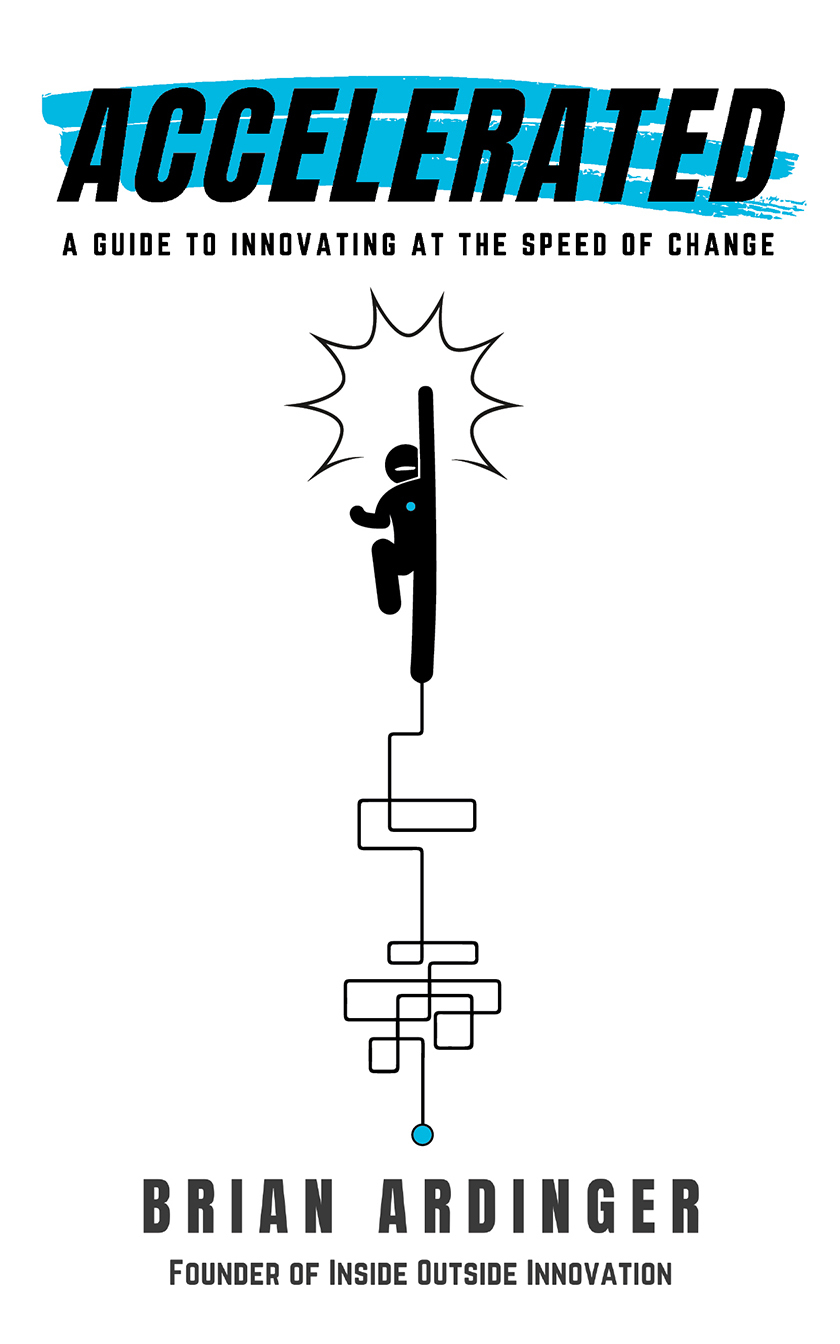
Brian Ardinger: Accelerated: A Guide to Innovating at the Speed of Change
Read the full transcript
Brian Ardinger
Brian Ardinger is Director of Innovation at Nelnet and the founder of InsideOutside.io, creators of the weekly podcast and newsletter by the same name, and The IO Summit—a conference and community for leading and emerging innovators. For over twenty-five years, Brian has helped top brands and explosive startups engage the latest tools, trends, and tactics to accelerate innovation and compete in a world of change and disruption.
Brian has published articles for The Wall Street Journal, Entrepreneur, and other top industry publications and is a highly sought-after public speaker and frequently-quoted industry expert. Connect with him online at InsideOutside.io or on Twitter at @ardinger.
📚 Books by Brian Ardinger
Transcript
[0:00:34] DA: The pace of change is accelerating. Repeatable success in a world of hyper uncertainty requires a constant cycle of innovation with a reliable process for transforming new ideas into valuable outcomes. Based on years of experience working with the likes of Microsoft, Apple, IBM, Nike and more, plus, hundreds of interviews with founders, investors and leading innovators around the globe, Brian Ardinger’s new book, Accelerated, is a handbook for navigating uncertainty and a quick start guide for accelerating innovation. The book invites you to explore the changing landscape of disruption, invites you to refine your own innovation toolsets and discover tactics to develop builders, makers and idea accelerators who can adapt, grow and harness untapped opportunities. Whether you’re a corporate innovator or a startup entrepreneur, you can learn what it takes to explore, engage and experiment your way through today’s accelerating change. Hey listeners, my name is Drew Applebaum and I’m excited to be here today with Brian Ardinger, author of Accelerated: A Guide to Innovating at the Speed of Change. Brian, thank you for joining, welcome to the Author Hour Podcast.
[0:01:53] Brian Ardinger: Thanks Drew, I’m excited to be here.
[0:01:54] DA: Brian, help us kick off the podcast. Could you give us a brief rundown of your professional background?
[0:02:00] Brian Ardinger: Yeah. So it’s long and varied. I began my career mostly in Hong Kong and Asia Pacific with Gartner Group at the early days of the Internet. Since then, I’ve moved along and been really focused on this whole concept of what does it take to create brand-new ideas and move them forward. So whether it was consulting for big companies or most recently, starting a startup accelerator program and now, where I’m at currently as director of innovation at Nelnet, my entire career is kind of focused on how do you take these new ideas, move them fast and create value from that process.
[0:02:34] DA: So you’ve been in the industry for quite some time as you mentioned, so why was now the time to share this story?
[0:02:40] Brian Ardinger: It’s interesting because, I started writing this book before the pandemic and I’ve been speaking and talking to a lot of folks prior to that about this coming disruption and what we were saying from a technologies perspective and the speed of change and I was going to write a book about how you need to prepare for that and then all of a sudden, the pandemic hit and that changes people’s perspectives pretty quickly. It was perfect timing from the standpoint of, I believe that everybody needs to be better prepared for creating value in times of accelerating change and that’s where we are right now. So what I try to do in the book is, create a simple blueprint and some easy guides to allow you to kind of navigate this new world that we’re living in. So whether it’s as a new startup founder trying to create something or as a project manager within a company trying to spin something up or just quite frankly, as an everyday employee trying to get better at innovation and entrepreneurship, these are the skills and the things that I’ve learned over the last 25 years.
[0:03:36] DA: I like that you just mentioned that. I always like to ask, when you started writing the book, who did you write this book for and it sounds like it’s for a lot of people but would you say it’s for already established companies or is this for people also who are trying to get their first idea out and off the ground?
[0:03:52] Brian Ardinger: Yeah, I would say mostly established companies from the standpoint, they’re the ones that have the most challenge in trying to innovate. If you think about a corporation, they have developed a business model that works and their job is to optimize and execute on that particular business model and so innovating is not something that comes readily, easily, to them. So this process is really what I’ve learned from working with early-stage startups who are effectively starting with nothing and how do they go through that exploration phase to create value and I think a lot of what you can learn from the startup so to speak can be applied in a corporate environment because things are changing so fast and these are the skills that you need to learn or you have a potential to being disrupted.
[0:04:36] DA: What would you say the goal for readers of the book should be?
[0:04:41] Brian Ardinger: I think the goal primarily is to one, give a level one set over what innovation is. I think too many times, we think of innovation as having to be creating the next flying car or Twitter or Facebook, things along those lines and while that’s certainly possible with innovation, that’s not necessarily where all the great ideas and the value creation comes from. So I wanted to first you know, let people know that innovation can happen anywhere and it can happen at the very earliest stages. It really is about finding an idea or finding a problem and then, iterating on that problem to create some type of value and you can do that at your current job with your current operations goals and not just looking for and observing where problems and opportunities exist and then taking action on that.
[0:05:26] DA: It is, you know, the title of the book and you did mention this phrase before. So I want to kind of start digging into the book. I want you to kick it off with a definition and so can you describe in your words, what accelerated change in business means to you?
[0:05:43] Brian Ardinger: Yeah, I think accelerated change, I mean, we see it almost every day. If you take a list and I have in the book, you know, a list of different types of technologies that are all hitting at once, you know, everything from artificial intelligence to robots, to you know, self-driving cars, all these particular technologies in and of themselves can be disrupted but yet, they’re all hitting virtually at the same time. So we don’t really know all the knock-in effects in that and then, you couple that with the advancement of access to capital, access to markets, all these different things are accelerating the ability for people to take their ideas, create something of value and immediately, disrupt or change the status quo and so my feeling is you have to have the skillsets and be able to adapt with these changes that are only going to increase as the world moves forward. You know, if you look at the Fortune 500 back when it was originally started, you used to be able to be on that list for years and years and years. Research shows now that your ability to stay at the top of the game is shrinking dramatically and I think that’s only going to increase with these types of changes.
[0:06:49] DA: I think it’s great that you talk about, you know, this rapid acceleration and it’s not just, I think everyone goes to you know, to tech-tech-tech-tech but it’s not just tech. It can also go from tech to capital to talented more, right?
[0:07:03] Brian Ardinger: Yeah, absolutely. So you’ve got access to capital that you’ve never had before, access to markets. I mean, if you think about it, my early days in my career, I was working in the research division and we were building websites for companies like HSBC Bank and Cathay Pacific Airlines and back in the day, you know, it cost two million dollars to build a website and then nowadays, you can be in your garage and over a weekend and you know, $500 and create a lot of the same functionalities that took years and a lot of resources to pull together. In addition, you have access to all these different markets that you would not have had access to before. You know, think about 15, 20 years ago, you had to have a big ad budget and you had television and a couple of other mediums but now, you’ve got Twitter, Facebook, you’ve got all these different ways to reach customers directly and so that’s changing the game as well. So you can experiment and change and create things like never before and what that allows you to do is not all of those things are going to be disruptive or going to change the game but you just have a lot more collisions of things that can possibly do that and then you couple that with you know, access to tools and skillsets that you wouldn’t have access to before. If you look at the power of what you probably have in your pocket right now, your iPhone or your Android phone, if you look at all the technologies that are wrapped in that particular device alone, back in 1986 when I graduated form high school, the cost of the components of that would cost you about $35,000, not to mention the computing power of a super computer that you have in your pocket. So you know, you have about 30 million dollars’ worth of value in your pocket and that’s everybody around the planet walking around in their pocket with this type of power and so that’s naturally going to create a lot of different opportunities, not just you know, change and disruption but if you look at it from the flip side, you have a lot of power in your pocket now that you didn’t have before.
[0:08:54] DA: I want to pivot a little bit to startup accelerators. You mentioned it earlier, you worked in that space for a while. Can you talk about, you know, some of the benefits of working in a startup accelerator and maybe, what you’ve seen with companies who have come in at a very early stage and then grown?
[0:09:09] Brian Ardinger: Yeah, I’m working at a startup accelerator. You know, when we started NMotion about 10, 11 years ago, the idea of an accelerator in the Midwest was kind of new and the idea that you could help create and move companies and accelerate their growth faster by the ability to pull new ideas together in a cohort, surround them with mentors and a community to help them accelerate their progress and then incrementally work with them to launch and grow their first products and new customers. That was kind of a new and novel concept but again, the things like the toolsets and the access to market is that, make that possible that where in the past, you might have had to go to a particular market to find that all on your back yard. Now that access is everywhere and our ability to create things from scratch and move them forward faster than ever before, is only increasing.
[0:10:01] DA: When you come to these you know, innovations and opportunities, would you say that they are always successful or can you go through the right steps and then maybe just through testing or maybe it is just not the right market fit, do things not work out some of the time?
[0:10:17] Brian Ardinger: What I want to say there is that’s part of the process and I think we have to become much more familiar with the fact that most of these ideas are going to fail and that’s part of the process and that is okay. I think again in the corporate environment, we often think you know, if you have an idea and it fails, you know, you’ve lost your job or you have all of these negative stereotypes or consequences around that and a lot of that is true because you are working on things that are known and you’re supposed to execute to the plan. When you step over to the innovation side, you’re by default working in the unknown and so it is a much messier process. You are going to have things where your assumptions that you thought going in don’t hold true and so the ability to pivot and experiment and try things and fail along the way, more importantly, take those failures and create learnings around it is vital to the process. One way we have talk about in the book to kind of de-risk these assumptions is a process we called one-two-three-four and one-two-three-four process really is a way to think about taking a brand new idea and walking it through and iteratively moving that idea along and then moving it to the next stage based on the evidence that you find. So it’s really simple, it’s one minute, two hours, three days and four weeks. So you take an idea with one minute, you jot it down, you kind of find those particular problems or opportunities that you have and you keep a notebook and you jot down in a minute what that particular opportunity is. What you find is if you do that more often, some of those ideas will kind of percolate in your head and say, “I really want to look at that a little bit more” and so maybe you take a two-hour block of time and you flesh that out a little bit. You talk about who is the customer and you look at the competitors and kind of do a little more research and after that two-hour block, you can also then kind of ask some friends or ask some colleagues about, “Hey, have you ever heard of this particular problem? Are you seeing this?” and then if you have enough evidence after that two-hour mark, you want to say, “Hey, I want to look at this a little bit more in depth.” So maybe you take a three-day sprint, maybe you go out and talk to some customers or sketch out a prototype, things along those lines. At the end of the three days you then get back together and say, “Okay, do I have enough evidence that I am on the right path or that you know, what I think the value of creation is, is actually there?” and then you may be put into a four-week sprint. Where again, you may be build it out, flush it out, do some customer discovery, determine whether or not there is any, you know, real traction in the marketplace and so forth and so on but what this allows you to do is take a really simple idea and incrementally test and bet at each particular stage to see if you can make some progress on it and you know, what it does is it changes your mindset because a lot of times, we think that we have an idea and we have to have it all flushed out and all perfect plan before we launch or before we do anything with it. We end up spending a lot of time and resources and money on that. Where this process allows you to at each particular moment to say, “Do I have enough moments that the next amount to bet is important and that I can make value from that?”
[0:13:22] DA: You know, I think it is really important because I imagine it is a tough conversation, you know, having a startup or a young company and you are looking for investment and you talk to a more traditional investor, who says, “Oh, you have done something good, you are successful but in the book, you constantly talk about if you’re not learning and you are not building and innovating every day, your organization won’t keep up. So what does that conversation look like between young CEO, young entrepreneur and traditional investor saying, “Hey, I know we got here and we have this great product but we need to keep building and learning and trying every single day and we might need some funding for that.”
[0:13:56] Brian Ardinger: Hopefully, this book gives you that process that can be an ongoing tool. It is not something that’s one and done. You are always constantly iterating because the market is always iterating and so, what you always want to be doing is kind of, you know, filling your backlog with new ideas and new opportunities and putting them through that particular process, so that you can always have some that are moving forward in that funnel and knowing full well that you know, a large chunk of those will be either shelved or killed or postponed. But the ones that do start showing traction, do start showing value can double down on the resources and that to make those things successful, you know I think too many times, companies have this process where they pick a pet project, they fully funded and then they say, “Come back in a year and tell me if it worked” and then at the end of that particular time they wasted a million dollars and years’ worth of time. Where this particular process allows you to take that same million dollars but maybe spread that over a variety of different projects and then save the resources for the ones that are actually showing evidence and traction.
[0:14:57] DA: You did talk about the exploration phase earlier. So for anyone that is at the company now and says, “Okay, I want to take that next step. I want to try something new” what are some tips and tricks you might have when they are doing that exploring and how long should they really spend on that that they’re not just going too deep down the rabbit hole in one area?
[0:15:17] Brian Ardinger: Yeah, so it obviously depends on what you want to learn and where you are in the process. You know, some ideas are closer to the core, so there may be an innovation that you have a lot more information on you know the customer, you know the market and you’re maybe just tweaking it or making it better. That’s a different type of exploration versus, “Hey, I want to come up with the next cure for cancer” where the ability for that is maybe a little bit different. So the whole exploration phase is really about getting in the habit of identifying ideas, identifying problems and identifying opportunities and becoming more creative around that particular process. So seeking out new voices, making sure that you have new experiences not only looking for ideas in your industry or your own backyard or with what your competitors are doing but looking outside into the startup world or to a different industry, things like that. It also means kind of looking for ways to learn and unlearn what you are currently doing. You know, just to double check, are we on the right path? Why do we do things the way we’re doing them? Can there be different ways? That ability to explore and ask the questions, goes a long way to finding new ideas and making something valuable out of it.
[0:16:29] DA: Now, we talked earlier about your goal for readers of the book but maybe when they are halfway through or even when they finish, are there any immediate steps that you hope readers will take either with their career or at their company, you know, after learning and educating themselves from the book?
[0:16:47] Brian Ardinger: Yeah, absolutely. Again, it has really been designed as a pocket guide to make you think some of these particular techniques, give you some insight into how other companies in that are doing it, kind of give you some case studies for how disruption is changing the world and I think at the end of the day, what you should feel after reading this book is just more confident in this uncertainty that we are living in. More confident in the mindset, more confident in the tools that you have, and more confident in your ability to connect and find the answers that you need to find.
[0:17:18] DA: Brian, you do have a website where folks can find out just a little bit about more about you and your company. Can you tell us what that website is and what folks can find there?
[0:17:27] Brian Ardinger: Yeah, absolutely. So I have been producing a podcast for about seven years way before podcast were cool called Inside Outside Innovation and we’ve developed a community around that. So you can go to insideoutside.io, find out all about our newsletter, and our guests, and our podcast as well as the book.
[0:17:44] DA: Well Brian, we just touched on the surface of the book here. There is so much more inside, the entire guide is there. I just want to say that, you know, building this book as a way for companies and company leaders to just continue to innovate is no small feat. So congratulations on having your book published.
[0:17:59] Brian Ardinger: Absolutely. I appreciate you guys giving me the opportunity to tell you more about it and look forward to connecting people, feel free to reach out to me on LinkedIn or Twitter at @ardinger. Always happy to share what I know and help people along the way.
[0:18:11] DA: Well Brian, this has been a pleasure. I am excited for people to check out the book. Everyone, the book is called, Accelerated, and you could find it on Amazon. Brian, thank you so much for giving us some of your time today and best of luck with the new book.
[0:18:23] Brian Ardinger: Thank you.
[0:18:25] DA: Thanks for joining us for this episode of Author Hour. You can get Brian Ardinger’s new book, Accelerated, on Amazon. Also, you can also find a transcript of this episode and all of our other episodes on our website at authorhour.co. For more Author Hour, subscribe to this podcast on your favorite subscription service. Thank you for joining us, we’ll see you next time. Same place, different author.
Want to Write Your Own Book?
Scribe has helped over 2,000 authors turn their expertise into published books.
Schedule a Free Consult