Matt Lesser: Episode 1021
Read the full transcript
Matt Lesser
Prior to founding Uniquely Normal, Matt Lesser served in various C-Suite roles in private equity, banking, and commercial uniform industries. Before serving in corporate roles, Matt launched and operated several businesses in the petroleum industry for 15 years (serving IN, MI, OH). Before selling in 2007, the business had expanded exponentially.
Matt is a published author and just finished his first book, Beyond Thriving… (in the publishing process). Matt enjoys traveling, biking, running, weightlifting, writing, speaking, and reading. Matt is the Founder/CEO of Uniquely Normal, LLC. Matt has had the honor of training leaders, teams, and boards of directors in 44 countries over the past 20 years.
Provided by Matt:
Matthew Lesser is the founder of Uniquely Normal, a firm dedicated to helping organizations develop healthy culture and high-performance teams. Matthew spent twenty-eight years owning, operating, and leading businesses, and serving on boards. He developed leaders and teams domestically and internationally before deciding to pursue his dream of writing, speaking, and consulting. Matthew earned undergraduate degrees from Indiana University and an MBA from Taylor University. He earned certification in nearly twenty personality, behavioral, and leadership assessments focused on growing in self- and others-awareness and building healthy relationships and teams. Matthew and Tiffani live in northeast Indiana with two of their three children. For more information, please visit
📚 Books by Matt Lesser
Transcript
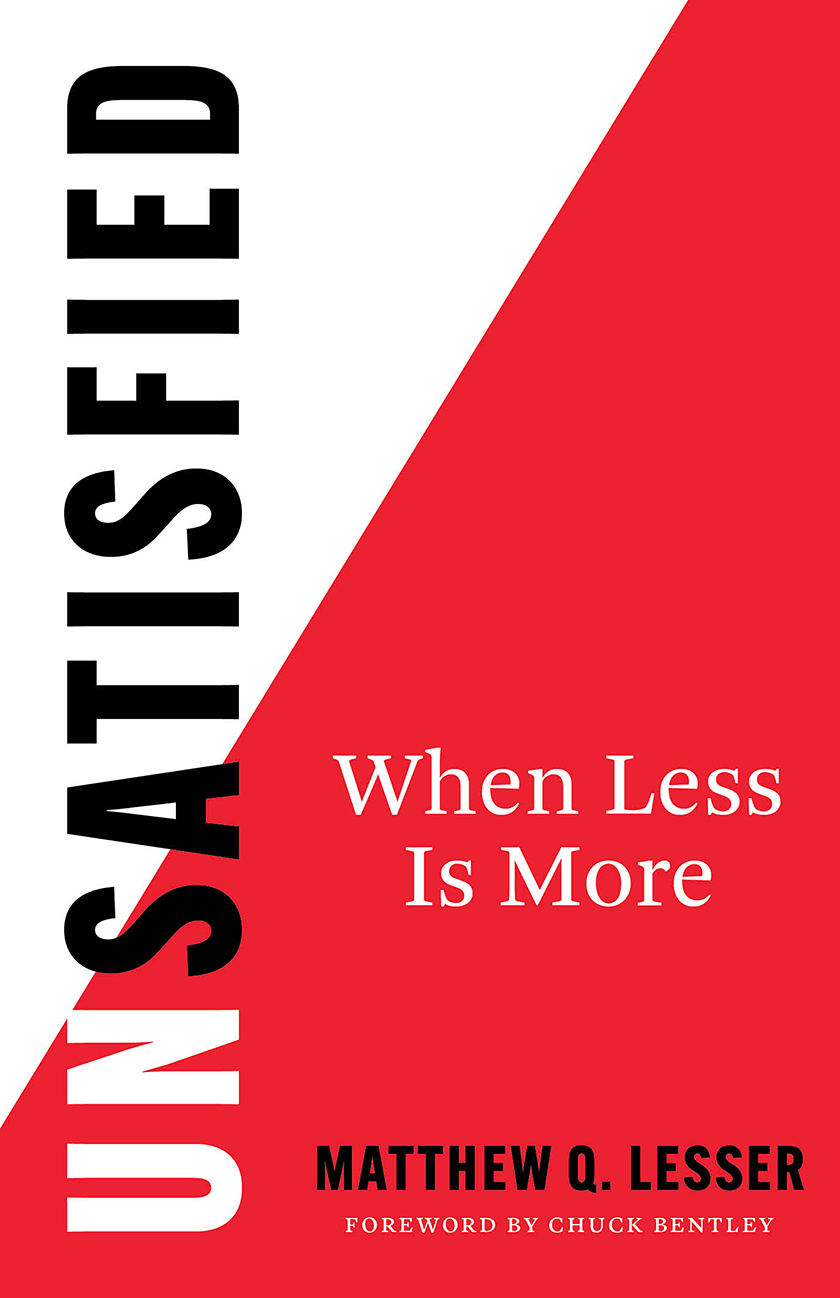
[0:00:31] GR: Hey everybody, welcome to the Author Hour podcast. As always, I’m your host, Gunner Rogers. I am joined today by a really interesting, intelligent man, Matt Lesser whose book, Unsatisfied: When Less is More, just hit Amazon yesterday. The Kindle version of his book is available for 99 cents for this week and this week only. So make sure you capitalize on that discount, but first, enjoy this conversation with Matt. All right everybody, as I mentioned in the intro, I am very honored to be joined by Matt Lesser today whose new book, Unsatisfied: When Less is More is available on Amazon today. We want you to go check out a copy but before you do so, I want you to listen to this conversation. Matt, thank you so much for joining me today.
[0:01:19] Matt Lesser: Thank you very much for having me on.
[0:01:22] GR: I’m really excited, I’ve loved reading through the book as we were talking about before we hit record, and just as a general question, I wanted to know, you know, the theme of the book is very much about as it says in the subtitle, “when less is more.” For you, as somebody who has achieved a lot, has always been incredibly driven, when did you personally first realize, all your achievements were leading to more dissatisfaction than they were satisfaction.
[0:01:49] Matt Lesser: That is a great question, Gunner. For me, it was not a sudden realization. I would say, it was a dawning realization over the course of several years and it really came to a head for me, probably about five years ago. I didn’t really know what was happening, I just realized that I have achieved a certain level of accomplishment and of success and there was yet this feeling of, “Is this it?” It was the same feeling that I had encountered several times over the last 20 years in working with leaders and leadership teams, and seeing them sacrifice and work their tails off to get to a certain level of success in life, and then they reach this point where they’ve climbed every ladder or they’ve climbed the highest mountain and they’ve reached the pinnacle of their game and they look around and say, “Is this it?” I had started to feel that same way and but yet, I didn’t really realize it until about two years ago. It really started to come to ahead and that’s about the time I got serious about thinking about writing this book.
[0:02:56] GR: That’s awesome, and as far as some of the restlessness and the discontent and the dissatisfaction that comes with this whole journey, was it something those closest to you were aware of as well or was it really just you like in your head and in your heart, knowing that you weren’t where you wanted to be in life, or was it pretty obvious to those around you as well?
[0:03:19] Matt Lesser: Again, another great question. My wife was very aware of it. In fact, when I worked in private equity, she had actually been praying that I would become more aware of what was going on inside of me and I just wasn’t and so, when I finally resigned, I called her, and on the way home and say, “You know, honey, I resigned today.” There was this long pause and then, I could hear her sniffling, so I knew she was crying and I said, “What?” And she said, “Just give me a minute” and I’m like, “What? I’m sorry, I thought we were on the same page and…”
[0:03:51] GR: I did a good thing here.
[0:03:53] Matt Lesser: Exactly and she said, “No-no-no” She’s like, “I’m fine” She’s like, “These are not tears of sadness or frustration, these are tears of joy” and I said, “What?” and she said, “Honey, I’ve been praying for you for two years that you would start to wake up to what was going on inside of you.” She was like, “I’ve seen it” and she said, “I’m praying that this is the moment where you begin to wake up and things begin to change.” Now, it took another – about a year, a year and a half for that really to start to grow in me, but she had seen it way before I did.
[0:04:23] GR: Well literally, thank God for your wife and her prayers because now, we’re here talking about an amazing book that’s going to help even more people work through this pivotal point in their life. I want to come back to that moment in a second but to zoom out really quick, you know, we’re talking about when you first started realizing personally and working through, you know, less is more, you're unsatisfied, let’s zoom out to the cultural level. Why do you believe our culture has gone so far down this path of more success equals more satisfaction?
[0:04:55] Matt Lesser: You know, I think there’s a lot of contributing factors. At a macro level, I believe that each of us are created to have a personal relationship with a God who loves us and a God who cares about us, and so as long as we do not have that then there’s this search for deeper meaning, deeper satisfaction in life, and we tried to fill that. Even those of us who have a relationship with God, there’s still this, can be this overwhelming sense of, “I have to find more, I have to have more” and I think that drives our culture and it drives us to the only way that you can truly be satisfied in life is if you have more this and more of that and you know, a bigger bank account, more cars, more houses, more titles, more positions and so that’s what we are sold. It isn’t even western culture anymore, I’ve experienced this in other cultures. I’ve spent a lot of time on the African continent and I see it there too and I think that it is at its core, and this is just me talking. I think at its core, it’s this – it’s the sense of, there has to be deeper meaning and satisfaction in life and we can find it, and yet, we can’t find it on our own. That’s the rub and the disconnect between culture and the way that we’re created.
[0:06:11] GR: I love that, just really quick, that makes me think of you know, I journal every morning and journal a lot of prayers and I remember one time, God laid this on my heart and it kind of experiencing some very similar wrestling’s and some tension with success and what is satisfying, and just wrote down the phrase, “God really speaks above the noise I create in my own life” and so, that has made me think of that and so, thank you for sharing that and then, let’s go back to that moment you talked to your wife and you mentioned you know, it took about another year and a half to get to a place where you felt like you were satisfied. Number one, how scary was it leaving a stable job, private equity, this position you’ve worked so, so hard for and have achieved so much for? How scary was it leaving that and then, what was the process of sort of, unraveling and shedding this habit and this conception of you have to do more and get more and actually, becoming less?
[0:07:09] Matt Lesser: Well, it was scary because I didn’t know exactly what the future held and so, I knew that I was beginning some kind of a journey. I didn’t know what the journey was and so, I went from there into another job that literally, I realized, within the first week that I had made a mistake and I gutted it out for as long as I could and then, left there, and then, honestly, at that point, I had no idea what I was going to do and I was okay with it for some odd reason and then, I wound up helping a friend of mine in his business for about another year. But it was during that year where God really began to bring some clarity to this idea, this dream of writing a book, which had been a dream of mine for about a decade. It’s one of those things that it was a dream of mine for a decade, about five years ago, I literally started praying, “God, take this dream away from me, I don’t want to do this.” I don’t want to write a book.
[0:08:03] GR: Which must be in your supposed to do.
[0:08:05] Matt Lesser: I guess. I was intimidated by it. It’s like, “I don’t want to do this, I don’t want to write, I don’t – this is too hard, it’s too difficult” and so I said, “Please, take this away from me” and every time I prayed that prayer. It’s like, within the next week or two, I’d have an additional step of clarity and I’m like, “God, we’re not on the same page here.” So when I stopped working for my friend and really started diving into the book is where my heart began to have some clarity on, “Okay, wait a minute, this is really as much about my journey as it is about talking about the cultural pressures that we all face” and so the book has both some of the cultural pressures of more and what that leads to as well as my own story.
[0:08:45] GR: I love that, and was that as far as beginning to work on the book and really began going down that path, was that in tandem with beginning to also work with business leaders and sort of consulting on this truth and not just in principle but this truth, that less is more, and I know you mentioned in the intro, you know, there was that moment where you worked with a couple of leaders and helped them sort of identify this problem and start working through that. So was that in tandem with the book or did it come before it or after it?
[0:09:17] Matt Lesser: Great question. It actually, over the last couple of decades actually, and working with leaders and their teams, it wasn’t that we necessary focused on this issue. It started out as okay, I saw it once and then I saw it again and again and again and so what I saw is a trend became a pattern ad that never really left me and I observed that over and over again and so, I began to ask the question, “Okay, what is it?” If this, if accomplishing a certain level of success in life is not leading to growing satisfaction then what is, what is that next level?” In fact, the initial working title of the book was called, Beyond Thriving because I believe our culture tells us, “Hey, you reached a thriving life, you’re all set” and it’s just not true. So when I started writing the book is when I also started a consulting firm to begin focused on working with teams become teams and leaders and leadership teams, to become the healthiest version that they can be both individually and as a team and part of it is, wrestling through this, “Okay, what is it that you're truly called to do, you’re passionate about doing, you’re good at doing and others that you contribute value?” For some people, they’re exactly doing that but they may be doing it for the wrong motivation and so it’s really starting to sort through, “Okay, what is your core motivation and how do you reach the top of what I now call flourishing?” not focused on yourself anymore, you’re focused on something that’s bigger than you, of pouring out, of giving back.
[0:10:50] GR: I love that, and as you’ve begun consulting, we’re going to talk about a little bit more too, that’s good the consulting piece. As you’ve been doing this and working with clients, working with individuals and teams. What is the thing or what is the message that helps your clients start moving towards true purpose and true fulfillment and thriving, and away from achieve-achieve-achieve, more-more-more?
[0:11:16] Matt Lesser: Yeah, it’s not really one thing, that’s both the beauty and the difficulty of trying to build a consulting business when you’re not necessarily trying to sell one thing and so honestly, the name of my business is called, Uniquely Normal because I believe we’re all uniquely traded, uniquely made and that’s normal. That’s the same thing for both individuals and for organizations and so when I have the opportunity to meet with the leader, I literally start with a blank piece of paper and a pen in my hand and I just start asking questions. First, I want to know their story personally and I want to know the story of the organization and that we just gravitate toward, “Okay, what are your points of pain, what are you observing, where do you want to be, why aren’t you there, what are the barriers?” and then we’d naturally leads to discussions on their own personal frustrations, some of their personal shortcomings at times. Places where they thought they might be by this point in life but they’re not and they don’t understand why. It often leads to personal discussions on family and marriage and kids and you know, what they’ve had to sacrifice to get where they are and asking questions of, “Has it really been worth it? How do I now bring in some kind of better…” I hate to use the word balance because they’ve had – it is overused.
[0:12:31] GR: It is such a lie.
[0:12:31] Matt Lesser: It really is and so how do we –
[0:12:33] GR: It doesn’t exist. It doesn’t exists everybody.
[0:12:35] Matt Lesser: No, you’re right and so I’d much prefer the word integration. So how do I live a better-integrated life, where I am not giving all of me to my work and leftovers to my family but I am giving all of me to everything that I do, in such a way that it brings me lasting satisfaction and inner peace? Because I know that I am not sacrificing one for the other.
[0:12:59] GR: I love that, and then continuing on as you work with clients, as even doing it, what has been a major misconception about what satisfaction even is as far as you know, what these clients believe is going to be satisfactory versus what actually is satisfactory?
[0:13:16] Matt Lesser: So again, it is not just one conversation or one solution. If it was then it would be a whole lot easier to sell it quite frankly. So it is trying to find out, “Okay, where are your points of dissatisfaction? Where are your frustrations and what did you think would happen or where did you think you would be by now?” and then it is leading to discussions about, “Okay, tell me about what is it that you thought would bring you lasting satisfaction, why didn’t it, and let’s talk about some other areas that you think could?” Often times that leads into, “You know, these are the things that I dreamt about, these are the things that I was hoping to have accomplished or hoping that would have happened in my life” and the reality is, those discussions they have yet to have – I am not going to say never because at some point in the future, there could be the exception but those discussions have never led to, “Man, I wish I had more money” or “I wish I had more possessions” or “I wish I had a bigger organization” or a bigger company or whatever it might be. It’s always like, “Man, I wish I had spent more time with my kids” or “I wish I had spent more time with my spouse. I wish that I would have focused more on giving back” and thinking about legacy and thinking about, you know, what is it that my life truly stands for versus just day in and day out grinding it out for more and more, and more money or a bigger this or a bigger that and that’s where those conversations have been moving towards.
[0:14:47] GR: That’s awesome and then coming back to that first experience you had really walking leaders through this concept and this truth, we were talking about Eric Liddell earlier just connecting on that and you mentioned in the book, you know, that was the moment that you experienced God’s pleasure and that was a very overwhelming moment, very powerful. I am curious even especially for myself, after that big “aha moment” how have you continued to allow yourself to experience God’s pleasure in day-to-day life?
[0:15:21] Matt Lesser: Oh, that’s another great question there. I sound like a broken record but these are great questions.
[0:15:26] GR: I appreciate that.
[0:15:28] Matt Lesser: One of the things, when I started this business, a good friend of mine, a friend and mentor of mine, we had served on a board together for many years and he said to me, he said, “As you’re starting your business” he said, “Don’t do it alone” and I said, “Well, what do you mean by that?” and he said, “Too many” as you know and I did know this, he said, “Too many leaders try to do it alone.” There is a reason why they are saying it is lonely at the top or leaders they feel alone because often time they don’t know who to trust or whatever. He said, “Don’t do it alone” and so I said, “What do you recommend?” and he says, “I recommend put together a personal board of directors. He said choose four or five people that you trust, that you know love you, that care about you, that won’t just nod their head and wag the tail every time you talk. That would lovingly challenge you and confront you what needs to be done, and so I took that to heart and I ask three men that I really value and I know that love me and care about me and I ask my wife and so we meet quarterly and so in our third meeting – I am answering your question, just a long way around the bar here.
[0:16:31] GR: Hey, take your time. I love this man.
[0:16:33] Matt Lesser: So in our third meeting, one of the guys that we literally shared an office and when we were private equity, we literally shared an office together by choice because he and I are so different than one another, we joke about it now but we were so different that together, we were one plus one is greater than two and so at the beginning of this meeting, it was a scheduled four-hour meeting, half our end of the meeting this guy says, “Time out.” And I love this guy and he is not that assertive verbally but he is one of these guys that when he talks, the room just goes quiet because when he talks, he has something to say that’s really good and he said, “I don’t want to talk about the business or the book or anything else for the rest of this meeting” and I’m like, I just chuckled. I’m like, “Okay, we have three and a half hours left, what do you want to talk about?” He just says, “I want to talk about your being” and I said, “My being?” and he says, yes, he says, “I worked with you day in and day out for six years” he says, “I know you are good at doing” he says, “How is your being?” and I literally said, “I am not sure what you are talking about” and so he challenged me to read two books. I read them both and one of those books was by Ruth Haley Barton. It was called Sacred Rhythms and it was that book that really challenged me. It opened my mind and my thinking to, “Okay, what does it truly mean to have, to live a life that is walking daily with God fully surrendered to Him?” and that led me then to join this 27-month experience with her to where you get away with a bunch of other people for three days, once a quarter and you spend a lot of that time just in solitude and silence and before God and really focus on your relationship with Him. That for me has helped center me and help put into focus okay, what does it truly mean to live focused on what is most important and surrendered to Him, which I talk about in the book and it reminds me then to live a life beyond me and that life is more than just me, that life is so much bigger than that. So anyway, sorry for the long-winded answer on that one.
[0:18:48] GR: Hey, take that apology back we’re all benefiting from it, my friend.
[0:18:51] Matt Lesser: Okay.
[0:18:52] GR: I know I’ve said it a lot, I love that. I love that answer and so I know it is going to be tough but I am going to make you choose one, so bear with me here. If you could share just one message from this book with the people who need it most, what would that message be? High stakes, I know.
[0:19:10] Matt Lesser: I know, just one. I think it would be this, don’t settle. Don’t think that the life you have right now is the only life that you can have. Life is hard, life can be frustrating, life can throw it’s fury at us, and that, sometimes, we can get to the place where we just say, “You know what? This is all there is and so be it” and I just don’t agree with that and that’s why in the book, it talks about this triangle model and culture tells you to pursue a thriving life. When you have reached that, then you have accomplished all of this life can offer and I don’t agree with that. I think it is a great lie and I think that there is more and that is why the top level and this model is called flourishing and that is living beyond myself. I guess the bottom line story for me is or the bottom line message for this book is, don’t settle for anything less than a flourishing life.
[0:20:07] GR: Gosh, I almost want to end the conversation right there, don’t settle for anything less than a flourishing life, I love that and so to get there, you know, reading the book is definitely going to be a part of getting people there, but I am sure there are some next steps and so for everybody listening who is going to go purchase a copy of, Unsatisfied: When Less is More, once they put the book down and they have read it, what are the best next steps they can take?
[0:20:31] Matt Lesser: Great question again, one of the things that I was passionate about in writing this book is that I did not want it to be just another philosophical and conceptual book that left you with ideas and really, you know, guidelines on, “Okay, what do I do with this?” and so the book is divided into three parts. The first two parts are about the model and about story and then the third part of the book I’ve actually labeled integration, okay? So basically it’s I get to the end of part two and you ask the question, “Okay, great. Now what? You gave me this information, I’m interested, I’m leaning in, so now what do I do with this?” and so the entire third part of the book is all about, “Okay, these are your next steps.” If you want to truly pursue a flourishing life, here are some practical exercises, some practical questions you can pursue and you can work through in order to really start to pursue and think about, “Okay, what is it that – how am I truly made, who am I? Why am I here, and what am I to be and what am I to do?” and the exercise is that that, in part three will lead you down that path. I’m not going to say it’s going to get you down the path fully but it’s going to at least start you down the path to answering those questions for you.
[0:21:47] GR: I love that, you guys all heard it here first and then last question I always like to ask authors is, especially for a book like this, where engagement is going to be so important to continuing to help people, once they take those next steps, they’ve read the book, they take their next steps, how can readers find you and engage with you?
[0:22:06] Matt Lesser: In the book, I have in the about me section or the bio section, I’ve included both the website for my business and also my contact information, so people can reach out to me via email or go on to the website and they could fill up the contact information forum either way, but I would love to engage with anyone that would like to talk about this more and go from there.
[0:22:27] GR: Heck yeah, awesome. Matt, thank you so much for your time today, I’m so excited for people to hear this episode and then once they hear it, everybody, Unsatisfied: When Less is More, is available on Amazon as of today. The Kindle version is discounted to 99 cents for this week and this week only. So make sure you check that out, go check out Matt’s website and make sure to follow up with him. Matt, thank you so much for your time but more than that, thank you for sharing your story and doing something that you told God you didn’t want to do.
[0:22:56] Matt Lesser: Thank you Gunner, I really appreciate it. Thank you.
[0:23:02] GR: Once again, thank you so much, Matt. Matt’s book, Unsatisfied: When Less is More, is available on Amazon today. Make sure you go take advantage of the 99-cent Kindle discount. A transcript of this episode as well as all of our previous episodes are available at authorhour.co. For more Author Hour, subscribe to this podcast on your favorite subscription service. Thanks for joining us and we’ll see you next time, same place, different author.
Want to Write Your Own Book?
Scribe has helped over 2,000 authors turn their expertise into published books.
Schedule a Free Consult