Chris Jennings: Episode 1133
Read the full transcript
Chris Jennings
Chris Jennings has worked personally with thousands of team over many years to make it easier for you and your team to just talk to people in plain simple terms, without over doing it, without saying something that doesn't fit your personality, without either you or your customer feeling awkward, even if the subject matter is difficult, Chris makes the conversation easy to have, and leads to better outcomes for you and your customers.
Chris has owned a sales, leadership, & business development consulting organization "Chris Jennings Group" since 1995. He is a featured & Top Rated Speaker for Vistage International, and has spoken to & coached thousands of private and industry specific organizations.
"He made sales simple for me"
"He helped me organize my sales department & grow the team's results in a well thought out, and easy to follow way"
"His style is so relaxed, and engaging, that me and my entire organization was willing to learn and try new strategies"
"Chris really wants to make us all better & he has given me a step by step way to get to my goals, not to mention much higher goals than i ever imagined before.
Chris is the proud father of 3 adult daughters, he and his wife Lenna, live in Orange County, California, and he is a service first minded individual, as well as former triathlete, and huge competitive sports fan. Everyone will enjoy their time with him, and the words he has to share with us all.
📚 Books by Chris Jennings
Transcript
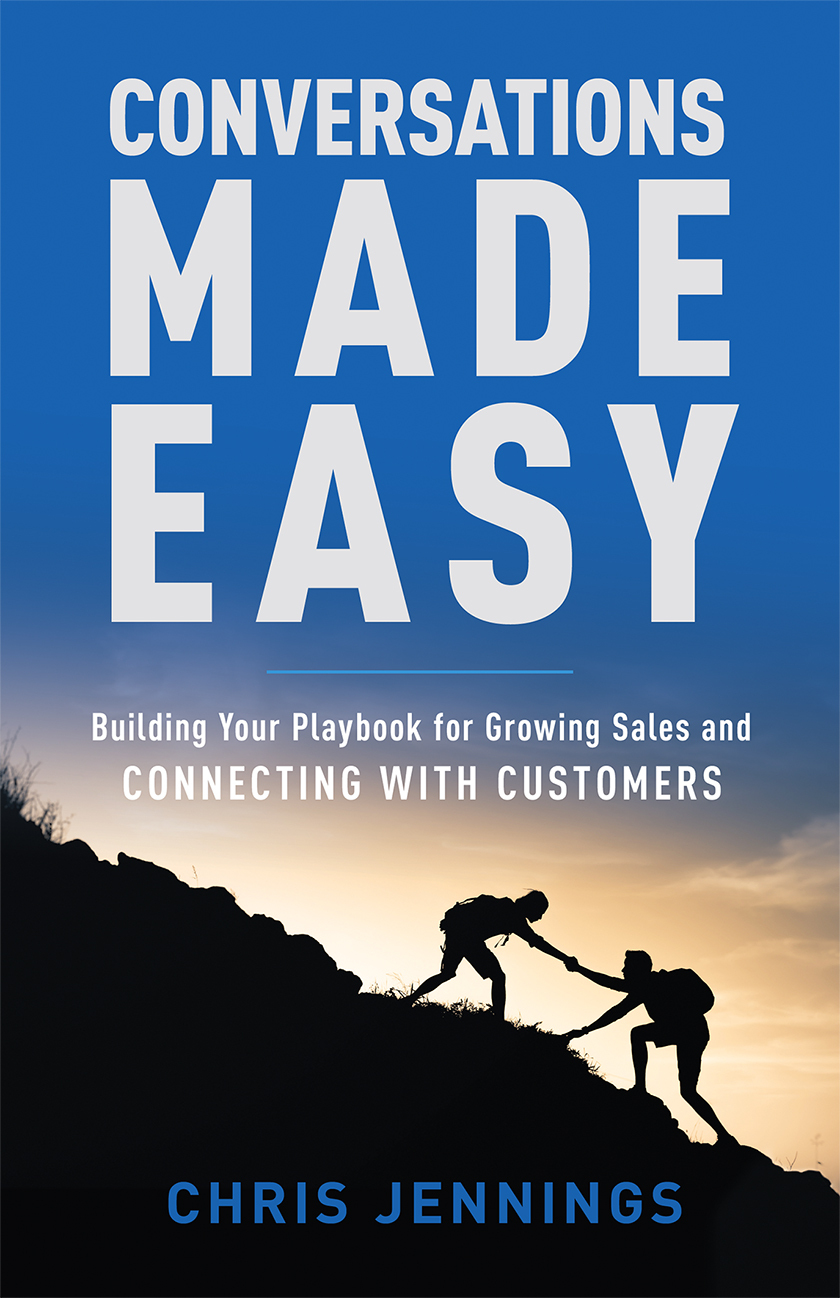
[0:00:34] HA: For sales professionals and business leaders, communicating effectively and authentically is a never ending struggle, especially in building new business and improving team performance. That’s a struggle with a long-lasting impact rippling into both profit and reputation. Welcome back to the Author Hour Podcast. I’m your host Hussein Al-Baiaty and my next guest is Chris Jennings, who is here to talk about his newest book called, Conversations Made Easy: Building Your Playbook for Growing Sales and Connecting with Customers. Let’s flip through it. Hello my friends and welcome back to the show. I am with my good friend, Chris Jennings today who just launched a new book called, Conversations Made Easy. Chris, thanks for coming on the show.
[0:01:23] Chris Jennings: Absolutely Hussein, glad to be here my friend.
[0:01:25] HA: Yeah man, this is really exciting. I found your book very easy to navigate, I was digesting these stuff. I didn’t read the whole thing, I got to be honest with you but I did find myself really sucked in. You use great stories, easy language for one not being a sales guru or anything like that, you’re really helping me set the tone. So kudos to you man, I know a book like that is tough, it’s tough businesses. Welcome to the show man. Before we get into the book, so I’m super excited to get into, I want our listeners, just an idea of who you are, your personal background perhaps, where you grew up, what that was like for you? Maybe a person or two that inspired you while growing up.
[0:02:05] Chris Jennings: You got it. I was born in New York, raised mostly in Connecticut and I mentioned in the book early on like, my first experience with sales was knocking on doors after a snowstorm in Connecticut, seeing if I could get 10 bucks to shovel somebody’s driveway or in the spring, you know, handing out flyers and knocking on doors to try to get somebody to let me cut their lawn or rake their leaves, you know? So I was working from an early age. I’ve always felt like I’ve had a good work ethic, and I suit up, I show up, I try to get stuff done and I would say in terms of inspiration in the east coast, there’s a lot of formality. My dad was one inspiration. He was a bit of a mad man kind of guy, he’s an advertising guy out on New York. He got on a train every day, worked for different ad agencies. But he had a work ethic, it was seven to seven for a long time for him. And I don’t think that you got to work seven to seven to get stuff done but definitely my dad is somebody that I looked up to and admired and then, when I go more broadly, in all honesty, I was influenced by a lot of athletes. Back then, it was Joe Namath and the JETS actually won a Superbowl, if you can believe that. Willis Reed and the New York Knicks and all these people from back in the day when even the Knicks were good and so there’s a lot of athletes and then as I hit my professional career and got through college, went to school at UCLA, starting my first job as like an avid learner, I’d be driving, I had this long commute and I would be listening to at the time books on tape. You know, I started getting into Stephen Covey and The Seven Habits and Phil Knight and work he did with Shoe Dog. There’s a lot of people who were inspirations to me and what they’ve accomplished. You know, that’s a little bit of me and today, I’m married to a beautiful, lovely wife. Her name is Lana, we’ve been married for seven 17 years, we have the most awesome marriage on the planet. I have three kids that are adults and I just had a grand baby on February 1st, her name is Ruby Willow. So…
[0:04:08] HA: Oh wow, congratulations man. I love that, you’re starting the year off real strong, I love that. Wow, congratulations man. Well, I’ve had the pleasure of meeting you in person recently while you started your second book and I got to say man, being around you is great, you have such a great energy. I love that and appreciate it. You have a very broad umbrella perception on things, which I really admire and this is why I’m really grateful to be sitting with you today. I do want to know, I mean, you talk about this in your book really early on and I thought it was really powerful because it’s so simple. What is being useful mean to you?
[0:04:45] Chris Jennings: Yeah, that’s a great question. That’s at the heart of the whole thing. I look at it, our job in life is to just go out and help the people that were good at helping. Find people that need the kind of help that we offer and figure out a way to connect with them and if we can help them or not. Hey, not everybody’s helpable but I want us to like use our energies to good purpose and whether you need help writing a book like you guys have helped me or you need to help figure installing some kind of software or you need help with sales or leadership or whatever it is, our job each day and we should be thinking when we go out into the world is like, “Okay, how am I going to put myself to maximum use to people that I encounter?” “What am I going to bring to the table for my clients?” I try to have a lot of passion around that. I do a lot of coaching and training as you’d imagine and I always, before I walk into a program, I give myself a little pep talk like just making sure, you know, I bring everything I’ve got to help that group and really be useful and I want people to just carry that messaging, never about selling anybody anything. It’s about like, can we be useful to them? And so when I got the inspiration to use that as a framework, it hit home with me and that’s what I try to convey all the time in the book and anytime somebody sees me live.
[0:06:06] HA: That’s so powerful, man. You operate from such a human element, and I just appreciate that. Can you share a little bit more about maybe your first experience as a sales person and how that influenced your journey from that point forward?
[0:06:19] Chris Jennings: Yeah, sure. So like I said, knocking on doors as a kid, that was really my first experience but then at UCLA, I got hired by a pretty big company, real big company and one of the things they had us do along the way was they gave us this territory to go knock on doors and I was in San Francisco knocking on - it wasn’t glamorous my friend. It was transmission shops in various parts of San Francisco and I was trying to see if I could get them to carry our products or not. I got to tell you, there’s times and I reference this in the book where you're in your head thinking about, “Is this going anywhere and is this going to produce some kind of outcomes?” and I also believe, you got to have some faith in whatever you’re doing, right? That I’m going to go, I got a plan, I’m going to follow the plan, I got faith that this is going to work out that I bet you, there’s a lot of people out there that need my help and it’s my job to go find them and I told myself that often. I tell everybody that I coach to tell themselves that. There’s a lot of people out there that need your help and it’s your job to go find them, and so I started knocking on some doors and I got some results much faster than I expected and that was inspiring and then I just started building, right? One step at a time.
[0:07:35] HA: That’s amazing, man. Yeah, I feel like at some point, every person finds themselves in a sales position, right? Like I think for me, where I started, was like, flipping gyros at a Saturday market and the sale was do you basically want to get them regular sized pita or the bigger sized pita, you know what I mean? But we all start somewhere and we all are in way, selling something of ourselves and it’s actually not selling, it’s really knowing what that person needs and if you can match that, you know what I mean? And you may not be able to because you may not have the skills or whatever and that flip in thinking is really on point in thinking about sales. What led you to believe that doing is more important than thinking when it comes to sales and coaching?
[0:08:23] Chris Jennings: The only thing we have control over is our actions. What we do, what we say. We have control over one person on this planet, it’s us. It’s the person we see in the mirror every day and it really stood out to me that if that’s the only thing I got control over, I better take care of that first and then, it’s really easy. It’s such a busy life, we’re just inundated with messaging, email text, the whole thing, social media, there’s so many incoming messages that you got to be able to set aside enough time to get stuff done. Otherwise, you’re never going to get to what you want to get to and that can mean your work. That can mean your personal life, like, what’s really important and are you focused on that or did we lose focus on that along the way in the myriad of things that just keep coming at us. So if you got control over it, we should probably take care of it, let’s go do that. If I can check that box, then the variables in the conversation, we can work on getting better over a period of time.
[0:09:30] HA: To think about – like listen, really the bottom line is you have control of over how you take action. However, what you input into the thoughts that provoke those actions, you know, matters just as much, if not more. I feel like, right? And your surroundings, how you actually… you know, if you’re moving from one house to another, selling a product or one business to another which I did, you know, I was offering my printing services for almost 15 years, right? I evolved so much from just one business to another to calling to online market, you know, all of these different ways of getting in front of customers. But the bottom line is and what I love about your book is those conversations that lead the relationships that can lead to meaningful ways of ensuring that not only you’re serving this thing but you're actually ensuring that that person still needs what you offer. That’s really powerful. How do you approach having healthy conversations with customers without gimmicks or pressure, what’s your way of sort of approaching that?
[0:10:38] Chris Jennings: Yeah, so I think it helps that your confidence in yourself, if you have a plan that you’re following and if you’ve got your top five activities and you’re actually executing on those, and you’re doing that day in day out, number one, at least you can feel really good about what you're doing. Secondly, once you get in front of somebody, I think one of the biggest things to have a great conversation, don’t get overly attached to the outcome. When you put too much pressure on yourself or the person you’re talking to, that this conversation has to go a certain way, you’re going to create some natural resistance. I just love you to walk in super open, looking forward to the conversation, knowing that you bring a lot, interested in that other person to get to know what they’re about, whether this turns into a piece of business for you or not is kind of irrelevant and if you can approach every conversation like that, I think that puts you at your best. You’re super relaxed, you’re more authentic, you’re not trying too hard and people know when you’re trying too hard. It just doesn’t come across as authentic, it doesn’t come across as real and I just think, what human beings crave, they want authenticity. They want to know you are who you say you are. They want to know you’re for real and the way you get there is you detach from the outcome and you get focus on the other individual. You get to learn about them and come to an assessment whether you’re not, you think you can help them and if you can, you can share that with them and give them your opinion of what you think you can do. But again you know, that might lead to something happening and it might not and as long as you have that mentality, I think you’re going to do great.
[0:12:17] HA: Yeah, it definitely takes the pressure off, right? I feel like any time I went somewhere thinking like, “Okay, I’m going to do some business from this and whatever” I was in the wrong state of mind. It was just, I didn’t feel good in my skin, you know? But then any time I went and kind of shut off and I was just, “You know, I’m just going to meet a couple of people, just be interested in them and what they do and how they do it” and literally, what led me to doing this podcast show, right? Like is that innate ability to shift my like the selling of who I am as a person that can offer value was dependent on being interested and I knew that was a strength of mine personally and by being interested, I am like truly in awe in how people do things, like I love that. So by asking those kinds of questions, you get people to talk about of course not only like, who they are but what they do, which is their thing that they’re passionate about and they just create a fluid sort of conversation. And again, it may lead to potential or it may not but the thing is, is creating a memorable experience when you meet that person and I think the most memorable thing we can do and create is like listening and being interested. I think that’s one of the most powerful things and you really go into those kinds of things but how do you address? I mean, this is something really, I mean, man, procrastination is a deep one, right? But how do you address procrastination in excuse making in sales and coaching methodologies because procrastination is no joke. It’s a heavy one, it’s there, it exists, how do you overcome it?
[0:13:51] Chris Jennings: So everybody’s got some element of that of things they like to do, of things they don’t like to do. That’s not really the point. It’s do you have clarity on what your plan is and are you committed to executing on your plan and just following through and doing what you said you would do and I feel like in life, if you do what you say you’re going to do, you feel better about yourself. Your confidence grows, you feel comfortable in your own skin and people naturally gravitate towards you. So part of the way I get there, I advise make your goals public. Tell other people, don’t keep it to yourself. Get an accountability group around you, surround yourself with other people who have an active interest in your success that want to hold you accountable for what you’re doing. Like we do on any of our writing workshops with the other authors that you’ve got in the Scribe community, right? That group accountability I think is super powerful and so if you got a plan, you got a way to track it, you’ve asked people to hold you accountable, the odds of you getting the stuff done go way up. If you don’t have any or all of those things, the odds, I’m not saying you won’t hit your numbers. But I am just saying, the odds of things going as well as you want start to go down. You got to fight the distractions. It’s going to keep coming at you, you’re going to be really tempted to log in websites that you don’t need to log into. You’re going to be tempted to do things that are not a part of your top five activities and if you can stay focused on those, the rest of like takes care of itself.
[0:15:30] HA: It definitely requires the sort of the awareness. I think for me is like, what is taking me away from being successful at X? And it’s usually yeah, the distractions. The things that cause friction, the things that may get hard for me to get to where I need to get to, how do you simplify those paths has become a huge thing in my life and I’m glad you addressed that and talk about that. It is a component, right? Because sales, it’s a mental strengthening game, right? So if you are constantly distracted, it actually takes away from that strength and of course, it leads you astray, right? And the potential success from it. Can you share a story where you coached someone or talked someone overtime, the ability to overcome procrastination and how that’s helped them move in a valuable way?
[0:16:20] Chris Jennings: I remember a guy named Dennis and he was working for a company that I have been coaching for a while and one year he said, “Okay, I got to take this seriously” and I worked with them for a while and he’s like, “I got to focus. I got to double down” and so he took one of our activities scorecards, which by the way, if you want one, you can download them off of our website and he made a commitment. He said, “I made 50 copies of these things and put this on my desk at the beginning of the year” and he said, “No matter what, I’m filling this darn thing out every week. Week in, week out, I’m going to track my activities. I’m going to track how many calls, I’m going to track what I’m doing and how many referrals, all the things that I’m doing” and you know, he went from a million in revenue in one year to four million in revenue in one year just from the discipline. That’s what it can do for us. Human beings are amazing creatures, we have all kinds of capacity inside of us. Getting us to produce anywhere close to our potential takes discipline, takes focus, accountability, all of the things that people love to learn from, I should say, right? Discipline doesn’t always sound fun. Accountability does not sound fun but it works and if you stay focused, it’s going to happen. Stay focused on the prize.
[0:17:43] HA: That’s very powerful man, I’m so glad you shared that because yeah, not only discipline but just like the sort of accountability, right? I think they kind of go hand in hand, right? It’s like the motivation definitely we all know like follows those things. It follows the commitment, it follows you showing up and it will certainly show up to push you but I feel like, you know, there’s room definitely also for inspiration. I think that’s why you know, I try to talk about the people who inspire us, move us, right? Our deeper sense of why can help eradicate some of those distractions as well. So embedding some of those in there could be a really compound-full like sort of way to move forward by just simply thinking of like, “Okay, I’m going to do this process every single day and see what the results may be” like instead of saying, “I want these results. I’m going to get there no matter what.” It’s like really simplifying the whole thing and simplifying the journey so that you can be doing it in a healthy way. I mean, let’s just be real, in today’s world, you got to do things as healthy as you can. So can you share some of these tools and strategies that you use to help individuals develop more confidence and of course, overcome fear, anxiety in business and business situations?
[0:18:58] Chris Jennings: Yeah, I feel like I was blessed to have a good role model in my father and the chance of him blowing off a day’s work was zero, right? The chance of him not doing the things that he had asked to do was zero. He was going to get down with every promise to get it done. I think if Phil Knight and his book, Shoe Dog, you know for years, 17 years they were on the cusp of you know, the whole thing collapsing. His mantra to himself was, “I just have to keep going” right? No matter what, I just keep going and there’s a lot to be said for that. So maybe if you were also blessed with great role models in your life and maybe you weren’t and maybe some of your role models quite frankly, you know, aren’t exactly the kinds of people that you want to be, you got to create your own model. You got to create your own mantras, right? You got to create your own inspiration and you can do that by looking at the people around you that count on you, you can look at the people around you that you would actually aspire to be and I have always been a fan of like find somebody that you like the way they operate, try to act like that person. You know, get your goal board together, get your vision board together, write down your affirmations. Really take responsibility for what’s rattling around your head, get it on paper and if you can get that stuff on paper and come back to that and train your mind and condition your mind to root for you and to support you because there’s a lot of people in the world. Listen, their role models have not been great and they have to overcome a lot. So we got to take responsibility for reconditioning our thinking and building some inspiration that gets us fired up to get stuff done each day.
[0:20:41] HA: Like many things, it leaves it up to us, right? We are the ultimate deciders of how these things can go. However, it is just taking one little step at a time to strengthening your ability. So when readers pick up your book and they begin to go through it and then when they finish it up, they put it down and they walk away, what do you hope that they walk away with?
[0:21:03] Chris Jennings: I’m actually hoping they’d come back through it again and again and reread it and study it and dog ear some pages and jot down some of their own thoughts, their own interpretations of our ideas and really make it sort of a working living tool that you come back to again and again, sort of a guide post or a guiding light to reference whenever you get confused or lost, that’s really what I’m hoping you get. Then depending on who you are, if you’re in a production role, you’re a professional, you’re in a business development role, I’m wanting you to have all the mystery of what is sales really about gone. All the confusion in your head, what should I be doing, what shouldn’t I be doing goes away, getting absolute clarity in the kinds of conversations to have with customers so you know what to say. You know where to lean in and you got tools to make it easier to lean in and if you’re leading a team, I want you to have a system and a process to develop everybody around you, to help everybody grow and to be that inspirational leader that everybody remembers that, “Hey, I once worked for so and so and this is the impact that they had on my career.” So if you’re in a leadership role, this is a chance to really have your impact be felt widely, broadly across your organization. If you’re in a personal production role, all of a sudden, the confusion or the self-doubt that you may have had about what to say to somebody starts to go away and you start to have productive conversations or frankly, you just want to have a better conversation with anybody. You could follow that model and that’s how it was built.
[0:22:41] HA: Yeah, see, that’s what it all comes back down to is that conversation and really that transparency and communication. The best way to show up is as yourself, I think that is the sort of the root of it all within your book and it stems into so many different facets that you go into and it’s really profound, man. You do invite the reader, I totally sense that to kind of make this a handy book for them. Take it on the road with you, put it in your pocket, throw it on your car, whatever it is always refer to it, put it by your bedside and really think through these things and really start to live from them. I mean, that’s the goal, right? It’s that I don’t want to be a sales person or to live like one and how does a person that has these products, these things, these services and show up as themselves to where, when that thing is necessary you are thought of first and that’s the crucial key here.
[0:23:32] Chris Jennings: I would love it if whatever you get out of reading it, you teach it to somebody else. Teach it to somebody in your team, teach it to somebody you used to work with, strike up a conversation with them about what’s in there and a lot of what I have gotten here too, it’s you know, I don’t want to say hide completely behind the emails. I really want us to get out there and talk to people. I want us to feel like after having read that, I don’t need the email people to talk to stuff because I wasn’t sure what to say to them. I can get on a phone call, on a Zoom call, show up in person and I can have a great conversation with anybody and I got total confidence in my ability to do that regardless of the outcomes and good conversations are going to come out of it. A lot of great relationships are going to get built overtime, that’s going to pay huge dividends.
[0:24:20] HA: Very powerful. Chris, my friend, very well said. Thank you for sort of coming on the show today and really blessing us with this amazing sets of gems and golden nuggets of wisdom. I really appreciated it, I know it’s very helpful for me and it’s just been great getting to know you throughout this show today. So, thank you for sharing your stories and your experiences. The book is called, Conversations Made Easy: Building Your Playbook for Growing Sales and Connecting with Customers. Besides checking out the book on Amazon, where could people find you?
[0:24:50] Chris Jennings: Yeah, absolutely. I’m on LinkedIn, they can look me up, Chris Jennings or Chris Jennings Group and our website, chrisjenningsgroup.com. We got a lot of tools and resources there. We invite you to take advantage of whatever is on the website, it is probably referenced in the book, some stuff that’s not referenced in the book. There is a lot of tools there. Again, we just want to be helpful. We want to be useful and this has been a blast, Hussein. I really hope this has the kind of reaching impact on the thousands, if not millions of people that are out there wondering if they should pick up the phone and call somebody and what to say right now. I hope this makes it easier for them.
[0:25:30] HA: Definitely, my man. Congratulations on the book, congratulations on just putting this thing out there man, because it is useful and I know it will create a huge impact. So thanks again for putting it together and putting your resources, your time and energy into it. I had a blast just hanging out with you today, I’m very fortunate.
[0:25:47] Chris Jennings: Yeah, likewise. It’s been an honor. Thank you sir.
[0:25:49] HA: Thank you Chris, I appreciate you buddy.
[0:25:51] Chris Jennings: All right Hussein, we’ll be talking.
[0:25:52] HA: Thank you all so much for joining us for this episode of Author Hour. You can find, Conversations Made Easy: Building Your Playbook for Growing Sales and Connecting with Customers, right now on Amazon. For more Author Hour episodes, subscribe to this podcast on your favorite subscription service. Thanks for joining us, we’ll see you next time. Same place, different author.
Want to Write Your Own Book?
Scribe has helped over 2,000 authors turn their expertise into published books.
Schedule a Free Consult