Laurie Leitch: Episode 1163
Read the full transcript
Laurie Leitch
Laurie Leitch, PhD had a psychotherapy practice for many years and did program evaluation around the edges of her practice. She is married, currently living in New York in the USA and has two adult children and two grand children. A turning point in her professional life came when she took a course in the wonders of the brain with neuropsychologist Angelo Bolea and learned exciting things that she had never learned in graduate school. Following that, she took a multi-year training with Peter Levine in Somatic Experiencing. She began working internationally, work that continues to this day. Her passion has been creating a model that can be used by anyone, regardless of educational level, race or ethnicity, country of origin, or type of trauma or pain they have experienced. The Social Resilience Model (SRM), also called the Brain Gain Program (BGP), has been used in countries suffering natural and human caused disasters, war trauma, and ethnic strife as well as in communities suffering the multi-generational impact of systemic racism and structural inequality. Laurie Leitch's passionate commitment is to offer people a powerful yet simple to use way of building their natural resilience.
📚 Books by Laurie Leitch
Transcript
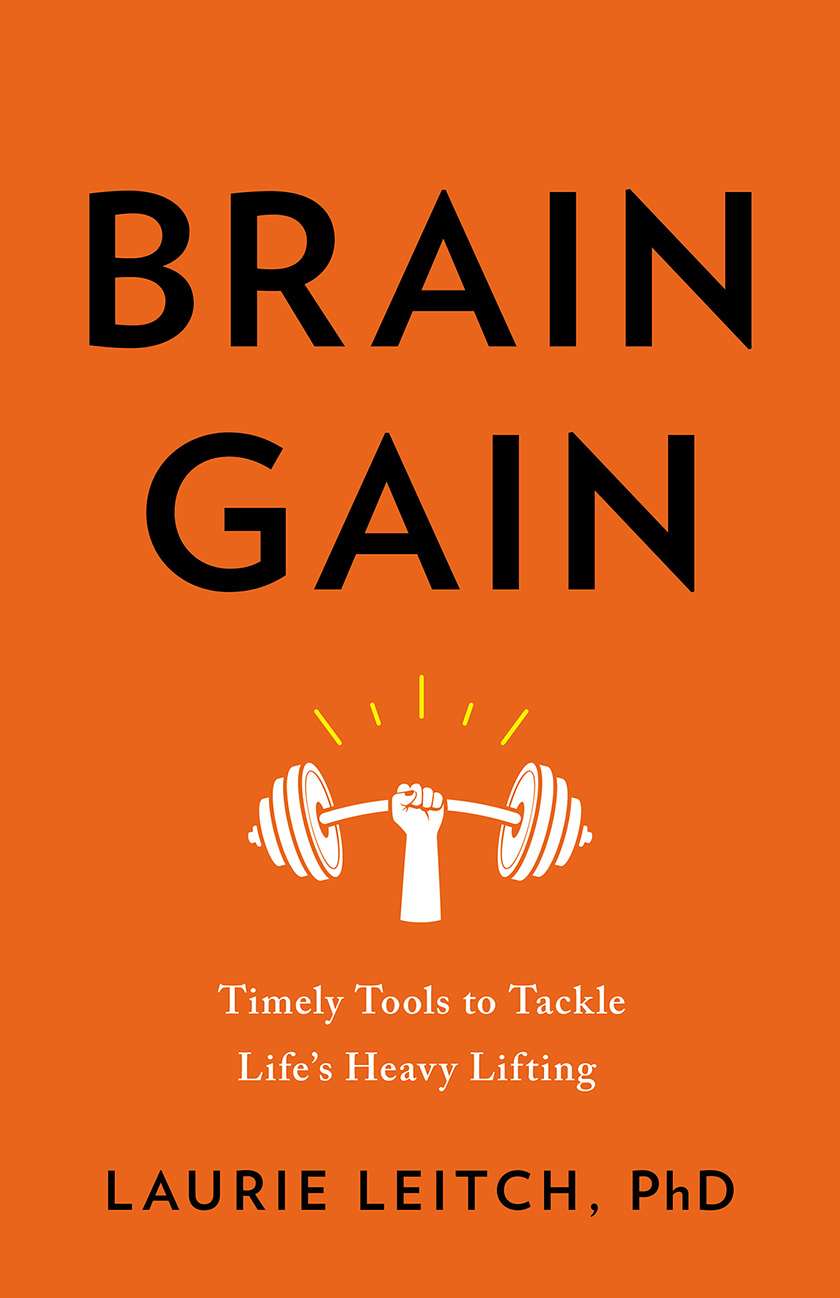
[0:00:30] HA: What kind of relationship do you have with your brain? This important organ shapes who you are, so it's important to make sure it's performing at its best. Welcome to the Author Hour Podcast. I'm your host, Hussein Al-Baiaty, and I'm joined by author Laurie Leitch, who's here to talk about her new book, Brain Gain: Timely Tools to Tackle Life's Heavy Lifting. Let's flip through it. Hello friends. Welcome back to the show. This is Author Hour. I'm your host, Hussein Al-Baiaty. Today, I'm hanging out with my good friend, Laurie Leitch, who just launched her book, Brain Gain: Timely Tools to Tackle Life's Heavy Lifting. Laurie, thank you so much for joining the show today. I really appreciate you.
[0:01:16] Laurie Leitch: Oh, thanks, Hussein, I'm really excited to talk to you.
[0:01:20] HA: Yeah. Laurie, I've watched your whole journey from the beginning to now the end, as far as publishing. Well, the new beginning is publishing, but I got to have the pleasure of really watching you come to the guided author workshop and really start working on your book. You’re always so positive and forward-thinking about your book and the ideas in it. I'm really excited to get into it because it deeply resonated with me. You're thinking around resilience is way more than spot on, so I'm excited to get into that. However, before we get into the book, I usually like to talk a little bit about maybe a little bit of your background, your personal background, and where did you grow up? How did you get on this path? Was it someone or a certain situation that led you down this road? I'd love to know a little bit about that. Then we'll jump into the content of your book.
[0:02:11] Laurie Leitch: Okay. Well, I grew up in the Midwest in Michigan and went to college at the University of Michigan in Ann Arbor. Then I moved to Washington, DC, where I raised my children and had my clinical practice. I had a psychotherapy practice in DC for many, many years. Also did evaluation research along the sides of that practice. I loved working in Washington, but I've ended up in New York, where I've lived now for not quite 10 years. It's pretty good up here too, though.
[0:02:45] HA: I love that. What a journey from the Midwest and then to Washington and up to New York. But your work has always been around, so tell me a little bit about your work and what got you into it.
[0:02:57] Laurie Leitch: While I lived in Washington, a group of colleagues and I discovered this man named Angelo Boleo. He was teaching a course on brain structure and function, and processes, which doesn't sound very interesting, but it was fascinating. He talked to us, all of us were psychotherapists, and he talked to us about how you can change the brain and how you can help people who need a little bit more thinking capacity and clarity with exercises and fun things to do that could strengthen their capacity for conceptual thinking and that kind of thing. I don't know it was spellbinding — Hussein and from there, I really got interested in neuroscience. He was a big influence. Then I heard about a weekend workshop by a group who were affiliated with Peter Levine's work in somatic experiencing. I went to that weekend and I got excited because that was a more practical extension of what I had already learned, Peter's SE work. I took his training — it’s three years, and it was very expensive, but I took it and I went through it. At the end of my, about second year, I guess it was of the three, was when the Thailand tsunami hit. I was one of the ones that he invited to go on a team to southern Thailand and work with people who had been in the tsunami. That was a life-altering experience for me. When I went, I also collected the data for that project in my doctoral program. One of my specialty topics was Quantitative Research Methods. I did the research for that project, but it was just life-altering to go into that level of trauma and realize that there were things that you could do to start to help the mind-body system restore its natural resilience. That was one of those seminal moments that many of us have that takes us down a path that we hadn't necessarily expected. After Peter's training, several of us got together and began to put together a model that would not cost as much as Peter's training could be done by all kinds of people. Over the years it's evolved and my version of that is called the Social Resilience Model. Actually, when I started writing the book, it sounded a little bit stuffy to me, the name Social Resilience Model. I just thought, well, what could I call it instead that would be a little livelier? I chose Brain Gain Program. Now I'm using both, because SRM, Social Resilience Model has been used since about 2012. It's a long time out there and many people have been trained in it and I've trained groups of trainers in it. I didn't want to leave it behind, but I decided to use a livelier term like Brain Gain Program. But it started back with Angelo Boleo and Peter Levine.
[0:06:08] HA: That's amazing and what a journey it's taking you on. I mean, especially that experience that starts to alter the way you see where your capacities lie. I think that's really powerful. I love your definition of resilience. Can you share that with me a little bit and how you use it throughout your book?
[0:06:25] Laurie Leitch: Well, a lot of people use resilience in a pretty limited way, which is to bounce back after adverse experiences. I think it's a very outdated way of looking at resilience, because of the brain's capacity to change. We have this wonderful process called neuroplasticity and also neurogenesis, the growth of new neurons. Now we can change the brain through or by certain very practical skills, which is what brain gain lays out and describes in a lot of detail. It's really the summary of my many years of work. I feel like I'm offering it up to the public in this book. We can begin to help people stabilize. It's one of the reasons I could take it to Rwanda or Nepal or China or Haiti, all the different places around the world we've worked, and not be guilty of a Western bias, taking a Western methodology, which is often insight oriented into cultures that aren't interested in more insight. They're just interested in having their capacity to contribute to their communities restored. That's what this set of skills is. My definition of resilience has three parts. It's a set of tools for being able to bounce forward after difficult times, [and] to be generative during times of relative stability. Well, those are the two keys. I always say to people, if you're sitting in the dead center of your comfort zone, you're taking up too much space. If we're going to really be resilient, we have to have times where we stretch outside of that center of comfort and expand ourselves beyond it. I think that's the most dynamic definition of resilience. Get out of the center of your comfort zone and stretch.
[0:08:24] HA: Yeah. I love that so much. It deeply resonated with me, because like my book coming from a refugee camp was around resilience, but really in how it shaped me through art. I feel like art was my crutch if you will. Obviously, every person defines it for themselves. It's like success, but really resilience has the same internal structure of just this idea of, yeah, not only bouncing back really but really pushing forward. I love how your book really gets our focus around this idea of moving forward. You share a really amazing personal experience in the Kenyan refugee camp that again I deeply resonated with, but it inspired the opening story of your book and it focuses on resilience in the brain. Can you share a little bit about your experience there?
[0:09:11] Laurie Leitch: That was an amazing experience, you're right, because in Kenya we were there after the post-election violence where people were really fighting with machetes and horrible machetes injuries, and the government, in an effort to quiet things down, offered villagers a small stipend of money to leave the village until they could get them settled down and send them to these internally displaced persons camps, IDP camps. We were going to go leave Nairobi and go about two hours up into that central plateau area and work with people in those IDP camps. Oh, my gosh. They were pretty horrendous places because they were established on really just fields of dirt, no greenery, no trees, no nothing, just dirt and which meant dust. The people were covered in dust and in the first two camps we worked in, everybody was in their tent and it was just a sea of dust, a water truck would come every day, but there was nothing people could actually create or had. But in this third camp, it was completely different. When we got there at the end of the day, all of a sudden you saw tents, but you saw gardens growing next to the tents. They had – people were planting their own vegetables. I said to the woman who had brought – I was there to talk to the teachers, initially. I said, “How come this camp is so different?” She said, “Because the people in this camp made a decision to pull their stipends, their government stipends, and they had enough people that when they pulled the stipends, they had a lot of money and they bought the land that the camp had been put on.” Well, first of all, the fact that people came together in a relational bond was just stunning to me. One piece of brain food, something that the brain must have is positive attachments in order to thrive. These people had come from trauma and had overcome that fear response to pull their money. Once they own the land, you can only imagine, and you especially, having been in these kinds of camps yourself, people started investing in that land. They started buying plants and seeds. They began starting microfinance endeavors. There were baskets being made. They were saving up when I was there to buy a school bus to take people to school, but also to take the women to hospitals so that they could have their babies in a hospital. It was just a thriving, energetic community. They had one big school tent. They had smaller tents for these microfinance projects. It was thrilling. I was so glad I saw it at the end of the day because it was really like this, a little wave of hope about, wow, what people can do when they bond together in healthy relationships was a great example of resilience.
[0:12:23] HA: Yeah. I love that so much. You really weave it throughout the beginning of your – I mean, it sucked me in right away, because I obviously very much resonate with that. I had a different experience, however, a lot of what you talked about was eye-opening in the sense that the people can really dictate what happens in there. Even if it is a refugee camp, you can still dictate what it's going to be like to a degree, right, with help, with working together. This idea of operating not from fear, but really, about love and it's this idea of coming together, bouncing ideas, and letting those ideas swarm the refugee camp, and then people collectively started coming together. If you're proposing something positive to look forward to, something to work towards, I feel like, people are more eager to sign up for something like that, rather than just dwelling and walking around this camp and waiting endlessly and those waiting days. I remember early on in our refugee camp experience, they were excruciating because they are the most boring, it's like a mental prison because you're not doing anything, you're not taking action towards anything, you actually start to dwell on what's happening to you on a very deep level and out so many people. Oh, my God. Spiral into depression.
[0:13:46] Laurie Leitch: And despair.
[0:13:48] HA: And despair, and lack of hope. They don't want to trust anyone. It just gets worse and worse, sadly. What I love about your book is that you highlight so many stories of where that spiral went the other way around. It spiraled upwards.
[0:14:01] Laurie Leitch: Well, you know. There's also a story, one other story that's negative that was really impactful to me and made me determined to do my work in a very particular way. It happened when I first moved to New York. I was invited by someone in a high city agency to come and talk to her about training her staff in SRM. I went in and she asked me a little bit about it. I was describing some of the neuroscience pieces. All of a sudden, she looked with I think disgust may be a little too strong, but disdain. She waved her hand and she said, “That just sounds like so much jargon.” This jargon — being parts of our human nervous system.
[0:14:47] HA: Yeah.
[0:14:47] Laurie Leitch: Like the amygdala or the parasympathetic nervous system, she said, “Why do they need to know that language?” It was such an objectification of people and especially the people that I was there, I was working with, in the city, [many of] who were formerly incarcerated people. Certainly, it had a hard – a lot of hard knocks in life. Some of them are not highly educated but are motivated. They deserve to know the names of the parts of their body that determine their resilience. It was such a great lesson for me in attitudes that hold people down and diminish people and especially in marginalized communities, people in marginalized communities. It really made me determined and excited to work with even more people in those communities. If you notice in my acknowledgments in the book, I acknowledge a group of students called Navigator Students. These are all formerly incarcerated students that I've worked with at John Jay College of Criminal Justice over the years. They have taught me so much about resilience and dedication and determination and rising above. I dedicated my book to them, because of what an impactful experience, it's been working with them.
[0:16:11] HA: Yeah. That's so powerful. I love that you felt the heat from that comment or those sets of comments that, obviously, resonate deeply in politics. These agencies that — sometimes you feel like they're there to help. When you offer up something that is really important that's not technically, I guess in a way tangible, as if people in refugee or in situations where they're in despair that they can't learn to come out of it, that they are human and they can — to understand where these things are impacting. I'm 38 now and I'm just like in the last, I would say seven years was when I really started to understand my own traumas, my own fears, my own things that I went through, and I haven't been able to understand them and unpack them. It took me a long time to do my own research, my own understanding – you know what I mean? The work that you're doing, I guess is what I'm saying is that you're essentially championing how we can really understand not only our resilience but how our brain works with resilience and this idea of building it and bouncing forward.
[0:17:19] Laurie Leitch: Well, and that we can do it. Anybody can do it, and so my book is inspired by my work in underserved communities, whether they're international communities or here in the United States. But it's also intended for people who just are stressed by the way they have to live their lives to support themselves economically or for whatever reason, that we're all wired exactly the same way in terms of what structures and processes we have in our mind-body system. We can all benefit from – because of those concepts, those processes, I mentioned earlier of neuroplasticity and neurogenesis. We can really have a major effect on our resilience. We talk a lot in the book about the “our zone”, or the zone of resilience. When you're in that zone there's a certain nervous system rhythm, and you're thinking is clear, you can be mad or sad in that zone, but not at a level where your body is churning out toxic stress chemicals. The skills that I teach in my model that are derived from Peter Levine's really help people deepen that zone of resilience so that it takes a bigger thing to bump you out. I think every human being on the planet, frankly and use skills like that. The good news is that the more you practice skills like that, because of neuroplasticity you begin to wire in a deeper zone of resilience. It's so simple, and yet it's like the best-kept secret.
[0:18:59] HA: Yeah. I love that. I feel like your book is taking it from the secret realm and bringing it into the world because it is much-needed information and especially your stories that deeply resonate. In your opinion, what is the most important thing people can do to develop a healthy relationship with their brain?
[0:19:17] Laurie Leitch: The main thing that they need to be able to do is notice. The process for almost everything that wires into our brain is a very basic process that every single human being uses probably a thousand times a day, which is attention and the things that we pay attention to are the things and the ways that we wire our brain and the things that we stop paying attention to are pruned away. Maybe at some point in school, you learned your multiplication tables and you could do them after a practice that wires it in. You could do them successfully and you got good grades on your multiplication tests, but 20 years later maybe you haven't done any multiplication in any speedy way and your capacity to do it would start to be pruned away. The whole process in the brain is dominated and shaped by the things we pay attention to and the things we don't pay attention to. What we wire in and what we prune away. In my model, we teach people first to notice because if you don't even notice where your attention is going, you're just on autopilot, the organ, the little – we have a smoke detector in our brain. We have two of them actually called amygdalae, but it's easier to say the amygdala that little smoke detector is always functioning to watch for novelty in your environment that might pose a threat. If you're not tuned into it, you're just giving that little smoke detector its way, instead of deciding, is this where I want my attention to go. If you for example at Scribe have an argument with a staff member who really matters to you and you're suffering, and you're mad at that person, and you're ruminating, but you're not – you're just on autopilot, that's what your brain is going to do. But if you notice that you're doing that, you could shift your attention away from that and focus on the things that make that person important to you, and the times when that person has come through for you. If it isn't that person, the time other people have come through for you and before you notice that your reactivity will start to drop down and you'll come back into your resilient zone, you won't be producing the stress chemicals of reactivity, you'll be able to think about a strategic way you might want to deal with the problem instead of just doing a lash out or a shutdown. When people are stuck on “high” outside of the resilient zone, they're stuck in very activated kinds of behaviors like anger and pain is one of those signs, anxiety, things that are outward-oriented, and when you're stuck on low below the resilient zone people feel shut down and numb. It's just a process that every human being on the planet goes through. We all have a zone of resilience. Some peoples’ it's really, really narrow. If you drop your pen on the floor you get mad. Other people have a nice robust resilient zone. Those are usually people who have pretty healthy relationships and they have some satisfaction in their life, it takes more to bump them out. Then meditation, monks who've been meditating for years are known to have really deep resilient zones because that focused attention on stability has wired that very strongly into their mind-body system.
[0:22:51] HA: Yeah. It's so powerful. I'm glad you brought that example up. I think everything you're saying, I mean, it's taken years, I feel like what you're talking about is are things that I've lived through, so that’s why like –
[0:23:03] Laurie Leitch: Yeah. I think that it sounds, so good.
[0:23:04] HA: Yeah. I mean, I remember growing up just my temper or my agitation or whatever was just the window was very small, right? Like the level of patience was limited.
[0:23:16] Laurie Leitch: It sounds like, you were a stuck-on high person.
[0:23:19] HA: Oh, yeah.
[0:23:20] Laurie Leitch: Because if you have anger and agitation and that's the outward directed, but it's also full of stress chemicals.
[0:23:27] HA: Yeah. It was just unprocessed emotion and all the things. It wasn't until, like literally, like my mid-teenage years and into my college years. Now really adulthood that I've been slowly just unpacking these things. It wasn't until I got therapeutic help like therapy that I really started to put things, at least like you said, bring awareness and language to what I was experiencing and feeling.
[0:23:53] Laurie Leitch: Yeah.
[0:23:53] HA: Now that I'm able to communicate that with family members, my wife, whatever. Like, I can now, I have the words and ways to communicate that. It’s so powerful. I can't agree with everything you're saying more. What was your favorite part of pulling this book together? Because I know, from watching you it's a journey. I watch you start from the beginning and now we're here, where you launched your book out in the world. Tell me what that experience was like for you. What was your favorite part?
[0:24:21] Laurie Leitch: I think I was unusual, at least in the other Scribe folks that I would listen to on your – the hour that we would do, and later with those of us who were close to publishing because it was a total pleasure for me. I had this one jolting experience with Tucker when I got to the scribe workshop, but after that when I, through him gave myself permission to write the book I wanted to write, I really loved writing it. I wasn't sorry when I'd finished it, but I missed the structure of sitting down with some of those stories. It really was like a trip back through my professional life of all the different people who had shaped my attitudes and my skills and my sense of myself, and all of that. I never had trouble sitting down to write it. When I read it the first time, I was so frightened, because I thought, “Oh, my gosh. What if I don't like it?” I read it. I thought, you know? I said what I wanted to say. The only thing I wouldn't let myself do is, I wouldn't let myself record the audiobook, because I was afraid what would happen is I'd be reading along and I'd think, well, I could have said that better and I'd interrupt myself to correct a sentence or something like that, so I decided to use one of your readers so that I wouldn't do that.
[0:25:46] HA: Yeah. It’s so powerful. Your journey is amazing. I loved watching, when you came on those calls there were times when you asked questions, you had so much value to the group, I believe. Your enthusiasm. Again, I think for me to be creatives to be scientists, artists whatever it is like showing up to a group, and asking questions, and being involved is something I just genuinely appreciate. I'm a big fan of building and creating community and being supportive. You really showed up and I'm grateful for that. I just wanted to tip my hat to you, because I sensed your presence when you were there. It was always amazing. You always had something great to share. Now, of course, with your book, it's going to make an amazing difference in so many people's lives.
[0:26:31] Laurie Leitch: Oh, I hope so. I'm eager to hear from people. I leave my email at the end of the book and the last chapter of the book is about how to become a resilience messenger. I give a detailed description of how to use my skills card in communities that matter to people. I'm hoping that – and I'm going to be offering classes and how to use the skills card on my website and things like that so that people who read the book have a place to come with questions and to learn more, and to be effective if they want to be a resilience messenger in their church or in their community or in their neighborhood or on their job site or whatever.
[0:27:10] HA: Yeah. It’s so powerful. Well, thank you so much, Laurie for coming on the show today. I've learned so much. I loved your stories and experiences. I'm definitely going to be finishing up the book this week. To all of those out there, the book is called, Brain Gain: Timely Tools to Tackle Life's Heavy Lifting. Besides checking out the book, where can people find you, Laurie?
[0:27:31] Laurie Leitch: Well, I have two websites. One is the book's website which is the www.braingainproject.com. It'll have the classes and all the sorts of things that are coming out of the publication of the book. Then my general website at Threshold Global Works, that’s www.thresholdglobalworks.com and which has my blog, it has all my published articles, it has information that people can use. It has a — I redesigned a survey tool that can be used on intake interviews that incorporates resilience and not just adverse childhood events, it's called Paces. It has a lot of resources beyond the book website, but I have a feeling the book website is going to expand itself, as people who want to be resilience messengers in their communities we’ll put a little group of them together and meet regularly and that thing. It's worth taking a look at both of those.
[0:28:35] HA: Yeah. Beautiful. Well, again Laurie, thank you so much. It's been an absolute pleasure not only watching your journey, but now getting to celebrate your book, so congratulations. Thanks, again.
[0:28:47] Laurie Leitch: Well, thank you. I was so excited to know you were going to be the one interviewing me, because I didn't know it would be a stranger or somebody I didn't know well, but you're so familiar. I remember you well from those first three days at the Scribe workshop, so it's really been nice to talk to you and thanks for your thoughtful questions, too.
[0:29:07] HA: Laurie, it's been my absolute pleasure, seriously. I have just really enjoyed your process. Yeah, so grateful I got to be on the journey with you. Thanks, again.
[0:29:17] Laurie Leitch: All right. Thanks so much. Bye-bye.
[0:29:19] HA: Bye. Thanks for joining us for this episode of Author Hour. You can find Brain Gain: Timely Tools to Tackle Life's Heavy Lifting, right now on amazon. For more Author Hour episode subscribe to this podcast on your favorite subscription service. Thanks for joining us, we'll see you next time same place, different author.
Want to Write Your Own Book?
Scribe has helped over 2,000 authors turn their expertise into published books.
Schedule a Free Consult