Dan Silvert: The True Competitive Advantage
Read the full transcript
Dan Silvert
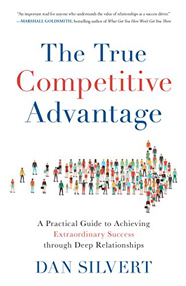
Dan Silvert is a behavioral expert, keynote speaker, and executive coach who serves as president of Velocity Advisory Group, a firm recognized on Inc. magazine's list of the fastest-growing companies. He has guided organizations through cultural transformations, coached hundreds of leaders toward greater success, and trained thousands of sales professionals to grow revenue through the power of deep relationships. His clients have included major corporations across insurance, technology, healthcare, and government. He is a coauthor of Taking Flight! and the author of The True Competitive Advantage: A Practical Guide to Achieving Extraordinary Success through Deep Relationships.
📚 Books by Dan Silvert
Transcript
[0:00:18] Charlie Hoehn: You’re listening to Author Hour, enlightening conversations about books with the authors who wrote them. I’m Charlie Hoehn. Today’s episode is with Dan Silvert, author of The True Competitive Advantage. Have you ever misread someone’s actions at work? Maybe you thought they were being a jerk bur for them, that’s how they communicate with everybody. Well, Dan Silvert is an expert at demystifying the workplace behaviors of your colleagues. As an executive coach and strategic adviser, Dan helps organizations identify personality types so they can predict how they’re likely to behave within the company. Our mistaken explanations for other people’s behavior can get in the way of unlocking opportunities for growth in our careers. We simply misread why people say and do the things that they do. By the end of this episode, you’ll know how to make the most of your relationships with your colleagues. Now, here is our conversation with Dan Silvert.
[0:01:48] Dan Silvert: Many years ago, my wife and I and two children moved from overseas to the States and prior to that, I had been a musician and a sound engineer and I had lucked out and just an amazing nine to five job composing music. When we moved to the States, that ended and I essentially had to start from scratch and I was unemployed for 10 months with two kids and a wife wasn’t working and this was the longest 10 months of my life and probably shaved five years off of my life. I did just about everything wrong when it came to looking for a job and I learned what to do right, make everything wrong first. And eventually, I sat down with a transition coach and he was extremely helpful and pointed me into some very good directions. I was able to get a job in sales and from that point on, thank goodness I haven’t been unemployed since. But, I always look back on that searing experience of tremendous stress and self-doubt. Probably the best learning experience of my life and within a few years, I decided that I wanted to get into career coaching myself because I knew what to do and I saw a lot of people out there suffering and as lost as I was. I got into that line off work, I left sales and I became a transition coach and I work with over a thousand people, mostly executives who were transitioning from one phase of their career to the next. That really got me into the coaching world and what different types of people need in order to take the steps required to make progress in life. Depending on who you are, you need – there are different buttons that need to be pushed. That got me interested in personality. Why is it that you know, some people are really motivated when you get in their face and speak very bluntly to them? Others will completely shut down if you were to do that.
[0:03:57] Charlie Hoehn: Sorry to interrupt Dan. Before we get into sort of the personality types and why some people are more successful than others, can you talk a little bit about maybe the hardest day or what the dynamic was like between you and your family when you were in those months of unemployment and trying to get a job, what did your days even look like?
[0:04:19] Dan Silvert: I did what most people do which was I spent an enormous amount of time on the job boards. Now, this is going back many years. The internet wasn’t nearly sophisticated, this was before Linkedin, there was still job boards and I was answering job postings and I was trying to network into interviews and I had a number of interviews over the course of that period and I just wasn’t landing, I seem to do well and then afterwards, I find out that I didn’t in fact succeed, this placed a whole lot of stress on my marriage, it was very difficult for the kids. Because they saw mom and dad weren’t happy. By the way, I left something out when we moved back to the States, I did have a job, it’s just that, eventually ended and so, that’s where I found myself in transition. The most difficult day? That’s easy. We were living in North Jersey at the time, you know, my wife drove me into the city and I was excited for this interview and she was excited for me and she was like, “You know, go get them.” I walked in to this office and sat down and was ready to and I waited and waited some more, about two hours, past when my interview was supposed to be scheduled and then the admin came out and said, “I’m sorry, he’s not going to be able to see you.” That was tough. Because at that point, I had already been looking for many months and I just remember sitting there, thinking, “Wow, I’m irrelevant. This is just not getting any better.” I went home and had to tell my wife and it wasn’t easy and I soldiered on for another month or so and then eventually did get a terrific job in the recruiting world in sales. Again, haven’t looked back but I have to tell you, there is – I haven’t had an experience in life that was as empty as that one.
[0:06:15] Charlie Hoehn: Let’s talk about your book Dan. When I opened the book, I was a little caught off-guard because when I was looking at the chapter headings, it was not at all what I expected. Instead of seeing normal chapter titles, I saw bird names. Can you explain what the different birds mean in your book?
[0:06:38] Dan Silvert: Sure. There are four basic drivers to how people behave and this book is based off of a profile called DISC. It’s actually my second book. First book, my co-author is called Taking Flight and in that book, instead of talking about the acronym, DISC which stands for dominant, influence, steady and consciences. We shifted the focus and used a metaphor and the metaphor is birds. It became eagles, parrots, doves and owls. If you don’t mind, let me interview you a little bit.
[0:07:15] Charlie Hoehn: Of course.
[0:07:17] Dan Silvert: When you think of an eagle in the wild, what immediately comes to mind? An eagle. I say eagle and you say?
[0:07:24] Charlie Hoehn: Bald Eagle. I envisioned perched on top of a tall tree, very stoic and focused, looking for prey and then swooping down to grab it.
[0:07:41] Dan Silvert: Okay, good. If we were to ascribe personality traits, would you say that if the shy cliché? It’s timid?
[0:07:48] Charlie Hoehn: No, definitely not.
[0:07:50] Dan Silvert: All right, pretty bold, right? Fairly aggressive? When you think of an eagle, do you think of a flock of eagles hanging out, chilling smoking cigarettes?
[0:08:00] Charlie Hoehn: Lone wolf or lone eagle I guess, yeah.
[0:08:03] Dan Silvert: Okay, eagles in the workplace are similar which is why we use the metaphor. An eagle style in to your office is pretty competitive and pretty aggressive about achieving whatever goals they have set for themselves. In fact, their central organizing focus is results, right? Eagles don’t go to the office to make friends, they’re not drawn to emotionally oriented conversations, they’re not like psychologically curious. They go to work to do things, okay? Because of that, their behaviors are a reflection of that central focus. Eagles are direct in how they communicate, they’re decisive in how they make decisions, right? Let’s back up. Why? Why are eagles direct? Because it’s efficient. If I can say it in 15 seconds, then why do I need to say it in four minutes. By the way, if you can say it in four minutes, why are you taking 15? To eagles, communication, the purpose of communication is to actually take action and do something and this is why they speak very succinctly. Eagles are decisive in decision making because they would much rather make a mistake if need be and get smarter than endlessly circling the situation, waiting for the perfect set of circumstances before finally arriving at a decision. To an eagle, that’s called losing. Because your competitor is moving faster than you. When eagles listen, they listen for the bottom line. They want you to cut to the chase. Why? Because they want to solve a problem. If you could just hurry up and tell them what you need, they can hurry up and help you fix it.
[0:09:46] Charlie Hoehn: Let me play eagle for a second here. Which is why does the four personalities of birds truly mattered to the person reading? Is it so that they have awareness of themselves or awareness of the people that they work with?
[0:10:01] Dan Silvert: Well, it’s both. The cornerstone of emotional intelligence is self-awareness. When you look in the mirror, do you see the same person that other people actually experience? An eagle might look in the mirror - so I’m going to mix my metaphors a little bit here. When I do talks, I put up a meme on the screen and it’s a picture of a kitten, little kitten looking into a big mirror and a lion is staring back. The kitten sees a lion in the reflection. That’s a problem because it’s a kitten, not a lion. Now, I’ve worked for a lot of people that when they look in the mirror, they see a kitten, they see a very kind and helpful human being, somebody who would never hurt another person. But when other people work with them, they see a lion. They see somebody who is aggressive and somebody who is not particularly sensitive. That person suffers from a lack of self-awareness because the person they see in the mirror is not the person that other people actually experience. One of the great advantages of learning about the birds is that you get to know yourself a little bit better and that can have really big positive consequences on your relationships. If you have a distorted self-image, it’s hard to have a relationship that is as clear as it could be. That make sense?
[0:11:29] Charlie Hoehn: Makes sense, yeah. Let’s talk about the parrots, doves and the owls, the three other personality types that you list in the book?
[0:11:39] Dan Silvert: Sure, for the eagles again, their central focus is results. For parrots, it’s fun. I mean, when you think of a parrot, what comes to mind to you immediately?
[0:11:52] Charlie Hoehn: Bright, colorful, talking.
[0:11:54] Dan Silvert: Exactly. These are your parrot colleagues. Your parrot colleagues tend to draw attention to themselves. Why? Always in a great mood. They bring a lot of energy and enthusiasm to the workplace and they talk a lot and as soon as you say something, let’s say you went hiking this past weekend. Your parent will say, I love hiking and then they’ll tell you about their hiking experience. You know, more interesting than the one you just told, okay? We call that responsive listening by the way. Parrots in the workplace, thrive on enthusiasm on optimism, they’re open to whatever is possible and their primary objective is to enjoy themselves. To be in the moment and to maximize that moment with fun. Now, parrots are often misunderstood in the workplace as lacking professional seriousness because they’re always smiling, okay? That is not true at all, reality is, the more fun parrots actually have, the harder they work and a great example of that is Richard Branson of Virgin, I don’t know if you’re familiar with virgin airlines or virgin group. Trust me when I say that Richard Branson is a flaming parrot, okay? No one had ever accused him of lacking work ethic.
[0:13:11] Charlie Hoehn: yeah, it’s true like 400 brands under the Virgin brand?
[0:13:18] Dan Silvert: Exactly. In fact, his whole business model is an expression of his energy because once he finds tremendous success in one industry, he gets bored and he says, let’s go do it again someplace else. Then everyone thinks he’s crazy and then he goes off and does it, all right? That’s parrot energy. That’s parrot optimism at work.
[0:13:37] Charlie Hoehn: Who is a, I guess, a famous business person who strikes you as an eagle?
[0:13:43] Dan Silvert: That’s a good question, well, how about a former business executive who is now in a different role that lots of people are pretty familiar with over the last year. I mean, can you think of an eagle who is now in the public sphere that wasn’t a year and a half ago?
[0:14:02] Charlie Hoehn: Mr. Trump?
[0:14:03] Dan Silvert: Mr. Trump. Probably the highest intensity eagle we’ve ever seen in public life. The key, when I say Trump, the problem there is that if you like trump, or you dislike trump, you immediately have a personal opinion?
[0:14:18] Charlie Hoehn: Well, I was thinking of actually, when you said that, the mere analogy that you were just saying of looking at yourself in the mirror versus how others perceive you.
[0:14:28] Dan Silvert: Yes. I think when trump looks in the mirror, he sees a different person than other people see in him. I think that’s fair. It gets him in trouble. But whenever I talk about the presidents, I always ask my audiences to not get political, just look at it from a style perspective, okay? Then it can teach you a lot about style. Trump is a great example of an eagle and since we’ve talked about parrots and Richard Branson, now we can go to Doves. Their central focus is harmony. Because doves believe that when everyone is getting along, everyone feels respected and each is allowed to make a contribution that benefits the whole. When you think of a dove in the wild, what comes to mind?
[0:15:16] Charlie Hoehn: Two of them, together.
[0:15:18] Dan Silvert: Exactly. Eagles are solitary primarily. Doves, once they choose a mate, that’s their mate for life and doves will nest in flocks of hundreds. Doves in the wild are all about their ecosystem and maintaining them and doves in the workplace are all about the environment and maintaining harmony. How do they do that? Well, they’re patient, they’re sincere, they’re soft spoken, they’re very methodical in how they execute their tasks. They’re often considered the glue of the group, they’re the colleague or manager that everybody gets along with because they genuinely care about other people. What’s the misunderstanding about doves in the workplace is that they’re weak and passive? Because they’re soft spoken, the assumption is that they lack the guts, the intestinal fortitude to really make difficult decisions and that’s nonsense. Doves are actually quite stubborn and once a dove makes a decision, good luck trying to get them to not move in that direction. You’re probably thinking who is a famous dove and let’s go back to presidents. Prior to Mr. Trump, we have Barrack Obama.
[0:16:34] Charlie Hoehn: Barrack Obama, yeah.
[0:16:36] Dan Silvert: I would say Obama exhibits many of the dove qualities. Think about his soft spoken nature. How he always came across as comfortable. As being in a reflective state and basically being calm. If you think about the temperament, again, not the politics. Just the temperament of Trump versus Obama, you’ve got about as wide of contrast as the human condition allows.
[0:17:04] Charlie Hoehn: Right, would you say that Tim Cook embodies the dove personality as well?
[0:17:11] Dan Silvert: Absolutely, very good choice and prior to Tim Cook could we have the head of Apple, Steve Jobs, well what do you –
[0:17:19] Charlie Hoehn: We have an eagle.
[0:17:20] Dan Silvert: Yeah, you know it. Exactly so something that is not often known about Steve Jobs is that when he returned from exile to take the helm of Apple, the first thing that he did was discontinue all of Apple’s philanthropic endeavors. And what he said at the time was if we’re not making money, we are not giving any away and what’s sadly true is that he never actually re-engaged Apple’s philanthropic activities even after he took them to incredibly high levels of success. The very first thing that Tim Cook did when he became CEO was in fact reinstate all of Apple’s philanthropy.
[0:18:02] Charlie Hoehn: Author Hour is sponsored by Book in a Box. For anyone who has a great idea for a book but doesn’t have the time or patience to sit down and type it out, Book in a Box has created a new way to help you painlessly publish your book. Instead of sitting at a computer and typing for a year, hoping everything works out, Book in a Box takes you through a structured interview process that gets your ideas out of your head and into a book in just a few months. To learn more, head over to bookinabox.com and fill out the form at the bottom of the page. Don’t let another year go by where you put off writing your book. You know what’s funny about that or I guess not funny is the fact that I am just now learning about this and I follow Apple really closely. I am surprised that they obviously don’t want to make a big show about that but still, you would think that would have been in the press a little bit more.
[0:19:03] Dan Silvert: Yeah, well look, Steve Jobs’s, tragic situation dying early and one of the Thomas Edison – but he was certainly an eagle, a ruthless eagle. Just completely fixated on not just introducing new products but demolishing the competition. Cook comes in with a completely different energy and Apply has changed dramatically as a result. I mean think about it, Apple used to reinvent entire product lines. Now Apple perfects existing product lines. That’s the difference between the super high eagle and a super high dove. So, last but not the least we have owls. So what comes to mind when you think of an owl in the wild?
[0:19:47] Charlie Hoehn: A creature of the night for the most part, yeah.
[0:19:53] Dan Silvert: Okay, absolutely. They are nocturnal predators and owls have these big eyes and they are notorious for being able to see with tremendous precision. Owls can actually spot prey two football fields away at dusk and then swoop quietly and take them out. So owls in the workplace also have a gift, a natural gift for precision and their central organizing focus is accuracy. So for you owl colleagues the pursuit of accuracy is not negotiable. I like to call them the guardians of integrity. So how do they manifest this focus? Owls are detail oriented, they just don’t read the fine print, they’re the ones who wrote it. They are very systematic, they don’t just accumulate information, they organize it and then once properly assembled, they will then analyze the data to arrive at a logical conclusion what represents accuracy. So when owls come to work, it is to either fix something that’s not where it needs to be or to create systems that are sound from day one. This is their focus. So we’ve got these four drivers – oh excuse me, we’ve done famous people on all the styles so let’s finish up with the owls. Let’s go back to business, we’ll pick two, there’s Bill Gates and Mark Zuckerberg, very owl oriented individuals. Very hyper focused on technology as exacting science that delivers measurable metric graphics to the business model.
[0:21:32] Charlie Hoehn: Yes, definitely. It makes total sense. So we’ve got eagles, parrots and doves, owls and as you were explaining those some of the people I know seem to fall pretty strongly into both categories. I’d imagine they’re hybrids right?
[0:21:51] Dan Silvert: Absolutely. So we have style blends. Most of us are a blend of at least two styles. So we have eagle-parrot, we have owl-doves, we have dove-parrots and so one of the advantages of using these fun little metaphors is that because the birds themselves are vivid, it’s easy to remember what it means. So here we have only been talking about it for a few minutes but if I say somebody is an eagle-parrot, another person is an eagle-owl, do you immediately sense what the differences might look like?
[0:22:23] Charlie Hoehn: Yeah, it makes sense.
[0:22:25] Dan Silvert: That’s the advantage of using metaphors like this. So the vast majority of us have a primary style and a secondary style and some of us have three but I have only met one person in 15 years of doing this and I have worked with tens of thousands of people. I’ve only met one person who in nature profile they scored for all four styles.
[0:22:45] Charlie Hoehn: Wow that’s wild. Where can people take the profile by the way? Is there a link in the book or?
[0:22:54] Dan Silvert: You can go to our site which orderdisc.com and there’s all kinds of free stuff there as well, you get t-shirts and reminder cards and things like that. But the next question is, what do you do with this? Okay, so now I know what my style is and I am starting to think about my wife or my kids or my colleagues or my boss, now what? Well now the question is how do you improve relationships? Because the quality of your life is dependent upon the quality of your relationships. If you are surrounded by happy healthy relationships, professionally and personally, the chances are very, very strong that you are living a good life that you are in a good place. If you unfortunately struggle with relationships, there is frustration and stress and disappointment then you are suffering and one of the main reasons why relationships are not as healthy as they could be is because we simply misunderstand where someone is coming from. We make assumptions. So for example, if you are working with an eagle and they are blunt with you. If you’re not careful you’re going to think, “Oh this person doesn’t like me,” or, “This person is obnoxious.” Well both of those are incorrect. They’re eagles, this is how eagles communicate. If you take it personally then you are missing the moment and one of the key learnings from the book is you want to match the moment, not the mirror. So if the moment requires you to lean a little bit in the eagle direction and be a little more assertive, make a little bit of stronger eye contact, have a little more confidence in your tone, win and you’ll maximize that moment. If you don’t match the moment you may very well miss it and there are a lot of moments in life in our relationships that are opportunities to improve or to house frustration in our lives.
[0:24:57] Charlie Hoehn: So Dan your organization, you guys have served – I mean it looks like over 11,000 professionals, you have done 600 training sessions, 400 plus workshops and your book has been out for a few months now. Can you tell me about the transformations or the results that you’ve seen when people and organizations really grasped these concepts that we have been talking about?
[0:25:29] Dan Silvert: Sure, I’ll give you two examples one from the book and one not from the book. We do a lot of executive coaching and philosophy and I was coaching a female executive who was convinced that her boss was being sexist towards her and this cost her tremendous, understandably, frustration and it stressed her out a great deal, it stressed out her relationship with her husband who is very upset about the situation and we started talking about this relationship. And the key question that I asked her was does he treat you the same way he treats other people? Particularly men. I said, “I want you to fan the next two weeks and really observe how this person behaves and see if there’s any real difference. Are you a special case or are you not?” And to her credit she did that and the next time we spoke, she was actually ecstatic. I said, “Well what’s going on?” And she said, “He’s a jerk to everybody,” and I said, “Wow how about that? So explain.” And then she did. So this person, her boss was under tremendous amount of stress. He’s in sales and he was overusing owl-eagle energy. So when we overuse our styles, we take our strengths and we turn them into weaknesses. So owls have a tremendous skillset for achieving accuracy but when they are under stress, they become hypercritical of everyone around them because nobody measures up and eagles are very assertive and get things done but under stress, they steam roll. So what was he doing? He was treating her very disrespectfully but it was from an owl-eagle perspective not from a sexist perspective. So once she saw this, everything changed and the prism from which she saw his behavior shifted and she was able to help him relieve some of that stress. They were able to have good conversations. They turned that relationship around and both of them really took off. I mean they both prosper. So here it is, a shift in perception changes everything that’s one example. I’ll give you another one from a talk that I gave. And we are fortunate enough to give keynotes around the country and I did the fixed session and 500 people and we’re doing the birds and everyone is getting up and moving around and we play four corners where all the eagles stand together, all the parrots, doves and owls in different corners in the room and so I am walking around engaging the group and after that exercise, I had somebody come up to me and say, “Dan, I’ve got to tell you you’ve really helped me here.” I was like, “What? What’s going on?” He said, “Well I am an owl and my kid is a parrot and I have been treating him in a way that makes him really doubt himself and I was so freaked out by this realization that I actually left your thought and run outside to call my wife to tell her we need to really rethink how we talk to our son. I just want to tell you I think I’m really going to be able to improve that relationship now,” and that was a great moment. You can’t put a price on that. I mean this poor parrot kid is being judged by an owl parent that doesn’t realize you treat people by the way they need to be treated not the way you need to be treated. Big difference.
[0:28:55] Charlie Hoehn: Beautiful story. Yeah, I mean when you’re explaining the first one, it hit me that some of the people that I’ve had the best working relationships with have been eagle-owls and I think generally, this is a guess, I need to take your profile but I think I fall into parrot-dove and it’s funny because it seems like those two may just be complimenting each other well because they bring what the other lacks.
[0:29:31] Dan Silvert: Absolutely, that’s if you’re a parrot-dove and by the way, I think I would agree with that based upon our little chat, the eagle-owls that surround you compliment your skills tremendously and you compliment theirs. Now this can also be a source of friction again when stress is introduced in a relationship but in a best case scenario, absolutely. You appreciate and honor the people around you because you understand what they bring to the table that you’re dealt. So I often have clients ask me, “You know Dan I am an eagle, you want me to flex to dove? That’s phony! That’s not me so you know, I don’t feel right about doing this”. You know my response and I appreciate where that person is coming from but it’s not about being phony. It is about honoring the person you’re with because if you can lean a little bit in their direction not reinvent your personality but just lean a little bit in their direction. You are saying I seek to connect with who you are not ask you to connect with who I am and if they do the same and lean in your direction, you can find a healthy middle.
[0:30:40] Charlie Hoehn: And Dan what are you? Are you a dove-owl?
[0:30:47] Dan Silvert: Yeah, good try. I am impressed. I was able to bamboozle you into thinking that I am an owl. I actually have parrot-eagle.
[0:30:57] Charlie Hoehn: Parrot-eagle.
[0:30:59] Dan Silvert: Yeah, I didn’t used to be. I used to be a parrot-dove, you know that’s how my brain was wired and that’s how I was raised but I did something a little bit unusual in life, referencing the earlier story, I lived for seven years in Israel in my early 20s and Israel is a very eagle society. It’s very assertive and so after seven years, I came back a parrot-eagle. Now I’ve been back in the States for many, many years now so the dove in me has resurfaced but I am pretty comfortable in all three of those styles but very little owl. Just ask my colleagues or my wife they’ll tell you.
[0:31:38] Charlie Hoehn: Well this has been great. Can you state again where people can go to take their profile to learn more about themselves and their colleagues?
[0:31:49] Dan Silvert: Sure, go to orderdisc.com and you can find the book, it’s called The True Competitive Advantage on Amazon.
[0:32:01] Charlie Hoehn: And you do some speaking and training as well of course so they can find information about there. And how can listeners connect with you or follow you personally? Do you have any accounts that you have personally?
[0:32:15] Dan Silvert: Yes on Twitter, you can find me on @danielsilvert and on LinkedIn, I am putting out a number of blogs.
[0:32:23] Charlie Hoehn: Great, well thank you so much Dan. This has been excellent.
[0:32:26] Dan Silvert: Thank you, I appreciate the time.
[0:32:30] Charlie Hoehn: Many thanks to Dan Silvert for being on the show. You can buy his book, The True Competitive Advantage, on amazon.com. Thanks again for listening to Author Hour, enlightening conversations about book with the authors who wrote them. We’ll see you next time.
Want to Write Your Own Book?
Scribe has helped over 2,000 authors turn their expertise into published books.
Schedule a Free Consult