Ari Meisel: Idea to Execution
Read the full transcript
Ari Meisel
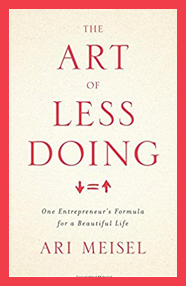
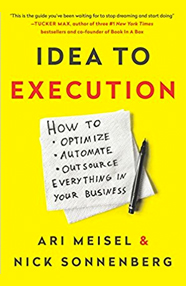
Ari Meisel is the founder of Less Doing, where he helps entrepreneurs optimize, automate, and outsource their work so they can scale. After being diagnosed with Crohn's disease at twenty-three, he built a productivity system that let him accomplish more while working far less, and was later cleared by his doctors of active disease. He is the author of several books on efficiency, including The Art of Less Doing and Idea to Execution.
★ Scribe Case Study
How Ari Meisel Used A Book To Impact The World (And Build His Business)
Ari Meisel took his Crohn's diagnosis and used it to transform his life by learning to do more, in less time, so he could live more. Then he wrote a book that helped othe…
📚 Books by Ari Meisel
Transcript
[0:00:14] Charlie Hoehn: You’re listening to Author Hour, enlightening conversations about books with the authors who wrote them. I’m Charlie Hoehn. Today’s episode is with Ari Meisel, coauthor of Idea to Execution. How many days does it take to go for idea to launching a business? Ari believes it’s just one. He and his coauthor, Nick Sonnenberg, successfully launched their new business in just 24 hours and that was almost two years ago. In this episode, you’ll learn how to launch a lean startup and use data to make yourself a more effective worker. If you’ve ever been frustrated by your ideas not turning into anything or you just feel overwhelmed with your never-ending pile of work, this episode is for you. Now, here is our conversation with Ari Meisel. Ari, could you tell me about what ultimately laid the foundation for Idea to Execution? Can you tell me a bit of your back story?
[0:01:31] Ari Meisel: Sure. I was working in real estate development and I was living a very unhealthy lifestyle and when I was 23 years old, I simultaneously reached the milestone of three million dollars of personal debt and was diagnosed Crohn’s Disease.
[0:01:47] Charlie Hoehn: Wow.
[0:01:48] Ari Meisel: After having worked for three years straight, 18 hours a day pretty much, I was now in a situation where I could barely work an hour a day because I was so sick and weak and after reaching a real low point in the hospital, I began the process to eventually overcome the illness through self-tracking, self-experimentation and a big part of it was dealing with the stress aspects of my life. So I created a new system of productivity, which I would call “less doing” as in Less Doing, More Living with the overarching framework of teaching people how to optimize, automate and outsource everything in their lives in order to be more effective. Now, fast forward a few years, I’ve been pain free, medicine free. I’ve taught and spoken around the world, I’ve got the two books on less doing and I was having dinner with my good friend Nick Sonnenberg on a Monday night in the middle of August 2015 and that morning coincidentally, a very large US based virtual assistant company went out of business very suddenly. We’re talking and sort of brainstorming about what we thought went wrong, what would have been different? Between the two of us, we probably worked with 30 different virtual assisting companies over the years and have outsourced thousands of things and Nick suggested we start our own virtual assisting company. So 24 hours alter, using free off the shelf tools with two assistants, 10 clients and not a single penny of funding, we launched Leverage, which has grown to a team of professionals, team is over a hundred people, a team of professionals that can do anything for any business or person as long as it’s legal and we service over 450 clients doing a thousand hours of work every week ranging from graphic design to shopping to travel planning to website development, to research and everything in between.
[0:03:47] Charlie Hoehn: Wow, so you learned through the process of using all this different virtual assistance for your own personal needs like what the biggest gaps were in these companies that you’d been using, right?
[0:04:01] Ari Meisel: Right.
[0:04:02] Charlie Hoehn: So what were some of the things that you wanted to improve upon when you started leverage that are different from other virtual assisting companies?
[0:04:12] Ari Meisel: The main thing, there’s two main things. One is that there are no services that we’re aware of that do the range of things that we do. So you have general virtual assisting companies that are great with scheduling and research maybe and travel booking. You definitely have developers who can do WordPress and travel specialists who can do travel and translators and writers. bBut there’s really no services that we know of that can do a bit of everything or really a lot of everything. Even if you look at something like Upwork where you can go hire someone to do any of those jobs, you still end up being the project manager in that case. We wanted to serve as basically the concierge level, outsourcer of outsourcing for people. So one stop shop for everything. That was one main thing and then the other one is that virtual assistant companies basically fall into two categories. Dedicated and on demand. With a dedicated assistant starters, you get one person, they get to know you, learn your business, learn your passwords, all this things about you and the problem with them is that you have a limited amount of bandwidth. So one person has one day or eight hours a day and they have a limited skill set plus if they get sick or they quit or they move on or whatever, or they have a bad day, there’s really no safe guards against that. Then the other side is the on demand assistant service where you have thousands of assistants maybe in some cases. With them, the nice thing…
[0:05:34] Charlie Hoehn: Fancy Hands.
[0:05:35] Ari Meisel: Exactly, like Fancy Hands. The benefit there is that you get a really wide range of skill sets and experience levels. You can issue a hundred task in the next five minutes and a hundred different people will start working on it, no bandwidth issues. It’s cheaper, the downside is that they’re usually limited to task that are 20 minutes or less because you really can’t get too deep with that kind of a service. The quality is all over the map and you really can’t get sort of strategic thinking on what you want to be doing. We wanted to create a hybrid, which is what we’ve done, we have a dedicated team. So you really get access to the whole team but because of the nature of the way we work, the small ish nature of the team and the information that we gather on clients that we share among the team, you get a very personalized approach.
[0:06:21] Charlie Hoehn: We’re going to get to your book in a second but I’m personally very interested in this. Did you build your team of virtual assistance through acqu—hires based on the best virtual assistance you’d worked with in the past or did you come up with, did you use your best hiring practices to build up the team from scratch?
[0:06:40] Ari Meisel: I think we kind of took a money ball approach basically to building those team to be honest. A lot of the people that we’re hired would be people I think based on their soil lsets and their personalities in some cases that other companies might say wouldn’t be good for this job. The top people from those other companies alike the one that went out of business that day and came back 24 hours later, not a single one of those assistance who can work for us made it through our training and testing processes.
[0:07:08] Charlie Hoehn: Why is that?
[0:07:09] Ari Meisel: They weren’t good enough.
[0:07:10] Charlie Hoehn: Just plain and simple, they just weren’t?
[0:07:13] Ari Meisel: They might have been good enough for the work they were doing but we’re demanding – I mean, one of the biggest issues that people have at outsourcing is quality and part of that is that some people have difficulties working remotely just in general, I mean, it does create some challenges which fortunately with technology we can mitigate almost every way but it’s also, say outsourcing to people or virtual assistant and they immediately think like “low cost provider in south east Asia,” that’s usually what comes to mind. It’s inconsistent, which is part of the problem. None of those people made it through, the thing is, most of those virtual assistance are like from those companies are used to working in a dedicated fashion. That becomes very comfortable, it kills a lot of the dynamism, if you ask me and a lot of that sort of hustle innovation because they get used to working with that one person. That makes it easier for everybody but it doesn’t necessarily make it efficient. None of them made it through. But for example, perfect example is that we have several travel specialist that work for us, we’ve had people who were travel agents for 20 years, none of them made it with us, none of them stuck like will stick it through. The travel specialist that we have are the 24 year old girl that’s lived in 60 countries and traveled to 105 of them. Those are the people that we want. The people that do customer service for us in some cases were not only like a PC way to say this but we’ve had escorts who work for us who are very good at talking to people. The people with those kinds of skill sets that know how to operate in the real world and can think on their feet are the people that do best with us.
[0:08:51] Charlie Hoehn: Why did you decide to write Idea to Execution? I mean, you’ve launched this company and it sounds – how long has the company been around?
[0:08:59] Ari Meisel: About 21 months.
[0:09:01] Charlie Hoehn: Okay. It’s probably going pretty well I’d imagine, there’s definitely demand for this type of quality concierge level service. Why did you decide to write idea to Execution?
[0:09:14] Ari Meisel: My partner Nick and I are pretty obsessive about data, documentation, process and optimizations. I’d say from day one, we were on a daily basis documenting everything that we’re doing and that either took the form of notes in ever note or we were using tools to do audio notes that we would then have transcribed or have somebody summarize. I don’t know if it was there, maybe four months in to the company that we decided we wanted to have a book and we had already had like hundred and something days’ worth of notes that made it really easy. It also helped us clarify the vision for what the book would be, which was “Year One” basically and that was the original title, it was going to be year one. We have it month by month, everything that went well, everything that didn’t go well. What we learned and what we didn’t learn and how we improved. It served as a really good lead generation because part of the problem with offering a service that doesn’t really exist is that it’s very hard to explain to people. This does a really good job of that of course and as a recruiting tool, it’s been fantastic too because people get to see the culture and the moving pace that we maintain.
[0:10:21] Charlie Hoehn: Yeah, builds a lot of trust. If you had to choose one major lesson or take away or even story from your book, what would that be?
[0:10:35] Ari Meisel: I’ll give you two if that’s okay.
[0:10:37] Charlie Hoehn: Sure.
[0:10:38] Ari Meisel: From a personal standpoint, this is just me like this is an individual, I always think had an issue with being very defensive about myself and whatever, like my ideas. That made me very closed minded to feedback and I certainly was that way I think for the first couple of months of the way that the company was going. If a client was upset with something I would just say, “Well, they’re being difficult,” and Nick, to his credit really pushed me to improve that aspect of my personality but I couldn’t improve it personally until I improved it in my sort of business self. I started forcing myself to ask people for only negative feedback and reach out to clients that I knew might complain if I got on the phone with them. Then I started to really crave that feedback because that’s what makes us better, which culminated in our company retreat a couple of weeks ago where I took five minutes to let everybody on the team just say bad things about me so that I could grow from it.
[0:11:38] Charlie Hoehn: So you become a masochist for criticism?
[0:11:42] Ari Meisel: Well, maybe a masochist for positive change I guess.
[0:11:46] Charlie Hoehn: Yeah, I’m teasing you.
[0:11:47] Ari Meisel: No I know but it’s really been a fascinating for me and I think that that has permeated into the way that we operate in a lot of ways because we’ve tightened the feedback loop on what we do so much that we make massive changes to the company in five minute conversations sometimes. If it goes well, we know right away and if doesn’t go well, we know right away and we can change. That was a personal one and then on the business side of things was really again about that feedback loop so you know, Facebook’s moto is — what is it? Move fast and break things, but with good infrastructure. I think that we really embodied that as well, we are open to pretty much any idea for anybody in the company and because of how nimble we are and how adaptable we can be, we’re able to test things really quickly and grow and just get better and better. That has been the most amazing thing to me is that we can have an hour and a half long conversation, get two minutes of a really big nugget out of that and it fundamentally shifts the way that we do things for the better.
[0:12:52] Charlie Hoehn: Author Hour is sponsored by Book in a Box. For anyone who has a great idea for a book but doesn’t have the time or patience to sit down and type it out, Book in a Box has created a new way to help you painlessly publish your book. Instead of sitting at a computer and typing for a year, hoping everything works out, Book in a Box takes you through a structured interview process that gets your ideas out of your head and into a book in just a few months. To learn more, head over to bookinabox.com and fill out the form at the bottom of the page. Don’t let another year go by where you put off writing your book. Now, I’m curious, I appreciate you sharing with me that you’ve had a difficult time in accepting feedback and not getting defensive. How has that shift that you’ve made in practicing, allowing that kind of critique come through, how is that affected your life outside of your work?
[0:14:00] Ari Meisel: Oh, hugely. It’s definitely something that I think I’m still working on a lot all the time and that sort of the phrase du jour for us is “extreme ownership”. It’s still something that I have to work on sometimes. But yeah, I think personally it has affected me as well as I really do try to, when some – it’s not that it doesn’t affect me the same, it doesn’t like the hair stand up at the back of my neck but the first thing I always ask myself now is are they right? Somebody might say, did you do this or why did you do this, it might come off really badly but the fun with profession is, are they right? In practice, that’s really helped me.
[0:14:38] Charlie Hoehn: Do you feel less – I mean, does that come from a source of like it feels painful to receive feedback or is it just, does it make you angry? Like, what does it do to you internally?
[0:14:53] Ari Meisel: I think in some ways, it’s like it makes me work harder and maybe I’m like being lazy or something and trying to avoid that. So it’s like, “Oh no, this is good, I’m done with that.” But then it’s like, “Well no, it’s not done, we have to fix this.” My mind…
[0:15:08] Charlie Hoehn: Yeah, it’s like an accusation that like there’s more to be done and when you're like, “No, I’ve done a ton already and they haven’t seen it.”
[0:15:17] Ari Meisel: Yeah, exactly.
[0:15:19] Charlie Hoehn: Yeah. That’s funny. Or, it’s not funny, I mean, it’s something I relate to personally. So, I mean, I appreciate you sharing that because you don’t realize those types of things are — you don’t see it but it’s emotionally shutting the other person down when you get defensive and it blocks either a relationship, a working relationship that could be mid-blossoming right? The people who offer you that feedback are often your biggest advocates but reacting that way cripples it. That’s great.
[0:15:56] Ari Meisel: Yeah.
[0:15:57] Charlie Hoehn: Can you tell me about what some of the response has been to Idea to Execution. How have readers used that for their business?
[0:16:08] Ari Meisel: I think that the response has been way more positive than we could have hoped in terms of A, showing people what’s possible in terms of a side hustle, a side gig. It also shows people, I think, a different way of operating the business that they have. I mean, we have people who have companies that are doing tens of millions of dollars in revenue every year and they’re saying that this is fundamentally going to change the way they do business. Which is, I mean, incredible and I think that it really challenges a lot of people to think that just because you have an existing company that is revenue producing and it has history, it doesn’t mean that you have to stop making MVP’s. You don’t have to lose this idea of minimum viable product but we really believe in the minimum viable everything.
[0:16:55] Charlie Hoehn: Can you explain that a bit more? So instead of let’s say, “Oh, I have an idea for this thing, let’s make the MVP.” Can you explain some examples of MVE, MV Everything?
[0:17:06] Ari Meisel: Yeah, of course. I mean, right now, we’re making a very big investment of time into a tool called Process Street. Process street, it’s a checklist tool basically, it’s an online — it’s a web app and you can make checklist, that’s basically what it is. But it’s extremely powerful in terms of ability to automate things, assign items to people, share a checklist across organizations and just add screenshots and media and just make every process really bulletproof. If we went through our day, so Nick, my partner and I will go through and look at what we do on a given day and or a week and there could be 30 or 40 processes that we go through. Everything from like hiring somebody to running a meeting and we constantly take this approach that we need to be replaceable in order for those company to be scalable and really bulletproof and grow and not have us be bottle necks. We’re always trying to remove bottle necks. To do that, you need perfect processes. So minimum viable everything, for us, we’ll test a process and it could be completely missing holes and we have a whole method for going through this now where we can swap process with other people and have them find the issues and the things that don’t make sense. We have a podcast production process and then we have a podcast promotion process. So when a new podcast comes out, we make a medium article, we share it on social media and we email the guest. You write that out and the first run of it is okay. Or maybe it doesn’t even work? But you test it and you put it out there, and you find mistakes, and you fix them, and then you add stuff and you grow it and like, “Oh, this would be a nice thing to add. We should have this, put this here and change this,” and then you have a really cool process that is so straightforward that anybody can do it without training. It gets this magnifying result, the things that you weren’t doing before. Some things like that, or we have a really interesting bonus process or structure rather, people applying every week to get a bonus and the bonus is usually it’s 50% of whatever they made that week, which is pretty significant obviously. They have to apply and explain sort of how they exemplified our core values that week. Now if they win, that’s great. Of they lose, it goes against their win rate. So if you apply twice for the bonus and you only win once, your win rate is at 50% and in our company, if you are at a less than 50% win rate, you don’t get paid the bonus. Basically, it’s game theory and behavior economics to get it so that people don’t just apply every week, no matter what, for no reason. That’s like a really interesting team culture thing that we tested it. It wasn’t like, “Oh, let’s do some surveys and let’s create the perfect application.” We implemented that in about an hour and it’s been great.
[0:19:54] Charlie Hoehn: Can you give some specific examples of other companies using this, or readers who have written in and told you how they’ve applied it?
[0:20:03] Ari Meisel: I can’t name clients that we have. But I mean, we’ve worked with organizations with 400 plus people, they are doing billions of dollars a year in revenue. We’ve worked with some government organizations. I mean, one of the things — I say one of the big things is this process documentation, that’s one and then automation is another one. And looking at the processes that their employees or that their key members are going through on a daily bases and seeing what’s repetitive and therefore is just sort of ripe for automation. Taking this approach again that we want to be replaceable. So what do you have to do in order to be replaceable so that somebody else can do your job if something were to happen to you or if you want to go on vacation for a week, whatever it is, and removing bottlenecks? And so all of those things were a plan to what people were telling us trying to keep out of this. And then we also have people who have nine to five jobs and are able to sort of launch a startup or a side hustle because of what they learned from the book.
[0:20:56] Charlie Hoehn: Right. Let’s say I want to become replaceable, right? For my company, I have a number of tasks that I’ve got every week, I get a lot of emails and I have an assistant and a process for sorting through those emails and not getting overwhelmed but I still have a lot to do, what are the first things you tell somebody like me in order to make myself replaceable?
[0:21:22] Ari Meisel: It just starts with the identification. What are those things that you aren’t doing every day or every week? And no process is too small, honestly. So,l ike I said, starting a meeting for example or doing social media or writing content or even hosting this podcast. You know, it may not realistically ever happen that somebody will replace you running this podcast. But, if you write a process as if it could happen, what would that look like?
[0:21:51] Charlie Hoehn: Okay. So let’s say I go through every process that I’m doing. I identify them, I list out all the little steps, what do I do next?
[0:22:01] Ari Meisel: Give it to somebody else to run through.
[0:22:04] Charlie Hoehn: Yeah, so I test it?
[0:22:07] Ari Meisel: Yeah, test it and I guarantee you, no matter how good you are.
[0:22:09] Charlie Hoehn: There are holes.
[0:22:11] Ari Meisel: They won’t get to step three the first time. A very basic example is when a lot of people write out these processes, they tend to speak in relative references rather than absolute references. Most people will be like, “Well, open the hiring document and then go to the first line. The number one is, “Where is the hiring document, how do I access it? Do I need a password you know?”
[0:22:32] Charlie Hoehn: Yeah, totally. So it’s tested and then I give it to somebody, I like it, I like it a lot. All this is laid out in Idea to Execution the exact — here’s exactly how to do all of this thing.
[0:22:45] Ari Meisel: Some of those things are much newer like since the book, the sort of mentality has never changed. But a lot of how we think about this things and how we approach the stuff, yes, that is definitely laid out of the book.
[0:22:58] Charlie Hoehn: Okay, cool. I like it. Ari, what is the rest of this year look like for you and Nick?
[0:23:04] Ari Meisel: We are diligently working on our own project management tool, which will be called Leverage and it’s a replacement for things like Trello or Asana.
[0:23:14] Charlie Hoehn: Thank goodness.
[0:23:15] Ari Meisel: It will be – what?
[0:23:15] Charlie Hoehn: I said, “Thank goodness.”
[0:23:17] Ari Meisel: Good.
[0:23:18] Charlie Hoehn: I’m not a big fan of Trello, nor Asana.
[0:23:20] Ari Meisel: Well, this will be a new way of managing projects and tasks and you can use it to manage your own projects and tasks and then click a magic button and someone from our team can do it for you.
[0:23:31] Charlie Hoehn: Wow.
[0:23:31] Ari Meisel: That will be out later in the fall, probably.
[0:23:34] Charlie Hoehn: That’s a great idea to have those two integrated.
[0:23:36] Ari Meisel: Thank you.
[0:23:37] Charlie Hoehn: Yeah. If you planned on writing a follow up book to this, what do you think that would be?
[0:23:45] Ari Meisel: That’s a tough one honestly. That’s something that we’ve been going back and forth on. I think that it would probably be something to have to do with the future of work and more about like a data-driven company which may sound like it’s an old topic but without being overly abashed here, I think that Nick has a way of looking at the way we optimize this company like I’ve never seen or even read about from anybody else. We look at metrics that people haven’t even heard of, I think. I feel like we’re doing a good job when we constantly hear people saying, “I’ve never heard of that before.”
[0:24:20] Charlie Hoehn: Would you mind giving an example?
[0:24:21] Ari Meisel: Sure. So Nick is really closely monitoring the ratio for us between internal and external hours. We have a team of 120 people doing about a thousand hours a week of work and a certain amount of those hours are done for internal stuff, meaning attending meetings and huddles or doing strategy calls with a client, or building our website, or producing our podcast like those internal hours. The thing is that, if we’re doing a thousand hours this week and we do 1,400 hours next week, that sounds great, but it could be misleading if 700 of those hours are internal, which means we’re not making any money on them. So it’s only external hours that we’re building timeline. This is – it’s not exactly like this for every company but there’s usually some form of this. Are your employees working on the company or in the company? Kind of like that. We are always trying to get that ratio as low as possible clearly but if we’re in the 25 to 26 to 27% range, that’s okay but it’s really not great. If we’re down to where our internal hours are 15% of the hours that we’re doing in a given week, that’s incredible. That has to do with the efficiency of our growth.
[0:25:34] Charlie Hoehn: That’s amazing. How do you measure that? Track the time I guess?
[0:25:40] Ari Meisel: With us, it’s literally hours and we’re using Toggle to track time to the second. We bill by the second and people always write what they’re working on so we have really good information on what categories things are working on, how much time is spent and what the breakdown is.
[0:25:55] Charlie Hoehn: That’s pretty incredible. Well, I would love to read that book when it comes. Do you have any parting wisdom for aspiring authors, people thinking of writing a book? I mean, it looks like that you are on your eighth book? 7th?
[0:26:12] Ari Meisel: Yeah, that sounds about right.
[0:26:15] Charlie Hoehn: Yeah.
[0:26:15] Ari Meisel: One is that they shouldn’t be afraid of it, right? Anybody should be able to write a book and there’s so many tools out there now. Obviously, Book in a Box is a fantastic one. We Love Book in a Box, it’s my second book of Book in a Box. But you can get things ghost written. There’s no reason not to get a book out, and a lot of people have some sort of knowledge I think that can benefit the world that they should be sharing.
[0:26:36] Charlie Hoehn: Perfect. So what’s the best way for our listeners to connect with you and follow you guys?
[0:26:44] Ari Meisel: They can go to getleverage.com and that’s where they can find out about the VA service, about our blog, our podcast, our books and everything else that we do.
[0:26:51] Charlie Hoehn: Great. All right, thanks so much for being on the show.
[0:26:54] Ari Meisel: Thank you.
[0:27:00] Charlie Hoehn: Many thanks to Ari Meisel for being on the show. You can buy his book, Idea to Execution, on Amazon.com. Thanks again for listening to Author Hour, enlightening conversations about book with the authors who wrote them. We’ll see you next time.
Want to Write Your Own Book?
Scribe has helped over 2,000 authors turn their expertise into published books.
Schedule a Free Consult