Steve De Mamiel: The Mongrel Method
Read the full transcript
Steve De Mamiel
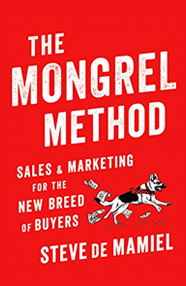
Steve de Mamiel is a sales and marketing leader who has guided a number of companies through successful evolutions by focusing on solving customer problems rather than simply selling. He earned a Bachelor of Business from Edith Cowan University in Perth, Western Australia, before moving to Sydney and later Melbourne. He has extensive experience leading, coaching, and consulting for sales and marketing teams across the United States and Asia, and has mentored teams at companies including Facebook, Google, and Telstra. He is the author of the Amazon best seller The Mongrel Method: Sales and Marketing for the New Breed of Buyers.
📚 Books by Steve De Mamiel
Transcript
[0:00:32] Charlie Hoehn: You’re listening to Author Hour, enlightening conversations about books with the authors who wrote them. I’m Charlie Hoehn. Today’s episode is with Steve De Mamiel, author of The Mongrel Method. What is the best approach for marketing and selling to your customers? Should you focus on email or Facebook ads or Google ads or chatbots? Well, Steve and his dog Samuel are here to help. Steve uses stories about his dog to make marketing and sales a little bit more approachable. Instead of feeling overwhelmed with all of your options, Steve’s goal is to just make marketing easier so that you can make better connections with your clients. By the end of this episode, you’ll know why you need to stop selling and start solving. Now, here’s our conversation with Steve De Mamiel. So Steve, let’s talk about your personal journey. What ultimately led to The Mongrel Method? What problem or obstacle were you faced with that ultimately laid the foundation for you to write this book?
[0:01:55] SDM: Yeah, so I had a career in sales and sales management and that required a fair bit of coaching and then I was also running sales training for small teams. One of the challenges was that particularly sales people and non-sales people, so professionals who had to do, or had to sell — we all have to sell — they hated training, they hated the time out, they hated sitting in the classroom environment and everybody knows that 80% of the training is lost in three months’ time. So in a training environment/coaching environment, you’re up against a resistant cohort who don’t really want to be there, they’re distracted by other things and we all in the room know full well that in three months’ time, most of it is going to be lost. So there was that piece. There was also the impact of technology on sales and marketing and we’ve seen over the last few years that marketing has crept into the sales environment and marketing now does a lot of the heavy lifting for the sales team. So that lead generation, that grind, that sales used to do now to a large degree is done by the marketing team. That’s predominantly inbound marketing as most people would know it. This technology piece, the resistant class environmental coaching environment, they were really the basis of the book. So what came out in a lot of those coaching sessions that I was running is I was telling stories about my dog that I used to take the vineyard and so I had these number of analogies where I would connect, what the dog did to the sales theme. Then what I found over time was…
[0:04:08] Charlie Hoehn: Can you give some examples?
[0:04:10] SDM: Yeah. So I talk about going to the vet and the scenario where I would take Sam to the vet and often I knew full well what was the problem. He was a Kelpie cross, an Australian sheepdog as most people would know it, and he would chew and swallow just about everything and I would often take him to the vet because he was in pain and sort of crawling around. He was a clearly in some sort of discomfort because he had swallowed a piece of wood or he’d swallowed a rock or something that he was playing these mad retrieval games with. I will take him to the vet and the vet would say, “You know, what’s the story?” And I’d say, “Well, he’s obviously swallowed something.” Then the vet would go through this process of poke and prod, take temperatures and do other things and then ask me another group of questions and then treat the dog and in sales, I used to say to the team, "You had to do a diagnosis before you came to a prognosis.” So the sales people would often start to hear a scenario and they would immediately jump to a solution for the customer because they’d heard it a million times before. So I used to tell the story about taking Sam to the vet, lead it into the sales idea that you have to go through a diagnosis, before you had the answer and most people would get upset if they met a sales person, they started or explain their issue, their problem they were looking to solve and the sales person essentially cut them off and said, “You need to buy XYZ.” Trust starts to unravel, the customer feels unheard. So when I started to tell these stories and we were working then on some of the opportunities the sales team were working on, if somebody even hinted that jumping immediately to the conclusion, somebody in the group would say, “No, no, you’re not taking the dog to the vet or you’re not doing a proper diagnosis.” So snippets of the stories, the anecdotes would get repeated back and at that point, it occurred to me that these stories about the dog was sticking. They were being attached to the sales concept and helping people to recall them.
[0:06:40] Charlie Hoehn: Yeah, that makes total sense. Effectively, you were telling them to treat clients like patients at a doctor’s office and instead of jumping right into the solution to take the time to properly assess their particular situation and even if you’re going to sell them the exact same thing that you plan on, you need to hear them out and make sure they feel that they’ve been heard. Is that right?
[0:07:08] SDM: Exactly, and then you need to show that you’ve gone a step further and really understand the issue because those things are very powerful in building trust and relationships with the client.
[0:07:23] Charlie Hoehn: So I want to hear about your book, what it entails specifically. I have a good idea of what the main idea is in the book, but I’m in marketing so I’m interested in hearing, like what would you tell me to do, specifically?
[0:07:42] SDM: Give me a scenario?
[0:07:43] Charlie Hoehn: Sure. I help authors with marketing their books. I work with authors and I help them come up with a plan and then we execute that plan based on their particular book. Now, what I do is I determine who they’re trying to reach with their book, what the best ways of doing that by extracting some of the best ideas and stories from their books and looking at as many potential strong, compelling angles as possible and then we look at what are the outlets in which this book is really going to thrive? Where is the audience really going to latch on to this and who are the people that can promote it that it’s going to make sense coming from them, and that they’re actually going to want to promote it? So my process in working with the authors is asking them a lot of those questions. Is there something in addition to that or a modification of that that’s in The Mongrel Method?
[0:08:50] SDM: Certainly the technology piece is a big part of the book. I spend a fair bit of time in looking at how changes in sales and marketing over the last five years have impacted the approach. So one of the other key ideas in the book is what I call customer intent and that’s really an idea that replaces what’s traditionally been known as market segmentation by demographics or to a lesser degree, marketing personas. They certainly have a place in marketing but I take it from an approach that these days, using Facebook and Google and certainly YouTube to a degree if you’re running advertising there, you’re able to actually look at what the customer is doing, what other interactions they’re having, what are they investing their time in to target the marketing so to develop the target market? I often describe a scenario where if somebody was buying a backyard swimming pool, they have to do all of these things upfront to enable the swimming pool to be installed. And a lot of sales people would, “Look, a typical customer for a backyard swimming pool, there’s two kids, they live in a middle class, they have a nice big backyard, I’m going to go and target that market.” My view on the world is that you instead should be looking for people who are doing the things that are prerequisite to having a pool installed. That might be, do we get approvals in place? Have they spoken to landscapers who might finish off around? Regards the industry, there’s often a lot of things that have to happen upfront to enable that person to be your customer and if you’re looking at it from that perspective, you’re forgetting about their income, where they live, all of those biases and preconceptions that a lot of people come with if they’re looking at marketing personas, they’re looking at instead exactly what the customer is doing, the clues they’re giving to show that they’re invested in your product or service.
[0:11:22] Charlie Hoehn: Right, you’re basically looking for triggers before the actual purchase happens. I think Target was – they got in trouble a while back. This is a few years back, it got a lot of press but they could tell by a person’s purchases that they were about to have a child and so they could cater their marketing. Do you remember this?
[0:11:49] SDM: Yeah.
[0:11:52] Charlie Hoehn: Just to finish the punchline of that story, they were sending like a 16 year old teenage girl marketing materials for having a baby and the father got so upset because he thought it was really inappropriate, but Target ended up being right in their marketing because she was actually pregnant. So basically, you’re looking at trigger points before you make the commitment to begin marketing to the customer, correct?
[0:12:24] SDM: Yeah. Target had it exactly right. The mistake they made was it was a push; they were sending stuff out, there wasn’t a pull towards them and had they done things that attracted the 16 year old to them, you know, it was more of an inbound marketing effort rather than pushing offers out.
[0:12:48] Charlie Hoehn: What do you mean by inbound marketing effort? What specifically are you referring to?
[0:12:53] SDM: A customer will get online, they’ll start doing searches. They will start doing things to educate themselves about solving the issue in front of them. That’s been the significant change in the last probably five years is the power used to sit with the sales people. They would go out and find a client who had an issue but they weren’t sure about how to solve it. Part of the sales person’s role was to educate and influence. They no longer have to do that. The client is now essentially doing all of that themselves and that’s giving a lot of weight to what I call community marketing where – and some people put a lot of effort into influence of marketing and that might be simple stuff like promoting a health and fitness product with somebody on Instagram. Some gym instructor, for argument’s sake. A lot of that inbound marketing piece is about how do you draw a client towards you? Rather than you pushing at them? Because a lot of the book and a lot of my sales approach is about, you need to be attracting customers to you, you need to show, providing them with things that helps them solve their problems or deliver a benefit and the second somebody starts pushing, pPeople become defensive, the walls go up, you’re unlikely to advance the cause. You're not going to sell them something, they’re simply going to move on to the next supplier
[0:14:48] Charlie Hoehn: Author Hour is sponsored by Book in a Box. For anyone who has a great idea for a book but doesn’t have the time or patience to sit down and type it out, Book in a Box has created a new way to help you painlessly publish your book. Instead of sitting at a computer and typing for a year, hoping everything works out, Book in a Box takes you through a structured interview process that gets your ideas out of your head and into a book in just a few months. To learn more, head over to bookinabox.com and fill out the form at the bottom of the page. Don’t let another year go by where you put off writing your book. Would you say that’s the top mistake that companies are making right now is pushing rather than pulling?
[0:15:42] SDM: It certainly is because I think a lot of sales people, they’re beaten into it. “You must get out, you must make calls,” and it starts from when they walk in the office, “You have a quota, what are you doing today to meet that quota?” What I found was I would be out chasing clients when I was in a sales role and I was in a technical software selling role and we would often bring in technical support people. I would get to the point where the clients said, “You know, we need to understand how we address some of these technical issues,” and then I would race out and drag my technical support person in who had a project management or business analyst background as well as practical expertise and then they would have this conversation with the client about very obvious things, which had a project management bent to them that talk about the resourcing, they’d identify the scope. All very obvious things that if there was going to be a sale, I should have understood and it was embarrassing because my technical support would have a better understanding of what the client required than what I did and that was really my job and when I did a project management qualification, I think that actually advance my sale skills because that piece helped me have a conversation with the client to say, “Look, if we are going to solve this issues for you, these at the things that we need to understand.” And by simply having a conversation with the client understood why you needed the answers to this and why we needed to get into the detail with this, it is the only way as this guest approaching is going to be delivered and soon as I had that “aha moment” sales got a whole lot easier for me. It no longer became a push; It became a conversation about how do we solve this together and doesn’t make sense for us to work together? Because again, a lot of sales people keep pushing and keep pushing. They’ll put the blinkers on and ignite the fact that it doesn’t actually make sense for the customer. These are priorities that are not ready for it now. There’s a whole bunch of other things in the way and by just sheer pushing they think suddenly it is going to get to the top of the list for the client. Well the reality is, it may not be right now. It’s time to move on to the next interested prospect and come back in due course to the one you’re talking to today.
[0:18:30] Charlie Hoehn: Right. So tell me a bit about how others have started implementing The Mongrel Method, what have you seen with people who’ve used your ideas in sales and marketing?
[0:18:47] SDM: Well certainly that, let’s have a conversation, make sure it makes sense to both of us to continue the conversation. That’s worked very well, certainly in that early hard grind piece inside those around finding qualified leads and then having that initial conversation, they become much more effective at that. Because that’s simply an approach from the view that I am not trying to push anything at you. I am just trying to understand, does it make sense for us to continue the conversation, and having you identified something that needs to be solved? And if it doesn’t make sense that’s fine. We’ll move on and we might come back and I have left the door open and we’ve had a sensible conversation so that I am welcomed back in at some other point in time. That initial qualification piece is doesn’t make sense for both of us. Can we work together? Can you see a hard, a tangible benefit at this to progress it? So that qualification piece works far more effectively. I am also seeing in some of the professional services area where lawyers, accounts, those sort of areas where they don’t want to sell, they don’t think they have to sell, but again they have similar issues where a new client often wants to ask and wants a questions and the professional is torn by this time that gets swallowed and by I guess tie kickers and they fight at this point in which they say to the person on the end grade of the phone or saying to a person: “Look if we are going to progress this point, you need to be a paying client. I need to turn the clock on.” Because a lot of professionals find they lose a lot of hours in that business development piece. So the technology piece is the other part of the board and a few years ago it was email automation and people would download the white paper, it would trigger a conversation, and three or four years ago, I was finding that was very effective. In that somebody might come to a lawyer’s website, they would download a document that dealt with a particular issue and then a few days later we would send them a follow up document saying, “Because of your interest in this, we thought this might be also have interest” and we found the people appreciated that. They loved it and they would actually start this conversation over the email and they assumed in a lot of cases somebody was actually doing it. But it was just a work flow in Hub Spot. So the professionals were seeing that they are saving lots of time that was sunk business development hours were disappearing and people were booking themselves to become clients because they felt like they were being heard. The law firm was switched onto their issues and we are serving them content that was relevant and it got to the point where people were turning up when we first started this process and it was embarrassing. Because the lawyer that was sitting in front of had no idea what I’ve preceded them. So we had to back up a bit and get to the point where we had to brief the lawyer about why the customer was in front of them but at the demo, this email conversation had gone on they have spent time on the content or these white papers and these checklists, this is their problem. So there was a number of silly embarrassing moments where someone would walk in the front door, sit down and go: “Great! So how could we solve this and the lawyer would look at them blankly because I had no idea what had happened in the marketing sphere”.
[0:23:06] Charlie Hoehn: Right that is funny. I can totally see this method being really palatable for people who are resistant to marketing and it makes a lot of sense. Just treating your customers like you are the doctor and they are the patient, automatically make you more heard and obviously setting up those systems is a better work flow so that’s cool. What is the rest of this year look like for you? Are you promoting The Mongrel Method? Are you trying to do speaking and business as usual?
[0:23:44] SDM: Yes, I’ve got a number of speaking events booked for the balance of the year and that taking a chapter a single concept adding the book and delivering that in typically a 45 minutes. There is also some sales coaching that comes out of it, so that will be — that’s a good piece of work that I really enjoy doing where we sit down with a team and we learn these sales and marketing techniques and then what I am finding also is that digital transition piece and bringing sales and marketing together. That’s a large part of the consulting piece as well because a lot of companies are still, I guess, challenged by that transition in bringing those two teams together and aligning them.
[0:24:38] Charlie Hoehn: Oh yeah.
[0:24:38] SDM: Yeah, so that’s a big part of it and you know marketing is slowly finding out that now as a cannibal now at sales and sales are now starting to find that they need to develop some other skills, which is almost falling into the business analyst and project management skill-set and I am talking here in complex business to business sales. So there is a lot of skills, up scaling to be done for sales people in that area as well as they find that, you know, their process is essentially shifted to the right that they need to be part of that business case and unless the business case is there and stands up, they will never make the sale. They will never have success with the client.
[0:25:34] Charlie Hoehn: So if you were going to write a follow up book, a sequel to The Mongrel Method, what would that be or it could be unrelated?
[0:25:42] SDM: Yeah, it would be looking at the sales management piece because I think that is a skill-set that is now very different. Going back a few years ago it was essentially supervision of the sales team. Sales management is now really just a pure coaching and development skill and sales automation and CRM’s and all of that now essentially do that sales supervision piece. You can see now if a sales person isn’t going to make it very early on in the piece by their activities. So yeah, book number two would be that sales coaching piece and how that ought to be done and then in also in visage the number of small how-to books. So there would be particular components around the technology piece and how that could be implemented. Some quick easy read, 80 page, 100 page little how to guides and one of those that we started to shape op now is, I was talking about it earlier about the email automation piece, the chat-bot is now, and to a degree artificial intelligence, the AI piece is now having impact on that sales process. So there is one big book and then a whole bunch of small how to books.
[0:27:07] Charlie Hoehn: Right, so what is a parting piece of advice that you have for fellow marketers or business men who want to write a book themselves but are on the fence about doing it?
[0:27:25] SDM: How do you tell them — say that without scaring them off? Look, the reality is that it’s an investment in time and I think with all large projects, the only way to achieve is to chunk it down and the way that I manage to do it is take a single concept and build that out and not get buried in this idea of going to produce this 30 odd thousand word document. I’m simply going to take one idea, I’m going to express it and I’ going to make it clear and simply focus on that in a sensible timeframe and then go on and do the next idea. I think the trick to it is chunk it down into small little pieces to not make it this all-encompassing monster task.
[0:28:17] Charlie Hoehn: I love that, that’s fantastic advice. How can our listeners connect with and follow you?
[0:28:26] SDM: All the usual social media pieces if they simply search for “Mongrel Method”, I’ll pop up on Facebook and the mongrel method website or sdemamiel, but the surname gets a bit tricky so certainly if they search mongrel method, they’ll find me.
[0:28:42] Charlie Hoehn: Perfect. Steve, thanks so much for being on the show.
[0:28:46] SDM: Fabulous, thanks.
[0:28:55] Charlie Hoehn: Many thanks to Steve De Mamiel for being on the show. You can buy his book, The Mongrel Method, on Amazon.com. How will you apply today’s lessons to your marketing? Let us know by leaving a review on iTunes or you can send us a message at Facebook.com/authorhour or on twitter @authorhourpod. Thanks again for listening to Author Hour, enlightening conversations about book with the authors who wrote them. We’ll see you next time.
Want to Write Your Own Book?
Scribe has helped over 2,000 authors turn their expertise into published books.
Schedule a Free Consult