Travis Rosser: You Inc
Read the full transcript
Travis Rosser
Travis Rosser is a software entrepreneur, speaker, and author. He co-founded Kajabi, a knowledge commerce platform that helps experts build businesses around what they know. In You, Inc., he offers a step-by-step guide to finding the business within you.
📚 Books by Travis Rosser
Transcript
[0:00:11] Travis Rosser: Author Hour is about answering one question: How can you get the best ideas from great books without spending so much time reading? Every week, we take you behind the scenes with a new author, about the most important points in their book. So if you love to learn while you're on the go, you’re in the right place. All of our book summaries are 100% free and we do more than a hundred episodes every year. So please subscribe to and review Author Hour on iTunes.
[0:00:48] CH: Today’s episode is with Travis Rosser, author of You Inc. You may not realize it, but you were given a gift that you need to be sharing with the world. The experiences you’ve accumulated throughout your life can turn into a potential business. You have knowledge that other people need and they’re willing to pay for it. That’s what this episode is all about. Travis is the Cofounder of Kajabi, which is an online knowledge platform that’s helped more than 10,000 people launch their own small businesses. To this day, these knowledge entrepreneurs have generated more than $600 million dollars in sales. Knowledge capital is a new reality that offers amazing opportunities for success and in this episode, Travis brings together all of the insights and lessons and strategies that can help launch you into an exciting opportunity of turning what you know into a business. So if you’re tired of working in a traditional job or a business environment and you want to become your own boss, you can become a knowledge entrepreneur. By the end of this episode, you’ll know what’s inside your brain that’s a special gift and your best business asset and how you can share that gift to not only change your life but the lives of everyone that you reach. Now, here is our conversation with Travis Rosser.
[0:02:40] Travis Rosser: As a kid, I actually stuttered my entire childhood until I was 18 and I think the first story I would start with was being in that situation where I couldn’t talk and I wanted to talk and I didn’t know how or if ever I was going to stop stuttering. So during that childhood, I became very internal, I just thought a lot, I was very creative, I was always outside on our farm with my dog and just thinking and inventing. As I look back on that now, that was very formidable — if that’s the correct word — of how I work, how I believe, how I think is like I’m stuck in a situation and I know it’s never going to change, I remember back then, I was just quiet, I just waited. It was like I was waiting for god or the universe to be like, “Here’s what you should do Travis, here’s what you should do,” and in the book, I talk about that a lot, I talk about times in my life, times at customer’s lives where they weren’t sure what to do or they have this thing, they have this feeling and they didn’t know how they were going to get there. Sometimes the best thing you can do is just be still and know that it’s going to work out and know that you’re going to overcome this and know that you’re going to finish this book because that’s the one thing that you have control over I how you feel about whatever situation. Back then, I didn’t know that. That’s the crazy thing. Growing up as a kid and stuttering and just, that was a mess, but now I can relate and now I think about it all the time, whenever I’m stuck and I know something’s hard and difficult but I know I have to do it, I know that eventually I will get through it. I just always have, even if I completely fail. That’s what this book is about is looking at all parts of your life. The good, the bad, your talents, your passions and really, it’s like, what if things happen to you for a reason? They happen to you on purpose and then you realize that actually gives your life purpose when you accept that.
[0:04:24] CH: So before we dive in to the content of the book, I’m curious, tell me about a time you remember when you were a kid, where you had that experience of god or the universe sort of unfolding the plan and telling you, “This is what needs to happen.”
[0:04:41] Travis Rosser: Yeah, there’s something powerful about being outside as a kid and I have kids now and they’re playing Fortnite all the time. I know they love it but it was powerful being outside like that and like playing and my hands in the dirt and I remember praying all the time like, “God, please, take this stutter away. Please give me a good ideas,” and I remember, my parents were very middle class but in my mind I thought they were so poor. I thought we were so broke. My dad was a football coach and then he also farmed our 20 acres and so, he worked hard all the time but I thought we were broke, I would pray to god like, “God, please, give me something, give me an idea, like show me something just to make money. Like where does money come from, how does it work?” I didn’t know anything, my dad, he was a hard working person but he didn’t understand money either and I remember having feelings like inside, it’s like, “I’m going to show you,” and I would see thing that didn’t make sense, like, not that it was the future or anything, it was just this feeling of, “This is going to happen one day,” and then I would forget for you know, 10 years, 20 years but until writing the book and looking back and going wow, this story has been unfolding for a long time. It’s just powerful.
[0:05:52] CH: Thank you for sharing that. You have in the book — well, the book is the divided into three parts, The Business Inside You is part one. Part two is From Knowledge to a Business and then part three is Launching You Inc. Let’s start with diving into part one, the business inside you. You say that you are the hero of your story but even before that, you talk about the story of knowledge capital. Break this down for me.
[0:06:26] Travis Rosser: Well that’s good, I’m glad you said it this way because I’ve kind of already started to do that one, as I started to tell my story. It’s important for the people reading this book to start thinking about their story and realizing, what have I been through, what have I overcome, what am I really good at, what do I love? You’ll get to this next phase and you realized that what you know and what you’re good at is an asset, It’s capital. We live in a world now where everybody’s worried about 401(k)’s or retirement. But the reality is, most retired people have amazing knowledge. They know things, they know how to do things, they know how to solve things. They don’t know technology as well, but there’s a way they could share that and that’s really about recognizing like the knowledge capital that you have. Then the other thing is the concept of the hero’s journey. I mean, we’ve been talking about it on here but I remind people that concept and a lot of us in business, we know that story, we’ve seen it, we’ve heard it explained a million times but do we live it? Do we actually live that in our life? Some people do, some people do the thing that I hate: “fake it till you make it”. But then when you make it, you’re fake and I hate that. Because I’m around a lot of successful people, a lot of millionaires, a lot of people have killed it and I do not like them all. There’s a lot of them that are just assholes, like they’re just, I don’t know how to explain it. I always say, see it and be it until you achieve it. Just see it first, that’s step one of the hero’s journey is, “Oh crap, I got to go do this thing, there’s call, there’s a feeling,” and like I can look back on my life and I didn’t realize every time I was called. Sometimes I move, sometimes I didn’t move. This concept of taking what you know and sharing it, you’re going to have to meet people along the way, they’re going to help you and you’re not even going to realize how much that’s going to change your life but just like in the hero’s journey, just like you know, in Lord of the Rings, you know, Frodo comes home, it’s like you’re going to come back home with this experience and you’re going to help others and your family and other people. There are stories in here of people that have shared their story and saved people’s lives. There’s this guy Keith Kalathis, I can never say Keith’s name right, I feel so bad. Keith’s in the book and he is an expert in starting a landscaping business. He shares YouTube videos all the time about starting his business, how you can start a business doing landscaping and he just talks and someone found him on YouTube late at night, the guy was having a rough couple of days, ready to kill himself. Here’s Keith on YouTube and all of a sudden he saw that spark of hope, like, “What if I did this, what if I got up and changed my life?” And there’s a lot of stories like that, that happen. It’s crazy, it gives me goosebumps thinking about it because I remember those stories in those moments and not realizing one day I would write a book about it.
[0:09:05] CH: Wow. So I’m about to blow your mind, Travis. I love that you’re talking about all this because you’re firing on all cylinders in my life right now. So I’ll share with you and we’ll make this a more personal podcast. Normally, this is sort of like — it’s like being on a date where I’m asking all the questions and I’m not getting questions back. But this will be more, a personal story. So we’ll each share our personal things going on. So I’ve done what you prescribed in your book. I’ve had a few experiences in my life, big problems that I’ve overcome and things that I’m good at that I’ve shared with audiences and not to boast but this is a fact, I’ve had that experience that you just talked about with Keith where people who were suicidal have written to me and said, something that I taught or something I shared pulled them back from the edge figuratively and literally, you know? I know that experience and I know how powerful it is and I also know what you're talking about when you hear the call and you either follow it or you ignore it. The pain of ignoring it and so I’m at a position actually right now in my life where I’m examining and testing like three things that I could offer to people as my knowledge into a business. Frankly, I haven’t exactly spun my wheels, but I have been feeling stuck because I know how much hard work it takes to really get this going and to do it well, and I have some trepidation to the call, so to speak, because I know what is in front of me, especially if I get it wrong.
[0:11:07] Travis Rosser: Here’s the thought about the hero’s journey, if you truly listen to the voice and you truly go forward, you can’t get it wrong. Even if you fail 10 times and you know this, you’re here, you know, killing it in your own aspects of business but somehow we have to overcome that because I have the same fear. Like, “What if I screwed up?” I get stuck in this perfection game when that person out there just needs me to show up.
[0:11:29] CH: Yeah, let’s talk about this part because this – I take it you’re a spiritual person, as am I. how do you know when you’ve heard the call? What are the flags going off?
[0:11:41] Travis Rosser: Sure. This is important because we all have voices in our head, whether we like to admit it or not and a lot of us have a lot of negative voices and there’s so many good books out there about digging in and moving beyond the voices. So number one thing, a negative voice is not the voice that you're going to need to listen to and I have the worst self-talks sometimes. Like, “You can’t write, you flunked out of college, how could you write a book?” That’s not the voice you’re listening to. The voice you’re listening to is, “You should go do this, what if you did this? Somebody should do something about this.” You know, then it comes up again and again or you have those moments where you get those goosebumps and you’re like, “Woah, that was weird, we were just talking about this.” Like just the other day my friend, my kids were explaining Fortnite and I was talking about Esports and the future of Esports and software and I got all these goosebumps and I was like I went and I journaled that and I was like, “Okay, I was talking about this and this happened.” Because, this crazy thing about life and Steve jobs used to always say the things about the dots and the dots connecting is, the dots are happening right now, whether we know it or not and there’s clues in life. Number one is this feeling that you feel. Number two, I always feel is when someone seems familiar, it’s because you were supposed to meet them. If you’d rather that happen? You meet someone — Like my wife, I just recently got married a couple of years ago and when I met her, I wasn’t even going to date her, just met her in business and she was familiar to me and those are the kind of voices you have to listen to, it’s not negative voice, it’s not ego, it’s not like, “I want to get rich, I want to do this.” It’s, “I should do this,” or I’m so scared to do this, that’s another cone. If you’re really scared of it, it’s probably time to go.
[0:13:16] CH: Can you think of a time where you heard, I’m so scared to do this and you did not do it?
[0:13:21] Travis Rosser: That’s a good question. When I was younger, probably all the time. I mean, in the book, I talk about flunking out of college. I went to Fresno State and got in a fraternity and drank all the time and had all those normal feelings of what I need to do to get success and so I flunked out of college eventually. My journey still led me through college and I still graduated but those were examples. Starting Kajabi was so difficult that I wanted to give up many times. I mean, I learned about anxiety back then. I thought I was having a heart attack but actually, too much anxiety, you get the exact same symptoms, I didn’t know that. That’s those moments where I’m like, “Holy crap, I have to jump off this cliff, I have to at this point.” Same thing with this book, I mean, we were just talking about this. I’m scared out of my mind to launch this book. I love it, the story’s powerful, I know it’s the start of a movement but I’m still scared. I’m still like, “Oh shit.” You know, I think at the end because you know, I just recently sold my ownership in Kajabi and towards the end, I knew I needed to go and I did try to ignore me moving on and depression started setting in, avoiding things starts setting in so you can try to ignore the true voice that’s coming, whether it’s coming from God or whatever. Unfortunately, when you do that, your life goes another direction. Sometimes I want to meet people that are addicts, I always tell them that I’m like, “God’s trying to tell you something, man. Must be destined to do something huge because if you chose to sedate yourself and anchor yourself right here, there must have been big plans for you.”
[0:14:50] CH: Yeah. I’m thrilled to be talking with you because I feel like I’m talking to a different version of myself. Everything that you’re saying is really resonating. Let’s dive into the actual part two, of actually doing this stuff. From knowledge to a business, right? Discovering your knowledge niche, this is where, personally I’ve really struggled because again, I’ve had problems I’ve struggled with, I’ve overcome. All three of these problems have been, that I thought of, “Okay, I could do more of this as business.” All three of these problems have been things that other people have asked me to help them with, a lot of other people and at times, I’ve just struggled in figuring out how to make this into enough of a niche or who to focus on and that sort of thing. So it’s hard to discover this for myself. What is your process? How do you recommend you get started there?
[0:15:50] Travis Rosser: Yeah, first, let’s start with that discovering your knowledge niche and this concept is trying to figure out what could you share? Because the whole book is about discovering the business that’s inside of you. I mean, we’ve been talking a lot of spiritual stuff and self-help stuff and like growth but the reality is, if you treated your life like a business, how would you treat it? There’s finances, there’s fitness, there’s a lot of things, but what you don’t realize is what you’ve been through, what you’re good at can become a business. So the book takes you through the process of discovering these things and you were just saying you have a couple but people that are listening to this, I have these things, I call them the four P’s. The first one is professional knowledge and that’s, you know, that’s what we’re doing right now. I mean, you know how to interview on podcast, that’s a great gift. I know how to design software and apparently I’ve written a book, so I know how to do that now and there’s a lot of things we know professionally and we’re geared towards that. We’re geared towards going to school, finding the career, having a resume, a LinkedIn account. You know, that’s number one, we all think that’s where knowledge is. The first challenge I will say is, it’s not always the obvious thing. One of the guys in the story, Joe, who is from Huntington Beach right here in Orange county, he was really good at excel and he was at a company where he did analytics and he could make these excel spreadsheets with all these like, graphs and formulas and functions and everybody in his company would ask him, “How did you do that? Can you do that for me?” Not realizing it, he started blogging about it. Having files that could be downloaded and pretty soon, he did email capture and then eventually sold a course on how to do it. Now he makes multiple six figures and he does not work in an office anymore. That’s obviously the dream of a lot of us that are, you know, trying to start a business or self-help. But the reality is you’re taking for granted what you’re good at. You need to think about, like, “When I’m at work, what makes me feel really good?” That’s a good way to find it, “What am I always asked to do, what do I finish quickly, what should someone fix in this business?” That’s also another thing. “I wished this company did that.” Those are knowledge niches, having that information and turn it into steps and how to do it and how to succeed, that’s knowledge. So that’s the first one, that is the easiest one I think. The next one is passion. Passion is simple also, it’s the stuff we love to do like golf and surfing and flying drones. I always use this example because I have drones and I love them. They’re so amazing. In fact, if I was in my 20’s, I would probably build a business around drones, whether it was security or surveying properties or who knows. Let’s say you’re good at doing drones, you could actually create a course on everything I just shared, like “How to start a business with drones” or how to – there’s all that knowledge you could package into something and turn your passion or your hobby into your business. The amazing thing about this is you meet people that do this that are now doing work, doing something they love, that they would have done for free and now they’re making a living and sometimes they’re making a killing off of this. The book goes through all that and helps you kind of discover what your passion might be that you didn’t realize was the passion. I mean, there’s so many little things that we’re good at. I know people are like, “Well I’m not an expert, how can I be an expert? I just know how to play golf, I just know how to do this thing.” But no matter where you are in your life, you’re an expert to somebody. I talked about my two kids earlier about Fortnite, well, one of them is 15 and my younger son is 11. Well the 15 year old, he’ll kill it at Fortnite and then my younger son will be like, “Kyle, how did you get there? How did you do that?” Then he shows them and that’s what it’s about, that makes you an expert when you are a couple of steps ahead of someone on whatever it might be. The next two, I’ll package these together, it’s pain and problems and I think a lot of us think stuff happens to us and it just happens to us. But if we realize, like I said earlier, it happens to us for a reason and has a purpose then we find purpose in our lives. I have seen this over and over again, whether it’s getting out of debt or overcoming a divorce or there’s a guy in there that throws his back out when he’s 22 doing CrossFit and he’s going to have to do surgery but then he figures out all these range in motion techniques and he basically heals himself doing these techniques and now he helps other people from a back pain that could have become completely debilitating. This is an example of like bad stuff can be really good when you use it to help someone else.
[0:20:16] CH: Oh yeah, because a lot of people have those pains and those problems and for some of them, it is a figurative bleeding neck problem that they’re like desperate to find a solution to and those are the people who are most eager to learn from you.
[0:20:34] Travis Rosser: I know, people get obsessed, they get on YouTube, they figure this out and all of a sudden, their angle’s different and it’s like, “You could turn that into a business and it’s going to help hundreds of people, thousands of people.”
[0:20:44] CH: You know, my friend listens to the show and I’m going to make sure he listens to this episode because he knows everything about getting through divorce amicably, successfully, without destroying the family and the couple. What I’ve encouraged him to do and what ahis wife is encouraged him to do is to make a course or make a business around this and he has hesitation because well, for one, he doesn’t want it to come back and bite him in a potential future, I guess, trial date? I forget the terminology. But he also is very good at marketing but it’s not his passion, but it’s always this lingering thing for him. So what would you say to him if he were talking with us right now? He’s been thinking about this for years, what would you tell him?
[0:21:37] Travis Rosser: I think the one thing I would say is think of it like if you’ve been through that situation, if you have that feeling, you need to go share this thing, I always think of it like, think of what if you went back to yourself. Because I’m assuming he might have went through that situation, I don’t know? Typically, that’s what happens. What advice would have given yourself back then when you knew nothing and get on the internet, in fact the book ends with that about how to get started and start sharing. Share it through YouTube, share it through Instagram, Facebook, keep it really simple. Maybe pick only one or two of those platforms and share those things, talk about those things, start connecting with people, start helping people. Because you’ll realize, number one, you’re going to help other people and there’s nothing more powerful in this world than helping another person and reliving that burden. Like you talked about people that have called in and said, “I was going to kill myself and then I heard this and you inspired them.” Like, that ultimately is the reason why we do this is to share. Is once we share with someone else and we show empathy and we’ve been there, we are the guide in that hero’s journey and that’s a thing, hero’s journey is dark and is scary and you want to turn around and you want to stop. Like you almost have an obligation to go do that thing because it’s on your heart first of all and I don’t know what people believe they’re listening to, god, universe, whatever, it’s on your heart for a reason, it’s there so you could hear it for a reason. So you need to do something about it and I talk about it in here, there’s a guy named Garret J. White that created this program called wakeup warrior and 2015, I got divorced, my life fell apart and Garret was on Kajabi and I’d seen his stuff and he has this great program for men, just rebuilding your life, connecting with God and just family and I couldn’t stop watching this stuff and pretty soon, I’m at one of his boot camps and I’m literally going through his program because he put it on Kajabi. That was one of those moments where I was like, “Holy crap. I made this software app because I knew it was a great idea and it will help people. Then Garret White went through this divorce and all this shit and then he created this program and he’s helping people and then I find it on my own platform,” and then it completely changed my life. I mean, that was a turning point in my life just three years ago where I turned my whole life around. I mean, you know, it was all because Garret shared his pain and he was brutally honest about it. He just put it out there. I mean, it sucks because it’s scary and people are going to criticize you and you’re going to put yourself out there but the alternative is having that in your mind knowing you should do something about it and that sucks because then, it manifests into other things. So no pressure.
[0:24:18] CH: Wakeup Warrior, by the way, I’ve had other people mention this to me in the past, their site is really great, it’s worth checking out, go to wakeupwarriormovie.com and I want to echo what you said and I want to share something personal again because I had this experience, let’s see. Let’s see, maybe seven years ago, I was working on a book and it was very long and over a hundred thousand words and I gave it to a handful of friends to review and they said, “All right, you got to get rid of a bunch of the stuff but this one section that I really liked,” they were like, “It doesn’t fit in the book, you got to take it out.” I took that out and I just said, “I’m going to publish part of this online and just have it live there.” That coincidentally, or I guess, serendipitously became the number one search result for years for how to cure anxiety. So I got all these people from all over the world suddenly reading this article and reaching out to me, thanking me, and it was a little overwhelming for quite a while. I ended up publishing my second book on the topic but what I found — so there was a lot of benefit, and I agree with you totally, that if you share your pain, and be brutally honest about it, it results in not only helping people but having of a business around it, you can make that into your thing. But what I found is that because it appealed to this broad audience, I was overwhelmed with, it’s like I couldn’t help everybody, you know? It was not only that, I started trying to help everybody and I didn’t want to help everybody. So when you said earlier that when you were starting Kajabi and that you had crazy anxiety starting this business, I went through the exact same thing. When I was working out in Silicon Valley or San Francisco and I was in the startup community, I went through the same exact thing. And from what I have learned, a lot of people will go through that with their high stress jobs and I loved helping entrepreneurs with this problem because they tended to be people who could turn their life around. They were very action-oriented. But when I try to help other people who were college students or retirees who were just extremely isolated, I really struggled and I found it completely draining. Have you had an experience like that with?
[0:27:02] Travis Rosser: Oh yeah. I mean, once we started realizing how powerful the concept of selling your knowledge online was I mean I wanted to shout it from the rooftops. There is some interviews that I did way back in the day and I remember always telling people that when Kenny and I built Kajabi, we had this idea that everybody was good at something or they knew someone who is good at something and what if they could share it and so I wanted everybody to do it. And then I realized most people just don’t hear it. They don’t realize they could do it. And all the time I would waste my energy on people or people would say, “Oh yeah, let’s meet up and I will help you,” and one of the things that I actually learn from Garett in Wake Up Warriors, is you can’t be people’s saviors. You can only lead them. As soon as you try to save someone, they are going to put you on the cross and you’re dead and that is just not going to help as many people. I mean, that is what eventually led to the book was when I was at Kajabi, I would be in meetings with my team and I would be like, “We have to tell more people. We have to. This is like a movement that people can wake up and realize that there is something powerful inside of them and if they share it, it is going to change their lives and we are going to get it out there,” and that’s why I eventually went with the book format because I want to build and hand this to someone like my dad who is in his 70’s. My dad was, like I said a farmer and baseball coach and my dad was a good baseball coach. A varsity baseball coach for 35 years. So he has all these knowledge and he’s always asking me, “Well Travis, how can I share this?” So I’m like, “Dad someday I will write a book and you can read that and do it.” But it is really about you just have to continue to spread the message because eventually the right people, there is all kinds of parables about that. You know, when the student’s ready the teacher will show up, and all of that stuff. Just keep sharing. Keep shouting from the rooftops and even if one out of ten hears it and changes their lives that was worth it.
[0:28:46] CH: Yeah and I love what you said about the guy who was doing the excel I think his name is Keith, that he found himself blogging about this and he wasn’t even really consciously aware of it and I find that is actually a fantastic – I never thought about this but that is a fantastic marker for you to determine what it is you are really passionate about to look back through the things that you were proud to share on social media as Facebook posts or on your blog or on Twitter. What were the articles that you were retweeting? What were the things that you were getting riled up about or sharing? I mean just the other day, I haven’t posted anything on Facebook in a long time, but I read about Elon Musk being burned out basically and I knew somebody at Tesla who told me this years ago that the whole team was just burning the candle at both ends. Something’s got to give at some point and so when I read that I was like, “Man this is such a common scenario for entrepreneurs,” and it is something they keep close to the vest because it is our culture. It is how we operate and a lot of the times, there is a lot of money riding on it. So of course, and especially if they are shareholders, my god. That’s why that interview was so shocking for so many people because it’s like, “This guy is backed by billions of dollars and he’s cracking? That never happens.”
[0:30:23] Travis Rosser: Well I think even though he has some crazy reasons why he’s doing what he’s doing, but that is important for us. I mean there is a lot of great books on finding your why and when you take what you know and you share it with someone else and you help them, your why becomes pretty powerful because a lot of the people I interviewed because what I did was for about two years, I was interviewing all the people that made it past a thousand dollars, the Kajabi heroes. And I would hear their stories and I would hear them come to that realization. Like, “I did first for this reason but then I realized it was this,” and a lot of times they were doing it because they just had a crazy passion about it or they knew people needed it. And the people that would do it to help other people first didn’t get burnt out as much as people that are like, “I’ve got to make this money. I’ve got to do this.” Because then you make different decisions. You are pressuring too much, you are not being authentic but if you come with the concept of just like Joe the excel guy, he’s just like, “Hey this is kind of cool, check this out. What do you guys think?” Try that approach. I mean as you read my book, you are going to get all kinds of crazy ideas and the book does end with some good like, “Here’s what you should do, here is how you should get started.” But it doesn’t take much to get started. I mean it is just a little bit of social media maybe even just a business card that you hand out to people and you go meet them in person. One of the stories is Tamzen who was an attorney and then she had kids so she’s a stay at home mom and her first time she started doing work at home was through Skype giving legal advice. That was her first sharing her knowledge. She hadn’t found Kajabi yet. She found other moms that needed legal advice and she’d get on Skype with them. So maybe there is a way for you to take your knowledge and just leverage it with a couple of people you know and create a side business. I mean, it is very possible. It doesn’t have to be huge.
[0:32:07] CH: Yeah, so let’s touch on part three. You talk about determining your product and then taking flight. What is the brief version of this?
[0:32:17] Travis Rosser: Okay, so the first thing is it is another P. I don’t know why I get so stuck on P’s. I go to Rick Warren’s Saddleback Church so maybe it is purpose driven. The P’s is stuck in my head, I have no idea. But so here is the next thing you need to do. Okay, you have determined that I am going to teach about drones. There’s three key things you need to look at. The first thing is, is there people out there that are interested in this? Do other people care about drones? And most of you know this already because you are already Googling it, you are already watching YouTube videos on it or maybe you are in a Facebook group or maybe you get magazines on this concept. There is a lot of old school examples in here of how to find out what people are interested in and one of them is if there is a magazine around your topic then there is usually a market. So if you can find a tribe of people that are interested in whatever it is because I have met some people that have the most random things they’re sharing like cosmic dog health or something. Like dogs knowing what their astrological signs are or whatever and they actually probably did find some people that are interested in that, but make sure people are interested, that is step one. The next thing is could you build a product around this? Could you create something that helped them? You know Joe with excel, obviously he just had these files. He didn’t even realize those files had enough value to become a course but could you create a checklist? Could you create two videos that help someone figure this out? There is another guy, Jordan, in the book that teaches you how to do hard rock music mixing like to produce records and he specializes in drums for hard rock. So he used to give away the drum samples and that was his first digital thing he would share and it might be that simple. Could you make a product that that group of people would pay for? And then the last key to make sure that you’re ready to build this knowledge product is would they pay you? Can you make a profit from this? Because the first two, if people find out and they write, “Ain’t nobody going to pay you for that,” and I say that at the same time as most people undervalue their knowledge like, “Why would I pay $2,000 for that? Why would I pay $10,000? Why would I pay $1 million?” I am actually sitting here in my office, I have a space that we work. So it’s like all of these other companies and there is a college right across the hall from us. People go sign up for that college and they are going to pay a whole bunch of money for courses. Unfortunately, those courses are only going to get them debt and they may not even get a job but your knowledge could change someone’s life. Your knowledge could create a career for them. There is a lot of people on Kajabi and in the concept of You Inc. that will teach you how to start a business around you. There is a lady that does pet photography. Now you would think that her course is about how to take a great photo, which she does show but the reality is what she teaches is how to start a pet photography business and that is where it’s like, “Oh wow, of course someone is going to pay for that.” But it is the same subject and she already knew how to run a photography business. But my point is you may have to shift what you are going to do a little bit and not much just change the target around and make sure, “Oh yeah there’s value now. I see it.” When you have all three of those, even if you are not a 100% sure you are ready to go and then the last part of the book called Take Flight because the name Kajabi actually meant to take flight. It was an old Aboriginal word and I used to work at a summer camp when I was a kid and I heard the word Kajabi. So I bought the domain 15 years ago and I didn’t know why I just bought it and then one day when we were building Kajabi, Kenny and I were talking and like, “Let’s use Kajabi, that’s a great name.” And then when we started Googling it, we found out that it was an old Aboriginal word that they would point to when they saw birds and when they saw planes and it just fits the whole concept of flying. Like flying is impossible, the fact that we can fly is impossible and the fact that you can take your knowledge and share it is going to seem impossible but there is easy steps. Like I am going to tell you about building a landing page and building awareness and about how to promote it and build a product and it’s just simple little steps. The book really ends with action of, “Go do this, give it a try, see what happens.”
[0:36:18] CH: Yes, man I love the origin of the name Kajabi, first of all. But second, I want to double down on what you said, which is the insecurities that people have of, “Why would anyone pay me thousands of dollars for this knowledge?” This is such a common mistake and I know because I have made it multiple times and I just have to relearn this lesson over and over. It is not about your process. It is really not. It is not about this proprietary information that you have, necessarily. What it is about is they’re not buying your process, they are buying their way out of a problem, right? They are getting out of this pain that they have been in because what you are offering is the key to getting to this better place and frankly, the quicker you can get them there the better. If you could give them a button, if that was your approach that’s immediately transformed them into that, which is AKA Amazon, then they would take that. But you are not offering that. So I heard something that made it click for me, which was don’t be the overzealous Sherpa. Don’t be the person who tries to give them every single thing in the world that makes your approach perfect but rather get them out of their pain as efficiently as possible and into the promise land.
[0:37:49] Travis Rosser: That is right and you might even do that for free. Like people are like, “Well wait a minute, can I just Google this? Can I just watch YouTube?” That is part of this process is you have to be willing to give away your best stuff. Like don’t worry about getting paid at first. The whole process in internet marketing knowledge is people need to know you, they need to like you and they need to trust you and so part of that is, is exactly what you said. You are solving their problem, you are showing them possibilities and I don’t know why I am stuck on P’s again. The reason they are going to pay you is because you are a real person. Maybe I just like to say P’s on the microphone, I don’t know but it always happens so funny.
[0:38:25] CH: Let us see if you can do the rest of this podcast only saying P’s.
[0:38:30] Travis Rosser: P perfectly, prepare yourself. So my point is –
[0:38:34] CH: Point.
[0:38:35] Travis Rosser: Exactly, it is so bad I get stuck, people will pay you. Oh god, I am literary stuck on P’s. They are going to pay you because they want that solution. I mean how many times you go to YouTube and you’re like, “Okay how do I unscrew this thing? How do I fix my iPhone?” Like help in that process –
[0:38:52] CH: How do I stop saying P’s so frequently?
[0:38:55] Travis Rosser: Exactly.
[0:38:55] CH: Yeah it happens all the time.
[0:38:56] Travis Rosser: I talk about this too in the book about think about the history of the internet. Now I have been working software for a long time. My first internet job was in 1998. So I have been around doing this forever back when there was no Google and there was just Yahoo even AOL and Comcast and all of these dialups. But the internet started with search, here is a bunch of information. Search, here is a bunch of results then with YouTube and social media it’s like search and then here’s some real people. And then pretty soon, they had personalities and I am doing it again, they have personalities and you got to know them. You’re like, “Wow this is six pack abs. I want to learn from him,” and that’s the process that’s where we are at right now is everybody is an expert. Everybody is good at something because it is you, your version of your life, you are an expert of being you whether you’re bad at it as you might think, you are still an expert at being you and what if you went out and shared that? There’s going to be people that is going to connect with that.
[0:39:53] CH: Absolutely. So I want to hear because how many people have you had go through Kajabi and build courses and stuff on there?
[0:40:02] Travis Rosser: Oh tens of thousands.
[0:40:04] CH: Tens of thousands, all right.
[0:40:05] Travis Rosser: I mean, tens of thousands and we’re talking — we created this program called Kajabi Hero and what it is, is as soon as you hit a thousand bucks you’re a Kajabi Hero. You get all these swag. It’s just a really cool milestone and we first did that program within the first three or four months we had created a million dollars in revenue for all these people because they just kept hitting a thousands. All of these different people over and over again and now at this point, there’s thousands of people that have hit that milestone and there’s hundreds of people that have become millionaires. And I want to say a hundred thousand-naires, but that is very common to make it to six figures because it is a process of, “If I can make a $100 bucks then I can make a thousand bucks and I can make $10,000 a month. Now I am making $100,000 a year, now I am going to do an event. I am going to do more.” I mean the process of scaling is so natural it just automatically happens with that momentum.
[0:40:55] CH: Yeah, so you’ve had tens of thousands and I’d love for you to share one or two of your most memorable. You have mentioned a few on the podcast, but what have been the ones that really took this information and truly transformed their lives?
[0:41:10] Travis Rosser: Sure, the first one is like lady named Leah from Canada. My wife and I were at a Shelene Johnson event here in Orange County and we were at — it was like lunch break so we went into a little restaurant and we were sitting at the bar. There was nowhere to sit, we had lunch at the bar. This lady sits down next to us and she’s like, “Oh, are you from Kajabi?” I’m like, “Yeah.” She’s like, “I am a Kajabi customer. I just started six months ago.” I’m like, “That’s so great, tell me about what you are doing,” and she tells me at this point she’d been on Kajabi on seven months and she already made $600,000.
[0:41:39] CH: Holy cow. The riches are in the niches.
[0:44:54] Travis Rosser: It sometimes is totally like that. So I love that story too because it reminds us that sometimes we take for granted this knowledge when it is right there ready to be turned into a business.
[0:45:06] CH: Man, this has been just a real treat. So thank you for sharing all of this Travis and I am so glad you wrote the book. I hope it gets into the hands of many, many people and it inspires them. I want to wrap up with a couple final questions. The first one is, how can our listeners connect with you, follow you in your journey?
[0:45:28] Travis Rosser: Yeah, I think the first place you can go is I have a site, travisrosser.com where I am constantly blogging about what I am doing, working on this book, the speaking gigs I am doing and the next big projects in my life. If you want to get information about the book, you can go to youincbook.com and like we said, September 18th it’s for sale on Amazon. So go support me, buy the book, get some gifts for friends, maybe inspire them to go out there and start a business.
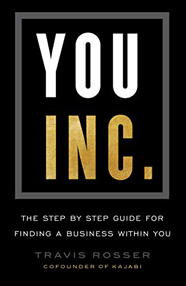
[0:45:54] CH: I like the cover too. It’s got a nice classic look, very nice.
[0:45:59] Travis Rosser: Thank you. It’s funny how just like the name Kajabi worked out and was such a great thing, the same thing with this. As I was creating this book, I was like, “Wow this is really powerful,” and I think that might be a lesson to us to stop worrying so much and don’t worry about perfection if you just go, you eventually adjust enough to where you look back and go, “Wow, maybe that really was perfect.” I don’t think we can really project perfection as much as we can look back on perfection.
[0:46:23] CH: I agree with that wholeheartedly and I was actually just this morning reading — it is kind of unrelated. I was reading an article about how Vince Gilligan tells stories. He is the creator of Breaking Bad and Better Call Saul. He is a wonderful storyteller.
[0:46:38] Travis Rosser: Yes, I thought that sounded familiar.
[0:46:40] CH: Yeah so he and I believed he worked on X Files and all of this. So he wrote that he had a character Tuco, get killed off and he didn’t want that. He planned for him to be the villain for the entire series and because of that he had to create this new character, Gus Fring, who ended up extending the series to be twice as long and made it so much better and he said the lesson from that is you cannot begin really with the true ended mind because you don’t know what’s going to happen and if you have the ended mind, it closes you off to all of these rich opportunities that could come up and so I am with you there. So sorry to hijack that, but.
[0:47:30] Travis Rosser: No, this has been great. Every time you interject I am learning some great things myself and I talk about this in the book, I call it GPS and it’s God Pushing You Softly and if you think about a GPS you’re like, “Okay, I am going to go to Starbucks across town.” Okay, cool type it in, you start going, you make a wrong turn, the GPS is so polite. It’s like, “Please turn around at your earliest convenience. Proceed to the route.” That is the voice. That is God telling you, “Okay we are heading over here. You missed it. It’s been three weeks, you haven’t done this.” That is the voice you need to listen to. That will help you not worry about perfection and just trust, “I am headed over here. I am going to write this book or I am going to do this thing,” and then just get to work and show up and just keep it really simple.
[0:48:16] CH: You ought to do a sermon at your local church and talk about how God is like a GPS because he really is. I mean I like that.
[0:48:24] Travis Rosser: For sure, you know, I think about this all the time because growing up and going to church, I mean we were always told there is something great in you. There is this thing in you, God is in you and the Holy Spirit, whatever and I have noticed as I wrote this book I was like, “Wait, well we should be sharing that then. We should be using that to help other people.” I really hope people listening to this and just realize it is okay to have an idea and go make money with that idea and help people at the same time.
[0:48:49] CH: Absolutely and final question for you, give our listeners a challenge. What is the one thing they can do from your book this week that will get them going in the direction they need to go?
[0:49:01] Travis Rosser: I think the one thing you should do is spend time every morning being quiet. Just sitting down being quiet and writing down what comes to your mind. That has been one of the biggest life changers for me is to find times where I ignore all the stress, ignore all the things I think I have to get done or all the things I have to do or all the things I’ve screwed up on and just try to create thoughts that you know will guide you. And it could be like, “I wish I would do this,” or, “I think I should do this,” and start writing it down. Because when you start writing them down even if you have no idea how you’re going to do them, that is the seed to all great ideas. I mean just like writing the book, I knew I needed to write a book a long time ago but I had no idea how I would ever get there and I am glad I didn’t wait until I figured it out. Like you just got to go.
[0:49:45] CH: Beautifully said, that is phenomenal advice. Travis, this has been such a pleasure. The book is You Inc. Thank you so much for being on the show.
[0:49:56] Travis Rosser: Awesome, thank you for having me.
[0:49:58] CH: Many thanks to Travis Rosser for being on the show. You can buy his book, You Inc., on amazon.com. Thanks for tuning in on today’s show. If you like what you heard, here is what I want you to do next. Open up the podcast app on your phone or iTunes on your computer and search for “Author Hour with Charlie Hoehn” and then click “ratings and reviews”. Take 10 seconds to rate this show or leave a review. It is a small favor but it’s really the best way to show your support and give me feedback and if you know someone else who’d love Author Hour, take another three seconds to text them a link to this episode. We’ll see you next time.
Want to Write Your Own Book?
Scribe has helped over 2,000 authors turn their expertise into published books.
Schedule a Free Consult