Kyle Racki: Free Trials (and Tribulations)
Read the full transcript
Kyle Racki
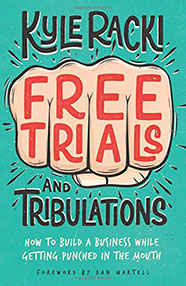
Kyle Racki is the cofounder and CEO of Proposify, a software company that helps sales teams manage their proposal process. He built the company after years of working as a freelancer, a journey he recounts in his book Free Trials (and Tribulations): How to Build a Business While Getting Punched in the Mouth. He also hosts the podcast LTV.
📚 Books by Kyle Racki
Transcript
[0:00:18] CH: What’s up everybody? It’s Charlie Hoehn, the host of Author Hour where I interview authors about their new books. Today’s episode is with Kyle Racki. He’s the author of Free Trials (and Tribulations). Now, Kyle is the cofounder and CEO of Proposify, which is a SaaS company that currently serves more than 6,000 customers worldwide and even though Kyle is a successful entrepreneur, he’s running this successful business, his book is about all the other stuff that comes with that as well. He shares his full journey, and I mean full journey, from difficult beginnings to dealing with grief, divorce and actually being shunned for abandoning a religion that he realized was a cult. So if you’re an entrepreneur and you know that running a company can be a lonely stressful experience, this is the episode for you because Kyle’s going to share how to build a business even when life punches you in the mouth. Now, here’s our conversation with Kyle Racki.
[0:01:35] Kyle Racki: I remember about 10 years ago, I was running a small agency here in town where I live in Dartmouth and my wife and I had just separated and it was a very messy breakup. Police were called, there was, you know, it was just extremely chaotic and I was living in this kind of rundown apartment because I had to basically pay for the house and try to have a – I needed sort of to get out of the house and so I was just down the street from the agency that I was running and the agency wasn’t doing incredibly well and I remember at one point, my now ex-wife had come into the office when I wasn’t there and in front of my business partner and all the staff demanded to be paid for her, I think 1% of the company and was basically trying to get money and they had to call the police and take her out of there and it was, you know, these kind of things happened many times and it sort of brought to mind, kind of that idea of right now, entrepreneurship, we’re in a time where they’re almost more rock stars than actual rock stars, right? You’ve got Jeff Bezos walking arm and arm with Grimes, having pics taken by the paparazzi, Gary Vaynerchuck on the streets getting selfies with fans. Elon Musk is like a fashion icon. You know, actually, I got that mixed around, sorry, it was Musk who was dating Grimes and Jeff Bezos, who is the style icon. Either way, right? It’s like rock stars –
[0:03:03] CH: Now he’s going through a divorce that’s highly publicized.
[0:03:07] Kyle Racki: Bezos or Musk?
[0:03:09] CH: Bezos, yeah.
[0:03:10] Kyle Racki: Yes, that’s right. Because I was going to say, Musk is – I think he’s been divorced there or four times or something like that?
[0:03:16] CH: Oh yeah.
[0:03:17] Kyle Racki: He’s had some trouble in the relationship department. But, you know, it’s kind of crazy now. When I was a teenager growing up, I wanted to be an actual rock star. Like I wanted to go on tour with my band and all that kind of thing and now it’s these same teenagers want to be entrepreneurs, right? They want to be the next Mark Zuckerberg or whoever. We’re just living in a really interesting time right now and I think what a lot of people forget is that much like an actual rock star, you have to go through years, decades even of a playing dive bars and having no money and sleeping out of your van to actually get to the point where you’re successful. So that’s kind of what this book is really meant to encapsulate is the idea that it’s not – even though it’s my story, it’s not really just me. It’s a reflection of the idea that you have to eat shit and get punched in the mouth countless times to come out on top as an entrepreneur.
[0:04:12] CH: Yeah, when I read the subtitle of your book, which is How to Build a Business While Getting Punched in the Mouth, it made me think of Elon Musk’s answer to somebody who – it was like a teenager who asked him, should they start a business, what is the key to successfully starting a business and he said, completely straight faced that starting a business is like swallowing glass and staring into the abyss.
[0:04:42] Kyle Racki: Totally.
[0:04:45] CH: Your description is right on. I mean, I’m reading the blurbs on the back of your book and the things that stand out is like, that your book is brutally and painfully honest and that every entrepreneur wanting to build something needs to read this because it delivers that honesty that like a book like The Dirt about Motley Crew broke down like, “Hey, this isn’t all glamour, this isn’t all great.” You do get punched in the mouth repeatedly.
[0:05:18] Kyle Racki: Absolutely, that was really the intention of the book was to be a combination of a personal memoire and an actual business book. So I don’t want people to think that yeah, there’s a story in there, it’s kind of a little dark, a little depressing, got some humor thrown in there to lighten it up. But ultimately, it is a business book with some practical takeaways and strategies that people can implement for their own business. Some of it is based on my successes, some of it is based on my failures but they’ll get some practical takeaways. But yeah, a lot of it is you know, just, there is actually a two year period in particular where my business was failing, I was practically bankrupt, chaotic marriage, which I had mentioned that ultimately ended in divorce, my father died, I realized I was raised in a doomsday cult and left and was shunned by friends and family. I kind of shared that story –
[0:06:07] CH: Wait, what?
[0:06:10] Kyle Racki: Yeah, absolutely, yeah.
[0:06:11] CH: Wow. Is that in – so your book is broken down into part one, two and three. Part one is In the Beginning, part two is Armageddon, part three is Rebirth. Is Armageddon when you left the doomsday cult?
[0:06:24] Kyle Racki: Yeah, absolutely. As you pointed out, the structure of the book is broken into kind of like a classical mythological tale of creation, destruction and rebirth. That’s kind of the idea behind that structure and kind of a little nod towards the major religious element in my life that shaped who I am but also kind of destroyed me and I came out of that.
[0:06:46] CH: Wow. Of all the things that you said, I had heard before except for the doomsday cult. So let’s dig into that story. Tell me what is that about? What was that like?
[0:06:57] Kyle Racki: Yeah, I mean, that’s a loaded topic but, you know, the funny thing is that I think that people would be surprised at what I described as being a doomsday cult. You know, we tend to think of like heaven’s gate and, you know, what was the one? Drinking the KoolAid, I forget what that cult was –
[0:07:12] CH: I know what you’re talking about, yeah.
[0:07:13] Kyle Racki: Yeah, you know what I’m talking about. People tend to think about those really like fringe groups that are very small that you know, maybe a hundred people fall for but this particular one has 8 million followers worldwide and you know, they’re the Jehovah’s witnesses. So I was actually raised as a Jehovah’s witness from the time, from babyhood. Grew up under that belief system and I think a lot of people, they all – most people don’t really know a lot about the Jehovah’s witnesses. They kind of think of them as a pretty benign group that goes around and kind of annoys you on Saturday morning when you’re trying to watch your cartoons, eat your cereal, you get a knock on the door, somebody’s pushing a watch tower in your face. You tell them to go away. So I think that’s what most people kind of think of is being a pretty harmless group but more and more these days, there’s actually a big movement from ex Jehovah’s witnesses who are now starting to shine a spotlight on the religion and a lot of the scandals related to child abuse that have been coming up. There was a lot to unpack there but essentially, I woke up one day basically gave myself permission to read literature that was written by ex members, which is forbidden in the religion. You’re not allowed to read anything that’s not written by Jehovah’s witnesses that talks about Jehovah’s witnesses.
[0:08:31] CH: Wow.
[0:08:31] Kyle Racki: For that exact reason.
[0:08:33] CH: Yeah.
[0:08:32] Kyle Racki: They call it the apostate material. Essentially,, they tell you that if you read anything that an ex-member has written, it’s going to poison your mind, Satan’s going to get in there and basically control you and there’s this fear of apostates that’s baked in. I basically gave myself permission to read it and very quickly realized that yeah, I had been raised in a cult.
[0:08:55] CH: Wow. That was earth shattering in your mind.
[0:09:03] Kyle Racki: Absolutely.
[0:09:04] CH: What happened to you next?
[0:09:05] Kyle Racki: Yeah, it was obviously a very transformative year, everything that I thought I believed or thought was true was completely shaken up. That’s actually the, I think it’s around the middle chapter of the book in the Armageddon section where I basically talk about kind of that time that I realized what I was in and then the steps I took to get out of it, which included sending an email to my mother thinking that I could present her evidence that –
[0:09:34] CH: Oh boy. Yeah that doesn’t go well.
[0:09:36] Kyle Racki: Did not go well. Ultimately led to the 2nd, the breakup with my wife because we had gotten back together a few times.
[0:09:43] CH: Was she a Jehovah’s witness as well?
[0:09:46] Kyle Racki: She was actually, yeah. She had been raised as well as a Jehovah’s witness and then left in her teens and then had come back as an adult. So a couple of years after, she had gotten baptized as one, that’s when she and I met. She’s 10 years older than me so we were both in kind of a – We went through this period where we’re both very gung-ho, completely brainwashed members and very into it and it was our life. Then that started to kind of fade as time went on for various reasons and so when I actually presented it to her, she rejected it at first because of the mind control but ultimately she ended up leaving as well. We’re not together anymore but she’s still out.
[0:10:25] CH: Man, Kyle, I’ve got to say, I so appreciate you including that story in your book. Because it is so tempting for entrepreneurs, anybody who has had any success in business to hide that stuff and sweep it under the rug. What do you think readers are missing out on in other books that don’t get the gritty stuff that you’ve included? How has it shaped their world view? Because in a way, it’s sort of like the Jehovah’s witness, right? You can’t read anything and talks about failure and the talks about all the ugly stuff and the harsh realities. What do you think young entrepreneurs, people who are just starting out in their journey, are missing by not getting this more human side, the full story of entrepreneurship?
[0:11:16] Kyle Racki: Year, I think we’re hearing a lot these days about what social media is doing to our brains and how when you’re looking at Instagram and Facebook and seeing people’s highlight reels, it makes people depressed because they feel like, “Wow, my life doesn’t match up to my friend’s lives.” I think that to a large degree, we get that both on social media and just in general. We hear about – we only really hear about the successful entrepreneurs. We don’t hear a lot about the failed ones and those are much more plentiful than the successful ones. Specifically when you read TechCrunch and hear about unicorns and, you know, you hear about the Ubers and the Airbnb’s and people tend to kind of not look at those as being outliers, which they are, they kind of look at them as, “Wow, why haven’t I done that or why isn’t my businesses as successful as them?” When you dig underneath the hood, you realize that there’s for every Airbnb or Uber, there’s thousands of businesses that have failed along the way or some of them actually are doing well. They just kind of fly under the radar but really, the stories are very disparate. I’ve also found through research that depression is much higher among entrepreneurs than the general population. There’s a higher rate of depression and suicide and drug and alcohol addiction and I think probably a lot of that is because building a business is really hard and everybody has challenges in their lives. Everybody has to deal with illness or deaths in the family or you know, issues with their relationships. Everybody deals with that but then throw on top of that the burden of trying to provide for your employees, trying to make payroll, trying to make your customers happy, try not to lose your house in the midst of doing that and it’s a recipe for disaster.
[0:12:59] CH: Yeah, it really is. It’s a denial of the full journey to not talk about this stuff. I mean, I think — I spoke with someone recently who had climbed I believe it’s the seven summits. The highest summits on every continent on earth. I’m thinking like, “Man, she didn’t just talk about hitting the summits, you know? Getting to the top. The journey was all these failures and miss starts and mistakes along the way.” For so many other industries, so many other areas of life, you would never deprive sharing the full story. But you’re right, within entrepreneurship and running a business, there tends to be only sharing success.It makes things a lot harder for people and like you said, I mean, if you’re only getting that side of the story, it makes you feel small and like you're not doing it properly because all your colleagues and all you see is success.
[0:14:09] Kyle Racki: Yes. That is how I had felt a lot over the years as an entrepreneur. I think that more and more people are coming out and talking about their failures or their personal challenges or tragedies, it kind of makes you feel like you’re not alone, this is common, you’re not the weirdo. I found that especially running an agency back when I was – I run a software as a service business now but back when I was running an agency, which was my first business and ultimately a massive failure. In the local community of other agencies who you’re mostly competing against, it was sort of this thing and I’m sure it’s the same everywhere where you go to a conference or an event where maybe somebody who runs a competing agency is at and you say to them, “Hey, how’s business?” “Oh, it’s doing great, amazing work, we have no, we’re just slammed with work. We have no time for anymore. We’re just killing it,” and it sort of this puffing out your feathers because you don’t want that competing agency to think that, “Oh geez, I don’t know how am I going to make payroll. We had a client who is not paying their bill and another one the project is way over budget and we are losing money on it.” Like nobody ever tells that because they don’t want their competitors having any view that they are weak or they are failing, right?
[0:15:26] CH: It’s so strange because, why? I don’t exactly know why. I am sure there are evolutionary behavioral reasons why we do this, but to admit that vulnerability and to say, “Hey, I am going through this stuff,” invites people who are doing well to actually come in and help you. It is not something that is necessarily looked down upon. I mean have seen it in the author world, right? Speaking with authors, I compare myself to a handful of authors who I know who have sold millions of copies of their books. And if I only look at them, I view myself as a not very good author. But they are in the 0.001% like literally in authors, they’re anomalies and I think the same thing goes with business.
[0:16:27] Kyle Racki: Yeah, I talk about that in the book too a lot about imposter syndrome it comes up again and again, which is that when I was a teenager, I mean I actually started community college at a pretty young age because I graduated just based on not because I am smart but just based on my age I graduated when I was 17 when I was born in the year and so I’d started collage and was really intimidated by the idea that I was there with older people in their 20’s and 30’s and 40’s. So I felt like, “Wow, these are the people I am competing with for graphic design positions out there in the city? Like there is no way somebody is going to hire a kid like me to design their billboard or whatever.” Then of course eventually I got a job in an 18 or 19 and I was like, “I can’t believe what are they doing? Why are they paying me for this to sit around and design things?” and then later becoming a freelancer and then becoming an agency owner and then a SaaS founder. Basically at every step of my journey I was like, “There is no way somebody is going to pay me to do this.” So a lot of it comes down to imposter syndrome even just writing this book. I’m like, “Wow, who is going to pay to read my words?” You know what I mean? It just is constant and I don’t think it ever ends.
[0:17:41] CH: Oh yeah, right. Yeah it’s constantly dealing with the insecurities in your head. I want to talk about part three in Rebirth and the tides changing for you. Tell me a story from this section of the book where you started to come into a new life.
[0:17:59] Kyle Racki: Yeah there’s a couple pivotal moments where at the time I didn’t realize how significant they were but in hindsight of course you realize how really your life may have changed if you didn’t take that action. One of them was, it was December of 2013, we were in the midst of trying to sell off our agency business, which was failing, which we were struggling to keep running. We had these buyers who were interested but they were delaying the deal. Our lawyers were delaying it and really, we should have just laid everybody off, filed for bankruptcy, screwed over our clients and our landlord and our debters and all that kind of stuff. It would have probably been the most practical approach, but we were trying to keep this thing floating just enough. Just long enough to be able to sell it and get it into somebody else’s hands. Proposify is a company, which is my software business, was really at the early startup stage. I was working with a developer on getting it out there but we didn’t have customers at the time and in amongst all of that I had just broken my toe because I kicked a dresser in anger and I was still dealing with a lot of the post cult trauma syndrome, which is believe it or not a real thing. So I was really in a bad place and it was winter too so it was always dark and depressing and I was just feeling like pretty borderline suicidal and then I just decided I was going to – I was like, “I need to get out there in the community or something and like go to an event and talk to other entrepreneurs.” So I noticed that this startup house, Volta, was putting on a pitch competition where you stand up for five minutes and pitch your startup and then you have judges who vote on it and so I ended up signing up for it and going to it and pitching and what was really cool was I won the competition. So the judges voted for me to win it. But then even more pivotal was the idea that there was investors in the audience, one of whom came up to me afterwards and basically said, “Hey, I knew we chatted a year ago and we didn’t think you guys are ready. We’re in now. We want you to pitch the board and get in. You know, we’ll fund your venture.” That was a game changer for us. So what ended up happening was in one month we literally sold our agency and raised a seed around for Proposify, which completely changed everything for us and it was just a matter of if I hadn’t gotten out there to that event maybe that wouldn’t have happened.
[0:20:25] CH: That’s amazing. For both of those things happening the same month, that’s a huge thing to happen, that’s amazing.
[0:20:34] Kyle Racki: Yeah and I lay out the story out in a lot more detail in the book but there’s more crazy stuff that happens in there.
[0:20:40] CH: Awesome and now you are the CEO and co-founder of Proposify, of course, and what is life like for you today? Describe your typical week at Proposify.
[0:20:53] Kyle Racki: We have a great team here. We’re just up about 65-person mark at the company. We have a very positive culture here at Proposify. A lot of new people because we have grown a lot in the last year, but we’re — a typical week is actually busy but it is a good kind of busy. I am trying to make health more of a priority. So I’ll usually go to the gym before I come in, maybe come in around 10 or 11. I usually have a lot of meetings and calls and that kind of thing for the afternoon but really have a pretty good work-life balance. I got remarried this past September to Christina.
[0:21:31] CH: Congratulations.
[0:21:32] Kyle Racki: Thank you, yeah.
[0:21:34] CH: How did you two meet?
[0:21:35] Kyle Racki: Oh the usual, social media. Actually we met on Match.com. We should be case studies for them.
[0:21:41] CH: Oh there you go.
[0:21:42] Kyle Racki: Yeah.
[0:21:43] CH: Yeah for real.
[0:21:44] Kyle Racki: And she had also come off a divorce in the last couple of years so yeah, we found a lot in common there and I also have two sons. So I have Micah and Ty from my previous marriage. So we are building a house right now and things are great.
[0:21:59] CH: That’s wonderful. It sounds like a summer season of life for you.
[0:22:03] Kyle Racki: It is, yeah. I am trying to hold on to this moment for as long as possible.
[0:22:07] CH: Right before the next Armageddon.
[0:22:10] Kyle Racki: Before the next one and you know, I wanted to touch on I am part of a coaching group with Dan Martell. I don’t know if maybe listeners have heard?
[0:22:17] CH: Yeah. Sorry to interrupt Kyle, he is the founder of Clarity FM, which I am sure many listeners have used to book calls with experts on particular topics specifically entrepreneurs.
[0:22:30] Kyle Racki: Yeah, Dan is the five times founder, two or three I think have gotten acquired and he’s got his own really interesting story. He actually writes the forward for the book. So I am part of his coaching group this thing called JFDI. There is about 10 of us in the group and we go to different cities. We were just in Boston last week and the reason I brought that up is that he did something interesting with us to help us get to know each other better, and it was basically we took a big piece of bristle board and drew a timeline of basically our birth to now and then we had to draw all the highest and the lowest points and talk about them to the group for 10 minutes. And the thing that was fascinating to me was just how many people who are all successful entrepreneurs with SaaS businesses in the five to 10 million a year range and how almost every single one of them has had crazy horrible things happen to them in their life. From addiction to trauma to suicides of close people in their lives and maybe that just speaks to the general population but I do think that entrepreneurs experience that at a higher rate than probably most.
[0:23:38] CH: Yes, I would 100% agree with that statement. Yeah that is fascinating and I think you are doing a real service again by sharing all of this personal stuff that would be really easy for you to not share. So thank you for sharing it and I think what you’re probably going to see is with this book coming out, you’ll be surprised at the number of people who read it who join your company and because they want to follow and work with people who have that kind of honesty and openness. So I think you’re doing a real service for not only the entrepreneurial community but also your company over the long run.
[0:24:24] Kyle Racki: Wow. Well, I hope so.
[0:24:26] CH: Yeah, I mean I am not blowing smoke. I have heard that from other authors who’ve done similar things. So I think it is a really good thing. So Kyle this has been great and I’ve got a few more questions for you.
[0:24:39] Kyle Racki: Sure.
[0:24:40] CH: So, I guess actually one question I had is what was your main goal in writing this story? Did you have one main goal in mind when you are making this book?
[0:24:54] Kyle Racki: I have wanted to write a book for a very long time, basically since I was a kid. I actually interviewed an author when I was I think 11 years old in grade six when they said, “What do you want to do one day?” and then you have to interview somebody who does that. So I actually, there was a local author named Leslie Choice, who came in and took questions from an 11 year old. So actually it was a lifelong goal just kind of personal milestone. I also really enjoy creating things. You know, I have been blogging and doing podcasts and stuff for the last few years. You know, I like making music and my dream is to actually one day make a movie. That is a big passion of mine. So I just enjoy creating content and I enjoy sharing the lessons, the mistakes and the wins and so this was just another format for that was to tell the personal story but again, talk about the actual takeaways, the business lessons. So I think for people who read the latter part of the book, the part three of Rebirth is like that is where you get into the more like how do you generate demand through content, how do you grow through key performance indicators? You get into more the actual meat, the really practical stuff around building a business. So I wanted to share all of that.
[0:26:09] CH: Awesome. If you were going to make a movie this year, what would that movie be about?
[0:26:15] Kyle Racki: Oh it would probably be some variation of this. Maybe the protagonist isn’t Kyle Racki but there’d probably be a lot of similar things happening. I think you could probably point to any ad agency in the city you live in and I bet there is a TV show in it, you know? Because there’s just ridiculous characters who work at these places and startups too for sure.
[0:26:34] CH: True. This has been awesome. My final two questions for you are what’s the best place for our listeners to follow you or potentially connect with you?
[0:26:44] Kyle Racki: So if they want to just, from a personal standpoint, check out my website, kyleracki.com. That’s basically where the blog and link to sign up to the book. You’ll get links there as soon as it launches. So from personal side, kyleracki.com. If people want to check out my business it is proposify.com and basically we’re a SaaS product that helps sales teams write proposals faster and get faster sign off.
[0:27:08] CH: And I’ll attest to Proposify being an awesome product. So it is definitely worth checking out if you write proposals and the final question is, give our listeners a challenge. What is the one thing that they can do from your book this week that will have a positive impact?
[0:27:28] Kyle Racki: I think so often people underestimate themselves. So I talked about imposter syndrome and one thing I had once said to an entrepreneur who was talking to me about what he had planned for his business, I kind of felt like he was aiming really low. So I actually wrote a post about it called, Stop Aiming for the Trees, and that’s what I think a lot of us do is we go, “Well we can never aim for the moon or the stars. We’re going to just set ourselves,” — Some people call it sandbagging where you set your goal so low that it is just easy to achieve. You don’t really have to strut yourself. So I think as a challenge what people could do is if you don’t have any goals for the next five years in terms of what do you want your ideal life to look like? I had written that down a number of years ago and then pulled it out. It was an Evernote file. I pulled it out recently and I was like, “Holy crap!” I actually knocked most of these things off and it’s not like I went back and referred to it every day. It just sort of happened. So I think when you write down what your ideal life looks like, you’d be amazed at how that sticks in the back of your head and how you put in the work and you do the things that will get you there, at how achievable it is. So I’d actually challenge people to aim higher than they probably already are.
[0:28:41] CH: That is a wonderful suggestion and I totally agree. As long as you write it down there is this weird magical power that comes with writing it down that it starts to translate it into real life slowly but surely. So this has been awesome. The book is Free Trials (and Tribulations), it is on Amazon now. Kyle Racki thank you so much for being on the show.
[0:29:05] Kyle Racki: My pleasure, thank you.
[0:29:08] CH: Thanks so much again to Kyle Racki for being on the show. You can buy his book, Free Trials (and Tribulations), on amazon.com. Be sure to check out show notes and a full transcript of this episode on authorhour.co and take a minute to leave us a review on iTunes. It will make my mother so proud. We’ll see you next time. Thanks for tuning in to today’s show. If you liked what you heard, here is what I want you to do next: open up the podcast app on your phone or iTunes on your computer and search for “Author Hour with Charlie Hoehn” and then click “ratings and reviews”. Take 10 seconds to rate this show or leave a review. It is a small favor but it’s really the best way to show your support and give me feedback and if you know someone else who’d love Author Hour, take another three seconds to text them a link to this episode. We’ll see you next time.
Want to Write Your Own Book?
Scribe has helped over 2,000 authors turn their expertise into published books.
Schedule a Free Consult