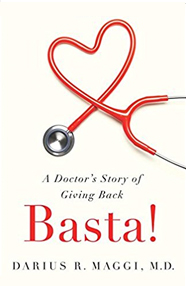
Darius Roderick Maggi: Basta!: A Doctor's Story of Giving Back
Read the full transcriptDarius Roderick Maggi
Darius Maggi was inspired by his familial mentors to put others first.
📚 Books by Darius Roderick Maggi
Transcript
[0:00:19] Charlie Hoehn: You’re listening to Author Hour, enlightening conversations about books with the authors who wrote them. I’m Charlie Hoehn. Today’s episode is with Dr. Darius Maggi, author of Basta!: A Doctor’s Story of Giving Back. Do you want to make the world a better place but you don’t know where to start? This episode is your shining example. For 22 years, Dr. Maggi was a successful OBGYN in America and then our healthcare system changed. Those changes meant that Dr. Maggi was no longer able to take care of his patients the way that he needed to. Instead of letting that stop him, Dr. Maggi has spent the last few decades focused on taking care of the poorest of the poor. In this episode, you’ll hear the heartwarming and heartbreaking stories of being a doctor. You’ll also learn what Dr. Maggi believes is the key to finding happiness. Now, here is our conversation with Dr. Darius Maggi.
[0:02:02] DRM: Well, have you read the book? You haven’t read the book — you’ve gone through some of it.
[0:02:08] Charlie Hoehn: Right, yeah. I’ve only had a chance to kind of read the description.
[0:02:13] DRM: Right, I understand. Okay. Well, I loved practicing medicine. I mean, I would wake up 3:34, 4:35 in the morning and couldn’t wait to go to work because I enjoyed practicing and don’t get me wrong, from my financial standpoint, you know, it was very rewarding but the most rewarding thing was helping people and being able to give back. If you saw someone in distress, and they even were in financial distress, you could help them out, you’re in charge a half brass or whatever, just to help them. To see that you have the ability to really make a difference in a person’s life was so rewarding.
[0:03:09] Charlie Hoehn: What type of medicine were you practicing?
[0:03:12] DRM: Obstetrics and gynecology.
[0:03:13] Charlie Hoehn: Okay. Can you kind of describe what your day to day looked like?
[0:03:20] DRM: Well, I mean, generally, I operated one day a week electively and the rest of the time, I would see patients in the office, Monday, Tuesday, Wednesday, Friday, I would see patients in the office and I generally operate on Thursday’s. I would see a combination of anything from very young teenage girls to 89 year old women, all that egg trains from all kinds of complaints and problems and then obviously I saw pregnant women. I saw all that whole spectrum of people but I really was very fortunate that when I was in medical school, I had excellent professions, I had one particular psychiatric professor that just drilled us on you know, you take care of that patient. That’s the only thing you need to do is take care of that patient and everything else will follow behind and you listen to that patient, you observe that patient and if you were a generalist, 75% of those people when they come in to see you, as a generalist in that field. They would have an underlying psychogenic problem to their cause of their problem.
[0:04:33] Charlie Hoehn: What does that mean?
[0:04:33] DRM: You need to pick that up. Well, they may come in with headaches, well, the chances of being a brain tumor is probably less than 1%, so is an aneurism. If you listen to them and you observe them and you sit down and you talk to them, you’re going to find out that problem. A good percentage time is going to be stress related, marital related, financial related, you know, family related and if you listen to them, you can help solve that problem for them. He was so right, we would literally, when I was in medical school, we spent hours interviewing actors and also watching films of interviews. It's up at the middle of the film. How’s she sitting? She ever make up on, she had a wedding band on? Her hair done, is her dress or a blouse or whatever pressed? How is she presenting herself in the chair? You know, you could learn within 10 seconds to know all of that because we did it so many times. That helped you, because the bottom line is they helped the patient and it avoids a lot of unnecessary things and you build a rapport of those people and just not with those people especially with pregnant women, you build a rapport in a friendship for the entire family. It was so rewarding and you feed off of it. I mean, by rewarding, it just makes you feel good. Brought you a lot of happiness since you were able to help people. You still made a good living so what drove to answer your question, probably what drove me to this point was, I’m not saying for a bit of poor me but that was taken away from me and it was taken away from me by many different factors. There were several factors that caused that to go away and –
[0:06:24] Charlie Hoehn: Where were they?
[0:06:26] DRM: Well, one of the big things that I call is the system. And it was greed, it was greed in big business getting involved in medicine, medical doctors becoming greedy, the cost of pharmaceuticals, the insurance company’s getting in the way, the litigation involved, all these things took that away from you and you looked at that situation, you look at that patient more as a possible litigant. Than anything, and I call it in – I think you guys knew at one point what would be my next book, it would be called The Wedge because there was a phenomenal wedge over the years that was gradually driven between the patient and the doctor. I mean that, the patient of a doctor is a tremendous – I men, in fact, yesterday, my doctor died, 56 years old yesterday.
[0:07:26] Charlie Hoehn: I’m so sorry,
[0:07:26] DRM: called in the afternoon. Yeah, my family doctor. Bet she said she was on and I’m 68, I know exactly what killed him, stress because he was that kind of doctor. In fact, when I retired 18 years ago, 17 years ago, I referred almost every one of my patients in because I thought he was sort of prototyped and I’m not bragging but you know, I was very successful. I had a very large practice because I treated people like I wanted to be treated.
[0:07:53] Charlie Hoehn: Like human beings.
[0:07:54] DRM: Exactly. My mother, I always used that litmus test. When I do surgery on my mother, and my sister or my daughter or my wife or any of my keen folks that was my litmus test. If I would, I’d do it, if I wouldn’t, I wouldn’t do it. Then come the financial, that financial stuff comes later and again, that’s part of the bust that when is enough, enough. Because I had enough and I didn’t need anymore. That is what drove me to write this book because I saw, I finished my medical school training at 74 and I did a internship and a residency and so, eight, nine years later I was out and practicing in late 78 and early 79 and then I saw over the next six, seven, eight years, I saw that happen and I saw how it wasn’t fun to go in and help people anymore. Because you had all these external people out there, sucking you dry and you weren’t able to do what you want to do and what – I mean, it sounds selfish but you know, in my book, I say, “I truly feel like medicine is a very unique profession and it’s a calling, you’re called to do it, you’re called to help your fellow man.” Obviously, all of those are probably called to help people in our own way as I stated, my wife used to love to do meals on wheels and do all that kind of stuff and do overlays just for free. Because she got tremendous amount of gratification from it. We’re all called to help our fellow man and then my opinion. It was taking that away from me, I got bitter you know? I really did, I got bitter, got frustrated about it.
[0:09:39] Charlie Hoehn: Can you take me to a moment where you felt most frustrated?
[0:09:45] DRM: Well, probably the first thing was, Is my – I worked and I’ll be the first to admit that I’m a workaholic and I love to work, I love to work but I love to have fun too. I mean, when you’re able to, you’ll see I’m a big jokester. But, it got to the point, I didn’t take much time off but when I took time off, I had fun, I went hunting, my first vacation ever after about three years in practice with my uncle and when I drove home from Colorado, halfway home, I was in Albuquerque New Mexico and I called my wife, and she said, “I’ve got a news today.” And I say, “What?” She says, “Well, I won’t name her name, it’s just – this lady died” and I was like, “You got to be kidding me,” she says “Yeah, she died from anaesthetic,” she’s one of my obstetrical patients. I left her in extremely good hands. This doctor is very talented and she had an epidural anesthetic and it went high and paralyzed her breathing, she had a cardiac arrest and died.
[0:10:49] Charlie Hoehn: Wow.
[0:10:49] DRM: I mean, I was devastated.
[0:10:53] Charlie Hoehn: I can’t imagine.
[0:10:53] DRM: I mean, I was pissed you know? I cried, and I still do. So, I drove home, took a shower, put my clothes on, drove 65 miles up to meet the parents and they were very hostile. “Why weren’t you there? Why weren’t you there? I understand you had pictures of Burt Reynolds and all these movie stars on the ceiling and you just reject her” you know? Don’t get me wrong, I have two daughters and a son and I realized if I had a daughter that died in childbirth it’d be aggravating, I’d be very upset to say the least but you know, I knew, and the psychiatric professor used to tell us said, “If you see enough patients and you’re doing those procedures, you’re going to lose the patient, it’s inevitable if you do that. There’s people you’re going to save that you shouldn’t save and there’s going to be people that, maybe a few people that die that shouldn’t die.” That’s part of it. That’s why a lot of people don’t go in it.
[0:11:59] Charlie Hoehn: Right.
[0:11:59] DRM: You know? But, that was the start of pure hell of five litigious situations that I had in 11 years and I mean, it started litigation that lasted for four years in this particular case and I mean, the trial lawyer called me everything under the sun, told me how bad I was and all that. I knew I wasn’t but I mean, how many times my office was canceled because I’d have to go to a deposition or they told me the trial was going to be here or going to be there and you’d book out an entire week and then Friday before the Monday when the trial was supposed to go on. They would call you,”Oh we’re going to put it off the mess.” They try to get you to sell and like to go on a great –
[0:12:44] Charlie Hoehn: Right.
[0:12:46] DRM: Two hours away but yeah, that was the start. Then you looked at everything different through different glass and it took it away. It affects – no one knows that how it feels unless you go through, it’s not a gamble a bit of to you but, or me, but it’s real.
[0:13:08] Charlie Hoehn: It is.
[0:13:10] DRM: But it’s terrible that the system is such that it drives the good people out of medicine, the bride carrying people that really want to help people, it drives them out and you have a different subset of people in my opinion, they are different going in to it. They go into it for different reasons and I’m not trying to put myself on a pedestal but I’m just telling you how I feel.
[0:13:41] Charlie Hoehn: No, I agree with you full heartedly you know, on a personal note, I’m really – it’s serendipitous that we’re talking because my baby daughter was born a week ago and we actually went through a midwife for the reasons that you’re describing is I’ve seen family members go through such difficult and often inexcusably horror experiences in what is now the normal medical system.
[0:14:18] DRM: Exactly.
[0:14:21] Charlie Hoehn: We refuse to let that happen during the birth of our daughter and what you’re saying is, I’ve never taken issue with the individual doctors and nurses who are involved, I take issue with the system in what it does and how it changes their behavior so I really appreciate you sharing your story and that particular story and how frustrating that and heart breaking that was.
[0:14:52] DRM: Yeah, it’s terrible and you know, childbirth should be something 98, 99% of the time, should be just a very wonderful experience and the system has created it to be so artificial or non-artificial I’m trying to say? I mean, they didn’t like – it’s not like having a heart transplant, it’s been going on since Manga you know? But complications but the pendulum swings so much. Anyhow, to answer your question, that’s what started it and then I can give you several other examples and I just added and added it on.
[0:15:33] Charlie Hoehn: I’m sure.
[0:15:36] DRM: Until you know, until in my book, you know, Basta means enough and that’s what my grandfather used to tell my dad when he was working so hard, you know, enough is enough. You can only sleep in one bed at a time, you can only wear one pair of shoes at the time and you stomach can only hold so much. That’s when my dad said, “Son, basta, you had enough of these folks, you need to get out of medicine,” which is what I did.
[0:16:02] Charlie Hoehn: Who is your book for Darius? Sorry to interrupt you. If you wanted to finish that thought.
[0:16:08] DRM: No, I think it’s all spectrums of ages from teenage on up you know? Because I try to go through my grandfather coming from Italy and sharing his experience at the age of 16 and I knew him very well. He died when I was 21, he came from Italy in 1905 through Elis Island, he shoveled pummel worked in the coal mines and he had three children but guess what? My dad’s mother died in childbirth. He was six and the principles that my grandfather and my father taught me primarily, I think are just not there anymore, I think they’re lost you know? Not saying I’m perfect, I’m not – I’m far from perfect but to think the things that my father would always say. Freedom’s not – I used to ride in that gas truck, “freedom is not free, you need to remember that son,” he was in World War 2, he was on Normandy beach Utah beach invasion and “you always tell the truth you know? Because if you tell the truth you have to remember what you said.” “Son, always do the right thing. You don’t change right, you change wrong.” I mean, all these things, tens of them I would hear over and over which I think made me of a fabric that I’m in you know? He always used to say, of course, we made pedaling amount of money every month, we lived from paycheck to paycheck because he pedaled gas lane, he was what we call a consentee, he was on consignment, if you sold the gases, he made two cents you know? If he sold a thousand gallon of gas he made 20 dollars but that took a lot of effort to do that and you know, he just – always do the right thing. He says, “I’ve got to teach you these basic principles, you are born knowing these things, I need to teach it to you, you know? Be productive and give back.” I mean, he was a giver, gosh, he gave. Of his time and his money at hand and just by his being a good example, hopefully molded me. You know, unfortunately – and I state in my book, you know, you see all these people taking all these selfish – nowadays, I mean, people are about themselves, they spend more time looking at pictures of themselves than they do and it just drives me crazy. I mean, this doesn’t last about in my opinion. I mean, if we’re going to keep this a free world and be productive in the society, you know, get out and go to work you know? But, the system is what drives me crazy.
[0:18:55] Charlie Hoehn: Yeah.
[0:18:57] DRM: Of all the things, it’s so ironic, I told you about this doctor, general practitioner that died yesterday from a heart attack at 56, well, it looks like my first nurse ever is probably going to die today or tomorrow, as a result of a medical error, she was having a cauterization of her corroded artery through the femoral artery and she bled out, went into shock and she’s on respirator right now. Go to Dallas this morning and saw her. You know?
[0:19:29] Charlie Hoehn: My gosh.
[0:19:30] DRM: Those things happen you know? Of course, I ended up going to Africa, that’s where I redirected my effort, I go, I’ve been going through 15 years now, giving up my services and I’ve been 44 times and – but I can do so much over there and get very much the same results with so little cost you know? I stated in my book, you know, I took care of this huge public access of infection, huge, about the size of a volleyball or a grapefruit that she had after she’d had surgery about two months earlier. She came in and was in shock basically and took her to surgery that night and drained it and the next morning, I walk by her bed, she had nothing, she has nothing. She looked at me, she says, “Doctor, thank you.” I stayed in there, you’d give me 10 million dollars and it wouldn’t bring the amount of gratification that I get from helping that lady.
[0:20:32] Charlie Hoehn: That’s incredible, yeah. That’s amazing. You’ve been there 44 times?
[0:20:37] DRM: 44 times.
[0:20:40] Charlie Hoehn: Wow. Author Hour is sponsored by Book in a Box. For anyone who has a great idea for a book but doesn’t have the time or patience to sit down and type it out, Book in a Box has created a new way to help you painlessly publish your book. Instead of sitting at a computer and typing for a year, hoping everything works out, Book in a Box takes you through a structured interview process that gets your ideas out of your head and into a book in just a few months. To learn more, head over to bookinabox.com and fill out the form at the bottom of the page. Don’t let another year go by where you put off writing your book. I hate to shift away. I guess we’re not shifting away but I want to talk about your book, does your book – tell us what your book is about specifically?
[0:21:40] DRM: Well, it’s about those basic principles that my father taught me and I got from my grandfather from there. From there, experiences and I express in there, you know, it’s really good to listen to people and if you hear enough from them, there’s something probably to it you know? Something to it. You know, I talked about wanting to be a physician and I think there were some very definite subliminal messages, I mean, I stayed in there that again, my father’s mother died in child birth and I remember how my dad used to underwrite that guest and say, how much he misses mother and how much he was embarrassed a lot of times because the teacher would say, you know, “You go home and have your mother sign these papers,” when he’s little you know? “Bring them back.” You never have a percent, he’d go home cried you know? How he was so bashful that he was flown – went in to singing in high school because he couldn’t recite the poetry you know? Then just then I saw my grandfather have a stroke in front of me, my dad’s dad, what we’d call ischemic attack, a TIA, fortunately it resolved and I saw him have that and it scared the living life out of me and then my next door neighbor which was Mr. Walden that worked in the railroad and I saw him walk across that track I don’t know how many times. In his overalls with that little khaki shirt on that red hanky around him and his hat and he was soaked from head to toe, I saw him have a heart attack and died right in front of me and then we had a tornado that hit my town 1960 when I was 12 years old, killed 13 people, I saw a lot of those people and I felt helpless and then I had a half-sister, my mother’s first husband was killed in World War 2. Stepped on a landmine and my sister, I saw her – I mean, turned 180 degrees when she was 16, 17 years old when she tried to commit suicide with Tylenol. I didn’t ever understand that and I followed her until she was 52 years of age, pulling her in and out of mental institutions and suicidal attempts because she had severe mental illness. I think what that drove me into medicine sublimely to go help people.
[0:24:00] Charlie Hoehn: Yeah, it’s the situations that are I think the most challenging and difficult for us I know subconsciously or consciously we end up spending most of our adulthood trying to rectify them or repair them and use that energy for good.
[0:24:18] DRM: Yeah.
[0:24:20] Charlie Hoehn: So if you have to pick a story from your book that you would want listeners to remember or a lesson, what would you try to impart on them?
[0:24:32] DRM: Well you know I think I mentioned to you about a man’s search for meaning and I think there’s a big take off from me from that. I mean as you know today, the cultures of people, there are so many of us that pursue happiness and I’ve learned over the years you don’t pursue happiness through drugs, alcohol, tobacco, sex, whatever or economics. You know, happiness is a byproduct of what you do.
[0:25:02] Charlie Hoehn: It’s a side effect, yes.
[0:25:03] DRM: Yeah. You know downstairs there is an office down here as a Mail Centre and the other day a lady wanted someone to help them unload a TV and I saw it, “I will help you unload it” and I mean it gives you a good feeling. I didn’t want anything out of it, I didn’t say anything else. I mean I am not trying to be preachy but most people like to feel like they are doing something, that they have accomplished something and today I’m not explaining that really well but I mean –
[0:25:35] Charlie Hoehn: No, it makes sense. As you were explaining that an example came to mind that made me smile which is at the beginning of this episode you said it frustrates you that people now are so focused on themselves, looking at pictures of themselves and stuff and it’s frustrating because that is not what life is about. Well a guy I know expressed that same frustration and he was working at a café on in laptop day after day after day. And he was always frustrated that there were so many people there who’d never talked to each other so he spent a couple of hours just going table by table asking all of those people what they were working on and he said some people were a little annoyed but the vast majority were like relieved and excited to just share what they were doing and ended up having a conversation with a couple dozen people and he said it was the best day of work that he had in years. I just thought it’s so bizarre I don’t know how to get people to snap out and I include myself in that because you got caught up in your own nonsense very easily now. So what do you suggest? Apart from don’t pursue happiness, it’s a side effect of what you do, what would you suggest to somebody who says, “You know I have been pursuing happiness. How do I go about doing things that will make me happy as a side effect”?
[0:27:16] DRM: Well I think I’ll give you an example, I brought a lady back that is in the book, a 23, 24 year old Sierra Leone girl that I examined and had this huge cervical cancer. I brought her back because I had some colleagues that would treat her and I brought her back and we went to a little small church in Denison, Texas here for several years and we’ve moved since but anyhow, brought her back to get treated and this lady which is she probably was terminal but I had hopes that radiation and chemo would help her. And so she lived in our house for three months, she got the radiation and chemo, took her back to Sierra Leone, four months later went back over there and she had persistent some disease. In other words, it never went away not reoccurrence but persistence and so when I brought her over the first time, she started going to church with us every Sunday and you wouldn’t believe the people in the 100, 110 people in that audience that have interacted with her and how it changed their lives. And how they would want to do things for her and then when I brought it back, she wanted to come back to die because at someday she was going to die. So I brought her back and she stayed with us almost 10 months and it was amazing what she did to the community, and how she influenced the community and when she died, they had a funeral. It was 150, 250 people in that funeral and they were just amazing people coming out of the woodwork wanting to do things. It gave people a purpose in life.I had one lady that wanted to help her read and another one with arithmetic and things like that and take her shopping and do things and I think that is all individually based and in my book I am saying, “Hey I am not trying to tell you you need to go to africa or telling you you need to do this or do that but find something that gives you that inner feeling that just makes you happy”. It’s like I say, every time I laugh it is around this lady where it’s overlay she loves to go buy her fish dinner. She goes buying her fish dinner and takes it laughter, setting it, she slices it and she’s not ambutory and she’s sitting there watching TV and it makes my wife feel good. She loves doing it.
[0:29:44] Charlie Hoehn: I have a friend who instead of allocating money for himself on Amazon, he allocates I think 20% of any money he spends on Amazon to be to people he cares about. So just making a small commitment to give you said, just that tiny thing pales in comparison to doing something real life I think or face to face but it is a start for somebody who might be looking for a simple shift that they can do today. This is all great and before we start talking about what your readers have thought of Basta, you said you were a jokester, Darius. I’m curious what is your favorite joke or practical joke that you’ve pulled while being a doctor.
[0:30:39] DRM: Well I have two of them. Well I really have several but you’ll read them in the book. One of them, there is a lady probably 80 years old had this huge mass. I mean she looked nine months pregnant and I examined her and did a brief ultra sound in my office and I was 98% sure it was benign but we needed to take it out and she had children, she was 55 years old and so fortunately we went ahead and did surgery that morning took it out and it was this big old large cyst. It was huge, absolutely huge, a lot larger than basketball and I parked in that night to make rounds which I normally did after I operated and hear the same thing and I have done that now out in the recovery room and told people the surgery went fine and I felt like there was nothing that everything was benign and all of the family was there. So that night when I went to make rounds, I found out small children were in there. So I went into nursery and I grabbed a baby and I took it in that room and I told her other kids I said, “Look what I had found. This is what I got out of surgery” and I mean you know it broke the ice. They were worried about malignancies and all of that. “This is what I found.”
[0:31:57] Charlie Hoehn: That’s good.
[0:32:00] DRM: And then I have another lady one time, I’ll try to shorten this, she told, her daughter was in labor and she lived across Texas, Oklahoma border here and she was my patient too but her daughter was my patient pregnant and so I told her to go to the mall and walk around. They did and they went up and came around noon or so and so I said, “Go over the hospital I’ll be able to check in a minute.” So I went in to check on her and I said, “It’s going to be a while.” And so the mother of the daughter, you know the grandmother to be so it’s her first grandchild. I said, “Well I am going to call in Oklahoma and tell everybody” well apparently this is when the phone lasts with her. She says, “I can’t get across. I am going to drive over into Oklahoma” it took her about 30 to 40 minutes, “Tell everybody everything is okay and I’m going to come back” and so she came over and in the interim, their daughter with her first baby she just took off. I mean the labor just progressed very rapidly, she delivered a baby, spit out a little baby boy, cute little thing and the grandmother wasn’t back and so I sent her a text and so I took the baby in the nursery and hooked up the fetal monitor to the mother and so when the grandmother walked in, I said “Well, I’m sorry Roxy is not in labor” and I said, “We are going to have to send her home and then maybe she will go in labor in a couple of days”. “I want the baby right now. I want a baby” this is the grandmother. I said, “She’s not in labor” well long story short, I said “It’s okay if you want a baby” so I went in there and grabbed the baby, brought it out and handed her the baby. “I don’t want this baby” “That’s okay, you can tell all these kin and folks that you don’t want this baby” “I don’t want this baby” you know anyhow it was the real baby, she just had said. Always pulling all kinds of stuff.
[0:33:47] Charlie Hoehn: You know you may be the first person I know who uses a baby as a prop for practical jokes.
[0:33:55] DRM: And I had a grandmother one time that was looking through the window and I told her, I have acted like she moved her head that she had twins this girl is a little on the stout side having a baby and I was teasing her. I put two fingers up and the next thing I know I didn’t see her and she was standing next to a scrub suit and scrub sink, “Oh my god I killed this lady” I ran out real quick and she had passed out and I was like, “Oh she hit her head on that scrub sink, this is going to kill her” but anyhow she passed out and so we have somehow that fortunate in her.
[0:34:30] Charlie Hoehn: Those are good.
[0:34:30] DRM: Well I have a lot of them, absolutely.
[0:34:34] Charlie Hoehn: I bet. Well tell me how has your book been received? It’s got a perfect five star rating with 45 reviews on Amazon. What have been some of your favorite pieces of feedback that you have gotten from readers?
[0:34:51] DRM: Well a lot of these were patients. Some of them aren’t, some of them are family out-patients. Unfortunately it hasn’t taken off like I wanted because obviously the monies from all of these is going to the foundation that I have, going to Africa and it’s been a little anemic but that’s fine but no, it’s all been very positive and for Book in the Box’s sake, they were right. Everybody says, “When I read it I think I’m talking to you” or saying, “I think you are talking to me” you know? I had several people tell me that. Of course they used the way they wanted to interview you, we had those interviews and I had about 400 pages of single space tap written notes I’d taken well from the mid-80’s up until this point because I used to get very frustrated at night and I am just sitting down and write, write, write but anyhow it’s been very positive. Very positive for the ones that read it.
[0:35:52] Charlie Hoehn: Good, well like I said before the call especially with a book like this and where the money is going, I’ll be more than happy to help with at least some book marketing strategy that we can do to help you get your book out there to the right people and more people.
[0:36:11] DRM: I appreciate it.
[0:36:12] Charlie Hoehn: Yeah, of course. Darius, what is the rest of this year look like for you? Are you heading back to Africa?
[0:36:19] DRM: Yes, I plan on. I’ve been back about two months and I was supposed to go back next month but I had a little hiccup over there. I’m going to probably change locations. I go to Sierra Leone but I am probably changed to a different hospital. Go up more in the bush and so on. So that’s what I’d do. I generally go at least three times a year at least.
[0:36:38] Charlie Hoehn: That’s great and do you recommend that to other doctors to go there and spend some time there or is it a certain personality type? What would you say to other doctors?
[0:36:53] DRM: Well it’s interesting you say that, our asset, there are a lot of doctors, I have had several doctors go and you’re either bitten by the bug or you don’t. It’s not something that you probably want to do but there is a certain subset of doctors that love to go over there to say, “Well I went to Africa and I have operated in the poor and horrible conditions” and they use that as a way to write a paper or something but yeah, again if you are bitten by the bug. I mean there’s not a day that goes by that I don't think about those people. I mean where I go eventually one out eight women will die in child birth through their entire lifetime and I mean one out of three children die from either malaria, typhoid, pneumonia or meningitis and you’ll pray for five hours and you see so much death, you see so much. I mean I have a lady right now when I was over there in March, she has a breast cancer and no one can treat her. There’s no radiation, no chemo therapy, the doctor that did the biopsy did a biopsy and it was surprising until about a year or two ago when you did a biopsy, if I snuck it into the States here to get looked at, you can have a pathologist read it. If you thought it was cancer you just take it out. She doesn’t have access to radiation, chemo or nothing. I mean it was just mindboggling how fortunate we are compared to them.
[0:38:20] Charlie Hoehn: It’s hard to remember that you know? Especially if you have never been exposed to any other context. I think it’s tremendously important for everybody to travel. It’s frustrating because Americans don’t do it.
[0:38:35] DRM: No and the value of a life over there is very, very, very small and unfortunately where I go in Sierra Leone, I’ve literary seen a doctor who let a patient die because she didn’t have $50 or a $100 for a C-section. I mean it happens so the value is varied and then I’ve seen conditions where a lady needed a cesarean and I’ve been there in the middle of the night, no lights, no water, no anesthesia, no suture, no IV’s nothing and you feel very helpless.
[0:39:07] Charlie Hoehn: Yeah, have you read Shantaram?
[0:39:09] DRM: No sir.
[0:39:10] Charlie Hoehn: Shantaram is a fiction that’s based on real life of a guy who was a fugitive in Australia. He flew to India and because of his knowledge of basic health care, he became a doctor of the slums and he writes about his experiences as being a doctor of the slums in that book and it’s one of my favorite books. I highly recommend that.
[0:39:45] DRM: How do you spell that?
[0:39:45] Charlie Hoehn: Shantaram, it’s really –
[0:39:51] DRM: I can’t believe that you said that because that’s exactly what I wrote down when you said that.
[0:39:56] Charlie Hoehn: Perfect, phonetics. So as we’re wrapping things up, I’m curious, do you have a parting piece of advice for aspiring authors or maybe doctors who have a similar message that they want to share with the world?
[0:40:10] DRM: Well I would say do your homework and get it out there. I mean very obvious to me, this was very therapeutic for what I’ve been through. Again, not for profitable boom like a lot of people were saying that I was and it’s very, very cathartic. I mean it is very therapeutic and cathartic for me. It was after I had those three hour interviews with the people. I mean I would just leave mentally and physically exhausted for me to relieve all of those events, you know? And I guess my big frustration and my wife’s is, you can’t change it that’s what I want to I mean where medicine is going today, you know what I mean? And don’t take this wrong, did your wife delivered in a home or?
[0:41:04] Charlie Hoehn: We delivered at home, yeah.
[0:41:06] DRM: At home, you know and is that a first baby?
[0:41:10] Charlie Hoehn: Um-hm.
[0:41:11] DRM: So obviously there is always a risk of something very tragic going and you know instead of you are forced to know that situation rather than having to make it a home environment right next to something where you can have an emergency care if you needed it, you know?
[0:41:30] Charlie Hoehn: Yeah, I mean I think we had a phenomenal team of experienced people around us who’ve been delivering babies for decades so we felt very safe but yeah, I mean the alternative was in comparison. It was our plan C and we knew there were risks for sure but we did everything we could for mitigating and we’re well prepared.
[0:42:00] DRM: Sure and of course you have a lot more people do what you are doing. I mean to give you an example and I have it in my book, I have two daughters one 41, one is 38 and one son, 35 and when she had her little eight year old which she would have been 30 at the time, she was down in a large hospital in Dallas and I was up here in Denison and they tried to induce her forever, one or two and she kept calling me and I said came out just a length. I would try to work against nature just pulling time and bottom line, she ended up going early labor and they were getting ready to give her an epidural early, early, early and they said in two hours they would do a C-Section and I dawn that she begged me to come down and so “okay,” I said “I am going to be a dad and grandpa and I’m going to be a doctor,” and they were getting ready to do a C-section on her and I knew they hadn’t treated her properly. And I said, “You know I want you to turn that epidural off and increase the Pitocin and I mean within an hour, we had a baby and they were getting ready to do a C-Section and the maternal mortality is much higher for a cesarean. That is for fast delivery and that’s why when I was in first time I was training from charity in New Orleans, the maternal tally rate was 5.5 per hundred thousand. Now it’s approaching 50 per hundred thousand, ten times and the reason? Increase in cesareans in America.
[0:43:40] Charlie Hoehn: Yep, there is a great documentary. I am curious if you have seen it Darius, The Business of Being Born?
[0:43:47] DRM: I don’t think I have seen that. I’ll look that up.
[0:43:49] Charlie Hoehn: It’s free on YouTube. It’s phenomenal for anybody who’s kind of interested or definitely anybody who’s pregnant, it’s a perspective that’s worth seeing because the amount of C-sections that are done like in New York for instance is insane.
[0:44:10] DRM: Oh yeah, for convenience sake.
[0:44:12] Charlie Hoehn: Right, it’s major surgery done for convenience sake. It’s unreal.
[0:44:16] DRM: Absolutely, yeah and you know I can honestly say I’ve never did unless the lady is in her third or fourth or fifth baby and she lived a 100 miles off, I’ve never electively did that. I like to give induction because you’re C-section rates are definitely higher. It’s just definitely higher and yeah.
[0:44:37] Charlie Hoehn: Unquestionably. Well Darius, this has been such a great conversation and I really appreciate you opening up and sharing those hardships that come with the profession and how can our listeners connect with you and follow you?
[0:44:56] DRM: Well I have a webpage, a website for our foundation. I do primarily obstetrical fistula if you read the book, you will read what that’s about. It’s when women over there are in labor for days and days and days and the baby almost always dies. I mean I’ve never seen the file but the baby dies and the head gets impacted in the pelvis. The head presses against the bladder and they get a hole in their bladder anywhere the size of a pinhole to the size of a softball. And they’ll leak there continuously at the vagina uncontrollably and that’s what I do primarily. We’ve done probably close to 2,000 of those surgeries and so it’s called an obstetrical fistula. So it’s Westafricafistulafoundation.org. It’s on my book.
[0:45:49] Charlie Hoehn: Fantastic. Well Darius thank you again so much, this has been great.
[0:45:53] DRM: Well yeah, thank you.
[0:46:03] Charlie Hoehn: Many thanks to Dr. Darius Maggi for being on the show. All the profits from the sale of his book, Basta, go to the support of the West Africa Fistula Foundation. You can buy his book, Basta, on amazon.com. What was your favorite takeaway from this episode? Let us know by leaving a review on iTunes or by leaving a comment at Facebook.com/authorhour. Thanks again for listening to Author Hour, enlightening conversations about book with the authors who wrote them. We’ll see you next time.
Want to Write Your Own Book?
Scribe has helped over 2,000 authors turn their expertise into published books.
Schedule a Free Consult