Alex Castro: Measure, Execute, Win
Read the full transcript
Alex Castro
Alex Castro has developed the ReM Score™, a data-driven measurement for determining a company’s execution capability (or readiness) for each strategic initiative it is considering.
📚 Books by Alex Castro
Transcript
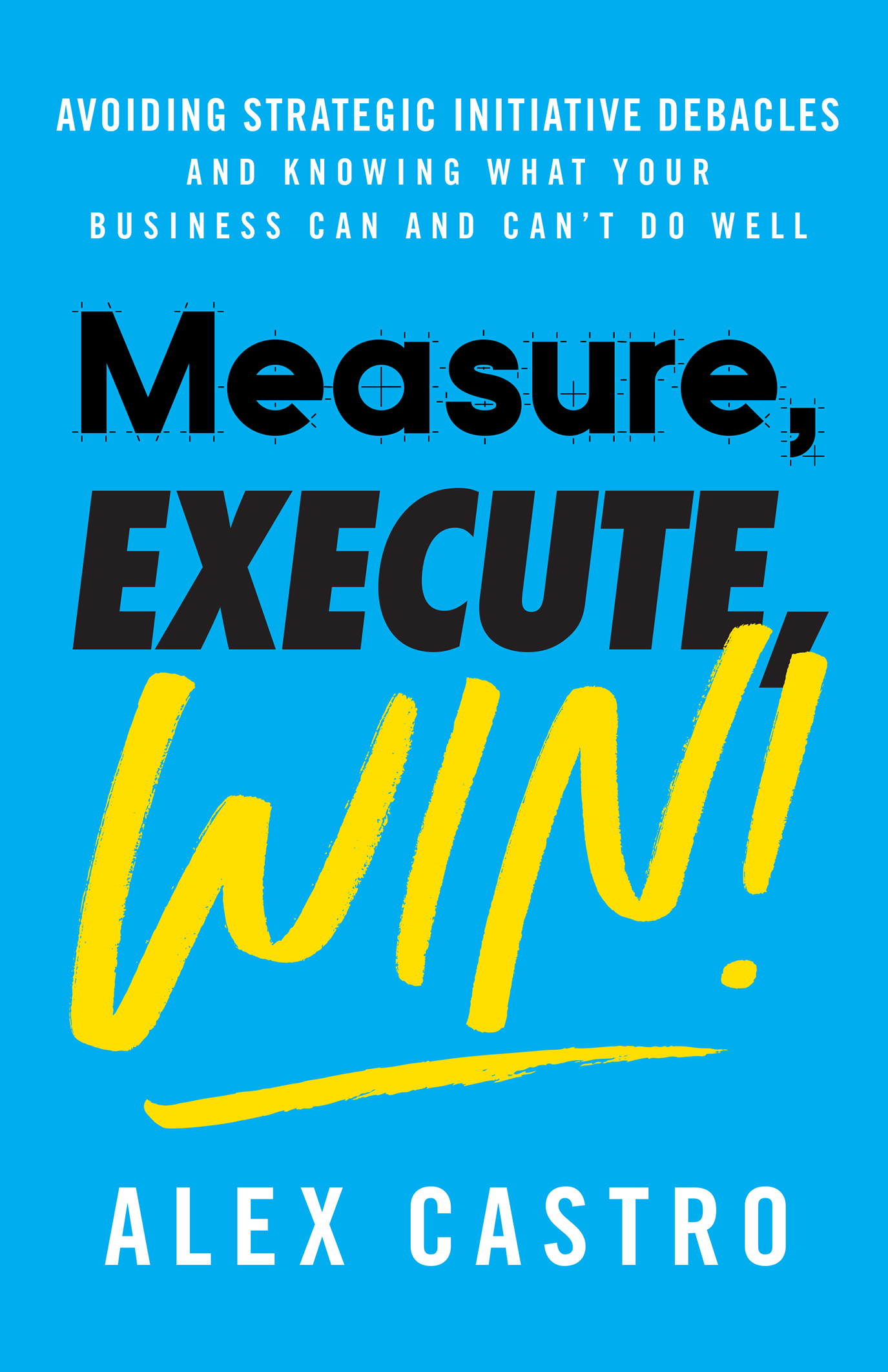
[0:00:28] CH: What’s up everybody, you’re listening to Author Hour where we interview authors about their new books. Today’s episode is with Alex Castro. He’s the author of Measure, Execute, Win. Now, in today’s business world, there are no lack of good ideas but 50% of them are doomed to fail. That’s because executives often green light strategic initiatives based on a business case or a financial analysis with no idea whether their company has the ability to execute successfully. But Alex believes there’s a better way to make corporate decisions. Alex is the CEO of M Corp and he has helped clients deliver a complex corporate strategy for the last 20 years. Now, you don’t get two or three chances to make a strategy work in today’s environment and this episode is going to help your company go forward with initiatives with full confidence that you’ll get the results that you want. Now, here’s our conversation with Alex Castro.
[0:01:40] Alex Castro: It was a combination of a few different things. You know, this book has been rattling I my head for probably five or six years but you know, the thing that I struggled with quite a bit was how to put together a very compelling story, you know? In the sense of how do you present a topic that really largely gets overlooked and people look at you kind of in a puzzled warty and tell a story about it in a way that it’s cogent. The way that it can connect the dots and work together. In speaking in different conferences or to different groups or having different meetings, I got a lot of encouragement to kind of finally hunker down and get this done, you know? Through professional acquaintances, customers, people on my business team, people in my life, you know, where you really got to get this book put together.
[0:02:37] RW: All right. What would you say is the main crux of the book or that main idea that people can take action on?
[0:02:45] Alex Castro: You know, the thing that I try to – I’m a data person, I like data because it helps, it creates these sort of stable pillars that you can – a foundation that you can do things with. The crux of the book is that half of all strategic initiatives in both public and private sector fail. What you start to take a look at, especially when you dive into the data and the research is that this has been a problem that has existed for significant amount of time and people don’t pay attention to it. The crux of it is that if you can begin to create better pools of strategic initiatives, if you can begin to watershed away, the things that either your company is incapable of delivering on or that initiative or project that you want to do that just is so compelling but you know, just doesn’t have a chance. To me, in a lot of ways, if you can begin to watershed those things away and focus on the initiatives that are going to move your vision forward, it’s going to begin to accelerate because you’re starting to get rid of all of those distractive initiatives and projects that just take energy, just sap energy out of a business, regardless of how good the idea is and allows that business to really focus on things that it can deliver, things that it can do. Also, understanding where they’re vulnerable, in the context that most businesses really like to look at themselves from the context of let’s do a health assessment to see how our overall business is and how well it can do. The reality is that that doesn’t tell you anything because each thing that you're going to do, whether it’s an acquisition, a new product, a new market, whether you’re going to modernize your back office to become more efficient or you’re going to take all of your applications and move them into the cloud or if you’re going to upgrade all of your systems. Each one of those initiatives has its own personality, has its own characteristics. There are different factors that will impact your ability to do those things. The reality is that you know, at any given time, half of the things you're doing are failing or just not performing. That is a significant amount of waste and if you can begin to really understand as a decision maker, as a chief financial officer, as a CEO, as a chief operating officer, when you have people coming to you and saying, "Look, I need some funding because I want to support the strategy that’s been put out and I want to do these projects or I want to you know, buy these companies or I want to do these different activities within the business." There’s no way for an executive to understand whether or not the business can actually execute those ideas. Whether they have the ability to actually engage and see it through. What this book is about is really understanding that you have to measure that. It’s measuring it like you measure your credit score, it’s measuring it like you’re taking the SAT or that you know a bond rating or a personality test before you get hired, right? It’s a metric that works within the equation of decision making. It’s been missing from corporate governance up until this point. Really, the emphasis is, really begin to measure your ability to execute that idea before you invest in building out the business case, before you invest in building out all the performance and doing the analysis of months and months of investment. This is not only costing you money but it’s distracting you from other things that you could be doing at the same time. And understanding very quickly, do we have the ability to execute this or is this going to be one of those things that’s going to have a significant impact on our business?
[0:06:38] RW: All right, before we move a little bit into the actual measurement and how we start to measure some of these things, let’s talk a little bit more about why businesses fail and why these ideas kind of don’t flourish sometimes. Tell us a little bit more just about the executive side of things and why ideas are not sometimes flourishing?
[0:06:59] Alex Castro: Everything that I tend to go to is about root cause. What is at the root of why something is happening? And what’s come out through studies and through authors from everything from MIT Sloan to Princeton, to Ohio State and many others, is that, this behavioral practice of decision bias comes in to play when decision makers are, and executives mostly are driving strategy or vision. They have this very cemented state of mind that their companies are able to execute on their visions and they’re going to put through because they have this great hiring practices and they’ve got the best people and you know, they’ve gone out and had all of these retention efforts and training and getting people up to speed and doing all these different things that build a good organization without recognizing that all that work is for your now state. It’s for your ability to function more efficiently today, to execute today’s strategy, today’s vision, today’s things. When you make that move up the line, up the growth line, depending on how aggressive that is, you’re going to have a gap in execution capability, you know? Or readiness to be able to do the work. That’s where the failure comes from and it has the single thing that is actually not measured in any decision making practice at the executive level, consistently across the Fortune or S&P 500, Fortune 1000 companies globally.
[0:08:41] RW: All right. Getting into the standard of measurement now. You have developed something called the – tell me if I’m saying it right, is it the REM Score?
[0:08:52] Alex Castro: REM Score, yup. It stands for Readiness Measurement Score.
[0:08:57] RW: All right. Tell us a little bit more about the Readiness Measurement Score?
[0:09:02] Alex Castro: The readiness measurement score, what we did is, went out and started to look at best practices associated to a lot of the studies for – they have been published by behavioral economist who really are the ones that are really pushing the concept around decision bias and the different behavioral traits that go into making decisions. We began to take a look at all of the different areas as to what was really impacting the different activities that a company does. Anything from something that involved an acquisition or a new product launch or any kind of technology development or back office system optimization where you’re trying to improve your accounting or your logistics or customer facing CRM. What we began to recognize is that there was a very clear pattern in the sense that there were consistent factors across – regardless size of company, as well as industry and type of initiative that you were doing. What we began to do is say, "Look, what of these areas that are getting impacted?" And what we wound up doing is calling them domains. We have these domains of impact that relate to all the different factors that from all the postmortem analysis as to you know, why something failed or didn’t really reach its optimal state. We built out these domains of measurement and we wound up building about 14 of them. That really, encapsulate everything that is important in terms of why something worked or what I call defaulted, right? Because the thing that, you know, when I speak to executives globally, what I say to them is that, "Look, every time somebody ask you for some money to go do something, in essence, you are a loan officer, you’re a loan officer that is telling a subordinate within the company that is asking for money, saying look, please give us this money so that we can go out and do this thing and bring it back a multiple of return for that money that you gave us. Instead of taking it and putting it into an investment fund or distributing to stock holders." When you loan that money out, what you’re looking at is not about, it’s success and failure because success and failure is very subjective. What you’re really looking at is did they come through with what they had committed or did they default on the loan? Did they not repay the loan. Kind of going back to sort of earlier question is that, the reality is that the default rate inside corporate America as well as government, actually higher in government, is 50%. Now, during the financial crisis in '09, let’s say. It peaked out at 18 and a half percent and think of how bananas everybody was going when the economy was in a state where home loans were defaulting at a rate of 18%. Corporate America, right? Companies have a default rate of 50%, on the things they invest money into. When we develop REM score, what we’re looking at is taking a look at the broad spectrum and saying okay, look. What are the factors that are contributing to these defaults, what are the things that are contributing to the ability or the inability to deliver on the commitment? These 14 domains fleshed out and then within those domains, we began to actually dig a little bit deeper and create these thematic models underneath and then we have to figure out okay, how are we going to collect data into these domains to be able to understand it because you know, people, if you’re talking to a technologist, they want to say, well, you have to look at the code and the architecture, right? Okay, you go out and you look at the code and the architecture and you're doing analysis on that. What you wind up realizing is like in that instance, that there is no data that supports that the reason technology projects fail is because the technologists were IT or whoever did a bad job. It’s literally a wives’ tale, there is nothing that support it, the technologists are doing a very good job, that’s not – it tends to be lesser evil, right? But it’s a bias. It’s a bias that gets included in the conversation. We started to look, it’s okay, how are we going to do it in an acquisition. How do you intake information in a way and what we really began to build out without really knowing it is, in essence, what we call swarm intelligence now, right? That whole hive mind, where swarm intelligence is beginning to take the inputs of people who are associated to that project or initiative, the thing that you're trying to do. They begin to provide data through a data gathering interface that begins to guide and steer as a collective, kind of little Star Trek-y here. As a collective in terms of the direction of where that initiative really is. The thing that we kind of came back and realized, as a fundamental baseline is that – this again is something that I don’t think executives really have the time to recognize because the blistering speed of expectation is that virtually, every answer that they want in terms of understanding can they succeed in a market, can they produce the product, where should they go next, what should they be doing, how should they be doing it, can they actually do that, what’s going to be the limit? All of those things that they want to understand is actually inside their company. They just have no mechanism, no method to harvest that data and bring it out of their company in a way that they could act on it, that they could avoid bad initiatives or what’s called a black swan event. That you know, one in six large scale strategic initiatives are things that could actually collapse the company. What we found is that not only in the 14 domains of measurement were we beginning to reveal things that we found that by using that swarm intelligence building this sort of hive mind of people’s inputs, that was actually steering us into a direction with the conclusion really that not only where they incredibly accurate and being able to determine whether or not they were ready to execute on a strategic initiative but in the fact that they actually possessed all of that data inside of their own company. And so I started to refer to it in many ways as the golden ticket from Willy Wonka, right? It’s like you have that dad who is buying that cases and cases of chocolate bars and having all of these factory workers just opening chocolate bars looking for a Willy Wonka ticket and at the end of the day, that is a lot of how strategy gets implemented and people are just trying to get – just ripping up candy bars looking for the golden ticket. The one that is going to really push him through and what we found is that these domains narrow that down and they allow a lot of that distraction to be removed and the focus comes back in and the swarm of your employee base becomes to actually stir because you have invested very well in hiring very good people and retaining them and training them and they actually know how to get you there but not as individuals. They know how to get you there as a group through a facilitated mechanism that intakes their data into domains that actually measure what’s important and actually calculates and gives you a metric that you can act on so that is the short answer.
[0:16:37] RW: Awesome, all right. No, it’s awesome. So what if anything should executives or leaders do to prepare for the implementation or just even using these method, is there any pre-work or anything they should be looking for before they start to do this because obviously this is going to make things a whole lot easier, usually there is some kind of preparation but is there for this?
[0:16:59] Alex Castro: Not really. You know really what you are dealing with when people – what we call is operationalizing this. You know what they struggle with is a shift because they feel that this is going to – you know I have had executives come back to me and say, “Well Alex this is going to kill innovation,” and I’m like, “It’s not going to kill innovation. It is going to kill stuff that just doesn’t work,” right? It is going to kill things that are going to waste your time. And I’ve had other executives come back to me and say, "Alex this is really going to slow us down." And it’s like look, this assessment can be done in two days. It can be done in a day if you wanted. This is not something that is going to take you months and weeks and collecting data, having people in conferences. You know this is not that. This is something that is very quick, it gives you that — you know it is going to – when you go to your bank and say, “Hey look, I want to buy a house, I want to buy a car, I want to buy a boat. I want to buy an office building, I want to buy whatever." You know one of the first things they ask you is what’s your credit score or they just look it up and based on that, it sets the path for what you want to do. So no matter how good of an idea that asset is as an investment, what they’re measuring as a bank is saying, “That’s a really great idea. That is a really great asset. Can you pay it back?” And if you can’t pay it back I don’t care how good the idea is. And so, this actually begins to melt away a lot of that distraction and so operationalizing it really is more from a culture standpoint saying, “Look, before you bring me some one pager on how amazing your idea is, I need you to measure whether we can actually do this and once you can tell me whether we can do it or not then I’ll hear your idea but until that happens, you know measure it out first. And I think that is the thing that scares leaders the most because they feel like that is going to somehow create a barrier to innovation. When in reality, it begins to help. It helps the people coming up with an innovative ideas filtered down and through and say, “You know these are really good stuff but I am going to wind up wasting a whole lot of time, a whole lot of money, a whole lot of energy on things that we are just not in a position to do." And so that tends to be the most challenging things but in terms of the organization itself, the organization, your company, it doesn’t matter what scale you are. The data you want is inside your business and all you have to do is funnel it through this model to collect it, extract it, parse it, figure out how to read it and you’re going to begin to see a lot more acceleration in the execution of your strategies.
[0:19:32] RW: All right and then do you have any examples that you can give us whether from your personal business or just other kind of applications in the real world that you can tell us about?
[0:19:42] Alex Castro: Yeah, you know we use a couple of clients as an example because the tendency for us is that we’re under heavy non-disclosures, you know? And so the difficulty is really talking about people who have used it and what they’re doing with it but we have a couple. One is taxaudit.com. taxaudit.com is an independent company that is the audit, tax audit insurance for Intuit. And so, whenever you go and you do your taxes online, you have a little box, You can check and pay some amount of money there and in case you get audited, it covers the entire audit cost and they have this automated process and they do an extraordinary job at helping people out. They are very, very high success rate and when I began to speak with Mark Olander, who is the CEO at the time, he wanted to modernize his entire platform on which not only people interacted with TaxAudit in the sense of providing forms and backup material and content and all of those kinds of things that they needed. But also their internal process and how the system internally and their platform internally was doing the audit defense process and he’d already began to hire people. He already began to hire project managers and coders and whereas opening up offices in Southern California to staff up and be able to do this and he looked at me during the conversation and he goes, “Alex, the biggest thing that scares me is what I don’t know. You know the other stuff I think I’m a pretty good manager.” “I am a very experienced business person but it’s always the stuff I don’t know that winds up biting me, you know?” I said, “Well I understand that.” And so we ran him through a REM Score. We ran him through a readiness score and revealed out some really sort of critical items that we’re going to really impede their ability to execute on their vision and you know we brought it in front of the team, his executive team and his executive team took it very well. I mean they were like, “Okay, this is good data. This is interesting data, we suspected already some of these things existed but this really gave us much more direction concrete action items in terms of we needed to be able to do." And yet, they were already in process a little bit and as their momentum kind of kept them going forward a little bit began to realized based on having that REM report or that REM score in front of them that detailed out and all of these 14 different areas of measurement of what was going to happen. As the momentum still carried them forward while they were reviewing the results and kind of going through their sort of their corrective plan, they begin to see them actually start to pop out and maybe it’s because it was something they had already been alerted to and so now, it was much more obvious to them but the minute that they really begin to realize is like, “Oh my gosh this is actually coming true,” they went full force and really invested in correcting their approach. Which really yielded out a modernized platform for them. Once they had gone through their corrective process to make the adjustments for what we call vulnerabilities in their delivery model, they came out with a really, really great product that really increased their ability to produce volume and meet Intuit demands. Unfortunately you know we can’t disclose a lot of those very specific data points but it was a very successful piece for them and the same thing happened to CalPERS. You know they are the largest pension system in the country and they needed to modernize their actual actuarial system and their CIO and the head actuary got together and they’re like, “Look, again we need to know what we don’t know.” And they went through that similar process and once they got the results, they stopped what they were doing for about nine months and did a micro effort of about nine months to correct the vulnerabilities that they had identified. And in that instance, they had accelerated their project by about two years in the delivery process and delivered it for two thirds of what they had anticipated spending. It made a significant difference in making sure that they were not exposed because this actuarial system handled computations for 3200 different pension plans throughout the State of California and those calculations had to happen on a quarterly basis and it was very significant. And it allowed them to modernize their back office in a way that really reduced their risk and allowed them to optimize what product they were producing.
[0:24:29] RW: All right, so if you had to go ahead and issue a challenge, so whether to our listeners, readers, just anyone who is thinking of implementing this making decisions at the executive level, what would you challenge them?
[0:24:44] Alex Castro: Really the challenge is to begin to weave in a readiness score mentality into your decision process because the thing that really gets confused, the thing that I see getting very, very confused on a regular basis, is that you’ll have an older executive. I mean I am 50 years old. So for me, I blurt this out every once in a while but a lot more senior executives tend to say, “Hey look, I have this experience. I have been doing this for X amount of years. I have seen everything under the sun.” Or “I have seen this scenario before and I have been through this before.” And those kinds — and they rely on that past performance as though that is going to guide them to future success and what I have found is that that’s partially true. And it is partially true because it is not having gone through that past scenario that is going to actually make them successful in the future because the things that happened on that past project, that past acquisition whatever may have been the past strategy. That has no bearing at all on what you’re doing today. What does have bearing is how you intake that data, how you take the information and process it, how do you connect the dots yourself as a professional, as a seasoned professional but when it gets blended is the fact that I believe that it’s well. “I’ve seen this before so because I have seen this before, I know what to do now.” And the reality is it’s, "No, you’ve seen this before but now what’s happened is you know how to process the information efficiently. You actually know how to recognize what’s happening." So the challenge is leave that bias behind. Leave the bias behind that you know how this is going to work out, right? And there may be that tickle or that little gut feeling, pay attention to it because it usually serves you well. But understand that the reason that gut is there is that it’s not telling you that you did it X amount of times in the past and that’s how it is going to predict out in the future. It’s that what that tickle is, is there’s this part of you that is saying the data is coming at me is not connecting. But I can’t articulate that as to why. And so rather than applying a new bias to it, the challenge is apply a metric to it. Apply a measurement that says, “I understand what it takes to get this thing done. I don’t have enough information to understand if I can do this next thing successfully. So I am going to measure that and now, it is going to begin to quantify it a lot better for me so that I can actually make a better decision.” And so it’s really transforming the way you look at how you make decisions as a leader and relying on some data rather than this bias that a lot of people have that past performance or past results in your personal history or the people coming to you is a predictor of whether they can actually execute in the future.
[0:27:44] RW: All right and then how can people contact you if they want to learn more?
[0:27:49] Alex Castro: They can get in touch with me through the remscore.com website. Also with the book will be releasing a personal website of alexcastro.io you can get more information there or I’ve got a channel on YouTube that I do explainer videos in little model walkthroughs in terms of different reasons why things work or don’t work. So I am open to all kinds of feedback and people coming back to really have a good dialogue about this. Because in the end, I think that the people who tend to adopt a Readiness Measurement Score or a readiness score start to see that their business actually begins to be much more pinpoint accurate in terms of what it is trying to do.
[0:28:36] RW: All right, thank you so much.
[0:28:40] Alex Castro: Yeah, my pleasure. I enjoyed it.
[0:28:43] CH: Thanks so much again to Alex Castro for being on the show. You can buy his book, Measure, Execute, Win, on amazon.com. Be sure to leave us a review on iTunes and check out authorhour.co for full show notes and a transcript of this episode. We’ll see you next time.
Want to Write Your Own Book?
Scribe has helped over 2,000 authors turn their expertise into published books.
Schedule a Free Consult