Harvy Berman: Undying Will: A Family's Story of Survival in War Torn Europe
Read the full transcript
Harvy Berman
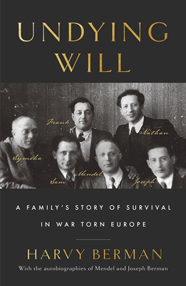
Harvy Berman is the author of Undying Will, the story of his family's survival in war-torn Europe. His search began when he learned that his father's first wife had been killed during the Holocaust, and he set out to piece together his family's history before, during, and after the war. Told in the original words of his uncles Joseph and Mendel Berman alongside his own novelistic writing, the book recounts how members of the Berman family were among the handful of Jews who survived the Nazi extermination of the shtetl in Kaluszyn, Poland.
📚 Books by Harvy Berman
Transcript
[0:00:17] NVN: Welcome to Author Hour. Today I’m talking with Harvy Berman, the author of Undying Will: A Family’s Story of Survival in War Torn Europe. When he was 19 years old, Harvy found out that unbeknownst to him, his family had lived through the Holocaust and World War II era Poland. This began years of discovery in which Harvy put together his family’s incredible story through a combination of research, discussions and unearthing first person written accounts from some of his family members. In this remarkable book, Harvy relays his family’s story of survival in a time and place in which 95% of the Jewish population was exterminated. In this interview, Harvy shares his family’s harrowing story of willpower, survival, heroism and ultimately, of triumph. At this period in history, Harvy’s book is a powerful reminder of the human toll of prejudice and racism.
[0:01:20] Harvy Berman: My parents did everything they could not to tell us the story of their background, you know, the issues that they went through related to the Holocaust. My whole youth, it was something that was never brought up. I really didn’t learn about it until pretty much when I started working in the family business and where I started interacting with my uncles and cousins and when that’s a lot of discussions and storytelling began.
[0:01:49] NVN: Interesting. Before you began learning those stories, what sort of basis of knowledge did you have about your family’s history? Did you know they had been through the Holocaust or were you completely in the dark?
[0:02:04] Harvy Berman: Completely in the dark. I mean, they did everything they could to avoid talking about it. There was no indication in my life. I grew up you know, a normal suburban area, I was very involved in sports so my time was spent every day playing baseball, football, basketball, interacting in that way, going home for dinner. Just eating dinner and going to bed and going to school. There was never any discussion. I literally didn’t know where – I knew they came from Europe because my parents had an accent but that was about it.
[0:02:40] NVN: So how did that impact you when you first found out? Do you remember that moment?
[0:02:46] Harvy Berman: Well, I remember the key moment where I started working at the factory at a fairly young age, about 19 years’ old. One day, my father wasn’t there at the factory and in the conference room, my uncles were sitting, my uncles and cousin were sitting and they spoke Yiddish. I, you know, working with them, I understood Yiddish and spoke it. So, I was in the next office and they didn’t know I was in there and I overheard a conversation that they had and they said something about my father’s first wife. And so, you know, obviously, it drew my interest and I walked into the room and when they saw me, basically, the put their hands on their head knowing that they said something that they weren’t supposed to say. So, that was the beginning of me finding out that there was a whole other story about my parent’s background that I was not aware of.
[0:03:37] NVN: Wow. And about how old were you at this point?
[0:03:41] Harvy Berman: 19.
[0:03:42] NVN: Amazing. Tell me how this story started to unfold for you? What was your family’s experience?
[0:03:51] Harvy Berman: The experience during the war? Before the war are you talking about or?
[0:03:55] NVN: Yeah, during the war in the Holocaust when they were in Poland.
[0:04:01] Harvy Berman: Right. Well, after I started researching it, you know, going to college, it became an interest of mine. I started looking a little deeper into it and I started studying a little bit about my family’s history. I became aware that they were very entrepreneurial type individuals in Poland. My grandfather had a factory where they manufactured sheep skin coats for the Polish army and the Polish railroad workers. My grandfather died when my father was 17 years old and before he had passed away, he had decided to have my father take over the business. So, my father took over the factory at 17 years of age, this was obviously before the war and the factory started growing and they were able to build a large three-story brick building and started manufacturing and hiring lots of employees. Interestingly enough, they were paid by the Polish government twice a year. They had to come up with their own currency that they could pay their employees. They basically called it a Berman Dollar and they’d pay all their employees with the Berman dollars and the employees would be able to go around town and buy their bread and their meats and whatever. And then, when the Polish government paid in zlotys – they were able to transfer the dollars into zlotys and pay everybody off. So, with that system, they were able to hire a lot of employees and business just grew tremendously.
[0:05:31] NVN: Then, how did their lives begin to shift in the Holocaust, were they actually in Poland at the time when the extermination began?
[0:05:44] Harvy Berman: Yeah, sure, they were operating the factory. You know, at that point, my father fell in love with a woman, he got married. About 1936, 37. Married a woman and they had a young son and you know; life was good. They were living a great life, a big part of the story that I get into which I learned later in life was that my father and cousin and an uncle decided they wanted to start a soccer team to play in the Polish district league. You know, they would leave the shtetl areas and go to Warsaw and they saw that there were soccer leagues and they said, well, “why can’t we have a soccer team from you know, in our city?” And they established their own soccer team to play in the Polish district league. Interestingly enough, the games were held on Saturday and as you could imagine, being the high, holy day for religious Jews, created quite a controversy in the town when they left to play their first game on a Saturday. They were actually stoned by many of the citizens in town on their way out to play the game.
[0:06:51] NVN: And then, walk me through obviously the book covers this in detail but first of all, were they able to escape ultimately?
[0:07:03] Harvy Berman: Right, well, in 39, when the Germans started bombing the town, it was one of the first towns that the Germans bombed because they had already made a decision that they were going to attack the Soviet Union and this was an area where they would have to drive their tanks and artillery through to get to the Soviet Union. So, it was one of the earlier towns they destroyed, they pretty much liquidated most of the town but when they went into the town, they saw this large factory producing sheep skin coats. What they did is they basically imprisoned everybody that was working at the factory, they gave them a work visa and said, “look, you guys could stay in the factory, you’re going to keep working, making me sheep skin coats but we’re going to be taking them.” That gave them basically almost two years to continuously work in the factory, making these sheep skin coats. And during that time, it was already individuals who had left them trains to the death camps and had escaped and come back and the word was already out that you know, if you’re headed in one of those trains, that was it. So when they ran out of materials, it was all gone, they were basically marched to the trains and knowing what they knew, they had a snuck some screwdrivers and some little tools in their pants because they knew that in the cattle cars, there was a metal breathing grate up on the top and they decided they would try to open that when the train left and one by one, push each other out of the hole in the train. That’s basically what happened, they got in the train, majority of the family was in the train with a lot of other individuals and one by one, they jumped out.
[0:08:48] NVN: I can literally feel my breath shortening as you’re telling this story. I can’t talk to me about what it was like for you to start to put all of this together about people who you love deeply.
[0:09:05] Harvy Berman: Right. Well, you know, fortunately, two of my uncles that survived the Holocaust wrote their accounts. One was only written in Yiddish and it was translated later in English by a cousin of mine and the other uncle wrote one in English. They weren’t brought out into the public these stories, so as I started writing my accounts about the early life, I said, “well why would I want to rewrite what these guys already wrote?” So, I basically took their firsthand accounts and stuck them into the story so that people could see, hear the actual story from people that were actually going through it at the time. What I did with my narrative was try to give individuals and idea of what life was like in this area before the Nazi’s arrived. A lot of people, you know, think about this Jewish shtetl before the Holocaust and you know, Fiddler on The Roof comes to mind. They think all the Jews were wearing black coats and black hats and have long beards or they think that they were a sign or a communist organization. But my father and his family, they were, it’s about capitalist, they were as western as could be. You know, my father wore a three-piece suit. Had a haircut like the people in downtown Warsaw and they loved that life, they didn’t keep us – they weren’t Orthodox, they were respectful of the Jewish religion, but by no means were they Orthodox. They ate food that all the Polish people were eating, they were eating Kielbasa, Pierogis, they were drinking, smoking cigarettes, just living the life like everybody else was in Poland. They had no intention of going anywhere else or being anything different than Polish citizens. So that was the life that they led prior to the war. Obviously, it all changed when you know, a lot of the Polish people turned against them and things of that nature.
[0:11:03] NVN: Yeah. You have a quote on the cover of your book from Stalin that says, “one death is a tragedy, millions of deaths are a statistic.” And the way that you just explained your family, and how they were living before all of this tragedy happened, really drives that point home to me. Like these are very relatable people, living obviously life in an earlier era than we are today, but just hearing you say that really drives home the point that this could happen to anyone given the wrong circumstances.
[0:11:48] Harvy Berman: Yeah, it’s an unfortunate reality and that’s why you know, stories like this are in my opinion important to be put out there. Obviously, everybody’s not going to read it, everybody’s not going to believe it, there’s going to be still people out there that you know, they hear the nonsense of people that you know, say it never happened. Well, you know, it happened to my whole family. 90% of my family was killed there, was actually – their town had 10,000 individuals, 8,000 Jews. 1945 when they got back together after they were liberated, there was between 10 and 12 survivors out of the 8000. You know, it’s just very fortunate, obviously for me that you know, my family was a big part of it. But if it wasn’t for their factory, you know, the Germans imprisoning them there, they would have been killed out at the beginning, you know? As my father’s first wife and first child was and you know, the majority of my family passed away in those situations. It was mass graves, you know, the town’s people will just take and line up and shot and thrown in the graves. Interesting which brought me to writing the story was I was invited to attend a memorial in my father’s city because another individual who had descended from the city went to see where his family was from and when he arrived there, he wanted to see the cemetery, he was greeted by a barren field and he asked what’s the deal. And they said, “well, when the Germans took over the town, they had the Jews remove every headstone from the cemetery and crush them into gravel and they used that gravel to create the streets so they could drive their artillery towards the Soviet Union.” So that empty field sat there since you know, 1940. And this individual contacted other individuals, decedents from the city, hired Israeli artist and they were able to purchase the land actually back from the Polish government and put a memorial there with a little dedication saying what was here, what this area – you know, it was a 200-year-old cemetery that was desecrated that way. Being there, seeing that, knowing that most of my family was buried there before the war, really gave me the inspiration that you know my kids need to know about this. My grandkids need to know about this and you know I hope other people are interested in this story as well.
[0:14:15] NVN: Yeah, how did it feel to you being in that place and that town that was such a part of your family’s history and knowing what happened there?
[0:14:26] Harvy Berman: It was really difficult. Before I went when I was contacted, I thought back to what my father said years before he died and I remember him on numerous occasions, you know once it was out in the open and we would talk about a little he said, he would never step foot in Poland again. You know understandably so. You know his wife and kid and his whole family were slaughtered there. So I had mixed feelings about going there. I just thought, “you know I never met my grandparents, any of them. I never saw a picture of them.” I just said to stand over a cemetery where they are buried and to be able to recite Kaddish in their honor, I thought would honor my parents, honor my father. So I decided to make the trip over there and then you know walking in the same areas that they walked. Actually, finding the house of my grandfather, which still exists. It was just an amazing feeling.
[0:15:21] NVN: You mentioned at the beginning of this conversation that you put a lot of this information together through research. I am curious and then you just also referenced a conversation with your father. So, I am wondering what sort of balance there was? After you put this together, did your family begin talking about it more or is most of this from the narratives that were written by your family combined with your research or did it become a more open dialogue overtime?
[0:15:55] Harvy Berman: Yeah, it became more of an open dialogue, but not so much with my father but with my uncles and cousins. When I started working in the factory, we were supplying the automotive industry with leather interiors and then we started going back to the roots and making sheep skin coats. I went to that division starting to make the sheep skin coats and I was put with a gentleman who was actually my cousin, but was older than my father and he was an energetic guy that loved to talk and have a great time and they would basically be the two of us working on getting this new part of the business going. And he would relate a lot of the stories to me that my father never talked about and so those were little things that I started, you know making notes of and it caught my interest. The story about since I was an athlete about how these guys wanted to create a soccer team in their town that just blew my mind thinking about that. And you know, the rest of it came from just talking to my uncles over time. Hearing the stories, I talked to my aunts, I talked to everybody that had a story. Fortunate to have very close cousin Sarah, who recalls lots of stories that her mother told her. So, when I was working on this, I would sit with her and she would recall lots of stories that her mother told her over the years because they had a very interesting survival story too where they avoided going to the trains by basically going to the Soviet Union, running away there. Unfortunately, they were quickly picked up as spies by the Soviets and sent to Siberia and lived out the war in Siberia. So, for six years with two sides of the family never knew the other side was alive and when it was all over surprisingly enough they got a note that they were still alive. So, it is just a matter of listening to people and listening to the stories.
[0:17:53] NVN: Yeah, I am so struck by the resiliency of your family not only for surviving in the first place, but also that after all of that, they were able to rebuild and have a factory once again. That is just incredible.
[0:18:10] Harvy Berman: Yeah, it is incredible how tight knit they were to survive, together, always having the concern for each other and not just you know individuals. So, they really stuck together. A lot of them hid out together out in the woods. You know that is an interesting part of the story that goes into and when they came here, they stuck together too. They came to the United States. They rented a big house and all moved in together and they all got a job together. They went to work together and you know eventually we’re able to build up their own factory again like they had in Poland.
[0:18:46] NVN: Once you were able to put all of this together, did it put anything about your father or your larger family in context for you that maybe hadn’t clicked before?
[0:19:01] Harvy Berman: Not really, you know as I said my father was a very quiet guy and he never really talked about it. I did not get much information about him. One thing I put in the book that father would chuckle when things were rough and a line he used to say was, “Hitler couldn’t kill me, what do I have to be afraid of?” And that’s –
[0:19:21] NVN: True.
[0:19:22] Harvy Berman: Actually, that was going to be the title of the book. That was my working title of the book, but the publisher thought it was too long and they had a few other issues with it so they do want to shorten that up. But that is the kind of guy he was. He just wasn’t a talk kind of guy. He was a doer. He did things in life when there was a problem, he would take care of it. He didn’t talk about it and that’s how they made things work in Poland. You know it wasn’t to worry, it was just to do something. You know you have to take life into your own hands and that is part of them, you know they weren’t a religious group and so they didn’t pray to try to get through the bad times. They figured out what had to be done to get through the bad times and that’s how they made it all through life.
[0:20:03] NVN: So, even understanding that your entire family didn’t survive, statistically an incredible portion of your family survived it sounds like.
[0:20:15] Harvy Berman: Right. Right.
[0:20:16] NVN: Have you thought about what you attribute that to?
[0:20:20] Harvy Berman: Yeah, it is everything that we talked about. Look, I mean a lot of it has to be luck. Any story of the Holocaust, of survivors, you know you could say, “oh, they had a great plan, ingenuity, they did this, they had connections and stuff.” But you know there is a hundred times they’re in those years that they could have died. So, you know the ones that survived obviously had some ingenuity, some wear with all to do things but it is still luck because at any time, you know a German could walk up to you and shoot you. It was a common everyday occurrence. When you read my uncles accounts, they talk about it on a regular basis. Just a German officer walking up to somebody and shooting him. It was just common place. You know the resiliency had to do with all of that together and again, you have to have luck.
[0:21:13] NVN: Wow and finding all of this out, did it make you put your life in any kind of different context or look at things differently?
[0:21:24] Harvy Berman: Yeah, well I don’t know. That is hard to say, I don’t know. Obviously, it turned me into who I am today. I am a martial arts instructor, that is what I do professionally and I try to engrain in kids that if you work hard, if you believe in yourself, good things will happen and that is the big part of it. You got to keep working for what you want in life, you got to fight through the bad times. You got to understand that everybody is going to go through bad times in life, right? So how do you get through them? How do you persevere? You grab it by the horns, you face the situation and you take it on and don’t put her on the back burner and think, “oh, it will just go away,” and you know that was one of the great lessons I learned from my family. The art of survival.
[0:22:12] NVN: What does it feel like to you now that you have finished this book?
[0:22:17] Harvy Berman: Well it feels good. Obviously, it feels good. I mean to be honest spending the last two to three years going over my uncle’s writings and researching and going through these old books and stuff, it was difficult. I mean I had a lot of sleepless nights where you just couldn’t get those stories out of your head and you would just spend all day reading about it making notes and stuff and then you try to go to bed and you can’t get those stories out of your head. So, I found it very disturbing. You know I had a very hard time with it. So, you have now that it is done how do you feel about it? I feel good. It is like I need to step away from it a little bit to clear my head. That is all about all I could say about it.
[0:23:01] NVN: So, I think you have already referenced this but especially considering how difficult some moments of this process were, why was it so important to you that this story be told in a book format?
[0:23:14] Harvy Berman: Right, you know as I said, I have children and my children started having children. So, I have grandkids now and I just looked at the fact that I never knew who my grandparents were. I never knew their story. So, I wanted my grandkids to know the story of their family. And this was the only, you know I had notes and a notebook. I had my uncle’s writings that here scattered in some different areas and stuff but I thought I needed one book that were kind of put it all together and paint a picture of what their life was like before the war. What they went through during the war, tried to find any pertinent photos that I could find that relate to the situation. Surprisingly enough, my parents held onto a couple of pictures and my father held onto one picture of his first wife, even though he never told us about it that’s why I found out who was in that picture later in the future. There was a picture of my mother with her Jewish armband on. The way she was hiding in the woods. So, I wanted to add out there in one cohesive type book where it could be passed onto the future generations.
[0:24:28] NVN: It sounds like a labor of love in the truest sense of the phrase.
[0:24:33] Harvy Berman: Yeah, you know I just adored my family. I was very fortunate to be in a situation where I worked side by side with them for 20 years, hearing their stories in their original Yiddish language. It was so colorful, a lot of tragedy. But you know hearing the earlier life there was a lot of humor and I thought that was important to get out there too, knowing the type of life that went on before the Holocaust.
[0:25:02] NVN: I got to tell you, I talked to a lot of authors but this strikes me as a truly important book to write. So, thank you and thank you for taking the time to talk to us about it also.
[0:25:15] Harvy Berman: Well I appreciate your interest in the story and thank you for helping me out.
[0:25:20] NVN: Thanks for joining us for this episode of Author Hour. You can find Harvy’s book, Undying Will, on Amazon. A transcript of this episode as well as previous episodes is available at authorhour.co. For more Author Hour, subscribe to this podcast on your favorite subscription service and if you’re feeling it, we love reviews. Thanks for joining us, we’ll see you next time. Same place, different author.
Want to Write Your Own Book?
Scribe has helped over 2,000 authors turn their expertise into published books.
Schedule a Free Consult