Joe Pomerenke: Episode 376
Read the full transcriptJoe Pomerenke
Joe Pomerenke was born on his family's farm outside Marshall, Missouri, a path that eventually led him to Chicago and a job with ARCO/Murray National Construction Company. There he embraced the design-build process, an approach that merges design, engineering, and construction into a single efficient process, and helped grow the ARCO family of companies. He draws on that career experience to explain what design-build is, how it works, and how it benefits the customer.
📚 Books by Joe Pomerenke
Transcript
[0:00:37] NVN: I’ll be honest with you. I know absolutely nothing about construction, design, architecture or building. I still found this interview with author Joe Pomerenke fascinating. Joe has a background in architecture, engineering and construction. He’s currently a partner and director at ARCO/Murray. Not to mention, the author of the new book, A Better Way. AROC/Murray is responsible for designing and building projects with heavy hitting companies like Whole Foods, Topgolf and Campbell’s Soup. In his new book, Joe explains a better methodology for merging together design, engineering, and construction into one highly efficient process. In our talk today, we chat about Joe’s passion for building things, the state of the construction industry and how changing to a design-build process like he explains in this book changes the entire game. If you're in the design or construction industry, I think you’ll take a lot away from this conversation and even if you’re not, I think you’ll still find what Joe has to say as interesting as I did. I want to go ahead and take us in the way, way back machine for a minute, tell me how you came into this industry in the first place? What’s your background?
[0:01:51] Joe Pomerenke: Yeah, I take a lot of pride in my story so pardon me if it is longer than it’s intended to be. But I was a very well taken care of young boy on a farm, in a farming community in North Central Missouri. And it was really a great way to come into this world because it gave you an enormous appreciation for the built environment, right? You know, I grew up in a place where you didn’t see another building for a half a mile and then I went to grade school in a town where the largest structure might have been three stories, maybe four or it was a grain silo. So, as I was growing up, I became fascinated by these road trips that we would take to the bigger cities and my grandparents lived in a town of about 150,000 people and they had a 20 story building in that town and I thought that was a sky scraper. And I just think that you know, it sounds a little cheesy and it says it in the book but I don’t care, I mean it. The buildings were absolutely inspiring to me. They were a sign of progress and sort of like a symbol of hope for opportunity, right? It was like, people had dreamed that we were going to build this building to the sky and we just did it. And so like, there was just something fascinating about architecture all along and then the construction part of it like getting things done like playing in the dirt, that was just part of my nature, right? I was outside all the time, I liked to move things, I was very mechanical. So, anyway, the bottom line is, I go to high school in the bigger city, actually, my folks moved me to that town where that skyscraper was. An I was like a city slicker then. Then, I was just like a normal guy in high school, you know, pretty good student, did well on testing, was very analytical. Basically decided to test myself on what I should do for a living, you know, those little career exams and the number one score was architecture, sounds like logical, “duh, I love buildings, I’m supposed to be an architect.” I’m not an artist, I’m a scientist as it relates to the way in my hand moves with a pen on a piece of paper. So, I actually was given the opportunity to go to college at a very well-known architecture program, but not a very technologically enabled architecture program because they were very classical in their design, a lot of the early stage classes in architecture were like art classes and I didn’t do great. I was a good student my whole life and I was like, “if I’m not doing great, maybe I’m just not applying my skills correctly,” and it was a logical step to then move from architecture to engineering so that I could still focus on the built environment and still build buildings or still design buildings at the time. And then as I got further along in my design education, I met some designers and I got a chance to learn about their jobs by doing some internships in design and it just never really clicked for me to be in a very detailed calculation mode for the majority of my professional day. I wanted to be more extroverted than that, more social than that, more sort of leader than that. You know, I wanted to be involved in the whole process and I was very interested in it like the business dealings and like how the actual thing came together and so, I took an internship in the construction industry and that was a great experience for me. Then you know, between the two sort of experiences, I realized I had to decide and I just leaned to construction because I felt like you know, “it’s not exactly what I want to do because it’s not as technical, it’s a little bit more management than I want but these people seem to get a different level of fulfillment out of delivering these buildings,” or at least that’s what I felt when I did it. I decided to go into construction and by total stroke of luck, I ended up working for ARCO/Murray right out of college and they were a design-builder which was different than construction and it was different than design and because they were design builder, I actually got the opportunity to sort of do both. It was just literally good fortune that II landed in a position to really be able to manage the whole process. And then from there, the rest is kind of history in the books, it’s like career development. Yeah, I hope that answers your question.
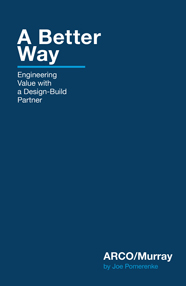
[0:06:16] NVN: Yeah, it’s so cool and explains so much that you have all these different vantage points like that sounds like – I know there was not a lot of design to it, but it’s the perfect design. I love your cover. I’ve never seen a cover like this before, there are something about the sparseness of it that just really appeals to me. I like it. Start there while you’re feeling so inspired.
[0:06:39] Joe Pomerenke: Yeah, I am inspired, you’re going to hear a little bit of that a lot in this conversation. The cover is stark because it actually looks like a book called Getting Real and Getting Real was sort of, well, the way I understand it. Now, I’m in construction and these were people in the technology industry telling me they were sort of respected in this way. But this company 37Signals was a small consulting development company in technology development like app development, software development. And they wrote a book called Getting Real which had like a perfectly black cover and just said the words Getting Real and it talked about a new and better way to develop software and it came out and I think like 2005 or 2007, somewhere kind of after the .com boom and write is sort of mobile phone and mobile devices for building applications and software is getting leaner. Anyway, long story short is. I’m reading this book about the Agile methodology through developing technology. And I’m realizing , “Holy shit, everything they’re talking about in how the technology world has discovered a better way to build technology products is exactly what we do for the construction industry.” The design- build methodology and the agile methodology are actually abstractly in parallel identical. When I thought about writing a book, I thought, “The best thing I can do for my industry is the same thing that these folks at 37Signals did for their industry,” which was discuss a methodology that could improve the delivery of the product that they were offering. And then you think about the way that just sort of simply stating your process and all the benefits that that does. You start realizing who your audience is, you start realizing how it can be leveraged as a thought leadership piece. You really start realizing that it adds a ton of credence to your existence, professionally and your businesses existence in industry and it’s totally inspiring. So, I thought, “Man, these people in technology really figured it out.” Plus, the other thing that’s really crazy is, technology industries have only existed for like 30 years. We’ve existed for like 3,000 years. The only thing you hear about from like anybody that is sort of an innovative or that’s sort of a leading-edge thinker is that construction has not evolved, that construction is antiquated and people just like to kind of give construction a bad rap. It’s slow moving and there’s the iron workers and they haven’t evolved and nothing’s changed. And they’re kind of right because we still build buildings somewhat the same way we did 50 years ago or a hundred years ago. We don’t build them really differently, we build them a lot differently than we did 300 years ago just because material sciences changed. But like, process wise, we build them pretty much the same sort of universally as we did a while ago. So, they’re right, I mean, it’s not that technologically advanced of an industry and it’s not very digitized on the management and business side of it. Primarily because the people who are willing to do it are also actually welding steel and nailing and boards together and like, as much as they love a computer, it’s not going to get the brick laid. You know? The point is I think, I sort of resent the fact that the construction industry is you know, which is my profession is labeled as not having evolved when I work in a business and own a business with a lot of really intelligent practitioners that build these buildings, with a methodology that actually is very advanced and 10 years, the technology industry has start of a way better way to say it than anybody has ever said what we do. But I think what we do from a process standpoint is very advanced. And so, I just wanted to shine a light on that and I wanted to try to communicate it as simply and as logically as possible by telling the story of how our company evolved and then how the process has evolved as our company has evolved as one of the leading players in the industry for this process. So, that’s where the words A Better Way comes from, sort of like our mantra and then that sort of why the book is simple, straightforward, no frills here, it’s just a simple process and it’s not that complicated, but it is very sort of advanced for what we do.
[0:11:15] NVN: There’s something so appealing about simple, which I was immediately reminded of when I saw the cover of this book. How long was this book idea marinating in your mind for? How long ago did you read the book that sort of ultimately led you here?
[0:11:31] Joe Pomerenke: Yeah, that was probably I guess 2017. And really, earlier in that year, I went to a conference and thought, “Uh, I hate the idea of being just another vendor with a booth,” so I was like, searching for ways to potentially differentiate the way we present ourselves as a service provider. And then later that year, I had been given the opportunity to lead our new technology division which inside of our company because I’ve always been one of the leading promoters of innovation in our business and you know, innovation to us is really just allowing people to space to think of new ideas and the freedom and invest in them to try something different and potentially fail. But innovate our processes along the way. And so, I was kind of the guy that was promoting that and when it came to hiring a new technology team, I was very instrumental in building sort of our technology leadership because of their role in driving innovation or business. So, I actually hired the first technology project manager, his name is Rick and Rick and I used to ride to work together and used to just talk about ways that you're going to innovate our business and about two or three weeks into the ride, he said, “you really got to read this book about agile methodology by 37Signals.” “I think it’s exactly what we’re talking about,” and as soon as I picked up the book, I mean, it took me three days to read it, put it down and say, “This is exactly what we’re doing that I’ve never been able to describe.” So, now, I’ve got an idea too, I could write a book and it could be exactly what they did, but it could be about what to do and so I sort of got with marketing and embarked in the journey to start the book and probably early 2018. And you know, life happens and it took me a little while to get it all written down and quite frankly, I’m glad that it took a little while because we got it a lot better. In the time that it was being written and so yeah, I’d say the idea has really been come together for about three years.
[0:13:28] NVN: That’s fascinating that you were working so similarly to such a different industry without even realizing it.
[0:13:35] Joe Pomerenke: Well you know, it’s interesting. I’m glad you bring that up because the more I’ve thought about it and the more I look at other industries in an abstract way, one of the things this book talks about is the nature of innovation and how innovation sort of – it drives more specialization, right? More specialization drives dislocation because as people get deeper at any one silo of understanding of a part of a process or a segment of an industry, the industry becomes more siloed. And as things become more siloed, they become more bureaucratic and more problematic to efficiently execute the life cycle of a process and like – After I wrote this book, I realized, because I’ve got a lot of family members that are in healthcare and I’ve recently had some opportunities to witness the healthcare system. It’s like, the same problem exists in healthcare that exists in construction. You know, because you’ve innovated and this book talks about in construction, we’ve innovated to like – so like, we’ve got skyscrapers now that are you know, 3,000 feet tall, a hundred stories tall, right? You’ve got to have a very skilled structural engineer, you got to have a very skilled concrete engineer and you’ve got to have a very skilled steel engineer and you got to have a very skilled architect and a very skilled glass designer. And so, you end up with all these specialists and no one really knows enough about what every else does or is responsible for knowing enough about what everybody else does so that there’s responsibility of the continuity of thought. So, inevitably what happens is, the process takes longer, it’s more expensive and it’s less reliable when it’s being delivered to what you expect versus what the outcome results end. It’s the same thing as like healthcare, you’ve got all these specialists kind of doctors, but you don’t walk into the hospital and get a project manager, who understands what all the doctors do that guide you through the process from end to end. And so, what I think we are proposing that the better way is sort of even more abstractly is that we’re sort of solving for the evolution of a complex industry, right? Our industry has evolved. In fact, it has innovated and material sciences improved the way that we deliver and design buildings. But because if their complexity, the way that you actually execute the delivery of them has gotten less reliable, it’s less good. It’s like less fun too because it’s segmented. Anyway, it’s been – I sort of waxed about that, but like it’s sort of been interesting for me to have now really reflected on our industry and see that a lot of other industries that are big and sort of old and maybe even highly specialized have become somewhat dislocated as a result to it and they need something like this to pull back together. In fact, as it relates to healthcare industry, the most interesting thing I’ve watched in the last three months was a documentary on the Mayo Clinic. The reason why it was the most interesting was because the mayo clinic is the better way, they are the design-build of medicine. Show up, you get a doctor, the doctor send you to all the specialists, but then they all get together and they’re all responsible for the interconnectivity of their recommendations as it relates to the holistic outcome. And inevitably, people get better and they have a more efficient process. It’s like, it’s just interesting, I don’t know if that makes sense.
[0:17:01] NVN: It makes perfect sense. Actually, I’ve been around the healthcare system recently too, notice the same thing. I’m simultaneously glad to hear that the Mayo Clinic exists but also a little upset because I was thinking, “oh, my god, you’ve just solved the healthcare system and the course of this podcast. You’re innovating as we speak.”
[0:17:21] Joe Pomerenke: No. I don’t know that anyone can write the book from a healthcare system.
[0:17:27] NVN: True. So, I’m really glad to be building biuldings right now.
[0:17:31] Joe Pomerenke: Yeah.
[0:17:32] NVN: If you keep the human being out of it mostly it makes things a little easier. That is such a great analogy to explain what you’re talking about though, because I think that a lot of people can relate to that and have had that experience in the healthcare system, so that drives it home. So, talk to those of us who aren’t in the field about the difference between design build and construction?
[0:17:56] Joe Pomerenke: Year, basically, it’s really designed build versus what we call in the book, the Plan & Spec methodology or a lot people call it the traditional method. Effectively, the way that a typical building gets built is an owner will have a need, so let’s say we want to build a new office building. So, I know I need to build an office building, I know I need X amount of square footage and I go out and I hire an architect and the architect brings my vision to life by drawing the building that we’re going to build. And then the architect goes out and hires a bunch of sub specialists to design all the different aspects that will allow that building to be built. So, there’s a structural engineer, a mechanical engineer and a fire protection engineer and electrical engineer and the list goes on and on. And all those designers put their sheets into a set and that set is accompanied with a big, thick, sometimes five or 600-page specification document that talks about every little thing that’s going to happen inside those drawings to make the contractor or the general contractor capable of building off of those plans. And then the owner goes out and takes like that plans and specs and they bit it out to general contractors and general contractors and general contractors, all they’re doing is reacting to the information that they’re given. So, they open up the drawings, they look through it, you know, there’s consistencies in every building so they become experts and they can look at these drawings pretty quickly and know exactly what they’re delivering and then they put a price to it. And the general contractors, they generally just go out the same way that the architect goes to the sub specialists, the general contractors go to trade sub-contractors. So, like a dry wall company, an electrical company, concrete company and they get all these different individual people to bid their portion of the work that exists in those documents and then they consolidated all to a price at a management fee and send it in to the owner. Then the owner picks typically the lowest cost general contractor and through a competitive bid process and then they hire them and they go start building the building. Well, there’s a whole lot of challenges with that process for some of the reasons I was talking about earlier about specialization and dislocation. None of it is driven by any one member of that processes intent to do anything wrong. It’s just generally the nature of complexity of a building. Imagine you’ve got 200 drawing sheets that were put together by 10 different people. Who is checking to make sure that all those people drew all those lines and all the exact same places were made, all those notes in the exact same way. Or you know, simple things like I’m going to put a floor drain here and the pipe comes through the other side of the ceiling here, but there’s a light fixture drawn there. So, the coordination of all those things and sort of the really the coordination of all those things is what becomes a challenge in the documents and then the problem with the general contractor is, they’re just looking at the documents and providing a price and they’re asked to do that really quickly. They’re actually not even studying every little detail; they’re relying on other people to study those details. If you can imagine the game of telephone that happens when something’s wrong, you got the subcontractor saying, “I can’t do it.” And then the general contractor is saying, “We can’t do it in documenting that to the designer.” And the designer saying, “Well, change it and do this.” And the general contractor’s saying, “Well, I’ll change it and do this, but it’s going to cost that and it’s going to delay me by two days because I didn’t know that that was wrong.” And so, what inevitably happens is it becomes this sort of game of telephone and then the game of telephone gets kind of exhausting to everybody in the process and it becomes a game of finger pointing like, “again? Why? Well this time it was your fault and this time it was your fault.” The whole process is just challenged, right? It’s not wrong, it’s just challenged. What we do in design build is we sort of kill all that noise and we say, “owner, you hire us and we’ll take care of all of that. The way we take care of all of that.” We manage the design with an understanding of what it’s going to take and a responsibility to build it. There is no one to point the finger at and there is no other person that can be responsible for coordination issue. It puts a lot more responsibility on the individual service provider. Quite frankly we execute it the same way. We still go out and hire all of those specialists and we still go out and hire all those trade people. We just carry a different level of responsibility because we are responsible end to end and I think what that does is it elevates the level of respect for things like coordination and things like listening to the supply chain and then letting it inform your design decision. So, if the electrician is saying, “I have a really hard time installing that type of light fixture,” you are able to tell that to your architect before they ever draw it into the drawings. Because they respect the fact that you have to deliver it and so you can say, “Hey, let’s look for three other types of light fixtures that might work there because this electrician is telling us this fixture takes forever to get. It never comes in right. It is expensive,” and so the sum total of all of that makes it more efficient and more enjoyable and makes it what we think is a better way.
[0:23:11] NVN: I am a pretty organized person, but hearing you talk about the 500 to 600-page book and all of the different contractors makes my head spin and I just have to imagine that among other things it has to leave a lot of room for error.
[0:23:27] Joe Pomerenke: Yes, so that is the other thing and this is what is so fascinating to me. It definitely is we leave a lot of room for error and because it is so complex and because people want things in today’s society faster than they ever wanted them, right? It’s so funny, the smartest people are these designers and they are given the least amount of time and the least amount of money. And the most amount of demand for excellence, right? So, it is just interesting. So, inevitably what happens is a lot of decision still need to get made when you start the process of building it and that’s a little scary if you think about it, but at the same time that’s not that scary because that is how anything works, right? You have an idea; you formalize that ideas close to the final answer as possible and then you start. And then you work through it with your team or your service provider as best as you can. And you sort of adapt and you make decisions as you go and then you end up with the final product like nobody has renovated a kitchen and drawn exactly what they want and then walk in six months later into the new kitchen and seeing exactly the same thing. There was an electrical problem there, the fridge was discontinued or the granite cracked, you know what I mean? Something happened. So anyway, the point is, I think that the more interesting thing about the way that design- build solves for some of that sort of level of detail and challenge is that it aligns the decision making, like the incentive of the decision making is also aligned, right? So, in any process you’re going to still be making decisions after you start but because in our process that level of complexity requires a thousand decisions versus just 10. It is really great to have an incentived partner who is really well-aligned to make all of those decisions with you. We call that dollarizing decisions. What we’re experts at is like looking at something that the owner wants and telling them good better and best and what it costs before we draw it and show them what they’re getting, right? Because once someone sees a version of their vision, to change it is really hard, right? Like if you want to drive a Tesla and I show you a picture of a Tesla and then I tell you, you can only drive a Volt you’re just not going to be thrilled even if that is what you end up driving and you know why but you are going to get in that car every day and be like, “Man that is kind of a bummer” I probably shouldn’t use name brands there, so you might want to cut that out. But you know my point is you know? I digress but.
[0:26:02] NVN: It’s funny because I was thinking, the other thing that occurred to me is without doing it this way, bids it seems like would be almost meaningless too because things are going to shift to so much as you move along in ways that you can’t project that I would imagine it is really hard to keep costs where you predict they are going to be.
[0:26:22] Joe Pomerenke: That is exactly right and you’re very astute by the way, have you built something before?
[0:26:27] NVN: Thanks, Joe, you know Legos are my specialty.
[0:26:30] Joe Pomerenke: You know it’s great, you are very astute and it is great to hear that you are able to logically put this together how challenging it is because that is awesome. but yes, of course like it is very difficult to have a reliable bid and I think people give themselves a false sense of comfort when they do, right? Like when you get to dial it in and you crunch down all the fees and you look at all the numbers and you analyze those cost to the nth degree and you have this totally high level of confidence. Well, what you’ve also got is a high level of risk. Like the more you define something exactly, the less opportunity there is to adapt, right? So, part of the beauty of not defining some building in 600 pages, but defining it in 60 that everybody can understand, but maybe isn’t to the pin size level of detail, is that you have the ability to adapt together as you go and you know the consequence of the problem that you talk about is that some people are bad actors. And historically there have been general contractors that have taken advantage of the fact that they know it is not right. Like I give the example, somebody told me this example, this is kind of an aside, but I think it’s a funny story. Someone told me the example one time of a general contractor defining a line in a closet on a page because of the way the line was drawn and that there was no note on it as a string. So the owner finished their project and they walked and they opened the closet. And the contractor had literally had taken a string and strung it across the closet and the owner is like, “What in the world in that?” And the contractor goes, “Look at the drawing, there is no note. It is exactly what you asked for.” And then the owner said, “You know that is supposed to be a closet rod for me to hang hangers on it.” And the contractor says, “Well, that would be 1,800 bucks please,” you know what I’m saying?
[0:28:28] NVN: Wow.
[0:28:29] Joe Pomerenke: So if you think about it, a good contractor could really screw you because they would know that your drawings were inadequate and they would load their costs knowing where the inadequacies were and where the changes were coming. And then by the time you made it to the change, they are under contract and they’re the only person that can deliver it and now you are paying whatever they say the cost is to get it right and that honestly has happened. And I think that is honestly why over the last couple of decades or the last maybe even century the profession of general contacting to some has lost a degree of honor if you will or like professional sort of, I don’t know what you would call it, but you know what I’m saying. It’s like sometimes people don’t think so highly of general contractors because I think in some circumstances the way that this process and the traditional process has worked has allowed general contractors to abuse it that is just not cool.
[0:29:22] NVN: Yeah and if you are not directly responsible, I mean there is just so many areas in that that leave room for that. This is probably not that relevant, but it keeps coming to my mind, do you know about the Big Dig in Boston?
[0:29:34] Joe Pomerenke: I know a little bit about it, yeah.
[0:29:36] NVN: Oh my god, so Boston decided that they were going to take their highway system and bring it underground, which was going to totally transform the city. It was going to create so much more open space in a small city, people would be able to ostensibly get around easier and it was federally funded to an extent because it was viewed as a pilot project for other cities that might take their highways underground. It was such a disaster from the beginning. It came out that the plans they had accepted, the contractor had forgotten to put off ramps on the freeway. So, there was no way to get on or off this freeway and the design pass through that way. It was so bad that ultimately they had to install windows looking down into the project so that the city could observe what they were doing because everyone was so pissed and all their tax dollars were going into this complete nightmare of a project and it is not exactly what you’re talking about, but I mean to me was a great example of how things can just go really horribly wrong.
[0:30:38] Joe Pomerenke: No, honestly it is exactly what I am talking about. I mean that is just an extreme and layered and scaled version of the challenges of dislocation. I mean who was responsible for delivering the Big Dig and who was incentivized to make sure none of that shit happened? I mean the reality is no one and once you had 50 people in the process with 50 individual responsibilities and no one responsible for collaborating those responsibilities, it was never going to be a success. And so like every project I see, I mean I am sitting here in Chicago looking at this highway renovation that should have been done a year ago and I am just watching them every day and I am thinking to myself, “the contractors is making up for the fact that they bid it tight and that is missing from the drawing and the city is bureaucratically still arguing over the change and the designers probably hasn’t been paid and when they get paid they are going to have to hustle because they were supposed to deliver that yesterday.” It’s just a mess and that honestly what is funny is I haven’t figured out how to scale my process to that size because a lot of what we do is have to figure all that out to take the risk at the beginning and so that is the limitations of my process. It is like we couldn’t do the Big Dig. It is just too big and too much to try to figure out. We would need like a year and a half to quote it and they don’t have a year and a half to quote, right? So maybe even more if it is possible. Like our limitations are generally in the $100 million range of projects because that is as much as we can practically quantify and take the risk of the total responsibility on.
[0:32:20] NVN: Well, clearly on projects like this it might take up more time upfront, but I am guessing it would still be more efficient in the long run.
[0:32:27] Joe Pomerenke: No doubt.
[0:32:28] NVN: So, for people who are in the traditional design-bid-build model right now, how tough is it to switch from that to design-build? What does it entail?
[0:32:40] Joe Pomerenke: You have to start the process that way and you have to have a lot of trust and the way you get trust is you have really good – you either find a really good partner and you work out a way to be transparent, which we do with most of our customer open book to finalize the cost, like we don’t have anything more to gain than X amount and everybody is on the same page. Or you have a really great set of qualified providers and that is the challenge with our methodology. There is just not a lot of people that are qualified providers because it is relatively new. So I think to switch, you just have to have an openness and an philosophical understanding to recognize the benefit and then you have to have a certain level of trust that the people that you’re talking to are in fact in it for the long run not looking at potential project and giving up control because you are giving up a lot of control. I mean you are basically placing all of your trust in one person’s hands. And saying, “let’s deliver it.” I think that the evidence of why it makes sense though to make the switch is in the stats about repeat and not even just with our company. I mean I think that if you look at the nature of the growth of design-build is a project delivery method or even other versions of it that are called integrated project delivery where the contractors and all the stakeholders are brought in really early together as a team and sort of cross incentivized between all of their performance. You’ll see that the adoption has risen rapidly. Like in our business, as soon as we can convert a traditional buyer one time they typically never buy a different way. But you know that the first time you feel like you’re really given somebody else control and I think that is hard for people. So, I think good practitioners, a lot of trust and trust because of a belief in a philosophy and then willingness to give over control and just try. So, like a lot of times also people will try it on a very small scale and then they will graduate to a bigger scale. So, like we’ll win a job with people that’s $750,000 and then they’ll try it on a $5 million job and then they’ll try it on a $50 million job.
[0:34:56] NVN: That makes perfect sense. I mean especially in an industry, which as you discussed there is such an entrenched way of doing things. I think even when it is pretty clear things are not working optimally. If that is just the way they’ve always been, you got to crack through that to make a change.
[0:35:13] Joe Pomerenke: Yeah, well you know there is another point I’d love to make if you’d allow me and I don’t know if this is exactly on that topic, but it just popped in my head.
[0:35:21] NVN: Of course.
[0:35:22] Joe Pomerenke: You know I think about something like – I don’t want to get political in this conversation, but I think about like government, right? And I don’t want to ever really be involved in government and just the reason is all the burden that comes to you personally by being involved in government. If you think about like, “where are the young really intelligent and hardworking and genius minds going, right? Where is their adequate financial opportunity, adequate growth opportunity, adequate intellectual challenge? Like where are all the best people going?” I think the nature of the construction industry and just the dislocated part of it, the design profession is hard because you are really intelligent and you are providing great value, but they have commoditized themselves and they have less opportunity to be rewarded for their value. They got to do it faster. It is a very sort of thankless, demanded profession and they’re great amazing people. And then you got these contactors that have been also commoditized and their fees have been dwindled down. And they’re dealing with inadequate labor supplies and difficult building conditions and got to do it faster. It’s like there is nowhere in the industry that a lot of people that are really talented really want to spend their time. So, what happens in today’s society? Most of the talent goes into highly educated service professions, consulting, legal, accounting and finance, investment, technology. You don’t see a ton of people get into construction, right? And that is why I think so cool about design-build it’s like, okay, for the first time part of my audience of this book by the way are like engineers like me who are struggling to make that decision between design and construction. It is like, “Hey you don’t have to choose, there is a place where you can actually influence both and that is design-build.” To me what’s also very inspiring about this is like it is going to bring in new generation of people into an industry that’s huge. It is an $11 trillion industry. It’s like we are going to bring great intelligent people into this industry and give them the power to influence the change of this industry and really innovate this industry. And so anyway, I just wanted to make that point because I think that what is really great about this process is that it gives more great people a chance to have an impact on a really large industry.
[0:37:43] NVN: Yeah, I think that is so cool. So, you’re so enthusiastic about this content, which is very clear and just delightful to hear. What other motivations really inspired you to write this book like what feels important to you about getting this out there?
[0:38:01] Joe Pomerenke: Well I think there is a few things. One, I think a lot of times our process is misunderstood and I think it is because it is new and there is a lot of people trying to do it that maybe aren’t doing a great job of it and it’s just not really perfected. So, I think I really just wanted a consolidated and straight forward way of describing what it is we do and why it’s different. I think I also wanted to describe the evolution of our business as it parallels the evolution of this process. And that’s a little self-serving to the founders of our company and my mentors because I think where they started their careers is a whole lot different than I started my career and I feel like it’s my responsibility to carry on their legacy by continuing improving on what they’ve done. You know you can only see further by standing on the shoulders of giants. It is like I have a lot of respect for the people that have taught me. And so, I wanted to record their story. And then you know I think about the newest generations of people coming into our business and it is like I have no other way of quickly and in a very sort of focused way abstracting their thought to the full breadth of what it is we are actually doing so that they can conceptualize with their brighter minds and newer thoughts and more innovative approaches, take us the next step. You know it is like you can only really take the next step when you understand where you are coming from. So, I was just inspired by that and so I thought that is why it’s got to get written down. You got to start somewhere and I talk about it in the very beginning of the book. I am a big believer in the 80-20 rule. It’s 20% for 80% of the information. I think I got 80% here, you know? It’s like, “can somebody tell me what the last 20% is because I could use some help and if anybody could help make sure that this stays at 80% as we go,” so maybe what we’ve done here is just said this is where we are starting in 2019. And please help and tell us where we’re going and write the next chapters because I am looking to be inspired by the next generation of innovation in this industry. And I hope to be and helping them in whatever capacity I can to reach their goals and continue innovating and being better.
[0:40:21] NVN: What a great collaborative growth mindset thing to say. I love that.
[0:40:25] Joe Pomerenke: Thank you. You know it’s funny, I don’t think I intended it. I think I just sort of learned because our company has just grown so rapidly with this process. It’s like it’s funny, I feel so honored professionally to be sort of placed in an industry that needs what I do really bad. And that the way I do what I do gives me an opportunity to change it, you know? It’s like you just have arrived at those points sometimes in life and you’re just like, “Man I am fortunate to be right here right now and in this position with this team to do something really special.” So, hopefully this gives more customers a willingness to want to try it with us and more bright minds that are into thinking about entering the industry a place to land to do it together with us.
[0:41:14] NVN: Yeah, my feeling is that it will do exactly that.
[0:41:16] Joe Pomerenke: I hope so. It is a pretty specific book. I told my mom, I was like, “Mom you know you will probably not going to want to read this. You’ll probably going to make it through chapter five and be like, ‘uh and joke and keep this design and construction thing to himself,’” so it might be a little narrow audience, but it was fun. It’s fun to get it out there.
[0:41:36] NVN: Yeah, I mean it is a specific topic, but for the people who it applies to it sounds really important and the other thing is that it has given you a platform to talk about what you’re doing. I have learned so much from this conversation that I would have never had a million years thought about and that’s interesting. This is something that impacts all of our lives on some level because we see it all the time, even if we’re not part of the industry. So, it’s interesting stuff.
[0:42:00] Joe Pomerenke: Sure. I am glad you feel that way.
[0:42:02] NVN: I do. Joe is there anything we haven’t gotten to that you want to be sure to include here?
[0:42:07] Joe Pomerenke: I think we have covered a lot of ground. I have talked a lot. I appreciate you letting me just keep rolling. Your questions are amazing, your insights are you are almost instinctive. I am thinking maybe there is a role for you at ARCO, should we talk further about this?
[0:42:20] NVN: I mean I always figured that building is my next natural career move, so yeah.
[0:42:25] Joe Pomerenke: Yeah you could totally do it. Sacramento needs lots of new structures, I know that for a fact actually.
[0:42:30] NVN: They do. Thanks for joining us for this episode of Author Hour. You can A Better Way, on Amazon. A transcript of this episode as well as all of our previous episodes is available at authorhour.co. For more Author Hour, subscribe to this podcast on your favorite subscription service. Thanks for joining us, we’ll see you next time. Same place, different author.
Want to Write Your Own Book?
Scribe has helped over 2,000 authors turn their expertise into published books.
Schedule a Free Consult