Craig Willard: The High-Performance Mindset
Read the full transcript
Craig Willard
Craig Willard is a high performance coach, author, and entrepreneur whose work bridges psychology and real-world leadership. A former IT director of a hospital with more than 170 beds, he transformed a struggling department into an award-winning team by applying the principles of autonomy, mastery, and purpose. He later cofounded SimplifIT, a multimillion-dollar managed service provider. A certified high performance coach and a member of the International Coaching Federation, he helps people and business owners reframe limiting beliefs, sharpen their focus, and build sustainable habits. He is the author of The High Performance Mindset: A Framework for Success in Business, Sports, and Life.
📚 Books by Craig Willard
Transcript
[0:00:28] Charlie Hoehn: You’re listening to Author Hour, enlightening conversations about books with the authors who wrote them. I’m Charlie Hoehn.
[0:00:32] AP: Today’s episode is with Craig Willard, author of The High-Performance Mindset. Is self-doubt and negativity holding you back? In business, sports or life? Craig believes that you need more than exercise or change in diet to achieve peak performance. You need to change your thinking. In this episode, Craig shows you how you can immediately sharpen your focus, boost your confidence and shift your personal performance into hyper drive. Whether you’re an athlete, executive or an entrepreneur. This episode is for you. Now, here is our conversation with Craig Willard.
[0:01:13] Charlie Hoehn: Craig, if you had to pick a meal or a drink to go along with the high-performance mindset, what would you pick?
[0:01:21] Craig Willard: When you mess with someone’s food, you know, when you interrupt someone who is eating. I want to say, I want to give you a drink, I’m a craft beer kind of guy and actually, I like the local breweries the best. Pick up a local beer and sit back in your chair and just enjoy the book. It’s easy to read but I’m not going to mess with your food because sometimes when you mess with people’s food, man, I just don’t want to get between them and their food.
[0:01:44] Charlie Hoehn: Craig, tell me about the period in your life when you realized you didn’t have a high-performance mindset. What problem did you face that inevitably led you down the path of writing this book?
[0:01:57] Craig Willard: In high school, I graduated eight in my class. That’s an amazing number, right? Let me clarify, that’s eighth from the very last and I kid you not, at a 1.448 GPA and people that I talk to today wouldn’t even believe me that I actually had a 1.448 GPA. I had to spend $7, went online and got a copy of my transcript to show people that it was horrible. I mean, by itself, that mindset that I used in school, you know, it caused me to go a different route but that was a tough journey.
[0:02:38] Charlie Hoehn: Why did you not perform very well in school?
[0:02:41] Craig Willard: My mindset got in the way and I don’t mean that literally. My mindset was, I’m going to be stubborn and hard headed and I’m going to do things my way and if no one wants to allow me to do it that way, I’m not going to do it. It wasn’t that I wasn’t –
[0:02:59] Charlie Hoehn: Give me an example.
[0:03:00] Craig Willard: Well I think I probably took about 40 college days my senior year. I mean, I just didn’t want to go, I didn’t want to be there and here’s a perfect example. When I was in high school, my English teacher wanted me to write a book report and at the time, it’s kind of funny. At the time, I hated books, hated them. I said, I don’t want to write a book report but I tell you what. If you’ll give me the opportunity to pull a magazine that I love, I will write you the best report on one of the articles in that magazine that you’ve ever had. She actually allowed me to do it. Not everyone would let me do that, that’s one of those examples of where I was actually able to kind of massage the expectations and create something that was actually allowed me to do what I wanted to do.
[0:03:58] Charlie Hoehn: Yeah. When did you realize that you didn’t have the best mindset, was it after you graduated from high school, you realized you had a low GPA, I mean, that’s four years building up to that, right? What was the breaking point for you?
[0:04:18] Craig Willard: It was a collection of things but I think one of the big things after that, I actually was diagnosed with general anxiety disorder, I’ve spent on it pretty strong medication and that was another turning point for me where I felt like I was in this fog of sorts and this medication had gotten me to a point where I was just bland. I didn’t have the highs, I didn’t have the lows, I was right in the middle and at that point I said, this isn’t okay. I can’t – there’s got to be a better way than medication to help my anxiety and I have to figure this out. I literally went on a – I just went on a road trip of sorts to figure out what it was about our mind that created, what is anxiety even? A lot of that I put into this book, I go in to great detail about anxiety because I think it steal so much from us. From that point moving forward, I realized that the mind was key, it was key to everything and thus I kind of moved, I got into healthcare and I had a conversation with our executive and he said, you know, you have a great opportunity to do some great things but you know, you don’t have a degree, you don’t have a college education because I went right out of high school and went in odd jobs. I was quite a bit of a late bloomer but that kind of started that domino effect, not only was it the fact that I had a 1.448 GPA, I had to figure out a way to not make that a barrier, right? It can’t be an obstacle, it has to be something that I can find some opportunity within and between that and going through a pretty good bout of anxiety which you know, I guess, essentially was the turning point for all things about how the mind works.
[0:06:07] Charlie Hoehn: Bring me to the breakthrough. Tell me what you learned from this journey of discovering more about anxiety and being a better performer in general.
[0:06:20] Craig Willard: If I work on fast forward quite a bit and I got into the coaching world and this really interesting thing that I noticed about people that I coached and kind of – it went from way ahead in the future coming back to my anxiety base and then coming back again with a new way of thinking. When I was – I worked with people, I recognized that when I asked questions like what is the thought, what is focus or self-talk? What I learned was that people had different – they had different opinions of the word, it’s almost like they just kind of create their own dictionary of sorts. It was a really big breakthrough for me to recognize that if I taught people how they think and what those words mean. If you think about motivational speaker. Motivational speakers love to tell you what to do and why you should do it but they forget to tell how, that middle ground seems to get missed quite a bit. If you know that you hear this –
[0:07:22] Charlie Hoehn: Like give me an example.
[0:07:24] Craig Willard: You hear this phrase, change your mindset or change your thoughts, change your life. Or, whatever your thoughts are, that’s your destiny, in some form or fashion but the piece in the middle is, let me show you how to do that. Let me show you that if you back up and you learn about how you think and how you create habits, if you do that, then you can adjust the way that you think, thus you can change your outcome. If I just tell you to change your thoughts, change your outcomes, that doesn’t help people because it just says, well, okay, I know that I need to do that but how? I learned, that was a really big breakthrough for me. I’ll go through it with you. You know, ask these questions, what is self-talk and they would give me an answer. I’d say, what is thought, they’d give me an answer. Sometimes odd, strange answers. Then I say, what is focus and they would usually say something like concentration. Okay, what’s concentration and they kind of giggle and they go, focus? Because you really didn’t have a true definition for the words but yet we tell people all the time to focus. What does that mean? What then I did is I broke it down in coaching and I said, okay. If you have a thought in your head, you have to talk to yourself about it, it’s not optional, we talk to ourselves all day long, we have what? 40, 50, 60,000 thoughts a day and as long as we’re having thoughts which we are consciously. We are talking to ourselves about it and while we talk to ourselves about it, it is our focus because we can’t really have dual focuses. The conscious mind can only have a single focus at any one time and then, whatever it is that you’re focused on is your concentration is what you’re giving attention to which we kind of call modern marketing outlets. If I can get you all, get you to focus on it, if I can get you to talk to yourself about it and concentrate on it, I can potentially sell you something. Hopefully that makes sense.
[0:09:14] Charlie Hoehn: It does and as you were explaining all this, I’m wondering, Craig, there are millions of people with anxiety disorders, basically, none of them end up where you are which is like, let’s talk about what the definition of a thought is and concentration and stuff like, why did you go down that path versus any other normal path. I mean, I see them personally, people who just stay in a rut.
[0:09:46] Craig Willard: I think for me, it was always asking myself why and never accepting the fact that I didn’t know. I say, well what is anxiety, for example, this is a perfect example. People will identify, we know about identities, we know that if I say that I’m overweight or I’m fat, I’m going to identify with this body of being fat. In fact, if I lose weight, there’s a potential I can have an identity crisis. Well, the same happens for people who have anxiety, they say, I have anxiety and I kind of giggle and I say well, you don’t really have anxiety because it’s not like the chickenpox, it’s not the flu, it’s not a broken arm, it’s an experience but you don’t have it and if we know that it’s an experience, well how do I fix the experience? Well I can change the way I think about it because my experience is based upon how I think about it. Well, if I can change the way I think ab out it, maybe I can just get rid of it. Well, and it worked. That’s a lot of what I put in this book. I mean, there’s a lot about anxiety in this book because as you said, it affects so many people and so I just went backwards with it, I said, what is – for example too, you know, if you go to the doctor and you have anxiety and you say, you know, my hands are constantly clammy, my heart rate, I’m a mess, I can’t sleep, he goes, well, it sound like you might have anxiety, let me give you this pill, right. That’s in effect. What you’re doing is you’re masking the problem and so when people go and get medication, what they’re doing is just masking what they were experiencing and so that’s why when you remove the medication, everything comes back because you don’t fix the cause. What is the cause? The cause is how we think and we realize that, we become so much more powerful because now we recognize that hey, I can change the way I think and if I can change the way I think then I don’t have to choose anxiety.
[0:11:39] Charlie Hoehn: Right. Tell me, how did you have that mindset shift and what was the mindset shift?
[0:11:46] Craig Willard: I think for me, and a part of this was, it kind of happened before I really realized that happened and then it was backtracking like I said earlier, I was back tracking trying to figure this all out and you know. I think when you recognized that – I don’t even know how to say this. Everything is in my opinion associated with time and so when I recognized that everything that I dealt with that was anxious was futuristic and then of course when I thought about that I went, well, everything in the past is depressed. I’m never depressed about the past, never depressed about the future.
[0:12:21] Charlie Hoehn: You're worried about the future.
[0:12:23] Craig Willard: Right, you worry and you get stressed and so forth. And I said, wait a minute. I started putting these down and I’ll be honest, there is a period of that really deep dig that I did, that deep dive into the stuff that I kind of lost my sense of time and everything just kind of seemed to blend together and it was almost like, literally, it was like, every star in the line. Everything just instantly made sense to me and I went, you know what I’m going to do? This is what I’m going to do. I want to teach – from this point forward, when I coach, I’m going to teach this very principle every single first coaching session and I cannot tell you how it’s changed the way I coach and how it has changed the way that my athletes and the executives that I worked with and leaders. It’s changed the way that they think, thus allowing them to have anything that they want in their life.
[0:13:18] Charlie Hoehn: Coach me, right now, coach us.
[0:13:21] Craig Willard: Well, essentially when – the first thing that I’m going to do is I’m going to have a conversation with you about thought, I’m going to ask you the questions that I did. I’m going to say, what is thought? And then they answer. Then I’m going to tie thought to self-taught. You know, generally, when I’m asking somebody and say hey, do you know how to change your thought?
[0:13:40] Charlie Hoehn: Don’t tell me the theoretical. Let’s do it.
[0:13:43] Craig Willard: Okay, let me ask you a question. Do you know how to change your thinking?
[0:13:47] Charlie Hoehn: Do I know how to change my thinking? Yes, because I’ve done it in the past.
[0:13:51] Craig Willard: Okay, how did you do that?
[0:13:54] Charlie Hoehn: Well, there’s a number of ways I’ve gone about it that have been really effective, one is reading books, two is talking with people who are experts on a topic and hearing their perspective. Three, writing about something over and over repeatedly has changed my way of thinking. For instance, I went through a phase where I was struggling with a pessimistic, sort of dark thoughts, I did 60 days in a row where I was writing about what I was grateful for, twice a day. Once in the morning, once in the evening, first month didn’t really see a change but in the second month, I saw massive change and it was almost effortless to notice things that I was – anything that was happening to me, I was grateful for it.
[0:14:46] Craig Willard: Right, what you’re hitting on and you may have heard this before, 95% of our thoughts are repetitive and so what you are doing in that regard is you're hitting on those – you’re doing the positive thinking, you’re changing the way that you want to believe and those habitual thinking and you’re doing it by repetition over and over again which is really good. If I were to put that back into a single moment though? If I were to say, if you need – if I tell you, change the way you think, change the direction of your life, it all starts with a single element, a single thought. Now, you may have multiples of those and you’re going to have another one and another one but if need to change a single thought, how would you do that? Just one. Within instance.
[0:15:27] Charlie Hoehn: I don’t know, I would think something else I guess.
[0:15:31] Craig Willard: Okay, let me ask you this, the conversation that you have in your head, can you change that?
[0:15:36] Charlie Hoehn: Yes.
[0:15:37] Craig Willard: Okay, then I’m going to back up and I’m going to say, in order to have a thought, you have to talk to yourself about it, that’s your self-talk. If you want to change your thought, change that conversation. It immediately changes the thought, it changes the focus, it immediately changes what you're concentrating on and what you’re giving your attention to. In the sense of how do I do this long-term, it is that constant reminder that I control my thoughts, not by trying to control the thought but I control the one thing that I feel like I can control and that’s the conversation. Because you're identical, your self-talk is your thought.
[0:16:21] Charlie Hoehn: Author Hour is sponsored by Book in a Box. For anyone who has a great idea for a book but doesn’t have the time or patience to sit down and type it out, Book in a Box has created a new way to help you painlessly publish your book. Instead of sitting at a computer and typing for a year, hoping everything works out, Book in a Box takes you through a structured interview process that gets your ideas out of your head and into a book in just a few months. To learn more, head over to Bookinabox.com and fill out the form at the bottom of the page. Don’t let another year go by where you put off writing your book. Just a quick side note on this Craig, I really noticed this, the most acutely when I did improve and improv, one of the core tenants is yes and. Whatever somebody says to you, you have to say, yes, and. And build upon whatever they said, you can’t reject it, you can’t say no, you can’t say yes but. You have to say yes, and. The crazy thing about this is virtually, everybody in the class fails this the first few times they do it. First several times. We don’t notice this but like our mindsets are always editing everything and saying that they’re not right exactly like everything has to be according to what I’m doing and I think this is a mindset disease of adults who – I don’t’ exactly know why it becomes this way but we do. It’s not good. It makes things harder.
[0:18:05] Craig Willard: It does, part of that is, how in this book, I talk specifically about how they cut subconscious mind gets involved. When you have a thought come in and this process happens so fast, conscious mind kind of goes, well as they say, again, for example, what I use in the book, is I say, your director comes in and he goes hey, I need you to come and talk to the executive team tomorrow. Tell about how great your company’s doing. The first thing that you do is go, what do I know about these – speak to in front of executive team? I can’t speak very well, I’m a horrible speaker. You know, you create this, you already have this pattern that you’re looking for that you found that’s similar to the past but what we know is that, our mindsets only pull a little bit of the past. The subconscious mind records partial pieces of the past but not all of it. It doesn’t’ do it very well. You get a lot of those things, whether it’s those individuals in that class whether they had heard that before or you know, whether their parents h ad always said but. They always had the but to go after any statement because it didn’t really believe it or they were trying to be convincing themselves that they didn’t want to believe it. I think that may have something to do with that is kind of just you know, maybe even how you’re raised to some degree. Is that, I hear that all the time. You know, yeah, but. You know, hey, you look really good in that dress, yeah, but I’m just a little bit weight. No. I think some of these things are quite habitual in the fact that no one has ever called us out on it.
[0:19:40] Charlie Hoehn: Yeah, it’s true. I’m just thinking, one of the things I love most about my wife is she says yes to like everything I suggest for us to go do or to just – any idea I have, she’s very supportive and so, it enriches your interactions with everybody else too, to have this mindsets. How can we, like, today, what can – apart from, okay, I can change my thought in a moment, what re the rep exercises that you recommend, how do we get there to make our thoughts better and where should we start?
[0:20:16] Craig Willard: The first thing is, recognizing that we can do it. A lot of feel like they can’t and they’re innocent by standards of sorts to their life and so, first, it’s making people, or heling people to realize that they can actually control that. You know, to a pretty good degree, they can make those changes. Then from there, it kind of goes back to what you were saying earlier, two things that I learned, one is, what we speak and what we write are so critical to how we consume information and I’ll give a story. My mom called me one day and I was at work and she called me and she said that she was tearful and she said, you know, I’ve got something I need to t4ell you and I said, okay. She said, well, I just left the doctor and I’m diagnosed with breast cancer. Kind of level and I said, okay, she’s in tears and I said, well, are we able to fix this? She said, yes, that’s what the doctor says and I said okay, we know where we are and we know where we’re going to go, we just had this marathon journey in between. She said yes and I said okay. I said we’ll do this together, we’re going to get through this, a couple of minutes later, I don’t know if the phone, I sat there for probably five or 10 minutes. I was not emotional, I was nothing and then I get up, I go tell the lady that works beside me. As soon as I verbalized the fact that my mom had breast cancer, I had to actualize it, had to make it real and I broke down. Literally, I just started crying and I said, I got to go and I left and I came back of course the next day but it’s so powerful when you say things. We don’t realize the power of the word that we use and most time we don’t even realize what the word means that we use. It’s having those verbal conversations with yourself in the mirror even. People say it’s un-coachable but the coaching that I have used and what I tell people to do with like an I am statement that I talk about in the book is get in front of a mirror. You know if you want more than you have ever had to say you’ve got to do more than you’ve ever done, get uncomfortable. If you can’t get uncomfortable looking at the mirror and yourself and no one else around, that’s ground level.
[0:22:14] Charlie Hoehn: Yeah.
[0:22:15] Craig Willard: Get in front of a mirror and start being nice to yourself. If you talk to your friends and your family members like you talk to yourself, everyone hates you. So we have to change that and it’s doing what you did and it’s doing it with repetition and it’s doing it with work because what we are doing is breaking down habits from years and years and years and years of negativity and I am not saying that everyone is negative. They say that about 95% of our thoughts are repetitive and about 80% of those are negative. Even if we got that from 80 to 50 or 80 to 60 that’s a massive difference in someone’s life. Massive and it starts by writing. You can even write down all the things that you went through in your life and especially if you are feeling down and you don’t have a lot of confidence. It’s remembering what you went through so write down all the bad things that happened and remind yourself that you have resilience to have gotten through every single one of those and you’re still alive today.
[0:23:15] Charlie Hoehn: Yeah, so I don’t know if you know this about me Craig but I went through something very similar with anxiety and I actually, my previous book I wrote something very similar to what you wrote just a different messages slightly but one of the exercises that I remember doing that was unbelievably powerful was writing down all of the things that I was worried about and stressing about and frustrated about, everything. Made that list and then I did it again except I wrote I am grateful for “blank” because “blank” and I could always find a reason because that’s just how our minds work but if you don’t give your mind the opportunity to come up with that reason then you’re always stuck in the same rut of only seeing the dark cloud.
[0:24:09] Craig Willard: That is exactly right and you found a different process and it’s the same mentality and that is debate yourself. You know don’t assume that what you believe is the truth. It is your truth and we have to recognize that it is your truth and this is my truth but we can question that and say, “Is that really right? Should I really be worried about this? Is this something I can control? Should I even control? If I can’t control it should I really worry about it?” Or am I spinning my wheels on things that are really good enough that at the end of the day are going to matter? And then we awfulize so bad when it comes to anxiety, right? We like to fortune tell. We like to tell what is going to happen, we want to make some certainty of the future. So we create this idea of what it’s going to be like and it’s going to be horrible. It’s just going to be absolutely and then when we wreck –
[0:24:58] Charlie Hoehn: That is literary every narrative of - oh what are they called? The people who think the end of the world is coming, what are they called? There is a name for them.
[0:25:11] Craig Willard: There is, don’t they even have a show on them or whatever? Yes, I know what you are talking about. I can’t think if the name of that group but the reality of it is, is when it happens that thing that we were so worried about, when it happens it is not near half as bad as we thought it was going to be. So we spent all that energy and the thing is that when you do that, you pull out. There is only three points of time, you have the future, the past and the present. And when you pull out of the present the only place that you can actually experience having this is in the present. When you move to the future you get anxiety, when you move to the past you get depressed but you can live in the moment and prepare for the future and be at present activity and actually find happiness. So I can prepare for what’s going to happen tomorrow but I have to recognize that I am going to be in the moment and so I’ve worked with what I got today and I’ll deal with that tomorrow. Then when you think about the past that’s the introspection so that’s that reflection that we have that says, “You know I really wasn’t good to my wife last night. I am going to do better and I am going to apologize to her because that wasn’t fair” and so both of those activities are very present moment centered thus when you prepare and you reflect you are going to become happy. You don’t want to get out of that wheel and go up towards the future. It doesn’t do us any good, it hurts us because we lose those precious moments that are the present and there’s no certainty. It’s not like that one movie where you have a time clock on your forearm that you know when your day is going to expire. We don’t know that and so every moment is precious.
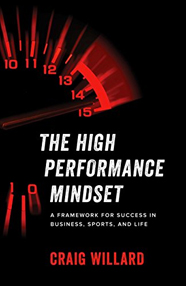
[0:26:42] Charlie Hoehn: Yeah, so this conversation has gone a little bit different than I thought it would just base on looking at your book, The High Performance Mindset, which the cover is really cool and it looks like it’s got an odometer, right?
[0:26:56] Craig Willard: Sure.
[0:26:57] Charlie Hoehn: Yeah, speedometer showing the number of RPM’s on going all the way and redlining. So it looks like this book that’s just going to take you to the next level but here we are talking about how to overcome negative thoughts, anxiety and it doesn’t surprise me but it does at the same time. So would you say that this is the top idea, the top takeaway from your book or is there exploration into other things?
[0:27:26] Craig Willard: There’s exploration in other things and the way the book has been created is it’s A, focus and introduce all the concepts but I want to teach you that the mind never stops evolving. It’s a constant evolution and it’s not a fixed mindset versus growth mindset. I don’t really fall into that category. I feel that fall into mindset and everyone has a growth mindset and you just need to have the tools to continue to thrive in that world and so I teach about the mindset being constantly evolving. Whether you want to be or not, it’s your choice, you can either control it and push it the way you want to or you could be a bystander or in the passenger seat and then we go in that from there, we go into understanding that negative beliefs are 80% of our lives. 80% and so I spent quite a bit of time not only on the anxieties, really it is more about depression and anxiety from a time perspective and they only go into there and we go into confidence and self-doubts and even I am doing some research for executives and even CEO’s of really big organizations have bounds of self-doubt. They become almost shutdown to risks so they should take this calculated risk that’s going to have an extremely large upside but because they have a bit of self-doubt and they are confidence is flailing and then they get a bit of anxiety because they don’t know what is going to happen, they don’t perform. So when they don’t perform they miss out on the big opportunity one way or the other but it shuts people down and so then we go into not only the beliefs but understanding how we increase our confidence. How we develop better relationships and again, it’s a constant building up. Every chapter builds upon the next one until we get to the end where we talk about how to set goals and how to live our purpose in life because that too is part of having this high performance mindset. I just envision being in this high performance car and going I just want to hit the gas pedal and go and so that’s really the core of the principles is about our negative thinking because that’s what really holds the majority of the people back.
[0:29:41] Charlie Hoehn: Yeah, great. Who is the one person you most want to read your book? You can only pick one.
[0:29:49] Craig Willard: That’s a really hard question.
[0:29:51] Charlie Hoehn: You come on Author Hour, I hit you with the heat.
[0:29:55] Craig Willard: You did and so I am going to back track a little bit because this question came up when I came to Book in a Box I talked to Tucker and he said, “Who do you want this book to be for?” and I said, “Everyone?” and he goes, “That’s what everyone says” so as I talked more I said but this book is about mindsets and every human has a mindset and so it will help anyone that reads it because they have one. It’s everyone.
[0:30:20] Charlie Hoehn: Oh yeah, I get it.
[0:30:22] Craig Willard: So if we back track if I gave it to one person –
[0:30:26] Charlie Hoehn: Right, let’s say there is one copy of your book in existence. Amazon has shut down there’s no more fun electronic distribution, Kindles or anything, all the other ones got tossed in the fire. We live in a censored country where books aren’t allowed. You only have one copy left and you have to get it to this person.
[0:30:49] Craig Willard: Donald Trump.
[0:30:51] Charlie Hoehn: That’s really what I was going for, all answers lead to Trump. Okay, perfect. All right so we won’t linger there but tell me about your reader transformation. What has been your favorite email from a reader or feedback that you have gotten from somebody who has used the principles in your book?
[0:31:10] Craig Willard: I’ve gotten many. One particular that I think was interesting, I had an athlete. This has been several years ago, this is a triathlete who was really good. We had our first session and I used two words, in the conversation I used race and fast and she kind of got a little crazy with me and she says I can’t use those words. I am not able to say those words. She was like, “It gives me anxiety” and I said, “Well wait a minute, you’re a triathlete. How do you not use the word race and fast?” And she said, “My coach works around those words” and I said, “Oh we’re done with that today. We’re going to work on this, we’re going to change our plan. We are going to work on this day because I think you need to use the race and fast in your training and so I don’t want you to get to a point where you avoid things. I want you to use them for what they are” and so we went through the process, the anxiety process that it’s an A, B, C, D, E process that I have in the book and we went through that. And I am not kidding you, 45 minutes later both of those words were fine for her. 45 minutes, she had to go through the process and she did and I have done this over and over and over again. We use this simple process and it’s a psychological theory but we use this process to improve on irrational beliefs and thoughts and when we forget about the word race, fast or whatever else then all of a sudden it’s like the clouds get lifted and they’re like, “Oh I can actually use those words. It’s not really that bad”. I need to change the way I think about the words and I need to break apart from what’s real and what’s fictitious in my mind as to what I believe about a certain words. So for her it was “I get anxiety when I hear the word race and fast” and so then I had to break down all the beliefs and what that result is like and then I had her debate those beliefs and then create a new effect to her new beliefs and then I had her create an affirmation statement from that. That she was able to read over and over again, telling you what you did when we talked about the first part of the podcast or to solidify those beliefs, those thoughts in our head because you do need to – as repetition kept you from using them you have to use repetition to start to be able to use them.
[0:33:24] Charlie Hoehn: So how did that translate into her role as a triathlete? Did it change her performance or just how she thinks before she does a race?
[0:33:35] Craig Willard: I find that many people who are anxious about one thing get continuous – seem to get anxious about a lot of things and so it helped in many other areas that she was having issues with so she learned a skill really to help her get rid of the anxieties but what it also did was it created more flexibility and freedom in the conversation as well as the training patent, the training plan to – you know I mean I want you to race, I want you to run five miles at race speed. So that is very specific and very simple. She didn’t have to have the coach figure out another word for race that get practice you know? Or fast so it opened her up to have the flexibility to not have that worry and that stress on her body, physiologically, physically but it did. It shut her down and this is across the board and I know we talked a lot about anxiety but there’s millions. There are 40, 50 million people experience anxiety and it’s –
[0:34:36] Charlie Hoehn: And you know for people who may have laughed at the fact that a triathlete is anxious about the word race and what was the other one, fast?
[0:34:47] Craig Willard: Fast, yeah.
[0:34:48] Charlie Hoehn: Yeah, talk to anybody about their money. See what happens to their mood like oh the irony of a racer who can say race and fast, that’s just performance pressure and it applies to whatever category that you are in as well if you feel that you’re not maybe living where you should be. So normally I would laugh at something like that not to poke fun at her but the irony but I totally get it.
[0:35:18] Craig Willard: Yeah and even some of the most random things and that’s where, anyone that’s a coach that listen to this recognizes the power of being where they are right? So I hear that and I don’t laugh about that because that’s her truth. It’s what she experience so I have to own that as mine temporarily to get with her to help her through seeing the clouds lifted then I can back out and say okay. So now we are all now at a new place and you know anxiety is about whether you can even finish it of a 5K or start a new career. People get real anxious because they feel like everything has to be aligned perfectly and I have to have the right ingredients on my resume and I have to have the highest GPA and they make all of these assumptions as to the expectations and all they do is when something doesn’t go well they get anxious and worried and whatever else.
[0:36:14] Charlie Hoehn: Yeah, so what is the rest of this year look like for you Craig? I mean what are you hoping to accomplish with the book?
[0:36:22] Craig Willard: So the book, I want the book to do nothing more than help anyone that reads it and from that, you know I would love for it to continue to help my coaching thrive and reach more people and that was really the core of why I wrote it. I said I can’t coach everyone but I think I have something that really, it’s made a big difference with people and I just want to over that out and then if I can help you further with that then I’m here for that. Then doing coach, I still do quite a bit of coaching. I have a couple of contracts with leadership for doing leadership trainings, seminars and things of that nature, speaking engagements. I want to continue to move that needle and push more of this mindset process that I’ve built into sales training. Maybe you work for a realtor company and they bring in a sales guy but if you don’t have confidence, if you have doubts, people that you walk in front of to attempt to sell a house they’re going to feel that. They’re going to know that and so let’s build something for you for that company that can teach your realtors how to have a confidence. Even if it’s in your stance but how to think more confidently and how to believe in the things that you say and then how to sell it based upon the fact that you know it well enough and that you are confident, you feel strong.
[0:37:51] Charlie Hoehn: Absolutely, what is a parting piece of advice that you have for aspiring authors?
[0:37:59] Craig Willard: Ebbs and flows. This is the one thing that I have learned so much about and I am a go-go-go-go kind of guy and it’s like you go 200 mile an house and then you’re neutral and you wait patiently and especially if you are doing a lot of the work yourself then there’s times when you have to put that over on editor or sort of copyright or whatever it maybe and be impatient to be patient because the process takes time and if you think it is always going to be as fast as the fastest moment that there’s going to be some really slow days for you. That’s the one thing that I learned about the processes just allow it. Be patient and allow the process to give you the best outcome because you didn’t push it along and force things to go.
[0:37:59] Charlie Hoehn: Perfect. This has been a great interview. Where can our listeners connect with you and follow you?
[0:38:58] Craig Willard: They can find me, I have a website at craigwillard.com. I am on Facebook and Instagram, they can just search for Craig Willard Coaching and then also I have a newly started podcast which is the Craig Willard Show on iTunes.
[0:39:11] Charlie Hoehn: Sweet, thank you so much Craig.
[0:39:13] Craig Willard: No, thank you very much.
[0:39:16] Charlie Hoehn: Many thanks for Craig Willard for being on the show. You can buy his book, The High Performance Mindset on amazon.com. Thanks again for listening to Author Hour, enlightening conversations about book with the authors who wrote them. We’ll see you next time.
Want to Write Your Own Book?
Scribe has helped over 2,000 authors turn their expertise into published books.
Schedule a Free Consult