Bill Coletti: Critical Moments
Read the full transcriptBill Coletti
Bill Coletti is a crisis communications and reputation management expert and the CEO of Kith, a firm that advises established corporations facing reputational disruption. He has more than twenty-five years of experience managing high-stakes crises, issues management, and media relations for Fortune 500 companies and global political campaigns. Earlier in his career he co-led the Global Risk Management and Crisis Communications Practice at Hill and Knowlton Strategies. He is the author of Critical Moments: The New Mindset of Reputation Management.
📚 Books by Bill Coletti
Transcript
[0:00:16] Charlie Hoehn: You’re listening to Author Hour, enlightening conversations about books with the authors who wrote them. I’m Charlie Hoehn. Today’s episode is with Bill Coletti, author of Critical Moments. What happens when your company’s reputation is severely damaged? Who do you call when your business is making negative headlines and the public no longer trusts you? The answer is Bill Coletti. Bill is a Crisis Communications and Reputation Management expert. With more than 25 years of experience, working in high stakes crisis and media relations challenges. He’s provided senior counsel in Reputation Management to Fortune 500 clients like AT&T, Target, American Express, American Airlines, Home Depot, Xerox and a whole bunch of others. In this episode, we talk about how companies can build an amazing reputation like Starbucks and how they can avoid destroying their reputation like Uber. And now, here is our conversation with Bill Coletti. Bill, tell me the story about how you really got into this as a business? What led you down the path that laid the foundation that ultimately led to this book?
[0:01:49] Bill Coletti: It started on the trade back table on an airplane flying from New York I think back to Dallas, on my way ultimately to Austin. We were with a client, and I try to go out of my way not to talk a lot about specific clients and really, that was one of the challenges that we had in the book. So flying back from an opportunity or crisis engagement with a client and we were kind of past it. We were kind of in the debrief phase of our engagement working with them post the crisis. We had this conversation about “Let’s never do that again, what do we do to make sure that that never happens to us again?” I began a conversation about this point that I had made numerous times about crisis to reputation management. Companies need to begin to think about reputation management. Was using vocabulary and talking about and with phrases that I love of things like, “A company owns its brand but the public owns its reputation.” Talking about and explaining that. This particular CEO that I was sitting with had been with me through the crisis and we’d been through – in the fox hole together a couple of weeks prior to the challenge that they’re in that challenge. There was this fundamental disconnect, there was this disconnect about my vocabulary around reputation and his understanding around marketing. As I would talk about the reputation and the public, he was thinking about marketing, land and customers. There was this huge disconnect, we were not connected. So flying home that evening is, I was like, “You know, what am I getting wrong? Why am I disconnected on this? Why is this concept that I’m trying to explain, of reputation management, lost?” Instead of critiquing myself and saying that everything I was saying was wrong, I knew what I was saying was right but I knew that I was having a vocabulary problem. We were not aligned on the topic. I said, “When people hear me talking about reputation, and I know that they’re coming from a classically trained discipline of marketing, what do they hear?” That sent me on this journey about the four P’s. And Charlie I’m sure you’re familiar with the four P’s of Price, Product, Place and Promotion. That was started late 60s or early 60’s is when that was sort of originally coined about Price, Product Placement and Promotion. Still a pretty durable concept, all these years later, even with the internet. What that led me to is that if that’s where people’s understanding is, that’s where I need to start. Then transition when we talk about reputation. How can I articulate a similar model and that’s where I came up with the four A’s of reputation management. The four A’s was pivoting off of that understanding of why did people get marketing? The four P’s got created, because it was previously all about sales, they got it by understanding the paradigm that the professor first said it, articulated it. I created the four A’s as a means to try to better create understanding. It’s often been said that reputation is one of the most important assets of a corporation, sometimes it’s measured as goodwill. The reputation is critically important but it’s really one of the most difficult to manage. I learned that people used to say that about marketing. That it was one of the most difficult things to manage. Now, marketing is a really highly sophisticated science. So what I’m trying to do is go on that same journey that the concept of marketing went on, with the concept of reputation by articulating those four A’s.
[0:05:26] Charlie Hoehn: Got it. Before we talk about what the four A’s are and how this applies to us, Because I’m a marketer, I have a marketing background, it’s very understandable to me. I’m listening to this and I’m thinking, “I can’t quite make the connection, I don’t really know?” I’m not sure if I’m like totally understanding the difference between – the client that you were referring to, was he thinking from “Okay, this is a branding decision, we have to influence how to brand the looks. This is just how we communicate with the public.” And you were saying something totally different?
[0:06:08] Bill Coletti: It’s not that we were saying – It’s a terrific question and a great thing to kind of dig in on for a little bit. It’s not that there was a fundamental misunderstanding because you know, in the marketing mix, people understands the distinction between marketing communications or marketing exercises. Which are trying to drive customer behavior by primarily purchase behaviors. Versus communications which is really more about talking to external stake holders. To try to influence ultimately purchasing decisions. People get that. They get that distinction of one is more straight line, the marketing. One is a little bit more of a bank shot which is communications or public relations. What we were talking about is this newer concept of your company has a reputation that is very closely related but different than its brand. The brand is all about the customer experience, the user experience, people and their affinity for the product and their affinity for what the spirit of that product or that service. You know, “What that means to me.” Lots of iconic brands. I feel very strongly about the Apple brand and with Apple products mean to me and how I use Apple products. I believe that there is another side of that coin which is this notion of reputation.
[0:07:31] Charlie Hoehn: So with the Apple example, a few years ago, I might – if I had never used an Apple product, I would have said, “Oh Apple and Fox Con, what a scandal?” Apple’s abusing their factory workers, that’s the public’s reputation based on what is being said in the press.
[0:07:47] Bill Coletti: Absolutely. That phrase that I love is that a company owns its brand and you can manage that brand, and as a marketer, that’s what you do. If you’re a consumer package good company or any number of other type of marketing disciplines. Marketing managers and category managers, each one of those four P’s have got a vice president if you will. Somebody responsible for all of those aspects. The company owns its brand and can manage it, influence it, manipulate it, improve it. The public just like you said. Even though you didn’t have a relationship with the brand of Apple, you had heard “Man, they’re taking advantage of people in China? I don’t like that.” That’s not a company I want to do business with even though you didn’t have, even though in this hypothetical, you didn’t have a direct relationship with the product, that’s the distinction. Even better example, Apple Fox Con is really a terrific one but BP is a perfect example. I don’t know where you bought gas, you know, in the early 2000’s but it might have been BP. BP’s marketers worked really hard to talk about beyond petroleum and to try and have you make a choice to go to BP versus Shell, versus you know, Texaco. BP worked really hard on that. The context of that is that with one massive oil leak in the Gulf of Mexico, I have a much stronger opinion now as a non-customer of BP because of what happened in the Gulf of Mexico than anything that the company could have done to try to create a relationship with them and the brand. That’s the reputation. I viewed that crisis is typically the doorway that most companies start thinking about issues around reputation.
[0:09:27] Charlie Hoehn: Yeah, to build off of what you said about BP. I mean, it makes it so clear that reputation management really matters because if nuclear energy had reputation management, we would probably be in a much better place because nuclear energy is like proven to be this wonderful form of energy that’s actually really safe and really powerful. But the reputation is horrific, it’s the worst. I can see how this applies across the board to companies, individuals, politicians. Yeah, totally.
[0:10:01] Bill Coletti: It does, on that, let me just interrupt on that point is the Nuclear Energy Institute was a client of mine and we worked really hard with them.
[0:10:10] Charlie Hoehn: No way.
[0:10:10] Bill Coletti: Swimming in that stream, post Fukushima. They brought us post Fukushima which everyone remember as the nuclear power plant that was a victim of a tidal wave, or a tsunami in Japan. The impact that that had on the nuclear fleet here in the United States was significant but we were swimming in that current that you just described, which had nothing to do with Fukushima. The reputation was already pretty bad pre-Fukushima and it has really not bounced back even though it is economical, it is environmental and it is a smart energy choice. That stream, that current was a very difficult to mess. Not about the brand attributes of nuclear energy, that is about the reputation of nuclear.
[0:10:55] Charlie Hoehn: Yeah, wow, that’s amazing. What a crazy coincidence. Let’s talk about the four A’s, what are they?
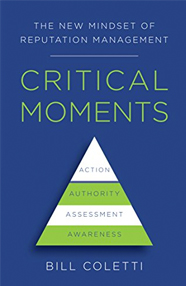
[0:11:02] Bill Coletti: Yeah. We’re real excited about this, we think it’s sort of really gives you an articulation. The four A’s that we talk about them is the first one is Awareness. Being aware of your marketplace, aware of your competitors, being aware of kind of the issues, the impact. Second is Assessment. Assessment both internally and externally. Assessment is actually different than Awareness but it is actually asking questions in a research context. Asking questions so you fundamentally understand where people stand, what they expect of you, what are their opinions of you on a finite set of what I call “levers” in the book, a finite set of levers that’s there. Third on the pyramid is this process of Authority. Authority is all about enterprise being bought in based on what they’ve learned from awareness and assessment and it’s the enterprise at the highest level being bought in to going on a reputation and journey. That’s the third step, there’s a hard blue line and then at the top is Action. Action is actually where you begin to deploy reputational programs, where we actually began to deploy the activities of public relations and other disciplines of communications that’s there. I make a big distinction in the book about that necessity between the third and the fourth A. Between Authority and Action. Which is that unless you become aware and then you do assessment and then you get authority – it is foolish to begin to go on the journey of reputational action unless you’ve done all of those processes.
[0:12:45] Charlie Hoehn: It’s funny, right? Because my impulse is to talk – let’s talk about action. Let’s get into the tactics, right? You know, I’m aware, I think I’ve assessed, I definitely buy in. Let’s take action. How granular do you have to really get with the awareness of the issues ? What kind of questions do I need to ask before I have an understanding?
[0:13:12] Bill Coletti: Yeah, it’s a terrific question. I kind of draw this parallel on the four A’s in this journey of reputation excellence is that it’s much like trying to bench press your body weight or you know, running a marathon. There’s lots of different ways that you can do that and lots of different lengths of time that you can do that. For me, I think that a minimum, Awareness sort of focuses on three things. It’s situational intelligence, it’s the, you need to have really good social listening tools that are not talking about customer experience only but are talking about a little bit more intangible topics that people are talking about your category and about your companies. That’s situational intelligence.
[0:13:59] Charlie Hoehn: how do we get that?
[0:14:00] Bill Coletti: Yeah, there’s a number of – the book talks about a number of really cool tools that are out there. So a lot of people talk about, a lot of a really good social listening tools that are out there, the one I particularly like is called Dunami, it’s a great social listening tool, really primarily driven off of Twitter. Things like Trend Kite and Session and Melt Water. Those are really built for brands. There’s very few tools out there that are really built around this notion of reputation that are looking at influencers and looking at sort of what those influencers are saying. It’s a really aspect of social listening that’s done in a much more comprehensive way. Not just by keyword but it’s a whole series of heuristics and shortcuts of people talking about this – not necessarily “Starbucks is the bomb” or “Starbucks is great” – but it’s talking about other aspects around your companies, which is a little bit more complex level of social listening. A couple of companies that I really liked.
[0:14:51] Charlie Hoehn: Yeah, Dunami. Okay, I’m looking at their site now. Does this apply to small businesses or is this Fortune 1,000 companies?
[0:15:04] Bill Coletti: It’s pretty big enterprises. Primarily, the whole concept of reputational accents and the concept that we’re talking about, are really built for sophisticated companies that are really large enterprises for the most part. Now, I think you could make an argument that a regional bank in central Texas is pretty sensitive and needs to be pretty sensitive about their reputation. But I put them in a different category than I do a regional lumber yard, small business. But primarily what we’re talking about in the book are kind of enterprise level thinking. Middle market and above.
[0:15:40] Charlie Hoehn: Got it. Okay, we’ve used the tools, we have some awareness, we’ve assessed okay, our reputation – What do you say to an enterprise where the reputation’s pretty good, it’s okay, it could be better. Do they need to be proactive or is this a “wait until the glass breaks” situation?
[0:16:01] Bill Coletti: Yeah, terrific question. I think it’s two parts. I think that in the assessment, process as you do that and that’s exercise of staple to research. Both internally, your employees and of course stake holder and those external which is others. I think there are seven levers, there are seven key aspects. They are transparency, responsible citizenship, leadership, privilege, employee endorsement, products and services, financial strength and innovation. I think that no company, even the hypothetical one that you just talked about was pretty good. I don’t think anyone scores off the charts on all seven. There is areas for improvement and what we’re talking about and what the model allows you to do, is it allows you to pull those levers in index on different things. Because responsible citizenship is one that most people say , “We’ve got a robust CSRR program, we’ve got a robust sustainability platform and that’s going to take care of all of our reputation.” They’re not very transparent and they’re not really good and their employees don’t think very highly of that. That creates levers that you can pull. I think the point of all of this is that even if you generally regard yourself as you know, reputationally strong, there are ways that you can improve it by dimensionalizing and breaking down your reputation to a handful of different categories. That’s what we’re trying to do with that in that assessment.
[0:17:33] Charlie Hoehn: What companies have you seen that have the most positive or the strongest reputation?
[0:17:41] Bill Coletti: Yeah, you know, there’s a couple of different groups out there. Reputation Institute and Heiress Interactive. Heiress has what’s called a reputation quotient. Reputation institute has rankings. Forbes and Fortune have different ranking methodologies. The names that you would expect that are there are Starbucks, Apple, Google, BMW, Mercedes to a certain extent, Kellogg, Lego, great companies like that are all generally regarded as having really strong reputation. Very few industrial companies are there. Just because of the inherent risk that those industrial companies have, very few of them are highly ranked. A company that I benchmark and look at is Starbucks. I think Starbucks on the things that they do with and for their employees, the things that they do about their corporate transparency, the things they do about their sustainability and their citizenship levels. Along with having innovative products, really sort of is a nice capture. They take all of the seven levers that have articulated and they have discreet programs and action around each one of those levers that reinforce what they understand about themselves along the way. I hold Starbucks out there. I think Google or Alphabet, I guess you know, is there as well, just because they’ve got this mantra to do no harm. Those are a couple of examples of companies that I think are getting there. We’ve seen Apple’s luster kind of weigh here recently. Apple has kind of lost in some of those public rankings, has lost a little bit of their luster.
[0:20:07] Charlie Hoehn: Yeah, I would guess and I’m curious what you think. I would guess that it’s due to the rate of innovation plummeting now that you know, like Steve Jobs has gone, they went through such a run of coming out with amazing products that were innovative and new and fresh and they’ve kind of plateaued in terms of – from the product standpoint, their products are amazing but they’re not getting 10x or 3x better each time. They’re getting incrementally better.
[0:20:40] Bill Coletti: Yeah, I think that’s it. I think and that’s one of – that notion of innovation and ideas or one of the seven levers that we talk about. But I also think not only that – they’ve had about the new products that you were talking about, the 10x, 3x you know, cool, new iBlank that we’ve never even thought of. Just even the current stuff. The current products and services they have in place haven’t been that cool. Everybody questions the decisions that they made about requiring me to buy a new app, a new plugin for my headphones or something like that. Is that just also added to it. I think and that’s where that dimensionalization of these different levers – I think that’s where all of that really comes in, is that it’s not just that one thing. If they just fixed that I think there’s some hangover on that. I think employee endorsement – there has been some grumblings about certain Apple employees. But yeah, I think that what you learned when you dimensionalized like you just done, when you dimensionalized reputation into these subsets because you get a real clear understanding of, “What do we do about it?” That’s what they can do about it, is to improve innovation or improve the product experience that they already had in place. And that’s the distinction between brand and reputation comes in because that is not “Let’s make the iPhone smaller. That’s to make the iPhone bigger.” That’s what a brand is, that’s what we are talking about. What you are talking about and what I’m talking about are something different than making the iPhone bigger or smaller.
[0:22:04] Charlie Hoehn: Yeah, so let’s get off the Apple example because they’re in a good position, let’s talk about something more interesting. I will give you a choice, Uber or Trump, who do you want to tackle?
[0:22:17] Bill Coletti: Well, who do I want to tackle? Literally or figuratively?
[0:22:22] Charlie Hoehn: Both but from a reputation standpoint, who would you? Like let’s pretend you’re sitting across the table from one of them and walk us through a quick version of your process.
[0:22:35] Bill Coletti: Yeah, so having come from this personal campaign perspective, I think that the complexities of corporate reputation actually are much more difficult to address than the complexities of individual reputation of themselves.
[0:22:52] Charlie Hoehn: Oh I was talking about the administration, the Trump administration.
[0:22:56] Bill Coletti: I was thinking that but I think the Trump administration is led by when you asked that question, is lead by the insult.
[0:23:00] Charlie Hoehn: Yeah, he’s the product.
[0:23:01] Bill Coletti: He is the product. So I think Uber is quite frankly a little bit of a better example.
[0:23:07] Charlie Hoehn: Yeah, let’s do it. So give the audience some perspective on what they are going through right now. Just in case people, some people just use Uber and they’re like, “It’s great, it’s awesome.” They have no idea what’s going on behind the scenes.
[0:23:19] Bill Coletti: Yeah, so Uber has kind of a multi-front challenge. I think their primary concern that they have right now is they are earlier this year, you had a female engineer write a blog post about a really horrific culture that they had in the organization. So that’s one front that they are dealing with. I think they had a second front related to how they treat their drivers. The subcontractor aspect of their drivers and the way they get compensated or not compensated, the penalties that they have and things like that. Third, at a little bit more under the surface level, we certainly experienced it here in Austin, is that their public affairs or regulatories de-farm has really pissed off quite frankly a number of opinion leaders, politicians and elected officials in the way they have done things – certainly here but they have also done in a number of other states. That’s there. Then fourth and probably maybe the overarching which encompasses all three of those, is the umbrella is leadership from the top. Is that their DNA has been very much go-go entrepreneur, screw you and get out of the way or I am going to run you over. There is a lot of people at an early startups are like, “Yeah, exactly. That’s how we want to do it” but that only works for so long. That attitude if you relate it back to individuals, that attitude that we work through when you are a teenager. When you become an adult and a parent, you can’t really say, “Screw you, get out of my way”. You’ve got other people that you care about that you’re carrying along. I think for Uber it’s this notion of self-awareness. I don’t think they had really good situational intelligence. I don’t think they knew what was going on in the market place because they had blinders on about deploying new markets as fast as they could. Deploying new innovations as fast as they could. I don’t think they were ready for any of these reputational crisis that hit them. I don’t know. Having looked a little bit inside of their business, having awareness of them and doing research – they had done a lot of brand research. In “Do you like the app?” and “Is the app fast?” and “Do you like the drivers?” But I don’t think they have done any sort of sense about who they are what people’s perceptions are. So there I think for them, the risk is jumping up to the top of Action of, “We are going to hire a diversity officer. We are going to hire a female CEO. We are going to do a round table on this.” Those may not be the problems and to your point, what you said earlier about Uber is, “I just love Uber. Uber gets me to where I want to go to get me there efficiently. I don’t really care how they treat the employees.” That’s not how everybody feels and so you’ve got to understand that and that’s this evolution from go-go startup where you can kind of say “screw you” to emerging adult if not a parent. It’s the process is a little bit different. So I think the journey for Uber is to fight the instincts to do what I call, across the blue line. Fight that instinct of just do programs. I know you had struggled with that because you mentioned it a minute ago but take a second to ask some questions about Awareness and Assessment authority. Are we really doing this board of directors because it’s right or we’re doing this in a reaction to what was wrong? And those were really important things that will shape the actions and more importantly what shapes the public’s opinion about those actions that they are a little bit more thoughtful and not superficial.
[0:26:37] Charlie Hoehn: Yeah, you know it’s funny Bill. I wanted to start to move towards about talking about the Action stuff that companies can do at the end of this. But you just made it totally clear. It doesn’t really make sense at all to be doing reactive actions and to even be discussing what can be done, until these preliminary stages, or these foundational stages, are fully addressed and you have complete awareness of the prompt. Like you said, trying to hire female leadership in response to the blog post does not fix a toxic culture and it doesn’t change what happened with the reputational damage that’s been done. In fact, that’s like putting a coat of paint onto a house that is falling apart.
[0:27:31] Bill Coletti: 100%, you made the point and that’s exactly in the model and the imagery that we actually have in the book. Is that there’s this hard blue line and that’s what that signifies – that’s intentional but that’s there to signify you know, “Do not pass ‘GO’ unless you have done the hard work.” I am careful about this concept but I really personally believe it because maybe it doesn’t mix with corporate context but it is much like personal growth. If I decided tomorrow to go run a marathon and did 20 miles. Or I decided to go bench press my body weight, I would hurt myself. I would do damage to myself if I went and decided to go do that without assessing or being aware of who I am, that I am a little bit overweight and that’s probably not the best thing to do. Maybe I’d actually lose some weight because I would be going to run this assessment. What’s the right training program to do? And then I am giving myself the authority. I am just going to give myself six months then I can start the program. So there is a lot of parallels to personal growth and development as opposed to – and with corporations. You read a lot about this personal growth literature as well as corporate literature. It just says, “Go do it get it done” whatever it takes just jump in and get started. I love that, it makes perfect sense but some concepts and problems and challenges are more sophisticated and just jump in and start making your bed or wake up every day at 5 AM and your life will be better. Identifying the Medium and I am sure you have read that article. Just get up at 5 AM and do some sit ups and everything in your life will be better. It doesn’t really work that way.
[0:28:59] Charlie Hoehn: No and that’s the challenge right? I know how exciting and fun it can be to take action and to feel like you’re making progress but for something like this, you’re right. It’s far too complicated. There’s far too many moving parts and that there’s blindness to our real problems. In fact I’d imagine that you’ve seen with the organizations and individuals that you’ve worked with, that there’s a cognitive bias against seeing something that hurts their reputation, right? Is that they are sort of in their own world because that has brought them to that point, that’s what’s made them successful in bringing these issues to light the truth of what the public’s reputation or what the public thinks of their reputation. They might say, “No way. No I am not going to be aware of these issues” or definitely not buy into doing something. Am I right in saying that or no?
[0:30:08] Bill Coletti: Yeah you are and it’s unfortunate, yes. I think there are a lot of companies that recognize that reputation really matters and that reputational excellence has been something they know they need to do. My argument is that and I empathize with them and I empathize with that CEO when I flew home from New York, I empathize with him because we didn’t connect. We didn’t get what each other was saying, that’s why I wanted to create a model. That lets me break out a slide that says, “Well here. Here is what I am talking about. Here’s what that looks like” and so that the leader can take this model and walk away and say, “Okay here are some steps I need to do. I don’t maybe need to do them all this exact same way but I’ve got to get aware” then do some assessment, then do some authority.” It doesn’t have to be perfect but it all will help you get better on that journey. So yeah, there is a bias. We read it everywhere in the business literature. There is a bias for action and I get it that we are all about lean, everybody is talking about agile. I get all of that but for major enterprises that have been around, that are fearful of being disrupted – which is really the target market that I talk to. A big company and the fear of disruption is that these are complex topics. Maybe a startup and Uber is a perfect example of that. Uber was the disruptor, they are now in fear of disruption and they are living it and we see that. Clay Christensen talks about that pivot point all the time. So yes. There is that bias reaction, a lot of people are like, “Hey we are just going to keep doing good things and everything will take care of itself.” It doesn’t really work that way. The public is forgiving but the public is also pretty intolerant of companies that don’t matter and don’t mean what they say.
[0:31:55] Charlie Hoehn: How long does it take to turn a reputation around, what’s the span the range that you see?
[0:32:04] Bill Coletti: So I tried really hard in the book to unpack that. I don’t think I do a very good job because it is really complex in order to do. So there’s the input side and the output side to the question. So Warren Buffet has this quote and it’s in the book, Warren Buffet talks about, “It takes 20 years to build your reputation and five seconds to lose it.” So that math basically is pretty straight forward. It’s on Exon or excuse me mobile or excuse me BP. So I had it built and worked on the reputation for a long time, one catastrophic incident collapsed them very quickly. There is some research out there that is really interesting. It’s kind of this four to one model and it has been talking about in an HR context. Is every criticism that I give you has to be backed up by four appraises. So there is this four to one matrix. So for people to take onboard positive phrase is that it takes four positive to every one negative in HR context manager critiquing your staff. There’s been no studies done about what does it take empirically overtime how much good behavior you need to do in order to build a reservoir of good will. That’s one of the great challenges with investing and reputation, is that you can measure that stuff in marketing. You know I think that a year of committed intentional repetitive over the long term, constructs is a really good way to go about doing this. I think people will have – the American public is incredibly forgiving. They also have a pretty short attention span. So I think a year from now if Uber does some things that are truly meaningful and does some things that are smart. Meaning they’re aware or they’re assessing and they have the true authority of the organization, I think they can kind of bounce back from this and really can begin to emerge. I think BP is a different example. They have bounced back but they really just retrenched. I mean they are a smaller company than they were years ago and they’re just really focusing on sort of upstream production instead of the downstream retail which is really where it impacted. So I think a year is a good measure of time. I wish I could be more precise on that. I looked and tried to come up with that really hard for the book but it is difficult and it is just like you’re readiness for a marathon versus my readiness for a marathon. We will be able to get there in six months and it’s going to take me a year and a half.
[0:34:27] Charlie Hoehn: Yeah because especially with companies that have so many thing pulling at them, shareholders, yeah there is so many things to be concerned about that reputation may be fourth on the list and because of that, it never gets repaired fully.
[0:34:42] Bill Coletti: Totally lots of complexes.
[0:34:44] Charlie Hoehn: Yeah. So Bill tell me about your client transformations? I know the book is coming out in September, what have been some of the clients that worked with what kind of results have you gotten for them?
[0:34:57] Bill Coletti: Yeah, so it’s really terrific. So we worked with car dealer, a really terrific client and talk about some of the successes that we’ve had – that they, by going through this process with us. It started with Awareness, it started with crisis readiness. We wanted to make sure that they were aware. We did some internal research, we got buy in from the authority is we built out what would became the car deal leadership, car deal beef leadership series. And we are a B2B company, so not much consumer exposure. So they are much more business that sells to businesses and so what we did for them is that we through this assessment process learned that there was a handful of issues that their customers expected them to be an industry leaders on. So we did a series of webinars. We did a series of programs and Action what we call Leadership Marketing. All around those categories around these webinars on animal welfare, food safety, antibiotic use. And really was very transparent, very open and a really great leadership program that really made a difference with the relationships and the connectivity for a commodities business that they had with some of their customers. I’ve often believed that reputation, particularly in a commodities business, reputation in a lot of other businesses is the ultimate tie breaker. So if you and I are selling a product or a service to a company, price is the same. Or terms of service are the same or delivery promise is the same. The company with the stronger reputation that answered my intangible needs will nine out of 10 times win in those battles. So I really believe that reputation is a great tie breaker and that’s why they need to do it and car deal has done that. Gone on this journey of Awareness, Assessment, Authority and into the leadership marketing program that we have created for their leadership series and a great success. The feedback has been really very, very positive as we walk our clients through this model. There is the pushback that you mentioned. There’s this, “Oh my gosh I can’t wait that long, why can we just do a program?” And we as a consultancy really stand firm that there is a process and if you want someone to go do an action, go higher the PR firm down the street. I’m sure they’ll create a very biz bang program for you. But I’m not sure that is fundamentally going to get you ready for the marathon. It’s not going to be transformative and that’s taken a lot of courage from me as a leader. To articulate that non-client centric position. I do firmly believe that it is an ultimately is in the best interest of the clients that had bought onto this and a gift. We are really fortunate to have a great set of client base that really gets it. We’ve done some amazing things.
[0:37:38] Charlie Hoehn: Yeah, I’m glad you put your foot down and uphold those standards because it means you get better results for your clients that way and it would hurt your reputation to accommodate what they want to do.
[0:37:54] Bill Coletti: Yeah and it’s not what we do. It’s kind of malpractice and having been a consultant in a big PR firm, who love to sell programs. It’s not in anybody’s best interest. It’s like any number of get quick elixirs that show up. Or get rich quick or get skinny quick elixirs that show up on the internet and nobody thinks they are a really particularly a good idea and they’re not going to buy them.
[0:38:18] Charlie Hoehn: So what can we do as individuals? We just spoke about the enterprise and what companies do, what can we as individuals do to strengthen our reputation?
[0:38:28] Bill Coletti: Yeah, I think it is the same pyramid, it’s the same paradigm. I think being aware. Self-awareness is a really important part of your personal reputation and excellence. I think assessment asking, asking people “Where do we stand, give me some feedback, help coach me a little bit as an individual.” And then giving yourself the authority to say, “I am okay with who I am. These are some blind spots” because we all have them. “I need to improve” and then taking the steps to take that action. So I think there is a lot of parallels to that. It’s not core to our business, it’s not what we do, it’s for me as a person. Something I really encourage people to do on their own as for my friends and colleagues. I think what I believe is that if people take a journey like this individually, it will make their job as communicators and marketers and leaders of organizations to transfer those skills to the enterprise that much easier. And I think we saw that with lean and agile and we have seen that with Six Sigma and all these major management trends is that people applied it to themselves and they said, “Wow, this made me more efficient, let me scale this to my company.” I am hoping that the four A’s becomes the same. So that’s how I would do it as an individual and that’s some coaching and commentary that I have given with some friends about this as well.
[0:39:44] Charlie Hoehn: How can our listeners connect with and follow you?
[0:39:48] Bill Coletti: Terrific. So on Twitter @bcoletti, Gift.CEO, we’ve got tons of content on our website. We are doing a webinar once a month and we do a blog post on an unrelated topic also once a month. LinkedIn is the platform that I spend most of my time on and it’s Bill Coletti in Austin. I think I am the only one, I am pretty sure I’m the only one Bill Coletti in Austin on LinkedIn. Those are the three best places to do it. Then very old fashioned and I pick up the phone and call. I actually enjoy and like talking to people so that’s a fourth and very, very old school way that people can contact me.
[0:40:28] Charlie Hoehn: I love it, Bill this was great. Thank you so much.
[0:40:30] Bill Coletti: Thank you Charlie, it was terrific talking to you and I appreciate your help and I appreciate this conversion.
[0:40:38] Charlie Hoehn: Many thanks to Bill Coletti for being on the show. You can buy his book, Critical Moments, on amazon.com. Thanks again for listening to Author Hour, enlightening conversations about books with the authors who wrote them. We’ll see you next time.
Want to Write Your Own Book?
Scribe has helped over 2,000 authors turn their expertise into published books.
Schedule a Free Consult