Daphne Scott: Episode 396
Read the full transcript
Daphne Scott
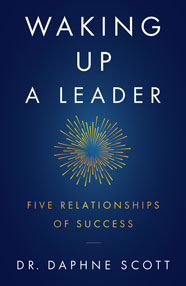
Dr. Daphne Scott is a leadership speaker, executive coach, and the founder of DS Leadership Life, as well as the chief culture officer for Confluent Health. She holds a Master's of Applied Positive Psychology and is a certified mindfulness meditation teacher, and her background in improv comedy brings a distinctive sense of humor to her work. In her book Waking up a Leader: Five Relationships of Success, she focuses on the inner life of the leader and the five relationships every leader navigates each day, with themselves, time, money, others, and the unknown. She also hosts The Super Fantastic Leadership Show podcast.
📚 Books by Daphne Scott
Transcript
[0:00:28] NVN: I’m here today with Dr. Daphne Scott who talks about her new book, Waking Up a Leader: Five Relationships of Success. There are a ton of books out there about leadership and mindfulness and productivity. As you’ll hear in this conversation though, even with all of that information floating around, Dr. Scott has managed to interweave all of these concepts together in a really compelling way that feels very fresh. Best of all, Dr. Scott talks about all of this simply and in a way that really resonates. As you’ll hear in this interview, I spent a lot of our conversation saying, “Yes! That!” Not only that, but she’s funny as you would expect from someone who is not only a business leader but also one with an improv training. You won’t want to miss out on this episode of Author Hour.
[0:01:14] Daphne Scott: I mean, my professional life originally was as a physical therapist but I was always interested oddly enough in humor and comedy and took improvisation classes which by the way, I would recommend to anyone who just wants to be a better – leaders talk about being better listeners. I mean, there’s nothing like an improv class to support you in becoming a better listener. There’s a lot to unpack there but I did that my 30s, when I was 30 actually, and started on that path and just started doing some presenting and then got very interested as I was going through my – I mean, the truth is, I was a horrible manager. This is like, I’m going to turn this into a big reveal on this show. I just struggled in leading and managing people. I got my first leadership in, you know, position like many people do or you’re just really good at your initial job you are hired for and you get the promotion and you’re really excited and then you realize, “Oh my gosh. I’m like responsible for these people in some way,” you know? Like, “It’s not just me anymore.” I really, I just struggle. I was like, “Why don’t these people just do what I tell them to do?” You know? “How hard can it be?” I’m like, “Well, people don’t work that way.” Okay, so I was like, “Either I’m going to get really a lot better at this or I’m going to just hate my professional life.” I chose the first one and started really trying to understand more about what it was to lead people and understand people which led me really quite frankly into this. There were two things that happened simultaneously. One, I was very stressed out and that led me down this path of what we would call now, Nikki, mindfulness. I wasn’t called that then by the way. It was in the self-help realm, you know, personal development realm and then the same time, led me into really understanding more about the real tactical parts of leading and managing people and psychology really. It just all sort of blended together and before I knew it, I was giving talks and presentations and talking with groups and that sort of thing and here we are today.
[0:03:09] NVN: Right. This is – I mean, so much of this is fascinating.
[0:03:15] Daphne Scott: Different.
[0:03:16] NVN: It is, which is amazing and I mean, I can see how you’re pulling from all of these different various elements and combining them into this really unique point of view.
[0:03:25] Daphne Scott: Yeah.
[0:03:26] NVN: I can make a jump about how mindfulness would make you a better leader but I’ve never heard anyone specifically talk about these two things together. We talk about them separately all the time so talk to me about how mindfulness fed your ability to lead?
[0:03:44] Daphne Scott: It’s such a great question. On one level, when we talk about mindfulness, we’re talking about how we’re working with ourselves, working with our emotions, working with our reactions to things which you know, you make a better decision when you’re calm probably, than you will when you’re stressed out or running around like a lunatic, spilling your coffee, you know, trying to do five things at once, right. And like the worst thing is for me to spill my coffee obviously. There’s that way of doing things which isn’t very effective, however, can really be something that we can all relate to in our lives or trying to do five things at once. There’s that idea. This is interesting because the second part of this that I would – I learned this in my own life and then when I was working with other leaders too, it’s like, I can meditate every day, I can be very mindful about things and yet I can find that I struggle. My list doesn’t work well, you know? My calendar’s kind of a mess. I’m trying to organize myself and there are just really tactical skills that I found that leaders need to have on board that are really helpful and so I’ll give you an example. This is where the two start to come together. Most people don’t realize that organizing like looking ahead at your calendar to plan your week is actually part of my mindfulness practice.
[0:04:55] NVN: Talk to me about that.
[0:04:55] Daphne Scott: Yeah, it’s like, how can I be present to what’s coming or what’s going to be showing up in my world if I don’t know what’s coming? You’re going to find yourself in a reactionary mode a majority of the time if you’re not aware, like for example, Sunday, I haven’t looked at what’s happening on Monday, right? Or what I’ve agreed to, I guess I’d say, if it’s on my calendar, that means I’ve agreed to it, I don’t know what’s going to be on there or I don’t know what is on there then it’s going to feel like I’m reacting to things all the time and you’re like, “Oh I forgot I have a doctor’s appointment at 1:00.” Like, “Oh my gosh, I didn’t – I forgot that I had to take the kids, I got to pick the kids up at four,” you know? It’s sort of things like that and then we always feel like we’re on our heels. Whereas –
[0:05:35] NVN: Sorry, I may or may not be guilty of that, I’m sort of cringing over here. Thinking, that makes sense.
[0:05:42] Daphne Scott: Right, exactly. You know, when I talk to leaders and work with leaders, it’s – for me, it’s both. This comes from my improv world for sure. It’s the yes, and. It’s both. I want the mindfulness practices and I think that’s very important I think meditation is very important. All the mindfulness practices and ways that we cultivate things during the day are very important and it’s also really helpful to have some skills, to understand how to do things in a way that makes you more effective. It’s both. I talk about both.
[0:06:10] NVN: I’m curious about this. Five years ago, it seems to me, if you would have suggested mindfulness as an element of leadership, you would have gotten written off as the quack. Obviously.
[0:06:20] Daphne Scott: Totally.
[0:06:21] NVN: We’re beginning to shift though. I’m curious how people tend to react to that now when you bring it up. Is it a sell or does it make sense to people?
[0:06:30] Daphne Scott: You know, it still can be a little bit of a sell on some level. I think what has helped so much in the Western world – I mean, first of all, I just want to honor like the Eastern traditions and really, all the contemplative spiritual practices incorporate some level, you can call it you know, meditation or whatever you want to call it but they all have some version of that embedded in them and so, you know, I want to honor those practices in histories for – especially from the East. A lot of these practices came from the Eastern traditions. I think what’s really helped is that where the West and the East have been very collaborative friends in a sense is that the West really brought the science, you know. We really started looking at – I don’t get too science-y in my book. I know all the science, you know. Scientist, originally in my career, but when they looked at functional MRI’s and they looked at what really happens with literally, structural changes in the brain. I mean, anything new that we learn is going to change the structure of your brain. That’s just part of the deal. When they looked at what meditation practices in particular really were doing to actually change structure of the brain and then how these centers that were reacting. For example, one center of the brain would react more reliably under stress becomes less reactive, you know? They were seeing these and they don’t know all the reasons why for this but when they look at meditation, that starts to happen. These changes are happening in the brain. I think the Western science part of this has been very helpful to people. It doesn’t seem as woo-woo. You’re like, “It actually is doing something,” and the more we’ve understood about neural plasticity, the more that we’ve understood about even how physiology works. When I get stressed, your breathing is more shallow. It’s sort of common sense that says, “Well, maybe I should take a deep breath three or four times. That will calm me down but literally, what’s happening is your physiology shifting too. It isn’t just a mind thing, it’s also a body thing. I think that’s really helped. I think that’s where this is becoming less and less of a sell in many ways and for people who want to be more effective, I think that you know – I like to say, people who want it all, right? It’s not just – you don’t want just a great bottom line. You want a great bottom line and to feel good about the work you're doing and have people around you who are relatively joyful, you know, as much as possible.
[0:08:36] NVN: Totally, I mean, that’s the dream, yeah.
[0:08:39] Daphne Scott: Right, yeah. I mean, I don’t think anybody wakes up Monday morning and says, “I can’t wait to get to the office and have the worst time possible with my colleagues,” you know? I mean, no one’s saying that. At least not the people that I talk to, they’re not saying that. I think that helps. I think that’s been something that’s made this feel much less ‘woo-woo’. I like to use that word ‘woo-woo’, and people seeing it as a way of, “This is another way that I can actually probably become a little less stressed in my life. A little more calm and a little bit more effective, you know?
[0:09:07] NVN: Yeah, I mean, it makes so much sense even in terms of little things like I know I’ve definitely had the experience of looking through my inbox and forgetting to breathe for a little bit. It’s a real thing and that’s not a great place to be responding to emails from, certainly.
[0:09:25] Daphne Scott: Definitely not.
[0:09:27] NVN: In your book, Waking Up a Leader, you talk about this sort of merging of internal and external – when it comes to becoming a better leader. We’ve already touched on that but let’s get really explicit for listeners about what you mean by this?
[0:09:42] Daphne Scott: I’m going to talk about it just ever so slightly differently than I do in the book, just because I think it helps round out some of this but a little bit. What I mean is, the book is really about how we relate to everything. A lot of times, we feel like stuff is doing something to us, you know? The person who kind of gives us that response on email, right? We think like “They’re doing this, they’re making me miserable,” you know? Sort of thing. Or time is a big one, time. The first of the five relationships in the book, time is the first one, you know? We act like a 1:00 in the afternoon is doing something to us. Hours in the day, right? It’s so true, right? The first part in working with ourselves is to recognize like we’re choosing how we relate to these things. That’s the first part.
[0:10:25] NVN: I like that.
[0:10:26] Daphne Scott: It’s great. I mean, it’s super – I think it’s the root of everything, like our mind is all we have. You know, our consciousness – that’s the thing that I have, to a point, a certain level of influence over. So I can’t control you, right? You’re doing what you’re going to do and why waste a lot of time on that. Therefore you’re not doing anything to me, it’s how I relate to this. That’s the first part, it’s very empowering. It’s very, “Okay, I get that.” That being said, there is a point and I think this is where some of these practices can become a little wonky for people because does that send the message that, “Okay, well, it’s all up for grabs then. Any problem that I’m having is just how I’m relating to it.” It means that nothing in the environment needs to change, nothing in the external needs to change. It’s just all my problem now. That is not of course, entirely true either. This is like the essay and I like to point to this when I talk about resilience with people because resilience as an example, you know – a lot of times people will take the idea of resilience and they think that it means that they should be able to tolerate everything or rather, that they should tolerate anything. That’s not what we’re talking about, so it’s both. When I work with leaders, what I tell them is like, “Look, there are absolutely the parts of your mind, like let’s talk about how you relate to time, that actually, that relationship means to shift for sure if you keep feeling at the effective and just notice, I mean, almost every person I know would say they have this experience of ‘not having enough time.’” How can we get all these people to agree on that? We couldn’t get people to agree on anything, right? That many people to agree on anything. But yet we’ll all agree on that. There’s clearly something happening in our consciousness and in the collective and at the same time, it really helps to understand how to use your time effectively. You know, how to have the best access to your energy as an example. That it really isn’t about time, it’s how you manage your energy. Managing your energy means, “I make sure I get a good night’s sleep, whatever that is for me,” you know? “I make sure that I move around during the day instead of just staying strapped to my computer for eight hours,” which they’ve shown isn’t really helpful. It’s both.
[0:12:26] NVN: Yeah, you know, all this stuff sounds so simple. I think we all know this but it really is, it feels like the big crisis of our time because of technology. As a creative, I remember not that long ago, like 10 years ago, where I just had time to be bored and my creativity was so much different than it is today and even though I know that, it’s like being a rat with this button to just press over and over again. It’s really hard.
[0:12:57] Daphne Scott: It can be. It really can. I mean, think this is where we come back to the internal parts of things. If you think about those moments when we distract ourselves or those moments when we let our attention get taken away, right? You’re not choosing where you’re putting it, you’re allowing it to be taken away and I think that’s where the internal part of this really lives because once you start understanding that, “I have actually the ability to direct my attention wherever I want it to go, when I want it to go there.” However, to be able to do that, I have to be able to pay attention. I have to even be able to know when it’s being taken away and I think that’s where meditation practices become really the root of even understanding what we’re doing with our attention and how we’re placing our attention on things and then how we’re relating to the things that show up in our world, right? Yeah, it’s a lot. I mean, it’s interesting though, we can blame our modern times but there’s a quote, I’m not going to say it exactly but Pascal said this and he said this the 16th century and he said, you know, “Man’s greatest challenge or man’s biggest problem is that they can’t – no man can sit in the room alone by himself for 10 seconds.” There were no cellphones then, you know? There is no computers, there are no – there’s not television then and yet you know, same problem, right? Same thing.
[0:14:10] NVN: Well, it comes back to what you were saying before which is we need to have something doing something to us. For me, my phone is the bastard, you know? It’s easy for me to outsource everything on that.
[0:14:22] Daphne Scott: Exactly. It’s easier to have someone to blame, right? Isn’t it? I mean, that’s really the whole thing, it’s like easier for me not to take responsibility, it’s easier for me just to blame everything else, absolutely. Yeah, that’s funny.
[0:14:32] NVN: It’s this phone I paid a thousand dollars for that’s walked into my life and tortured me.
[0:14:38] Daphne Scott: That’s really good.
[0:14:39] NVN: The subtitle of this book is Five Relationships of Success, that’s what you're talking about, but time is number one. Let’s break down what those other four are. That one was very resonant so I’m curious to hear that.
[0:14:52] Daphne Scott: The five relationships are time, money, the self or identity, friendships, and the unknown. The essence of all those is first and foremost, how we relate to those so how we relate to the idea of time. How do we relate to the idea of money, I don’t know if you’ve noticed but we tend to always want more and not to lose any?
[0:15:11] NVN: No, that’s not me.
[0:15:12] Daphne Scott: Yeah, exactly, you’re like, “No”. And then the chapter where we get into how we relate to the self or the identity is probably where the deep practices of mindfulness really take root in the book and it’s intentional that that one is right in the middle of the other two, you know, kind of book ending on the other two around them. How we really relate to this idea of a self is a very deep part of the book and really is where I get into, and throughout the book, really get into the root of how we see reality which is, if you’ve also noticed, we spend an awful lot of time trying to keep things permanent. I don’t know if you’ve noticed this either.
[0:15:48] NVN: You’re talking to everybody else in this conversation, not me.
[0:15:51] Daphne Scott: For you that are listening to this podcast, not Nikki or myself. We spend an awful lot of time wanting to keep things permanent, believing that that we are permanent and so that is a very deep part of the book in seeing how we relate to this idea of a self, including the idea of our bodies that’s in that chapter and then how we relate to friend and just in general relationships, they are the stuff of life, right? They’re the greatest, the things it can bring us the greatest joy and also the greatest heartbreak in our life and so I talk about friendship and why that is so important. And I start off that chapter actually talking about suicide, which I think is very interesting but it sounds horrible. I look back on it and I am like, “This is a weird way to start with friendships,” but I’ve got to start there because I don’t know, it’s my book. So I did talk about friendships and why we need them and in particular for leaders and people in business, this can become a very hollowed sort of existence, you know? You are trying to go out to get the next deal, or a majority of your time is spent with your team and there is not a deep root there. You know it is just sort of the surface sort of existence. The last chapter then is on the unknown and naturally that is one of the big ones because once you recognize that we can’t control everything and life is impermanent by nature, that is the deepest truth of the whole thing, you recognize that we are always in the experience of the unknown and our brain is wanting so much to control. So much to predict what is going to happen so that we can feel safe and so how we relate to this experience of really being in the unknown is a real critical factor in our success as well. In a nutshell, those are the five relationships.
[0:17:26] NVN: Wow, so it makes sense to me I mean my brain is sort of exploding here but I love that you are talking about leadership in this context. Well I mean it makes sense because you are a chief culture officer for Confluent Health but I feel like one of the great things about work places today, it is not everywhere but I am guessing your company is one of these places is we are starting to turn our attention toward the whole self and –
[0:17:54] Daphne Scott: Yeah. Yeah exactly.
[0:17:56] NVN: Yeah so in this context it all makes sense but I feel like even 10 years ago there was your personal self and professional self and we all pretended like one didn’t have that much to do with the other, which is ridiculous really but I mean that was the culture we were existing in.
[0:18:12] Daphne Scott: I think what’s starting to happen too over time is we’ve hit this and we are hitting it, I think we are still right in the middle of it, but we are hitting the sort of, where especially in the west, and in the United States probably more so, we are hitting this point where in many instances businesses are figuring like, “We can make money,” you know? And I say this to some of the leaders that I work with and it is sort of reductionist in a way but I am like, “Look, any jerk on the planet at this point can make some money, you know? You really don’t have to be a rocket scientist at this point to do that.” And they get a little agitated by that. The point that I am really making is that, if that is your big benchmark, if that is your only benchmark for success in this day and age I think people are really turned off by that. It is very hard to really have access to your full wellbeing as an individual and in an organization if that is really your biggest metric is, “Did we make money or not?” People want more than that, you know, they want to know that they can, “Yes, the business can make money that is important.” If you’re not making money, you don’t have a business, you have a hobby. So you need to have some cash. At the same time, people want to have a sense of wellbeing. You know, work is a beautiful way that we can find meaning and purpose in our life. It allows to feel like we are making a contribution, which is a huge thing for being human on the planet. You know we want to have a sense of belonging. We want to have a sense that we can get better at things over time and so work becomes a means by which we can do that and when organizations can foster all of that, it is that triple win for people and within the organization. It is a big deal. It is what allows I think organizations to thrive and become sustainable and reproduce-able over time for sure.
[0:19:48] NVN: So I am asking you to generalize here for sure but I am curious, when you talk about these concepts, how do people generally react to them? Is there some hesitancy because it is different than what they have been taught as leaders or is it like a relief to people and then something clicks all of a sudden?
[0:20:08] Daphne Scott: Well first of all, let me comment, you know, the generations that are in businesses now. I mean we have four generations working together, right? And so you have the baby boomer generation where this is very sort of foreign. This idea of wellbeing is foreign. I mean it was just, you stayed with one company for 50 years, you got your pension and you got out. You came, you work, you did your job, you went home, you know, to your point. And I am generalizing obviously. It is not that way across the board and then you know you have my generation, which is Gen X and we’re just mad, we’re just cynical. I mean we watched our baby boomer parents, right? We watched them lose their jobs and lose their pensions and all of these things, and then you got the generation after them, you got the millennials, and you’ve got even the generation coming up now behind them. So you know I think some of that plays a part in how people perceive a lot of these different ideas. I also think that people get in a mindset of ‘either, or’ pretty easily. You know, either we make money or we are ‘nice’, or we have a nice culture and I am like, you actually can do both. They’re not antithetical to each other and so, you know, I always honor the skeptics. I think healthy skepticism is a good thing. So I always honor the skeptics in the room and what I really say to people is if you haven’t done it this way then you don’t know and so if you haven’t tried these things don’t poo-poo it without trying. If you give it a full effort and if things don’t work out and you are well within your right to say you know, “I really gave this a full effort, none of this worked. My life became a disaster.” So you are well within your right to do that but if you haven’t then you have to be willing to give things a try and to see what your own true experience is first. Then by all means, you know, criticize away. So I just try to encourage people that way. So yeah, I mean I think there is always some healthy skepticism about what does this look like. And by the way, for every organization that I worked with, for every team that I work with there can be nuances that have to be addressed. There can be differences and the way in which people can go about it can look very differently and I think that is very important too, yeah. The context matters greatly.
[0:22:10] NVN: It also strikes me that for something like this to work, there has to be elasticity because it would be a disaster if you had a very strict program with something like this. I can’t see that fitting into every company very well.
[0:22:23] Daphne Scott: No, not at all and you’d sort of be – it would be really in the opposite direction of being aware of what is happening, right? “We are just going to do this the way we have always done it,” which again comes back to just trying to systematize things to a level that doesn’t exactly – I love that word elasticity, that doesn’t have some elasticity built into it is really that helpful so yeah.
[0:22:42] NVN: So talk to me about some of the transformations you have seen as people have started to concentrate on these five relationships, whether it is individuals you have worked with or you know entire cultures of companies whatever the case might be.
[0:22:55] Daphne Scott: Yeah, oh my gosh. You know individually I’d say more than a handful, where people start to experience themselves as more relaxed, they can really see what is starting to happen. Really the number one thing that people come back to me and say as individuals is, “I just feel more easy about things. I feel relaxed about things. I feel more peace within myself even when things aren’t going the way that I’d prefer that they would. Even when things aren’t going the way that I would have wanted them to go or I wish that they were going, I am not feeling as stressed about those things.” And I think that is the big compliment that people give me or the feedback that people give me where these practices have been incredibly helpful for them. That says everything to me. I think actually, I was just speaking at a conference several weeks ago and a woman came up to me and she’s like, “That talk,” you know it was a 20 minute talk and she said, “You know, a few things that you said around impermanence, being able to be with our feelings really just struck me.” She’s like, “I just am seeing where I am just trying to control something in my life and skip over it and this is creating – that is really what is creating all my stress.” Yeah, I mean people say things like that and I don’t ask a lot of questions or anything because I am standing there in front of a group of a hundred people but you know she gets very teary eyed and I can just feel that she is letting go at some level. You know she is seeing what is happening for her and she’ll take whatever action she needs to take. So on the individual level that is not an uncommon experience. For teams and organizations, that is where the rubber really hits the road. That is when I hear that people have been able to go to their boss and talk to their boss about things that are happening for them and the boss responds in a way that they just – you know where people would have been fearing retribution, right? Or worst, futility you know, where nothing is going to change. And where changes happen. And they happen in a way that they didn’t anticipate and then where teams function, where teams can really talk to each other and connect with one another and then they get their work done in a more meaningful way. And that has happened tons and tons of times and where things have been normally swept under the carpet, where they’re not now, and they can really address things and handle things that allow them to be more effective in the workplace and I think that is a big deal.
[0:24:58] NVN: That is huge. That is like the corporate version of mending a marriage and preventing a divorce basically. Huge.
[0:25:05] Daphne Scott: Yeah huge and even when people do – and I think this is the other part. This is the other side of this, which since you said that – when things aren’t working well for somebody, where – I am so glad you said that about divorcing. There are going to be times where it is not a good fit for people you know? Where, “Oh I thought this is what this was going to be like and it turns out it’s not,” and I think one of the other things when people are really awake is that they can leave an organization without blame or criticism. They can leave because they know it is the right move for them but they are not judging and criticizing the people that they’re used to work with. You know they don’t leave from a place of just blaming. They leave from a place of like, “Wow, I really looked at this and what is happening for me and I actually meant to be over here not here.” I mean that is a whole other level of just taking responsibility for yourself in a way and not holding other people accountable for your preferences, for your desires and I think that is a big deal too.
[0:25:56] NVN: Absolutely and I mean it strikes me too that this is so important for people who are in cultures, who are working within cultures that can’t withstand something like this, to be reminded that it is not the only way because work is one of those things where – I know I have been in bad work situations where I lose all sense of perspective and it feels like this is forever or this is my only option, which is simply not true.
[0:26:21] Daphne Scott: Right, exactly. It simply is not true and they are probably not trying to do something to you.
[0:26:28] NVN: Right just like time. I am learning I don’t have all of these enemies who I thought were out to get me in this conversation.
[0:26:34] Daphne Scott: Exactly. There is one other thing I wanted to comment onto that you said that was good where you were like, I don’t remember the exact words but I’ll put my words on top of the essence of what you were talking about but it was like, “some of this is like common sense,” you know? And you are exactly right in the spirit of what I was talking about, getting good sleep, and I actually make this point one part of the book. I’m like you know, those are not earth shattering practices. And when we can see though how we are relating to things, we start to understand like why we don’t – if I believe I don’t have enough time like how much sleep am I going to allow myself to get. I thought that was very good when you said that because I actually make that point in the book too. It is like, “Please forgive these non-earth shattering practices that I am about to say to you,” but when you understand the relationship that we are creating with all of these five relationships, you start to understand how we create this self-fulfilling prophecy in a way.
[0:27:22] NVN: What I really enjoy about everything that you have talked about and the reason that I keep laughing is because it’s like, “Oh yeah, it is so simple and straightforward that I can identify it as, ‘Oh yeah that’s me,’” and it sounds silly when you put it that way. Like, I mean I keep coming back to this, but it is ridiculous to think time is out to get me but it really does feel like that sometimes and becoming aware of that is valuable and I don’t know, I feel like we can try and make all of this stuff so tricky, which then results in more overwhelm. It is completely counterproductive so I love hearing this all put together in such a straightforward way. It is really powerful, all joking aside.
[0:28:03] Daphne Scott: Yeah thanks. You know I think that is my approach too, is to do my best. Two things. You know, making it straight forward in a sense, and really letting people, you know, what I hope for people really is that they give themselves the opportunity, the practices, and that they really find out from their own experience. I think that is the only way to truly know. I think that is part of what happens is we get told a lot of things, we learn a lot of concepts. We learn more constructs, we are given more descriptions of things but we don’t really give ourselves the opportunity to see, “Well, how is this working?” you are already catching it like, “Yeah I actually do see how I create this relationship with this thing called time. I really can see the things that I tell myself and they literally are just thoughts in my head but man, I start believing in them and then I start experiencing all of the stress.” Once you actually start having the experience of that for yourself you’re like, “Oh now I am seeing how it works. You know it is not Daphne the author telling me anything,” and ideas are good. I mean they help but I really hope for people that that is what they start to experience. They have that experience for themselves. I know you can do that from practice, right? You need to have some practice.
[0:29:08] NVN: Yeah, damn practice but you are right. Those thoughts are like the rubber band on your wrist so that when you catch yourself doing it, you’d be like, “Ah! Stop that! You are doing it again.”
[0:29:17] Daphne Scott: Exactly, yeah there it is again and how much attention I want to give to it. Oh none? Great, you know. Go on my way. Yeah I love that damn practice. If only I would just do what I tell it to do.
[0:29:30] NVN: Seriously that is the book I want to read is how to make that happen. Things just do themselves for you. That would be lovely.
[0:29:36] Daphne Scott: Yeah it would be helpful.
[0:29:37] NVN: Okay, so let’s talk about where listeners can find you. You’ve got a lot of things going on here.
[0:29:44] Daphne Scott: Yeah I do. Well, my website is www.daphne-scott.com. They can actually get the book on Amazon. So if people want to get the book, they can find it there, Waking Up A Leader: Five Relationships of Success. My website, I am also on Twitter @daphnescott and I have a Facebook page, DS Leadership Life and if they are interested, I have two courses that are available. My Waking Up a Leader, it is a 10 week online leadership development course which really is the crux of bringing some very specific modules together. I think they are the core skills of any great leader that needs to have on board for sure. They can find that at www.wakingupaleader.com and there is also a mindfulness course on there as well. So feel free to check out any of those resources. And I have a podcast. If you really want to listen to my voice every week because you just love the sound of my voice you can find my podcast, The Super Fantastic Leadership Show and I talk about all kinds of concepts on there related to leadership and life by the way so.
[0:30:43] NVN: And I want to point out also, you are Dr. Daphne Scott. You made me laugh before we started recording. So I was like I am just going to drop the ‘Dr’ and call her Daphne. So apologize for that and I want to point out to listeners that you are official.
[0:30:58] Daphne Scott: Yeah stop, that’s fine.
[0:31:00] NVN: All right perfect.
[0:31:02] Daphne Scott: I appreciate it, thank you.
[0:31:05] NVN: Thanks for joining us for this episode of Author Hour. You can find Waking Up a Leader, on Amazon. For more Author Hour, hit the subscribe button on your favorite podcast service. Thanks for joining us, we’ll see you next time. Same place, different author.
Want to Write Your Own Book?
Scribe has helped over 2,000 authors turn their expertise into published books.
Schedule a Free Consult