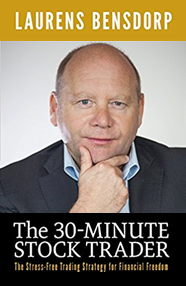
Laurens Bensdorp: The 30-Minute Stock Trader
Read the full transcript
Laurens Bensdorp
LAURENS BENSDORP is an expert at combining multiple non-correlating trading strategies to achieve a high risk-adjusted return regardless of what the market does. He shares that knowledge with a group of brilliant and dedicated students in the exclusive Elite Mentoring Program that’s part of his Trading Mastery School, of which he is the founder and CEO. What Laurens has found is that teaching has helped him exponentially grow his skills as a trader. Author of the bestselling book The 30-Minute Stock Trader, Laurens has lived in eleven different countries and travels the world as he pleases. He currently resides in Spain with his beloved wife and children.
📚 Books by Laurens Bensdorp
Transcript
[0:00:28] Charlie Hoehn: You’re listening to Author Hour, enlightening conversations about books with the authors who wrote them. I’m Charlie Hoehn. Today’s episode is with Laurens Bensdorp, author of The 30-Minute Stock Trader. Laurens’ secret weapon is a software program that he developed that basically does all the hard work for him. He spends a half hour each week on trading and still maximizes his profits. Over the last 10 years, he’s made a risk-adjusted return of five times more than the S&P 500, which to those who aren’t familiar with stocks, means that he keeps outperforming the market by a factor of a five. In this episode, you’re going to learn a better strategy for investing, whether you’re an experienced trader or just starting out. Without further ado, here’s our conversation with Laurens Bensdorp. Laurens Bensdorp, you are the author of The 30-Minute Stock Trader: The Stress-Free Trading Strategy for Financial Freedom. That sounds like an interesting book, one that anyone of us would be interested in checking out. Tell me a bit about why you decided to write it and what your life is like today.
[0:01:58] Laurens Bensdorp: Basically, I decided to write it because I think I’ve got an important message to share, first of all, with a lot of people who are investing and trading. That message is that it’s really easily possible to be very profitable trading the markets with an automated stock trading system and only working 30 minutes a day. That is something that you read about it sometimes, and people talk about algorithms and stuff like that. For most investors and traders, it’s like a road which they think that they can’t walk. What I had decided like, “Okay, I want to write a real good book in which it is really described step-by-step how you can actually trade a system like this.”
[0:02:50] Charlie Hoehn: Very nice. Very nice. The automation aspect of investing is really appealing, because I don’t want to be thinking about stocks all the time. If you had to say, Laurens, and this is a section I like to call “too-long-didn’t-read”, what is the number one take-away from your book for our listeners? If you had to choose the one unique idea that makes your book worthwhile, what is that?
[0:03:21] Laurens Bensdorp: Basically, the main take-away is that it’s really possible to trade very profitable and have consistent annual double-digit returns, beating the benchmark, trading in a simple automated trading system, and doing that in only working 30 minutes a day. That’s, in a nutshell, basically, the main thing.
[0:03:46] Charlie Hoehn: Can you go a little bit more into the specifics of how that’s possible for the average person? Is this only for sophisticated investors?
[0:03:58] Laurens Bensdorp: No, it isn’t only for sophisticated investors. People do need to have, of course, some knowledge about the markets and there are some technical indicators that you need to know, but it’s not very hard to learn. Basically, because it is an automated trading strategy, what we do is we use historical data, and with that data on a daily basis, we have our decision-making process programmed into the computer. The computer is basically doing the work for us, and on a daily basis, tells us what to buy and what to sell. Since we have, over more than 25 years of historical data, we have a very good view of how this strategy actually worked over the last 25 years. That part is, of course, completely documented in the book of when to buy stocks, when to sell them, and how much to buy and how much to sell.
[0:05:13] Charlie Hoehn: This is a software that you and your company developed?
[0:05:18] Laurens Bensdorp: Yup, that’s correct. Yup.
[0:05:20] Charlie Hoehn: Interesting. I’ve read the book The Black Swan, and so I don’t know that much about investing but I do know that, throughout history, there are these events that can happen that no one foresees. Does your software take those things into account?
[0:05:38] Laurens Bensdorp: We can never take anything completely unexpected into account. It’s a great book, by the way, The Black Swan. I have read it myself as well. What is important that if you develop a trading strategy, that you always need to account for the unexpected. So if you assume that, okay, X or Y can happen, and that specific event can have a certain effect on your account; let’s say that the market crashes tomorrow 30%. Now, if you’d be invested 100% on the long side, then you know what you will be losing in that specific day. In my book, I also show people that you can trade both long and short at the same time. Basically, meaning, that at the same time, you protect yourself as well for those events. Of course, as I mentioned, we never know exactly what is going to happen and we never know exactly the exact magnitude of that. Therefore, the term position-sizing comes into play. That is basically that it tells us the answer to the question, “How much?” With how much, I mean how much do we risk of our equity? One thing is, to have a really good automated trading strategy, but If you’re risking too much with that, then on certain events, you’re going to lose more money than you’re actually comfortable with. That part always needs to be accounted for.
[0:07:33] Charlie Hoehn: Tell me who specifically is your book for and who is it not for?
[0:07:42] Laurens Bensdorp: It’s not, basically, for people who want to predict market. We can split up the investing and the trading into fundamental analysis and technical analysis. What you see many times for people who trade on fundamentals, where they basically see the values of a company, and then make a prediction of what the stock market price will be. Based on that prediction, they’re going to buy. That is not how it is working. It is very difficult for people to trade in a way like that. We have Warren Buffett, of course, who does it like that, but we’re talking here about somebody who has 65 years of extremely well-developed skills. The technical side, what I offer, is where we basically — We follow price action. We follow price action, and we measure price action through technical indicators. There, we’re basically making decisions based on what has happened. Those decisions have a certain expectancy then. To resume this, it’s basically for people who want to increase their returns on a consistent basis using a quantified trading approach.
[0:09:10] Charlie Hoehn: What results do you tend to get the people who have read your book and applied this information or use your software?
[0:09:21] Laurens Bensdorp: I think the main thing is that, first of all, people can trade in a way that suits their personality. Everybody is very different in their personality. Based on your personality, you have different strategies that you can trade. You have different lifestyle preferences as well. For example, in the book, there is one strategy which only trades on a weekly basis. Which means that during the week, you do not need to take a look at the market at all. That part is, of course, very interesting for people who have a very high-paced job. They might travel a lot, et cetera, and don’t have time to put in their trades every day. So they only need to do it once a week. On the other hand, we have also strategies that are a lot more frequently trading on a daily basis. For those strategies, there’s a different personality. To give some more insight as far as the returns, the strategy in my book where we only trade once a week has got a tested compounded annual growth rate of 19% over the last 22 years. To compare that a little bit the benchmark, as most people when they look at the news, they see the S&P 500 et cetera, and the S&P 500 only made about 7%. That’s the simplest strategy Then, we have other strategies as well where we combine different directions with a different risk management as well. Then, we get all the way up to the best one that has a 39% compounded annual growth rate.
[0:11:12] Charlie Hoehn: So I want to hear more about how you ultimately came about writing this book. Can you paint the picture and take us back to when you were facing this challenge, this problem of trying to find a better way to trade. What ultimately caused you to create this software and eventually write the book?
[0:11:38] Laurens Bensdorp: It all started with me in the year 2000 when I started to trade. When I started to trade, I was very good at one thing; I was a consistent loser on a daily basis. I did everything wrong that you could do wrong as far as trading. Every day, my account was getting lower. I made rookie mistakes that all rookie traders make. So after a couple of years —
[0:12:10] Charlie Hoehn: What was some of those mistakes that you made?
[0:12:13] Laurens Bensdorp: The main mistake is that you trade without a plan. 99% of the people, they go in the market and they start investing and they start trading but they’ve got no specific plan of when to enter and when to exit. Many people, they just — and I did as well. I bought some stocks and said, “Okay, let’s wait until they go up.” Of course, they didn’t go up because in 2000, the big bear market started. I saw the accounts going lower and lower and lower in every day and of course, because I didn’t have a plan of when to exit, I didn’t want to take a loss. I said, “My goodness. I’ll better wait this out. Wait until the stocks revert and until I can sell it again even if I break-even. I don’t care, but I don’t want to take a loss on these trades.” That’s probably the biggest mistake that most investors make. You see that in general life as well; people do not like to lose. We are taught from since we are very young that we need to be good at everything. Now with trading, having a losing trade, there’s nothing wrong with that. It’s better to have a plan where you say you buy at a certain price and when you see, “Okay, the stock is not working in my favor,” well, get out and buy something else. For that specific process, there is, of course, automation. I didn’t know that at that time, so I bought expecting that it would eventually go up. It didn’t. The when I’ve lost 30, 40%, then, psychologically, I couldn’t handle it anymore. At that moment, I said, “Okay, I’m just going to sell everything.” That was, of course, at the worst possible time. So not having a plan is absolutely a main issue for many traders.
[0:14:23] Charlie Hoehn: How much money did you lose and how did that affect you?
[0:14:28] Laurens Bensdorp: Probably a couple of hundred thousand dollars that I lost. It’s affected me — There’re lots of things going on when you trade for a living and you start to lose money. One thing is, of course, the money that you’re losing, I mean, that’s real. But I think there’re a couple of things that are a lot worse with that. That is a psychological impact that it has on you when you start to lose money. I couldn’t sleep very well anymore. I was smoking about 60 cigarettes a day. There came issues with self-esteem as well, because I had to admit to myself that I couldn’t make this work and that I was losing money. So I was in pretty bad shape as far as my psychological health. That really made a big impact, of course.
[0:15:30] Charlie Hoehn: Wow. Author Hour is sponsored by Book in a Box. For anyone who has a great idea for a book but doesn’t have the time or patience to sit down and type it out, Book in a Box has created a new way to help you painlessly publish your book. Instead of sitting at a computer and typing for a year, hoping everything works out, Book in a Box takes you through a structured interview process that gets your ideas out of your head and into a book in just a few months. To learn more, head over to bookinabox.com and fill out the form at the bottom of the page. Don’t let another year go by where you put off writing your book. Take us to the moment where you started getting yourself out and you eventually broke through to the success that you were seeking. Tell us that story.
[0:16:31] Laurens Bensdorp: It basically started when — During this time when I was losing so much money and everything, there’s one thing that I never stopped doing. I never quit. I was extremely hard-working and I really wanted to make this work. I was reading a couple of trading books per week to educate myself, et cetera. I think around 2006, 2007, I more and more stumbled upon approaches of trading where you automate your strategy. So we basically say, “Okay, I have a strategy where I buy X and I sell it on Y and that’s a theory. That theory, of course, needs to be proven if it actually makes money. In my trading, everything started to turn around when I decided to actually quantify my thought process. Quantifying means that we were programming my specific buy and sell decisions in a trading software, and then taking a look how this would have returned over the past. Now, when I started with that, I started to see scientific evidence of how my strategy would have done. That process, for me, was so comfortable knowing that, okay, we can have evidence at least as what I’m doing, if it actually makes sense, yes or no? From that point on, I started to really map out more and more strategies, turning those strategies into specific buy and sell decisions, and those decisions coding them into a software. After a couple of years of very hard work and lots of failures about software, what was working, what was not working, I came up with a set of strategies with specific buy and sell rules. They really showed that they made consistent money over the last 15 years. When I was there and I saw that, I had the feedback that it had been working for so long. At that time, I said, “Okay, I need to trade this but I need to trade it consistently.” Every day, I followed the exact buy and sell rules and from that point on, I started to make money.
[0:19:13] Charlie Hoehn: Wow. How did you come up with those rules? Was it through researching what had worked for other successful investors?
[0:19:21] Laurens Bensdorp: Yeah. It was reading a lot of trading books. You’ve got good trading books out there. Not all of them, of course, according to me, but everybody’s different with that. I basically started to learn different styles of how you could trade, when you could enter, when you could exit, etc. A lot of them made very good sense, so I was like, “Okay, yeah. This made sense.” A simple trend-following approach where we say, “We buy when the stock is trending up. As long as it keeps going up, we stay in the position and we stay in until the trend bends and then we get out.” That is a very simplified trading approach, but you definitely have an edge in there. That part then — I got it basically through lots of different books and publications, systems that I bought, et cetera. Then, after putting that into specific software that I could quantify and verify myself if it actually worked that time, then I knew, “Okay, there is something good over here.”
[0:20:34] Charlie Hoehn: In your book, The 30-Minute Stock Trader, how long has it been out now?
[0:20:39] Laurens Bensdorp: About two weeks.
[0:20:40] Charlie Hoehn: Two weeks?
[0:20:41] Laurens Bensdorp: Yup.
[0:20:42] Charlie Hoehn: Great. What impact has your book created so far? I know it’s been a short period of time, but has it been well-received?
[0:20:51] Laurens Bensdorp: Yeah, it’s been very well-received. I have got an average of five-star reviews on Amazon. I get a lot of emails from people telling me how much that they liked the book. I’ve been very fortunate so far about all the positive and so many friendly reactions about the book.
[0:21:13] Charlie Hoehn: What’s been your favorite email that you’ve gotten or success story from people who’ve read your book?
[0:21:21] Laurens Bensdorp: The favorite emails, there’s a couple of them. I think I can put it together in a resume of what is in common on all those emails. It’s basically that a lot of people said like, “Wow. Finally, I read a book where nothing is left out, where really it is explained from A to Z how to trade, and revealing the exact buy and sell rules, and showing what the results have been for that.” People get a really clear picture of how they need to trade. As long as they apply it, then it will be successful for them. Many of them wrote me as well and said like, “Wow, this is so great. I’ve finally got a lot of clarity now of what to do in my trading. Now, I’m going to implement that.” That, of course, was a big part of my mission as well to make sure that it really impacts the reader that it can help them a lot. It’s probably the clarity for the people that they know now how to trade. That is exactly the issue that I always had as well when I was educating myself. I said like, “Okay, there is some great material out there available that can help you understand more of how to trade successfully, but there was never something that mentioned the whole process from A to Z.”
[0:22:54] Charlie Hoehn: That’s great. Part of the thing that holds myself back, for instance, from doing the investing on a more regular basis is that feeling of a lack of a game plan and just wanting to say, “You know what? I’m just going to do an index fund and set it and forget it.” Do you think for people like myself, it’s worth diving into the book and saying, “You know what? There is a better way than index funds.” Or would you say to somebody like me who’s pretty lazy when it comes to stuff that, “You know what? Stick to what you’re doing.”
[0:23:31] Laurens Bensdorp: I think it’s definitely recommendable for you to do that, because I can explain a little part of it. For example, the weekly strategy that I mentioned earlier, it’s a very simple strategy. Basically, what it does on a weekly basis, it measures two main things. The first one is the index. So the whole market as a whole needs to be in an uptrend. The second part is, when the index is in an uptrend, then we can trade, then we can buy stocks. If it’s not in an uptrend, you’re completely flat and you do not have any position on. Then, when we know when it’s in an uptrend, we only buy the 10 stocks that had the largest price increase over the sixth month. That is a very simplified way of a trend-following strategy. Just with those rules, you get up to a 19% compounded annual growth rate versus a 7% of the index. But there’s something else, and that is what we call in the trading world drawdowns. Drawdowns is basically when you had an equity high, and then the market starts to drop, and you start to lose money. If you see that on the S&P 500, the largest drawdown was in 2008 with the big financial crisis. The index lost 56%. Most mutual funds lost more. Imagine yourself if you start to trade $100,000 and you just started at the beginning of that financial crisis. Now, suddenly you’re down to, let’s say, $45,000. That’s not a nice feeling, right?
[0:25:21] Charlie Hoehn: Right. However, I’m curious though. During that time, isn’t that the best time to buy stocks, because everything’s at a discount?
[0:25:31] Laurens Bensdorp: It is, but you do not know how long it can keep dropping. It has dropped already so much, and that is a part in that weekly strategy that I have, what I say is, “Listen. When it starts to drop, we just get out.” We’re flat. We’re not doing anything. We can go to the beach every day, whatever you want to. You don’t need to do anything, and wait until the market shows evidence again that it is in an uptrend. With that specific strategy, you only would had 30% drawdown instead of 56%. I explained that as well. That’s another part in the book. We had also other crises like in 1929 to 1932 where the Dow Jones lost about 86% of its value. Now, if something like that happens, and you say, “Well, I’m just going to stick with the position,” you’re going to lose a lot of money, of course.
[0:26:40] Charlie Hoehn: Yeah. I’m curious about the business model for the book. One of the things I like to do on this show is make authorship a little bit more transparent in how it works. From what I understand, your book is great marketing for your software. What is the name of your software, by the way?
[0:27:01] Laurens Bensdorp: It’s a TMS Elite software, but it’s not really the software that I’m aiming for. It’s my mentoring program. So I decided to have this book, because it’s a great way to get good leads. People that read the book, they will be really interested to talk to me further about their trading and may be starting to work with me together to bring that trading, really, to the next level. What I offer is a mentorship, and with that mentorship, people can choose to also buy my software. It’s not 100% necessary if people have very good software skills themselves that they can program, et cetera. Generally, it is the mentoring that is my main aim. Therefore, of course, this book is a great lead magnet, as we say in marketing terms. The other part as well is, of course, a positioning. If you write like this, which has been received so well, you position yourself very good in the trading education world.
[0:28:14] Charlie Hoehn: That’s true. That’s very true. All right, Laurens, I want to get into the speed round where I give you some quick questions. You give nice, succinct, sound-bite-type answers, and we’ll just go through these really quickly. Does that sound good?
[0:28:29] Laurens Bensdorp: Sure. Go ahead.
[0:28:31] Charlie Hoehn: Great. Number one. If you had to lay down a soundtrack for your book, what song or songs would you pick?
[0:28:43] Laurens Bensdorp: That’s such a great question. I like very much, and it really applies here as far as the title name, it’s a song from Sade. The song is called Smooth Operator. It really applies to my book, because if you read my book, you read the exact entry and exit rule, the only thing you need to do is operate it right, and then you’ll have a very smooth operation.
[0:29:13] Charlie Hoehn: I love it. If you had to pick a drink, a cocktail to have with your book while reading it, what would that be?
[0:29:24] Laurens Bensdorp: A glass of red Bordeaux wine.
[0:29:27] Charlie Hoehn: Yes, great answer. What is the best place? What would be the ideal setting for somebody to read your book that would make you happy if you saw somebody reading your book there?
[0:29:40] Laurens Bensdorp: A quiet place where they can really sit and they can really focus on the book. If you have a really quiet place, then it’s just a very easy readable book as well.
[0:29:55] Charlie Hoehn: Let’s get more specific. Does that mean in the library? Does that mean in a Starbucks, under a tree? Where would be your ideal place to read the book?
[0:30:05] Laurens Bensdorp: Mine would be actually in my personal office where I work. I’ve got a big chair in there, and that’s exactly where I read most of my books. For me, it’s just in a very nice and quiet environment with some nice soft music on and where I really feel very well at home.
[0:30:27] Charlie Hoehn: Perfect. What is your favorite online resource or app that you use that’s not your software?
[0:30:39] Laurens Bensdorp: Correct, yeah. It’s Facebook actually, and I’ll explain to you why. You can read that in the bio of my book. I’ve lived in 11 different countries over the last 20 years, so I’ve had the fortune to really know a lot of different people from different places. When Facebook was starting to get big, I have been able to get in contact with so many friends that I did not have contact with for 10 or 15 years already. You kind of lost contact with them, because they wasn’t such a thing like Facebook. For me, if you use it right, it’s a phenomenal tool to really socialize with people like that.
[0:31:26] Charlie Hoehn: That’s a great answer. Who is the one person that you would most want to have read your book? A specific person.
[0:31:38] Laurens Bensdorp: I don’t know. My answer would be I’d really like people who have invested in a lot of money in trading, who have invested a lot in education, but still have lost a lot of money. That’s the people that I like to read the book, because they will be benefitting so much from it. People who have lost a lot of money in the 2008 crash, that’s the part. Mentioning one name, I don’t really have it.
[0:32:11] Charlie Hoehn: All right. That’s pretty specific. That’s good. Fill in the blank with a book title for this. If you liked ____, you’ll love The 30-Minute Stock Trader.
[0:32:25] Laurens Bensdorp: I’m not sure.
[0:32:26] Charlie Hoehn: It’s a tough one.
[0:32:28] Laurens Bensdorp: Yeah, it is. I’m thinking of it and probably I’d say if you liked Market Wizards, you’ll love my book.
[0:32:36] Charlie Hoehn: Perfect.
[0:32:37] Laurens Bensdorp: Market Wizards is —
[0:32:38] Charlie Hoehn: Yes. What was the most challenging part about making your book?
[0:32:47] Laurens Bensdorp: It was getting the trading systems done for the book. A part of this, I really needed to do myself, which was all the testing and putting in all those details about the trading strategies, et cetera. That part, because you’re actually exposing this to the whole world, you want it to be good, you want it to be correct, you want it to be accurate. That part, of course, took a lot more time that I expected. That was really challenging for me to make it as good as possible.
[0:33:26] Charlie Hoehn: Yeah. Did anything previously hold you back from becoming an author?
[0:33:32] Laurens Bensdorp: Yeah, it was definitely overwhelm. I’m not a native English speaker. I speak good English, but it’s by no means perfect, neither is my writing. Since I’m aiming here, of course, for an international audience, it of course needs to be in English. That was the first part that I said, “Oh my goodness!” Then, the second part; there are so many things that you need to think of when writing a book, et cetera. I’m just not a specialist in writing. I don’t like writing that much. Only thinking about it, of publishing a book, was like, “Oh my goodness! That’s just so much stuff to do.” That, for one part, could maybe a limiting belief, but it was definitely a large part of overwhelm.
[0:34:25] Charlie Hoehn: Right. Tell us about a recent embarrassment, or personal failure you had and how you dealt with it. One of the things I like to do on the show is just make authors seem normal people, because they are.
[0:34:39] Laurens Bensdorp: Right. Yeah. I think, for me, it was definitely entering into the perfectionism trap that I was focusing, with this book, so much on perfection, and that focus to perfection actually caused me not to take any action at all, not finishing the stuff that I needed to do. I kind of froze, and that is, of course, by no means a desirable mental state. It’s terrible, because it’s as unproductive as it can be. That really was something that was limiting me in many parts for this book.
[0:35:25] Charlie Hoehn: If you were going to write a follow up book to The 30-Minute Stock Trader, what would that book be?
[0:35:32] Laurens Bensdorp: It’d probably be an extension of trading strategies and go a lot deeper in what I have right now. What I wrote now is a basic, but very good A to Z plan, but there’re many parts of that that we can address and we can go a lot deeper into that. That would definitely be something to do for the next part. I’m actually thinking about it already.
[0:36:04] Charlie Hoehn: I love it. What is a parting piece of advice you can give to aspiring authors?
[0:36:11] Laurens Bensdorp: I think the main thing is if you’re going to work with guys like Book in a Box, trust that the process is 100% perfect. Trust the process and just do what you need to do and have 100% faith that the end results will be perfect. Especially, if you do this for the first time, there’s a lot of open questions, like how it will be? Will it be good? Will people like it? Et cetera. With Book in a Box, you’ve got a group of such committed professionals who really know their stuff so well. If I knew that before, I’d have no doubt whatsoever. You can trust this process 100%. I don’t think there’s anything better in the market available, and you’re going to know that you’re going to write an Amazon bestseller. You will know that the book is of such high quality that the readers will really like it a lot. Everything of the whole process is just perfect. If you know that beforehand, you’ve got the right mental state to actually make this work and do your part as good as possible.
[0:37:27] Charlie Hoehn: Wonderful. It’s a heck of an endorsement, sir.
[0:37:31] Laurens Bensdorp: Well, you guys deserve it. My pleasure.
[0:37:35] Charlie Hoehn: Thank you. Thank you. I’m definitely going to pass that along to the team at Book in a Box. Laurens, this has been great. What is the best place or way for listeners to connect with you?
[0:37:47] Laurens Bensdorp: If you’re more interested in the trading, of course, I think the first thing is buying my book, of course. You can go to my website as well, which is tradingmasteryschool.com.
[0:38:03] Charlie Hoehn: Tradingmasteryschool.com.
[0:38:06] Laurens Bensdorp: Correct, yeah. Over there, you can get access as well on a free video course when you are a purchaser of this book. That’s for the traders, by far the best place to go. For people who have other things, you could also always look me up on Facebook, just typing in my first and my last name.
[0:38:30] Charlie Hoehn: Perfect. They go to masterytradingschool.com for the mentorship stuff too?
[0:38:36] Laurens Bensdorp: It’s tradingmasteryschool.
[0:38:39] Charlie Hoehn: Oh, I’m sorry. Tradingmasteryschool.
[0:38:41] Laurens Bensdorp: Yes. Over there, you have the links as well with the information of the mentorship and everything, and there’s an email address as well over there, so if you want to drop me an email, you’re more than welcome.
[0:38:53] Charlie Hoehn: Perfect. Laurens, thank you so much for being on the show.
[0:38:57] Laurens Bensdorp: My pleasure. This was really cool. I really enjoyed this.
[0:39:00] Charlie Hoehn: Yeah, me too. Many thanks to Laurens Bensdorp for being on the show. You can buy the Laurens book, The 30-Minutes Stock Trader, on Amazon.com and follow him at Tradingmasteryschool.com. Be sure to check out our next episode, where we’ll be talking with Rob Waite, author of No Magic Bullets: Hard Things Great Executives and Entrepreneurs Know and Do. Thanks again for listening to Author Hour, enlightening conversations about book with the authors who wrote them. We’ll see you next time.
Want to Write Your Own Book?
Scribe has helped over 2,000 authors turn their expertise into published books.
Schedule a Free Consult