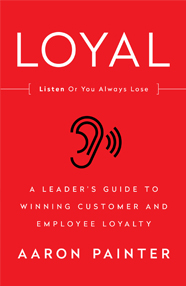
Aaron Painter: Loyal: A Leader's Guide To Winning Customer And Employee Loyalty
Read the full transcript
Aaron Painter
In LOYAL, Microsoft executive Aaron Painter explains how accomplished leaders use the time-tested secret of listening to turn the concept of loyalty into a powerful reality.
📚 Books by Aaron Painter
Transcript
[0:00:28] Charlie Hoehn: You’re listening to Author Hour, enlightening conversations about books with the authors who wrote them. I’m Charlie Hoehn. Today's episode is with Aaron Painter, author of Loyal: A Leader’s Guide To Winning Customer And Employee Loyalty. Aaron is the Vice President and General Manager at Microsoft in China. So if you’re business leader, an executive or an employee, you definitely want to listen to what Aaron has to say. By the end of this episode you'll know the most sustainable way to grow your company without having to rely on chasing new leads or hiring more talent. Now, here's our conversation Aaron Painter.
[0:01:21] Aaron Painter: About five years ago I still remember the first day I came to work in China. I had moved there on a Saturday and I had started work on a Monday and kind of just like anywhere else, I’d aim to start at 9 a.m. Traffic in Beijing is a disaster, so it ended up being 10 a.m. The first thing I had was a meeting with my manager and he outlined all of the situation and reminded me of kind of where we focus and what the big task was that I had accepted for my team and I to lead and go off and do. I walked away super excited. I said, “Wow! I’m so glad I’m China,” and sometimes when you move somewhere new at first everything is exciting and different and there’s just a ton energy around that. Sometimes later, weeks or months, you start to see the challenges a bit more. In this case, I don't think it took me beyond the end of the first day. I walked out of that office with my manager, maybe 11 a.m. and I immediately jumped in to saying, “Alright. Where can I begin? Who can I go kind of learn from? Who can I go find out deeper some of the things that I knew I needed to do for my job?” It was really in the course of that discovery process that by the end of the day I left thinking, “Whoa! This is going to be really big challenge. I’m up for it, but it's going to be a really big challenge.”
[0:02:30] Charlie Hoehn: Can you tell us more about that assignment and how it unfolded?
[0:02:34] Aaron Painter: Yeah. I really had two core things I agreed to do when I went to lead the business in China. The first part was to build a more sustainable business for Microsoft in China. A lot of our customers there, call them that, were very good users of things like Office and Windows, products most people kind of know and love. In China, there wasn't really a practice that people always paid for those products. We had a lot of users and we didn't have so many then that paid, so most of our sales —
[0:03:05] Charlie Hoehn: Was that piracy or –
[0:03:07] Aaron Painter: Yeah, piracy would be the right term. Essentially, pirated download, found other ways to use the products. And it was great, we were so happy that they liked the products and wanted to use them, but we’re a for-profit company and so at some point monetizing the products we make is pretty important. Aside from best sales motion, fortunately most of our customers just thought, “Okay. I paid Microsoft a little bit. They came knocking on my door, maybe a salesperson or a partner there saying I owe them money. I paid them. They’ve gone away,” but the reality was that technology at Microsoft has changed a lot and we don't just make things like Office and Windows. We make a lot more sophisticated cloud computing services, ERP, CRM, the kind of tools that most businesses really at the core of their business. Because of what had happened and the experience that most of our customers had with Microsoft previously, they didn’t really think about us when they needed those kinds of solutions. They often thought about other companies and, frankly, went to them first for their technology needs, not for Microsoft.
[0:04:06] Charlie Hoehn: Why did they find other companies and not you guys?
[0:04:09] Aaron Painter: The experience that they had with us was very transactional before. A salesperson would call them and say, “Hey, we've seen on the Internet or we think for various reasons you have these number of employees and they probably all have a computer. Therefore, you probably need to buy this many copies of Windows.” The customer was already using it. Maybe the numbers were correct, maybe not. A negotiation might go from there, but it was a very transactional process. It wasn't about someone trying to understand what their business was and find new ways to help. It felt almost like a tax.
[0:04:38] Charlie Hoehn: There was no relationship at Microsoft that seemed very much like, you said, transactional with their customers. How did your work and you studying this problem take shape over time? How did you eventually end up landing around loyalty as the solution? That was the first really important piece for me. The second one and maybe the second part of my role was actually more around people. My task was to retain and develop our millennial workforce. We have this principle that it was great for diversity to have people from a variety of different backgrounds. Of course, we hired a lot of industry and experienced senior people, but we also wanted a lot of fresh talent and fresh graduates from undergraduate and MBA programs who could bring different perspectives, different levels of energy. We could maybe help teach them a little bit the Microsoft way or best practices of doing things. Also, learn from them new ways to do things that might make our business in China successful. We were hiring a lot of people because we were growing fast. Sorry to interrupt. I was just curious. Did the higher-ups think that retaining millennials was a big opportunity at the time or did they feel it was a problem, because millennials were dropping out and not applying to the company as much? Where did that ultimately come from to make that the focus?
[0:06:06] Aaron Painter: The initiative was something that we've done in our whole company's history, right? Arguably, Bill Gates, left college before finishing. Steve Ballmer, our old CEO, kind of dropped out of business school. We had a long history of having people that really early in their life helped solve really big problems. We’ve always had a corporate culture where we want to have people that are really experienced, so we want to have people that are earlier in their career and kind of bring them together. The challenge we had was that the people we were hiring earlier in their career in China kind of weren’t stay-in, we would call from an HR term “attrition”, or the ability for them to stay with us wasn't as strong as it should be or where it was in the rest of the world.
[0:06:43] Charlie Hoehn: Why?
[0:06:44] Aaron Painter: That’s what I set to find out. I tried to understand kind of those two things. That was the two problems that I had in my role. Literally, I set out on that afternoon. I left that manager's office first thing in the morning and found out my two things. I set out to kind of meet customers and to meet some of our managers to try and learn why. I called it kind of a listening tour. I literally remember that afternoon I went to visit my first customer and I still remember the meeting because it was a manufacturing customer. You might know in China, there are certainly a lot of manufacturing companies that produce many of the things that we use around the world. That manufacturing customer had told me that their business was great and still doing really well, but that over the years they were facing more and more competition and that the pace of change and things for China was accelerating. While they started and they maybe had 20 or 30 competitors, they now sometimes had hundreds of competitors in certain areas and they were worried that they were losing some of their customers and they were finding it harder to differentiate from some of these new competitors that were popping up. On top of that they really wanted innovate. They wanted to make new products, but as their existing customers weren’t always coming back to them, they felt like they weren’t as plugged in and they felt like maybe they weren't listening and able to get that feedback from their customers in order to know what to build next. In fact, the challenge felt a little bit, like the challenge that Microsoft felt like it had with its customers at the time in China.
[0:08:13] Charlie Hoehn: Right. Did you realize as you talk to more and more customers that all of them had this similar issue, or was it varied?
[0:08:21] Aaron Painter: It was super consistent across a lot of the customers that I had met with and across different industries. That was manufacturing that first meeting, but I found the same thing in retail and I found the same thing in logistics and distribution and the same things even with bank and financial services customers. The problem that they were all describing was a little bit different, but very consistently there was this theme of what is sounded like they needed and what is sounded like he needed was really loyalty they needed, and what it sounded like they needed was really loyalty. They needed customers that would come back and think of them as the first choice, so to speak, when they had a need or had a new project or even if they had a new idea for something. They should go back to the company they were buying from before and that need for loyalty just felt so strong in a market, particularly like China, that’s so big. You may normally think, “If there’s just so much opportunity, how can you run out of customers?” The companies were describing the need for loyal customers.
[0:09:14] Charlie Hoehn: Yeah, from everything I have read about business in China, and correct me if I’m wrong, but they are not super loyal to brands. They just go with whichever product is best. It doesn't really matter as much to have the brand. Is that accurate to say?
[0:09:33] Aaron Painter: Yeah. I actually think and talk a little bit in the book about a subtly broader theme there. I usually segment countries or markets in the world into two categories. I call them building markets versus refining markets. A building market to me is a market – it doesn’t have something. For example, if you don't have the jeans then, “Wow! It’s cool that jeans are available to buy in your market.” And creating a company that brings jeans to markets and can manufacture them and put them in a store or sell them in some way, you're creating something that wasn't there before. As a business leader, that's a lot of work and really hard to do. The other side to that though is a refining market, where all of those factors of production are in place, but there are improvements you can make. Maybe slightly tweaking the way it’s sold or tweaking the packaging or improving the customer sales experience or what happens in a retail store. If you think of, really, what we often think of as emerging or developing markets, sometimes just getting access to a new good or product is really, really amazing. If you go to others, you might say, “Oh, there are tons of people that provide this, but how do I make the experience better?” To me, brand really kicks in particularly when you enter that refining stage. China, to answer your question more specifically, in many industries, is entering that refining stage where there's plenty of availability of so many kinds of products, but they’re starting to realize the importance of brands.
[0:10:53] Charlie Hoehn: Wow! That’s amazing. Tell me about companies that have really achieved customer and employee loyalty and that their products and services aren't addictive. For instance, we could probably make an argument that people are really loyal to Coca-Cola, but it also has some addictive properties. What are some examples that we can look to?
[0:11:20] Aaron Painter: You don’t want to think about my journey. There was kind of that second part to it. The first was that time that I spent with a lot of these customers, Microsoft customers and just companies let’s call it, in China, who were doing business. The second part was really sitting down to learn about our millennial workforce and about the employees we had at Microsoft. When I sat down to listen to a lot of our people managers they would tell me pretty consistent things. They would talk about that they believed in diversity in hiring fresh graduates and then many of the people we were hiring were really smart, but they felt that these younger employees, sometimes they’re only there to get Microsoft in the resume and that if they were going to stay, then why should they invest so much time in helping them grow and develop? Then when I would sit down with the new hires themselves, they would tell me that they had many new ideas and they thought that that's why they were hired because of their fresh perspectives. But it seemed sometimes that their managers didn't want to hear them or weren't interested because they just wanted them to get up to speed quickly and help out in the short term. For me, that was a little bit of an insight on the people’s side, a big insight in some ways because I said, “Wow! This concept of loyalty that I’ve realized my customers are looking for, in fact, our managers are looking for the same thing from our workforce.” Then the employees themselves, in many ways, are looking for their managers to make a commitment in them and to be loyal the other way. That's when I realize that there was this same need for both groups. This idea of customers and employee, and the need was loyalty. It’s what they needed. Then I had a kind of figure out how. Once I had established that loyalty was the key thing they needed, question was then how to help make that happen.
[0:12:56] Charlie Hoehn: Yeah. From what I understand, Aaron, the workforces had changed a lot especially in Fortune 1000 companies, where it's often more affordable to just cut full-time employees, make them contractors instead. How is it possible to be loyal? How did you bring loyalty into the DNA of this mega company that's already operating in a certain way? How did you make that happen with how things are nowadays? I don't know if Microsoft is as much that way, but from what I understand, a lot of the bigger companies, it seems inherently difficult is what I'm saying. To offer loyalty in a world where the way we operate within companies were changing jobs every few years for most people. That's such a dramatic shift. Does that make sense?
[0:13:58] Aaron Painter: Yeah, it does. For me, I was trying to figure out this how and I reflected on a few years that I had spent living and working in Brazil, because when I moved there at first I had this big job and I was the first foreigner we had in Brazil. I didn't speak any Portuguese, and not a lot of people there including in the office spoke much English. I had to find a way and the time to kind of do my job, and what I discovered then was this importance of listening, because Brazilians fortunately were very expressive and they use their hands and they draw words and they’re really charming. But it was a great group people and a great culture to be a listener in, because when I would sit there and listen I could often understand the intent behind what the people were saying. I spoke some French and I spoke a little Spanish, so I could kind of eventually piece together the words. But I learned a lot from the nonverbal cues and their expressions and the intent behind kind of what they were saying. More importantly, what I realized when I was going through that was that the people I was meeting with and listening to felt incredibly respected, because even when they sit down with another Portuguese speaker, that person was often jumping in and offering their own commentary. They weren't sitting there and listening. I was able to develop these really strong relationships with customers and with our employees and my team members in Brazil simply because I adopted this practice of listening really well. For me, I developed this hypothesis that may be listening could be the how to kind of Institute this idea or culture of loyalty.
[0:15:33] Charlie Hoehn: Yeah. Teach us how to listen better. How do we become better listeners?
[0:15:39] Aaron Painter: Yes. Let's talk a little bit about listening. I think that there are several things that lead to listening well. To me though it really begins with this concept of — I call hearing as passive. When you hear something — We hear a lot of things in our lives; street sounds, and phone ringing, and TV in the background. Often, people that we’re with, but hearing is something that's passive. To me, listening is something that's active. Active listening to me is there’s a practical side where you’re listening, maybe you put your phone away and maybe you're not looking at your computer screen. You're looking at least to the person that you're speaking with, but the other deeper side is really about wanting to listen with a sense of curiosity or this desire to understand someone. Being curious about what they're saying and what the topics are.
[0:16:34] Charlie Hoehn: Author Hour is sponsored by Book in a Box. For anyone who has a great idea for a book but doesn’t have the time or patience to sit down and type it out, Book in a Box has created a new way to help you painlessly publish your book. Instead of sitting at a computer and typing for a year, hoping everything works out, Book in a Box takes you through a structured interview process that gets your ideas out of your head and into a book in just a few months. To learn more, head over to bookinabox.com and fill out the form at the bottom of the page. Don’t let another year go by where you put off writing your book. Give us some examples of what you were like beforehand and what you eventually discovered and implemented into Microsoft? What were some of the results that you saw from that?
[0:17:31] Aaron Painter: Let me give you a really practical example of listening as a manager versus not listening. A scenario sometimes we’re all familiar with. Many years ago I’ve learned the hard way. I hosted a meeting and we were in the middle of the meeting and the key member of the team hadn't come and she eventually showed up late. Of course, I’m jumped in and called, “Oh, I’m really disappointed that you’re late. Please be on time next time.” Later I reflected on that. I had a long talk with that employee and I learned. I learned that there is probably a better way to handle that situation and one that was much more about curiosity and listening. Let me tell you a little a bit what I now do when someone's late to a meeting. I often say, “Welcome. Glad you could join us,” and then after the meeting one-on-one, not embarrassing the person. I might sit down and talk to them and I might share an observation. I’d say, “Hey, I observed that you came in 15 minutes late for the meeting today.” Then the impact to that. “Also, it was kind of disruptive, because you’re a really important part of the team and you weren't able to hear the updates from some of your colleagues who shared earlier maybe in the meeting.” Then I ask the question, I say, “Help me understand,” and I pause. It’s a bit of a scary moment, because you're not quite sure how the person is going to react. But I listen to whatever they say. The interesting thing I learned is you never know what you're going to get back, but often times there's a reason. There's a reason or a perspective that I might not have considered if I had just jumped to chastise them or to embarrass them for being late. For example, they could say, “Oh, I had an emergency at home,” or “my relative is ill,” or “my car broke down,” or it might not have been just what my guess could of been before, which was they didn’t care or they’re not a timely person or they wanted to be late or who knows? By listening to them, it becomes an opportunity not only to coach and help them learn, but also a chance to build a relationship and build a sense of trust, because the employee feels incredibly respected that I'm sitting there and trying to listen. Being curious about what might've prevented them from getting the meeting on time. Now, we usually close on a resolution. We then say, “Okay. Well, I totally understand, but on the next meeting, if you think you're going to be late, maybe you could email the team in advance and let them know or maybe we could move the time of the meeting to something that's more convenient so that you wouldn’t have to be challenged by it each week.” Things like that. We move to a resolution, not a conclusion that just says, “Okay. Next time be on time.” We move to resolution that's based on what I heard. The best part of it is, again, it’s strengthens relationship often between the employee and the manager because they walk away feeling respected and that I, as a manager, cared about them. I firmly believe that the building of any relationship begins with respect. Because when someone feels respected together you can build trust, and conversations like that help the employee in this case, they feel more respected.
[0:20:20] Charlie Hoehn: I love that. How did you ultimately reach that point, Aaron? Were you’re studying principles of great listening? Were you reading books? Asking for advice? How did you arrive at becoming a great listener?
[0:20:35] Aaron Painter: For me it was a lot experiential. Again, my experience where I was sitting in Brazil and didn't have words to use. I could only really listen, but I found that surprisingly be an effective technique to connect with people and to eventually make them feel respected and to build trust in our working relationship. Over time I started to learn more words in Portuguese and sometimes people learned a bit more English, but we had a relationship that was based on trust. I saw that work in Brazil incredibly well with both employees and with customers and all the people in my life there professionally. When I came to China and I was seeing this challenge that so many people were craving this loyalty, craving in a world of fast change and innovation and the incredible world that is China today. People were really craving for loyalty, for customers to come back, for employees to stay. I then wanted to understand, “Is there a connection between the two?” and that’s where I think a bit to your earlier question I set out to say, “Hey, where can I find examples of where that's working?”
[0:21:40] Charlie Hoehn: In taking it back to the manufacturer that you mentioned earlier and listening to his problems and what he was ultimately driving. How did that shape your products or services at Microsoft in the way you interacted with your team and how they interacted with customers? Did those realizations that you had get implemented into the company?
[0:22:06] Aaron Painter: Yeah, it happened at a variety of different levels. In Microsoft, we even place a little bit more importance on terms how we develop product. What’s starting to happen in the world is a theme that we talk about now a lot we call digital transformation. Something I unpack a lot in the book, and there's been more and more noise about it in in the industry. What digital transformation really means is that technology creates new ways for business innovation. Let me give you an example of another manufacturing customer to put that to light. Recently, actually I met two different manufacturing customers and they were both in the shoe industry. They both manufactured sneakers. One of them said, “Why are you here? My assembly line works fine. Those are the only computers in our world and everything is just like it needs to be.” I said, “Okay. Thanks you so much.” The next customer I met actually said, “Oh! I'm so glad you're here, because I really want to talk. I’m putting sensors into my sneakers, and that’s changing my whole company and I need to talk to you for Microsoft to understand how technology can play a really big part in that even more.” What this company was doing is they're putting sensors in the shoes that were connected back to the cloud and the cloud was essentially giving them the data about what was happening when someone wore those sneakers. So they could provide a service to their customers that maybe when you're wearing your fitness wristband you can track your steps better. They were taking the data that was coming back and proposing a new business model for them as a company where they said, “How about subscription sneakers? Meaning we can predict when you might need a new pair so we can send them to you automatically.” They use the data that were coming back from the sneakers to improve their product to see how the sneakers were wearing and maybe the sole wear was in good condition or not. So they could make even better sneakers. Then they were going out and improving their assembly lines and the way that they’re actually producing the sneakers based on the demand that they were seeing from how fast the sneakers were selling. Those are two companies in the same industry that were doing the same thing, but they were approaching technology in very, very different ways. That example is one that I’ve been seeing in so many different industries around the world now of new technology really changing the way businesses are done across a variety of industries. Usually, those four pillars or four examples or common themes and similar ways that companies approach what we would call digital transformation.
[0:24:27] Charlie Hoehn: Yeah. Let's talk more about what's in the book. Digital transformation, that's a great example. What other examples do you talk about in the book of companies or industries that are doing this really well?
[0:24:40] Aaron Painter: One, it was very open question for me was, again, this hypothesis, as I thought more and more about listening as the how to achieve this loyalty as kind of the what that companies were looking for to have a sustainable business or to continue to grow. I started to look around the world to say, “Were there companies that maybe are at that refining stage or subtly more advanced stages of building a brand?” Not surprisingly, I found that companies where there were employees who’re really big fans of the company often had employees and customers, both, who really big fans of the company. One company in particular I found in the U.S. that really stood out, and that’s Warby Parker.
[0:25:22] Charlie Hoehn: Tell me about it.
[0:25:23] Aaron Painter: Warby, as some of you might know, is a young kind of upstart eyeglass company. They’re based in New York, and over the past decade they’ve develop this pretty reputation for challenging the status quo and taking kind of a quirkier innovative approach to how they do business, both with their customers and with their employees. They essentially have practices inside the company that helped develop this culture where it's okay to be quirky. It's a fun place to do business very practically. For example, on Monday mornings in a Warby Parker staff meeting, new employees are asked to stand up and to share a fun fact or funny story about themselves. It's a really vulnerable moment, deliberately so, because the company wants to foster the perception that being a bit odd and a bit quirky is acceptable and encouraged. I would argue that vulnerability and expressing vulnerability is really an incredible way to build trust in any sense and it’s something that Warby doesn't in building it in their workforce. It's a really fascinating way that they're able to build this culture of expressing vulnerability and to make it playful and fun, and then they do things like asking employees every week for an idea about how the company can do better or about how they can innovate. That stimulates employees to think about ways things to be done better. Part of this vulnerability, for example, I was recently hearing the story from the team there. One of the call center representatives was talking to a customer and the customer was using a lot of references to the Game of Thrones, the television show, and it was very clear in this conversation that the caller was a very big fan of the show. This telesales rep smartly got up and he went to one of his colleagues who he knew because it was very casual work environment, where there was a lot of trust and said, “Hey, aren't you a big Game of Thrones fan? I have a customer I think you should talk to.” That employee got on the phone and the customer had obviously an incredible experience because they felt it was fun. They felt it was quirky. They felt like Warby Parker understood them, and led to another probably great story that that customer is out now telling.
[0:27:26] Charlie Hoehn: Yeah. I love that. It's funny, because I remember — This had to have been seven or eight years ago, but for some reason I had a phone call with customer support at Budweiser. I don't remember why, but I will never forget how great a listener this guy was. I actually wrote a blog post about it. I had an affection for the company after that. I don’t really drink that much anymore, but it stood out to me. In Zappos, of course, they have phenomenal customer support. They’re great listeners over the phone, and those instances always really stand out and they permanently etch into the mind of your customer, that this is a company I need to be loyal to.
[0:28:14] Aaron Painter: You mentioned Zappos, and Zappos is another example in the book. What’s so fascinating about it is you're talking about as a customer experience with Zappos and what I focused on the book in fact was the employee experience at Zappos and the way that they treat their employees. In fact, when a new employee starts at Zappos, they have a period of time to see if they like it, and Zappos will even offer them compensation, a bonus to leave if at the end of that period they don't feel like they're fit. Because they would rather have employees that participate in that culture so actively than to have ones that are just there because it’s a job.
[0:28:49] Charlie Hoehn: Right. I think that's brilliant. Yeah. What is the number one thing that people need to take away from this conversation or the best idea that they ought to know from your book? Three months from now after listening to this podcast, what should they remember?
[0:29:09] Aaron Painter: I really want people to remember that loyalty is an incredibly powerful way to build a sustainable business, and cultivating a culture where you listen in a company. Where employees felt listened to, where they listen to each other – is a culture were those employees will attract loyal customers. Because they create the kind of customer experiences you give an example of when you call that representative and they made you feel like you mattered because you listened. People, at the end of the day, have that in common. Whether you're an employee or whether your customer, you feel respected when you listened to. And customers or employees who feel respected are often ones that are going to come back. If they’re loyal then you have a business that's sustainable because it will keep going and you have customers and employees that are going to give you feedback on how to stay relevant in times when things are changing.
[0:30:05] Charlie Hoehn: Very nice. Aaron, I got to mention that this is one of the very first podcast episodes I’ve kind of felt on the edge about — I’m just thinking, I really have to listen to everything and I can't let Aaron down. Tell me about your proudest transformation or change that you've witnessed at Microsoft after having implemented some of these loyalty practices.
[0:30:34] Aaron Painter: I feel really fortunate that we’ve had a lot of successes at Microsoft overall as a company in the last two years since our new CEO, Satya Nadella, has taken the role, and he's really helped change much deeper a lot of elements of our culture. Part of that, although he might not describe it that way today, is building more of what would be a listening organization. In China, in particular, I've had the chance to develop a lot of the local culture in the last few years, of course, that we have been and how we do business. For me, that's really led to some standout business results and helping to put China on the map globally within Microsoft as being a very, very strong place not only for employees, where our attrition levels and employee satisfaction scores have risen dramatically, but also in terms of business results. We've created, really, one of the top performing businesses that Microsoft has globally in just the last few years by implementing some of these practices.
[0:31:33] Charlie Hoehn: Do any particular instances stand out, whether they're remarkable or surprising?
[0:31:41] Aaron Painter: Living in Hong Kong for a while and leading a large team in the business in Hong Kong was a really powerful learning experience for me particularly in entering kind of Asian culture, and we think of Hong Kong as kind of an east-meets-west place in many ways it is, but our employees and our customers there were local customers. They were certainly Chinese in their approach to things. Sometimes when I go somewhere new, when I moved to Hong Kong and these people all thought, “Oh, I have this foreign manager who maybe is not going to understand us.” They were often very surprised at first when all I really wanted to do was sit and listen to them. As they felt more comfortable that they could share and that I wouldn't be sort of judging them or making them feel bad, they felt more willing to share ideas and to open up and maybe they had always had some great ideas or innovations and people just weren't asking them about it or really sitting and listening. Very quickly it became exciting. Our staff meetings became really exciting, whether they were my leadership team meetings or our all-hand meeting, because people were constantly offering innovations and offering ideas, and when they were in those meetings they had this culture where, “Hey, it's okay to ask a question.” There’s a big debate in Chinese language, the word question is sort of the same word as problem, and so sometimes you say, “Oh, how come maybe someone of Chinese origin doesn't raise their hands and have a question?” Often, it's that language element. You’re kind of raising a problem, and so people don't do it culturally. I was trying to develop a culture where it was okay even if you didn't do it in public, but to ask yourself, “Hey, is this the best way to do something? Are there other ways to do it?” The impact was normally profound with our employees, one, because of how they were reacting and the energy that we brought to the team, but surprisingly it helped us attract more employees. Our applications started skyrocketing. People wanted to work in the company. They wanted to work on our teams, because they saw what kind of culture was being built there. Then our partners and all of our — in Hong Kong, we had over 2,000 companies that were business partners. They could feel our change and they saw how working with Microsoft was starting to be different, because we were an organization that wanted to listen to them and listen to their ideas and not just tell them the policy or how things should be or sort of enforce rules. We were there, they felt to build, to build a business with them, for example, and our customers felt the same way.
[0:34:09] Charlie Hoehn: I love that. It’s really refreshing to hear, especially from Microsoft, that you're creating this culture of non-judgment. Assuming that the person who asked the question has the best intentions to improve the process rather than just complaining about it. That’s wonderful and any company can do that.
[0:34:32] Aaron Painter: Yeah. We also call it a lot. We think about diversity and inclusion, and inclusion is kind of one step beyond diversity, and that’s one thing to bring different people from different backgrounds together. I’ve always felt really passionate on that because, honestly, I've been working in places where I was different and I had a different background and so I wanted to come to foster that environment. Simply, that means if you have a business problem in front of you, if people around the table have different backgrounds or experiences or later in their career or early in their career, they’re just going to bring different ideas. They’re going to see the problem and see solutions in different ways. That to me is diversity, but inclusion is making expressing those ideas be okay. Make it so that other people at the table want to ask your opinion and really want to listen to what you have to say. One of the things that we do really practically now, it's interesting, globally, we have a campaign for inclusion in all of our offices physically, like posters on the wall. There are four different posters and one of them actually is “listen.” It’s the Chinese character for listening that we posted on the wall and below it we defined it in English, just to remind people how important it is to be great listeners.
[0:35:40] Charlie Hoehn: I’ve got a couple more questions for you, Aaron. The first one is what is the challenge that you can give to our listeners either to be better listeners at that their company with their customers or their employees, or is there something you can challenge them to do this week?
[0:35:58] Aaron Painter: That would be the challenge, is to sit and try and listen, but actively listen, right? Put down your phone. Even when you're with your kids, for example, or family members, put your phone down. Maybe close your computer if you’re working in the computer, and truly just sit there and listen and engage in what the other person is saying. Regardless of what they're saying, they're going to feel that level of engagement that you have even as a starting point, before you even ask questions, before you even kind of express curiosity. Just being there to listen is an incredible starting point to build or to rebuild a relationship of any kind in your life.
[0:36:36] Charlie Hoehn: Where can our listeners contact you if they want to tell you about how they give this a shot?
[0:36:42] Aaron Painter: Yeah, that’s awesome. I’d certainly love to hear from some of the listeners. It’s a really great group of authors that you pulled together here and a lot of ideas. Anyone who’s kind of logging in to listen to those ideas are probably people I love to meet. Check out my website, aaronpainter.com. Of course, on Amazon too, our book is available and would love your feedback in the review section.
[0:37:03] Charlie Hoehn: Yes. People listening, if you give Aaron's challenge a shot or you read his book or implement any of the things that we've talked about in this episode, contact him. The final question I have for you, Aaron, is if you could sort of express a wish that you have for yourself in where you're trying to take this book over the next year or so, that you could share with our listeners. What is that wish?
[0:37:31] Aaron Painter: I want to really change the dialogue on loyalty. So often people feel like loyalty is dead, it’s not attainable.
[0:37:39] Charlie Hoehn: Or that it’s only for dogs.
[0:37:42] Aaron Painter: — And pets. Exactly.
[0:37:45] Charlie Hoehn: Right.
[0:37:45] Aaron Painter: I also feel there’s a really bad rep, for example, with millennials. I think the generation, let's call it, is often misunderstood and people think that it's a generation that is not loyal. When, in fact, I think it's a generation that's craving engagement and to be listened to. I think the more that you listen and you develop that as a skillset in your toolbox, you'll find it's applicable not just to millennials. But, really, to all generations, and in fact all relationships.
[0:38:10] Charlie Hoehn: Aaron, how old are you? Are you millennial, gen-X, or boomer? I know you're not a boomer. Are you gen-X?
[0:38:17] Aaron Painter: I just missed the millennial cut off, so I feel like I’m a little bit of a bridge between generations. But I certainly spend my time with people from all different generations.
[0:38:25] Charlie Hoehn: I agree with you. Millennials get really bad rep for some reason in the media. Every generation has its own problems, but particularly, millennials, get raked over the coals it seems. As a millennial myself, I appreciate what you're doing. This was great, Aaron. Thank you so much for being on the show.
[0:38:49] Aaron Painter: Thanks, Charlie. Keep up the great work.
[0:38:50] Charlie Hoehn: Many thanks to Aaron Painter for being on the show. You can buy his book, Loyal, on amazon.com. Thanks again for listening to Author Hour, enlightening conversations about books with the authors who wrote them. We’ll see you next time.
Want to Write Your Own Book?
Scribe has helped over 2,000 authors turn their expertise into published books.
Schedule a Free Consult