Mark Baird: Rules to Riches
Read the full transcript
Mark Baird
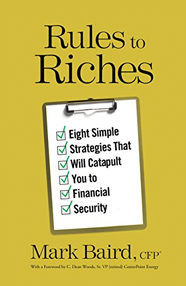
Mark Baird is a Certified Financial Planner who works as a financial adviser and coach. Fascinated by the world of personal finance, he enjoys building plans that help people reach their goals while steering them away from destructive choices and toward financial freedom. He is the author of Rules to Riches: Eight Simple Strategies That Will Catapult You to Financial Security, a practical roadmap that covers everything from budgeting to investing.
📚 Books by Mark Baird
Transcript
[0:00:23] Charlie Hoehn: You’re listening to Author Hour, enlightening conversations about books with the authors who wrote them. I’m Charlie Hoehn. Today’s episode is with Mark Baird, author of Rules to Riches. If you’re like most Americans, you probably don’t feel financially secure. In fact, money might even feel like a daunting problem for you. But Mark believes that lifelong financial health is possible for everyone regardless of their income level. In today’s episode, we talk about a few simple steps that you can take this week to improve your financial future and start building wealth. Now, here is our conversation with Mark Baird.
[0:01:20] Mark Baird: My wife and I had great jobs in Houston Texas and this is back in the early 80’s, mid 80’s. I would say we were living a mediocre financial existence like I said, we did have – we both had great jobs and more money than we had ever made before. We both grew up on a farm so it was a big culture shock when we moved to a large metropolitan city like Houston. You know, the mortgage payments and the car payments and the thinking about kid’s college expenses, started to do a lot of interplay in our thinking. We kind of got bogged down with the debt load and with the obligations that just come with normal everyday life. But in my heart, and to my wife’s heart, we knew that there was a better way. We were ordinary but we wanted to become extraordinary and I knew we could do that because I’ve seen people around us do that very thing. We became very interested in being better when it came to money. While money is not everything certainly, it allows you to get to the next step or the next level of life that you want to be. I remember it very clearly. I got invited to one of these “free” seminars and everybody knows what free means, it means that there’s probably a course or a video seminar workbook that you’re going to be buying or that they’re going to be at least selling. I don’t even remember who gave the talk but I remember a few other points very distinctly and I walked away from that seminar and I started to implement those. One of them was a systematic savings program and at the time, IRA’s had been around for a while, but I had not setup one and my wife had not setup one.
[0:03:17] Charlie Hoehn: How old were you at that time?
[0:03:19] Mark Baird: We were just married so that was probably 25-ish, we were probably 25. So we started an automatic savings plan in an IRA. We started very small and I remember exactly the amount, it was $25 a month for both of us but we watched that continue to grow. The other one, the other distinctive piece that I remember, that I had really never heard about. I mean, this is like revolutionary to me when I heard the guy say, “You know, you could make extra principle payments on your mortgage,” and I’m like, “Wait a minute I signed up for a 30 year mortgage, how could I make extra principle payments?” He said “Yeah, you can make extra principle payments.” He said, “Go to your bank,” – at the time, you know, you had to go to your bank – “and get an amortization schedule which laid out a 30 year stream of payments for every month.” It was a document that had 360 lines on it and it showed the balance, the payment, the amount of interest in that payment and the amount of principle. And sure enough, you’d look down that list and we started to make extra principle payments. Each and every month, we would send in an extra $100 or whatever we could afford, $50 and I would start to take off extra month’s payments and we widdled that down and paid that off in under 10 years as it turned out. But that was the first time I’d heard somebody give me that kind of direction and it was one of some of the best advice that I got and truly, it was free because I didn’t buy the guy’s course. The other thing that he talked about was starting a part time business and how taking advantage of tax rules and tax laws, by starting a business, can really come out to your advantage in the end. If you pick out something that you really enjoy, something that – maybe a hobby that you could convert into a business, then there’s all sorts of advantages to that. I remember having a lot of fun with my wife and I setting down and thinking about the various kinds of businesses that we could start and get some advantage to. To this very day, we’ve got a family business that we started and run – As a sideline right now, sort of a side gig, we would call it now. But it’s a lot of fun and this is a little money, that’s not a lot yet but who knows, at some point in time, that may be well worth spending off to one of my kids and hopefully they can make it into a full time venture, if that’s what they want to do. I remember those three things coming out of that. Out of that, I became really obsessed with personal finance to be quite honest. And I wanted to be educated and informed about all aspects of personal finance, whether it be investing, whether it be risk management – which is really insurance. I took the step of going back to school and actually signing up for the course work that leads to a CFP designation or certified financial planner designation. Now, mind you, I wasn’t in the financial field and did not have a financial background. My background was actually in engineering, that’s what I went to college for. I had this passion for learning more about finances and at the time, I didn’t really think about proceeding to take the CFP exam or getting certified as a financial planner or anything like that. I just wanted to take the course work. I remember stepping in the first class and I was one of about probably 25 in the class but I was the only one that wasn’t in the financial industry fields. I thought, that was kind of strange but everybody was asking me, “What are you doing here?” I just like this stuff.
[0:07:20] Charlie Hoehn: I like to learn.
[0:07:22] Mark Baird: Exactly. You know, after I took that course work and it took about a year and a half to get through all the course work requirements of a CFP. Somebody said, “Why don’t you take the test?” I said, “Well, you know, you got a good point. I’ve spent all this time so why not?” I remember I took a couple of pretty extensive review courses, the CFP exam is a two day exam or it was at the time and sure enough, I passed it. I’m like “Wow, this sort of opened up another potential career path.” Because keep in mind, it wasn’t an engineering related field and was now, at least passed the test to be a CFP. It was built out of a passion of wanting to know more about the financial realm not corporately but from a personal standpoint, personal finance.
[0:08:19] Charlie Hoehn: I love it. What I’m curious about Mark is at what point did you decide “I need to write a book about this” because let’s be honest, there are a lot of financial planning books out there. Do you think it’s a matter of information or how that information is being delivered?
[0:08:38] Mark Baird: Yeah, well, it’s interesting that you bring that up. It was really based on my willingness or maybe my guilt for not passing along this knowledge to my kids, in a way that I thought that they could retain it. I wanted to leave a legacy for them, that all of the things that I’ve been preaching and my wife had been preaching over the last 20 years or so, they couldn’t give an excuse that “Well, I forgot that dad,” or you know, “You didn’t explain it to me that way.”
[0:09:17] Charlie Hoehn: You throw it right back in their face. I wrote a book.
[0:09:20] Mark Baird: Exactly. Now –
[0:09:23] Charlie Hoehn: You're a true family man Mark.
[0:09:24] Mark Baird: I have the book. Well, this way, there is no excuse guys, you know, you’ve got the manual in front of you and believe me, this is not the end all when it comes to financial advice, there’s a lot out there but this is the basic concepts that people can use to grow their wealth or to not make some serious mistakes.
[0:09:47] Charlie Hoehn: Yeah, let’s get in to it then, let’s dive right in because I’ve read a number of financial planning and advice books. What are the most important concepts in your book? We don’t have to go into all of them but maybe pick the top two or three that people can take away from this episode and implement?
[0:10:09] Mark Baird: Right, I would say the umbrella, sort of encompassing the entire book, it’s mindfulness about money. Many of us spend money with largely no thought to it, we spend it willy-nilly. Whether it be credit, whether it be Starbucks or whatever the case may be and we don’t – really unaware. My big call to action for people is to start a system. I don’t prescribe a system, what I tell people is do what is right for you. It could be on a big Chief Tablet or it could be a spreadsheet on Excel or it could be an app like Mint. It could be a program like Quicken but do something and it doesn’t have to be perfect to start with. One of my favorite sayings is “Don’t let the perfect be the enemy of the good.” A lot of people, especially the type A folks will want everything to be just right and perfect starting out and you can’t do that.
[0:11:09] Charlie Hoehn: It won’t be. It just won’t be, yeah. It’s impossible.
[0:11:13] Mark Baird: It’s an evolving process. Don’t beat yourself up but sit down with your spouse or your partner. One of my favorite things to tell people to do because my wife and I have done it many times is to go out to eat and sit down with a sheet of paper or your budget sheet and go through it once a month. And say, okay, “Here’s how we’re doing, here’s what we did.” People say, “Well why do you say go out to a restaurant?” Because, if you get into an argument, hopefully you won’t get too loud and embarrass yourself.
[0:11:49] Charlie Hoehn: You’re in a public place, yeah.
[0:11:51] Mark Baird: Exactly.
[0:11:52] Charlie Hoehn: I love that. Mark, I want to share with you real quick because I am crushing your first tip. I am dominating in this regard. My wife and I, we got married in December so we’ve been married for nine months now. We decided to do a marriage meeting once a week where we discuss our finances every Sunday for at least a couple of hours in addition to other stuff. Ways that we can improve our marriage and every week, we basically say, “This is the smartest thing that we are doing as a couple.” Because it nips these problems in the bud and you do realize, it truly is an evolving process, you get a little bit better each week and you find ways to improve and one of the things that actually came out of those meetings – That as soon as we implemented it, we’re like, “My gosh, why haven’t we been doing this our entire adult lives?” We put an iPad right next to the front door, or the garage door, I’m sorry, where we walk by every day in the kitchen. We look at the iPad, it is always on and it always has Mint on it, it is our financial dashboard. At any given second, we can see exactly where we are with our budget that month, where that money is going, we can adjust the budget once a month and make changes. Because you’re totally right, you have no idea where your money’s going unless it’s staring you in the face and fortunately, we have the tools and technology to make that a possibility where in the past, it was kind of a pain in the neck. You know, I remember, sorry I’m blabbering on a little bit but I love this topic.
[0:13:45] Mark Baird: No, it’s a great story.
[0:13:48] Charlie Hoehn: Yeah, I remember being taught how to balance my checkbook and I remember thinking, “Yeah, I’m not doing this, this is ridiculous. I hate this.”
[0:13:57] Mark Baird: It’s a chore.
[0:13:58] Charlie Hoehn: Yeah, it’s not fun. But now it is fun because it can be automated, you know, people geek out, I geek out over tracking my number of steps and the number of hours I sleep. Because it changes your behavior for the better, just being aware of what you’re doing and you can do the same thing for your money.
[0:14:19] Mark Baird: Absolutely. You guys are on the right track and that’s exactly – what you’re doing Charlie is exactly the type of thing that I encourage people to do and it needs to be within your comfort zone. iPad and Mint is a great way to do it and like you said, we have so many more tools at our fingertips now than we had in the past. It’s really great to see these tools because you know one thing that may be great for one person, may not be so great for another and it allows you to be more mindful about what’s going on with your money and what’s going on with your finances.
[0:14:56] Charlie Hoehn: Exactly. What’s the next thing we got to be doing?
[0:15:00] Mark Baird: Yeah, the one thing that I think is probably the most important thing in the book aside from starting to track where you’re at financially, is what we do with our homes and with our transportation or cars. I call this chapter, “Curb Your Enthusiasm” because we have become so enthused about where we live and what we drive, that it sometimes clouds our future, either figuratively and especially financially. One of the or the two biggest things that have an impact on our future wealth are where we live and what we drive. That sounds very simple but it is so true because probably the two largest things that 90% of the people out there will buy in their life, largely from a financial standpoint where they live and what they drive. If you look at who’s selling you those items, you know, between car salesmen and realtors and the mortgage bankers. What goal do they have?
[0:16:19] Charlie Hoehn: To make money.
[0:16:20] Mark Baird: To make money. It is in their best interest to sell you what? The biggest house that they can or really has the largest mortgage because that puts more money in their pocket, same thing for the car salesman largely. I tell people, be careful what you can qualify for is different than what you should actually spend for those two items. My gosh, if there’s two people that have decent paying jobs, they qualify for an astronomical loan these days. You know what? When you’re filling out those loan papers, they don’t ask you some very important questions. They don’t ask you, well, what if one of us wants to stay at home, what if one of us, or what if we as a family decide we want to send the kids to private school? Or what if one of us or both of us say, you know, we want to retire at age 50 and not age 60. The bank doesn’t ask you that.
[0:17:22] Charlie Hoehn: Wait, Mark, you’re telling me the banks didn’t learn their lesson from the housing crisis and they’re still giving out these horrible loans?
[0:17:31] Mark Baird: Well, there are short memories out there. I don’t have a crystal ball but you know, the housing market has turned around quite considerably. Most everywhere in the country really. I know after being in Texas for many years, it was an up and down yo-yo type of experience. Which, I kind of highlight our journey in the book of buying high and selling low a couple of times, when you buy a house, that’s one of those “investments,” it’s really a purchase that…
[0:18:03] Charlie Hoehn: It is a purchase. Yeah, I mean, why do people, and I think I know the answer. Why do people think of homes as investments? My guess is that the real estate industry sort of perpetuates that myth even though the average return on “investments” for homes is like 0.9% which is atrocious. Why are they marketed as investments, Mark?
[0:18:35] Mark Baird: Well, it’s marketing and really, self-service and look, hey, I’m a capitalist just like the next guy but let’s face it, it’s in their best interest to sell homes. Our tax code to a large extent is incentivized by how much interest can I deduct. And people are conditioned to think, well, you know, I’ve got to buy a house because that will save me money on taxes. Where I tell people, wait. You also need to evaluate renting and in some markets, renting will come out ahead of purchasing because when you purchase a home, look at really what you’re doing. You’re not only paying a mortgage but you’re paying for insurance and you’re paying for upkeep, you’re paying for maintenance, you’re paying for a new roof probably in 10 years if it doesn’t have a new one on it.
[0:19:27] Charlie Hoehn: You’re also paying for keeping up with the Jones’ which is a very real phenomenon if you have neighbors that you’re good friends with who are upgrading their houses.
[0:19:37] Mark Baird: Exactly, I paint a scenario in the book that shows maybe a 25 to 28-year old couple, they’ve already bought their first starter home, maybe a three bath or three-bedroom, two bath home. Maybe a three-bedroom one bath home and they’ve got maybe one child and another one on their way and they’re getting the itch you know? “We’re running out of space, we need a bigger home.” So sure enough and along the career, they’ve gotten some good jumps in salary, so they go to the realtor and say “Hey, you know?”
[0:20:13] Charlie Hoehn: Time for an upgrade.
[0:20:14] Mark Baird: “Time for an upgrade.” And what’s the first thing the realtors are going to say? “Well, how much do you make?” Or one of the first questions, “What’s your income?” How much can you afford in their words, to spend on a new house. Well, it comes back that they can afford a house wildly more expensive than what they thought so then they start the process of dreaming. Okay, instead of a two car garage, you get a three car garage. Well, “We’ve only got two vehicles, we need something else for that third baby. Well what about a boat? What about a jet ski, what about a camper? It’s a bigger house, we need more furniture.” And the list goes on and on and on. Like you said, it’s keeping up with the Jones’. If we stop and be mindful about our needs versus our wants. You know, it’s a cliché, we talk about it a lot but it’s really true. Do we really match up our needs with our wants, given that we have these other goals in mind? That’s a part of planning, that’s a part of what a financial plan does is put everything in perspective. It doesn’t just pick out one or two things to focus on, it looks at the entire portfolio so to speak of the different aspects of finance. Insurance, college financing, things like that, that maybe we don’t think about when we’re dreaming about that next bigger home, that’s going to be so fantastic to live in. My mom and my mother in law would be so grateful to come over and help me decorate, you know? It’s more than that or what my father in law come over and help me with the new boat or the new toy that I can put in the garage. They didn’t think about that when they bought it but 10 years from now, when one, maybe wants to stay home with the kids or they want to put their kids in private school. Or some other financial obligation comes down the road that they didn’t anticipate, disability can always happen, that people get stuck. They get stuck and they get stranded by a home payment that yeah, they can afford now. Is it something they would have worked in 10 years from now. Maybe not. Cars to a large extent are the same way.
[0:22:37] Charlie Hoehn: Yeah. They depreciate in value and everything – I think, what you’re touching upon here is the fact that personal finance is called personal for a reason. It changes over time and you really have to be honest with yourself about what you really care about, what you really value, because money is just a tool to either buy more time or to enrich the time that you have in very specific ways. I think it’s easy for us to kind of be herd mentality when it comes to how we spend our money in following what everybody else does or what everybody else advocates. That is not necessarily a good path to becoming rich and having control of your time and really control of your life.
[0:23:29] Mark Baird: That’s right, absolutely. People can get hung up on the fact, “Well, I don’t want to let money control my life or money is not everything and I don’t want to put too much emphasis on money.” I agree with some of those things but money is kind of like oxygen, you’ve got to have it to live. If you have less oxygen to breathe, that doesn’t make life very easy. It’s part of life, it is money, it’s not inherently evil but it can lead that way if you take it to extremes or you take it in the wrong direction. Use it as it should be and sit down with – and plan out for the future instead of being surprised down the road about things that “Hey, we should have anticipated a long time ago.” But no, you’re absolutely right.
[0:24:28] Charlie Hoehn: Author Hour is sponsored by Book in a Box. For anyone who has a great idea for a book but doesn’t have the time or patience to sit down and type it out, Book in a Box has created a new way to help you painlessly publish your book. Instead of sitting at a computer and typing for a year, hoping everything works out, Book in a Box takes you through a structured interview process that gets your ideas out of your head and into a book in just a few months. To learn more, head over to Bookinabox.com and fill out the form at the bottom of the page. Don’t let another year go by where you put off writing your book. Mark, I’d imagine some people listening right now might have a little bit of a discomfort feeling, right? Because they’re not at the level that they want to be. I think about people who – they don’t go to the doctor because they’re afraid that the doctor’s going to tell them they have some illness or that something’s wrong and they’re going to feel worse about themselves. They’re afraid of that pain. I think a lot of stuff with money is that way, especially because so many people are struggling with debt right now. I think to your first point of being mindful about your spending, that is one of the easiest, simplest ways to get comfortable with it and to get rid of that discomfort is to stare that thing in the face and recognize that it’s not this bad scarlet letter. This thing that you have to feel bad about but it’s just a thing. It is your oxygen levels and you can work on boosting those levels up slowly but surely, right?
[0:26:18] Mark Baird: Absolutely. Being mindful of it means that you have the knowledge that you didn’t have before. I tell people all the time that this money thing is not all knowledge, it’s really only about 20% knowledge and 80% behavior. Behaviors can be changed, even though maybe your income can’t be changed at a blink of an eye, but behaviors can be. Being aware of what all goes on in your pocket book can give you some sense as to what changes maybe we wanted to attempt; maybe we can make in the future. It’s all wrapped up into – sometimes a maze is what people see. But if you sit down and like you said, “Stare it in the face,” get it down on paper, get it down on a spreadsheet, get it down on your iPad and know what you’ve got, what do I owe, what do I own, what is my expenses, what is my income? Really, those are the four basic categories that you line your sheet out with and then your task is to balance those. For most people, it’s not going to balance, hopefully you have more at the end of the month than expenses but sometimes that doesn’t happen. So you need to make adjustments. With the advent of such easy credit, it’s so easy just to live on a credit card and worry about payment later and that’s – as we all know, that’s where people get in trouble is that that credit card does have a day of reckoning and it’s not pleasant for those of us that get in that situation to get out. You can get out. I’ve never seen a situation where someone couldn’t get out of it and it doesn’t always take bankruptcy to get out of it. But it takes a concerted effort, working hard and paying down debt, maybe increasing income to get things balanced out. Because the expenses minus income should be zero at the end of the month, with any extra leftover to pay down debt, or put into savings, or put aside into whatever goal or objective you have as a family. And like you said earlier Charlie – very, very important – this is personal. This is something that should be about you and not about, “Well my neighbor is doing this so that must be the right thing to do.” Or not about your co-worker. “He said to do this or she said to do this. We may need to do the same thing too.” No, it’s custom made for you and you have to do what’s right. The mistake that people make is trying to live their life through other people or to live their life through an advice given by somebody that doesn’t know their full picture. So sit down, take some time and then grab somebody that can help you too. There is no harm in looking on the internet for financial coaches or financial planners. Or you may say, “I need somebody to help me get out of debt.” Well there are plenty of financial coaches out there. In fact there is a lot of what I do, which is to coach people through reducing debt and to getting out of debt. One story I’ll relay, about a couple – man and wife three kids, both of them teachers. And they said, “Mark you know it just looks like we can’t get ahead and we’ve got this debt hanging over our head.” And after a few sessions, and I showed them a great tool that I use to lay out what they owe, what they’re paying on it now and show them some tricks that they could use to start putting more money towards that debt. Well they were simply blown away that they could be debt free and I think if memory serves me correct, in their particular case, it was five years. And that was with a 30-year mortgage. If they applied their savings and all of their extra income towards that debt. They were totally blown away and most people are. You know the power of compound interest works both ways. It will help you but it can certainly hurt you and paying interest on credit cards and long-term debt can really give your financial health a hit if you allow it to.
[0:30:42] Charlie Hoehn: And what was that tool Mark that you used?
[0:30:45] Mark Baird: Yeah if you go to my website, rulestoriches.com, you can download – it’s a debt to management spreadsheet. All you have to do is to put in your name and an email address and you’ll be allowed to get immediate access to the spreadsheets that I have on there. Talked about them during in the book and also available for you to download, no charge for those.
[0:31:06] Charlie Hoehn: Sweet and I want to give a plug to another author who is on the show named George Newberry. He is the author of Debt Cleanse and he has a very unconventional methodology for getting rid of debt. He found himself in over 20 million dollars debt because he owned a number of apartments and there were some massive issues with his business that he was effectively almost forced to declare bankruptcy and he didn’t want to go about doing that because he had so much debt. And he studied debt law intensely, with lawyers and found out how to get his debt down over a long period of time from 20 million to about $20,000 and it’s really fascinating. Again not a conventional wisdom type thing, where we just says, “Pay it off,” he does not say that. In fact he goes the opposite route but really interesting either way. So tell me about your favorite personal transformation that you’ve witnessed in somebody who’s either read your book or used these principles? You gave a great story earlier of the couple who was able to get their debt paid off in five years when they were staring at a 30-year mortgage. What’s been your personal favorite transformation you see?
[0:32:35] Mark Baird: Well there’s one that was really heartening to me and it illustrates something that many of us will run into at some point in time. It was a single mom with two kids in high school. She was scared to death that she would not be able to pay for the kid’s college. One of them was coming up on 16 and she felt obligated to help them out with a car because they had a job. She felt obligated that she needed to provide them money to go to a college. And this was a single mom but she had a good paying job. Certainly not wealthy by any means but was very responsible and we sat down and went over her finances. What she owns, what she owes, her expenses and what her income and looking through it, I told her, “Well here’s something you want to think about.” And where a lot of people think about college education they think that it’s sort of an ate responsibility of the parents. To put the kids through four years of college, four years maybe not a private school, but four years of estate school and I said, “You may want to take a look at that again.” Because what happens if mom, by yourself or even a mom and dad take on that responsibility and that obligation. It may strap them such that they have to delay retirement or maybe they can’t even retire with the lifestyle that they’re used to and what that does ends up as a burden onto the kids. So get rid of the guilt and don’t feel obligated to put your kids through college. Step back and say, “You know two years of community college is not the worst thing in the world and that last two years of college, if college is in the plan, at a state school that degree looks the same going there two years as it does four years.” There’s no difference, there’s no ribbons on that degree. No one will know the difference. The other thing I told her and I think this is maybe a failure of our education system, there is so much emphasis on a formal college and more than a four-year degree now is sort of the bottom credential if you will out there.
[0:35:04] Charlie Hoehn: Right and sorry to interrupt you Mark but it’s to your point earlier of what do they have in it for them? They are trying to make money just like realtors and all the others and they have the best positioning in the world of any institution, which is if your kids go here, your kids will be successful and you will have succeeded as a parent if they get a degree. Which every college kid, or in my generation, knows that that is not true. So it’s not a failure of the schooling system as much as it was the success, I think, of the marketing of a college degree.
[0:35:47] Mark Baird: You know you are absolutely right Charlie and we have to recognize that everyone out there is trying to sell something. Again that’s not bad but recognize what is that person in it for. And colleges are in it, a lot of them are in it to make money even the state school their numbers are based on how many students they can get into the door. So what they are paid by the state government or the federal government is based on enrollment and that’s just a fact of life. That happens in whether it would be a four-year college or a two year college and then you’ve got the whole private university thing going on out there, the for profit colleges that have made it extremely easy to get loans. We could spend another hour just talking about tuition loans for people that they are very underwater. Well they will always be underwater and it’s the other crisis in America that’s really strapping a lot of people coming out of college with, gosh, six figure debts. That we didn’t have to worry about that it was nothing compared to what it is today. So anyway, going back to her, we came to the conclusion that yeah, maybe the kids can consider having a job, for one. A lot of people think that while a kid is going to school then they shouldn’t be saddled with a job. Well maybe that is true but more times than not, kids may be involved. They need to have a skin in the game to that college and maybe that first two years can be a community college. And you know what maybe at the end of that two years, they figured out that a four-year degree is not for me and a technical degree is better or a certificate or maybe, “I want to be a welder or whatever that pays great.” I mean there is such a shortage of skilled trades people in that area and really across the country that it doesn’t take a four-year degree to do that. It takes hard work and stick-tuitiveness, if you will, persistence to go after those opportunities. And they are not in a four year college setting, they are in an apprentice program at the local factory or maybe at the community college who has a relationship with a local employer. Very good things can happen by staying with a trade that doesn’t involve a heavy debt load coming out of college.
[0:38:17] Charlie Hoehn: Completely 100% agree and I’m going to restrain myself because this conversation could get really longwinded and passionate very fast. But I completely agree with you and I think the other thing to this is there are companies out there that now value self-taught individuals just as much, if not more, than people who just went and got a degree. There is tons to be said about YouTube University and people who’ve taught themselves this valuable skills in their own free time. Without having to show up to a room to be lectured and fill out a Scan Tron. There are so many options to empower yourself now and you’re totally on point that there are jobs out there that you can earn six figures and you do not have to take on any debt to get yourself in those positions. It actually really frustrates me when we talk about how jobs have been lost and everything because there is this uprising at the same time, of the new blue-collar type jobs – in addition to the technical skill ones that you are talking about. Coding is the new blue-collar job and there are tons – endless opportunities right now for people who are good at that. It’s just a matter or taking it into your own hands and learning it so.
[0:39:45] Mark Baird: Yeah in fact I was just reading an article today about a former prisoner who had been in prison. I forgot exactly what his infraction was but spent I think 11 years there, got his college degree, learned coding, while he was in there, came up with an app that essentially was a drug recovery/physical activity app. He’s coming out of prison with this under his belt and has a plan of action – would never have come on the radar screen had it not been for the proliferation of online learning. And like you said earlier, YouTube university and all the different tools out there that you can learn by yourself, it doesn’t take anybody. It doesn’t take a classroom to do it. If you want a classroom experience great but you can get that online too if you want it. So there’s a lot of different tools at our disposal that we didn’t have just a few years ago really.
[0:40:49] Charlie Hoehn: Yeah and we are going to keep seeing more and more case studies. I have seen so many of them at this point that I kind of just – it’s not remarkable to me anymore but more and more case studies of kids and their teens, their early teens earning more than the average adult college graduate because they went about the self-taught path. It’s an amazing time to be alive but I think a lot of us tend to forget that or overlook it so –
[0:41:19] Mark Baird: Yeah tremendous amount of opportunity out there.
[0:41:21] Charlie Hoehn: Yeah so you mentioned tax rules and tax laws if you start a side business. By the way, your wife and your side business – can you talk about what that is or maybe give some general information about it?
[0:41:38] Mark Baird: Yeah, it was born out of really laziness on my part of not wanting to mow the yard. So like I said before we head –
[0:41:48] Charlie Hoehn: Let me guess you created a Rhumba for your lawn?
[0:41:52] Mark Baird: I wish, whoever comes up with that I think there are out there but now this is the next best thing really. Like I said earlier, my career had started in Texas. My wife and I spent 25 years in Texas and then decided to move back home. Home is Central Indiana and that’s where we’re at now. But moving from that large urban setting to a largely rural setting, was not so much a culture shock for me but kind of a culture shock for the kids. They adapted very well but you know one of the favorite spectator sports we’re finding out in Central Indiana is mowing grass. There are some huge yards in our area and when we moved back, we bought a house and it had just more yard than what I wanted to deal with and I said, “What can we do to get out of mowing grass but maybe get into business?” And a group on a family farm and still involved in a little bit of farms business side and I knew that we could grow popcorn in our area. At one time we’ve grown, the family had grown a lot of popcorn, and on contract to a large major producer of products that you see on the grocery shelves. So I knew that there was popcorn genes in the soil. So I said, “Well let’s plow this up and see what happens?” So we plowed up, it was about two acres that we’ve plowed up. We planted popcorn and we really didn’t have a business plan like all the books tell you, but we thought to ourselves, “Homegrown popcorn, going to farmer’s markets for people that want a better connection to the farm and the farmer –maybe there’s a niche there?” So sure enough we started that five years ago, started growing popcorn, harvesting that popcorn, bagging it up and then taking it to our farmers market. We had some success but then we started to think outside the box, “Okay what’s the value added to these things?” You know it’s just a great lesson for us and our kids to show that product extension. Well instead of selling the kernels why don’t we pop it and sell it? So we went out and we bought a commercial popper. Started the popcorn on a Friday night to take in to the farmer’s market on Saturday night and it went great and it continues to do great. We expanded into some other farmer’s markets, into some stores. One of the unique products that we developed and we’re continuing to develop is a microwave product that actually pops on the ear or pops off the ear really. So we sell a product that we put a couple of ears in a bag, we put two parchment paper bags in there. And people can just have a blast popping that popcorn, pops off the ear, open the bag and wow, you’ve got this air corn. It still has popped kernels on it and the bag is full of kernels that popped out. Yeah, so if you go out to our website, roomsfullofpopcorn.com you can see a little video that shows that and it is a really neat thing.
[0:45:14] Charlie Hoehn: That’s really fun and unique, I love that.
[0:45:16] Mark Baird: Yeah, so you know figuring out what do you need to do to start your business like that? What are the health department regulations? What kind of logo do you need to do? Do you need a logo starting right out of the gate? Well no you don’t need one. What kind of packaging do you use? What are the rules around taxes? Well what can I deduct? What can I not deduct? What do I have to depreciate or what about mileage on my car? All of those things cost me and my wife and my two sons to understand better how to run a business and a side business at that but that makes a little bit of profit. And you know along the way, it supplies some extra money and to be quite honest that’s what those side businesses put our kids through college and could do the same thing for a lot of people out there. So think about what you like to do. The business could be born out of passion or in my case, just wanting to get out of mowing the yard. And starting something like that, give it a whirl. It doesn’t have to be a huge investment to start growing popcorn. It was really minimal. We had access to some farming equipment that we borrowed to help plow up the yard and to plant, watch it grow, get out there and harvest it and make the best of it. It was a great experience and continues to be that way.
[0:46:44] Charlie Hoehn: That’s great and the one thing I will add to that, to people who are listening who might be thinking, “Oh I have this hobby knitting,” or whatever. People will buy what you’re selling, when you sell what people are buying. In other words, start with people’s behavior of what the market is who the group of people you’re trying to reach first and serve them. Maybe before you start with the product itself. Because I don’t know about your experiences Mark. But in my experience, I’ve had a number of products that I’ve tried to make or even brought to market that didn’t do well. Just because it was something I only cared about a lot and not a lot of other people did. I’ll give you a personal example. Ramit and I, Ramit Sethi, the author of I Will Teach You To Be Rich, he and I developed an app called Negotiate It. Where we created an app that showed you what to say to customer service representatives at a variety of companies in order to save money. So these companies have scripts in order to keep you as a customer and to get you to pay let’s say late fees or whatever. We gave the user exact word for word tested scripts to help them save money and the average amount of money people were saving with our app was over a $100. Some saved over a thousand using these scripts. The problem was no one wants to negotiate, so the app didn’t sell like crazy even though it could help people save money.
[0:48:30] Mark Baird: Well I would have bought it Charlie.
[0:48:32] Charlie Hoehn: Oh I know but you didn’t know about it until now, right? So it never really took off the way that we thought but in any case. This was all phenomenal advice and I’ve got a couple more questions. First, what would you challenge our listeners to do this week to maybe give a shot to applying some of the things that you taught? What would be the one thing you would challenge them to do?
[0:48:57] Mark Baird: I would say give sitting down with your spouse or your partner a shot and talk about money. It doesn’t have to be a lengthy conversation, go out to your local coffee shop or your local restaurant and sit down – probably without the kids around – and just challenge each other. “What do we want to look like as a family financially in five years, 10 years, 20 years? When do we want to retire? What kind of goals and objectives do we have as a family?” And this first discussion didn’t have to be every jot and twiddle about every detail about your finances. But think big and think broad and come up with goals and objectives that you want to do with the family. I would venture to say that the majority of families out there haven’t done that. They are too busy in their mind with just life. Life happens. But take some time and go off and take a couple of hours to do that and then use that as a spring board to get more mindful about your money. Use that as springboard to maybe sit down with an app like Mint, or a spreadsheet like we have on our website or like I said earlier, just a big tablet of paper and start writing those things down. What do you owe, what’s our income, what’s our expenses? That, for some people, that will be the first time that they see it all in one sheet and that’s a very powerful vision. It could either be a good vision or a bad vision depending on where you’re at. Something that everyone should do and do it sooner than later.
[0:50:44] Charlie Hoehn: How can our listeners get in touch with you, connect with you, maybe thank you for the advice on the podcast, let you know how that meeting went with their spouse?
[0:50:55] Mark Baird: Yeah, a couple of different ways, you go out to rulestoriches.com and on that website, there’s a tag down there that you could email me directly and I’ll get your email and I’ll read it obviously and appreciate any kind of communication that you show my way. You can also look me up on Facebook, it’s “Mark Baird Financial Adviser” and feel free to like my page and you can get some tidbits along the week. I usually try to post a couple of times a week with some financial tidbits that hopefully people can get some value out of and take away a bit of wisdom.
[0:51:35] Charlie Hoehn: My final question for you is, what is the number one wish that you could share with our listeners, that you have I getting this message out there? What do you ultimately hope for with this book that maybe our listeners might be able to help you out with?
[0:51:56] Mark Baird: Well, you can spread the word on the book obviously. We’d love for you to go out and buy the book on Amazon, it’s out there both by Kindle version as well as a physical version. I would encourage people to go out and read the book and tell your neighbors about it, tell your friends about it, post something on Facebook about it. I think everybody can get something out of it that will definitely save them the cost of whatever they had to pay for it. Then, just my hope is that people will take something away from this book that will make their life more streamlined and easier from a financial standpoint. Go out, get more educated, but remember that behavior is sometimes more important than education. Don’t be afraid to ask for help from qualified and educated advisors, there are a lot of them out there. Sometimes you have to sift through several to get to the one that you’re comfortable with. Interview ones that you’re interested in and ask some tough questions. We go through those in our book of things that you need to ask before you hook up with a financial adviser. If that’s the direction that you go. And if you don’t go that way, get busy and learn on your own, you can put all these principles into action, you don’t have to go through what I went through. Just because I had a passion for it, I decided to take it to the end-th degree but you don’t have to. You can get educated yourself and then you can grab somebody to help you out along the way.
[0:53:33] Charlie Hoehn: The final thing I’ll add for you Mark is, listener, if you attend church and maybe your church wants to invite in a speaker to help people with financial planning, Mark is a great guy to get in touch with. He’s wanting and willing to do, speaking to groups of people who want to get better in their personal finance lives. Thank you so much Mark, this was phenomenal.
[0:54:03] Mark Baird: Great, it’s my pleasure Charlie, thank you.
[0:54:05] Charlie Hoehn: Many thanks to Mark Baird for being on the show, you can buy his book, Rules To Riches on amazon.com. Thanks again for listening to Author Hour, enlightening conversations about books with the authors who wrote them. We’ll see you next time.
Want to Write Your Own Book?
Scribe has helped over 2,000 authors turn their expertise into published books.
Schedule a Free Consult