James Robert Lay: Episode 454
Read the full transcript
James Robert Lay
JAMES ROBERT LAY is one of the world’s leading digital marketing authors, speakers, and advisors for financial brands. As the founder and CEO of the Digital Growth Institute, he has guided more than 520 financial brands on a mission to simplify digital marketing strategies that empower banks and credit unions to generate 10X more loans and deposits. His insights have been featured in outlets including U.S. News & World Report, The Financial Brand, American Banker, Credit Union Times, and Credit Union Journal. James Robert has also spoken at 200+ events and leads the CUES School of Strategic Marketing while lecturing at universities throughout the United States.
📚 Books by James Robert Lay
Transcript
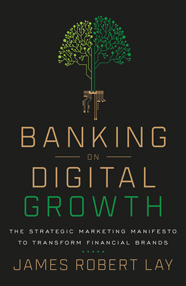
[0:00:24] NVN: As James Robert Lay was writing his book, Banking on Digital Growth, it was clear to him that the financial industry was already in the midst of exponential change. They require their marketing, sales, and leadership teams to think differently. Now that we find ourselves in the midst of COVID-19, as he puts it, the exponential change is now exponential. In this episode, we’ll find out how financial institutions can adjust their digital programs and outreach to cater to this new climate we find ourselves in and also, where there’s a lot of room here for opportunity. I am joined today with James Robert Lay, the author of the new book, Banking on Digital Growth, the strategic marketing manifesto to transform financial brands. James, thank you for joining me today.
[0:01:14] JRL: Nikki, thanks for having me.
[0:01:15] NVN: I have lots of questions for you and the first thing I want to dive into is, in your book, you talk about how the financial industry is in the midst of exponential change. Talk to me about what that change looks like and where we’re at right now?
[0:01:32] JRL: Well, considering that we are now moving through a post-COVID-19 world, that change has been accelerated at an exponential pace. The conversation, it’s really I think more relevant today than it was in this pre-COVID-19 world. Because COVID has been a forcing function for financial brand marketing teams, sales teams, leadership teams, to truly transform not only just the business model, but the growth model – beyond the physical world of branches, of broadcast media – to a true digital-first, mobile-first, acquisition retention growth model.
[0:02:18] NVN: Talk to me a little bit, first of all, let’s explain to the listers what you do, so they have a little bit of context.
[0:02:24] JRL: Sure, I am the founder and the CEO of the Digital Growth Institute based out of Houston Texas and over the last 19, almost 20 years, we have been on a mission to simplify digital marketing and sales strategies that empower financial brands, banks, and credit unions to generate 10 times more loans and deposits. We’re doing this, more importantly, because we believe that money is stressful, and the stress takes a toll on people’s health, their relationships, and their overall sense of wellbeing. People are looking for someone that they can trust to guide them beyond the stress. Once again, I think more so now in a post-COVID-19 world. When we look at the way that we work with financial brands, we’re helping to elevate their positioning through strategy, through training, through coaching, beyond the commoditized promotion of great rates, amazing service, and really position themselves as the helpful guide in the communities that they serve so that they can guide people to a bigger, better, brighter future.
[0:03:30] NVN: Yeah, you’re absolutely right. All of this was relevant before and now, outside of health, there are few more stressful topics for people than money obviously.
[0:03:41] JRL: Well, there’s actually a strong correlation, both through our primary and secondary research, that we had found a person’s financial wellbeing is directly correlated with a person’s physical wellbeing, which is then very closely tied to a person’s mental wellbeing, or their sense of happiness. If we distill down what people want, they want to feel healthy, they want to feel wealthy, and that’s that to say everyone wants to be a bazillionaire, it’s just, I don’t want to have that nagging stress of money, of bills. I want some financial peace, I want some security and, ultimately, I just want to be happy. When money is sitting central to a person’s physical wellbeing and their mental wellbeing, I’m really advocating for financial brands to look at the whole life of a person, not just that their wallet.
[0:04:33] NVN: That makes so much sense. Talk to me a little bit about what that means and especially how that’s translated in this environment and the kinds of conversations you’re having with these banks and financial institutions?
[0:04:46] JRL: Let’s look at this post-COVID-19 world and COVID-19 being a forcing function to really throw out any preconceived notions of what a financial brand, what their mission was to begin with. That’s why in the book, I unpack what we call the digital growth blueprint. It’s nine interconnected, codependent elements that are required for a financial brand to maximize their digital growth potential. At the central heart of this blueprint is purpose. Because I feel if a financial brand can really look inside to the bigger questions of why do they do what they do? Beyond the legacy mission and vision statements, which are traditionally inward facing statements. If we can turn outward with a purpose that empathetically connects with other people, that purpose becomes the North Star. There are some financial brands who have taken the time to transform beyond the traditional mission, the inward focused statement, to develop a purpose statement that is really centered around people and guiding people along their financial journey. Those that have already done that hard work are in a much better place than those that haven’t – but even if you haven’t got to that point just yet, it’s not too late to really look at where we can reinvent ourselves, where we can transform ourselves as a financial brand within the communities that we serve.
[0:06:14] NVN: You’ve done a great job of really outlying these different purpose-driven ideas. The thing that strikes me as we’re talking and thinking about your book is, obviously, this is a very stressful time, but I feel like one of the really amazing offshoots I’ve seen of it is this versioning humanity between businesses and people and, obviously, how people interact with each other. It seems like the things that you’re talking about here just naturally fit with where we’re heading, regardless, right now.
[0:06:49] JRL: Well, for a lot of financial brands up to this point, digital was part of the conversation – strategically and rightfully so – but for many, it was viewed as online banking, which became mobile banking, and that’s only one part of the equation and that’s really what we’re looking at through the lens of service and delivery. The conversation hasn’t – at least at scale – been around, well, how do we use digital to actually grow, attract, new accounts, attract deposits, attract loans? That’s where there’s the gap because the conversation has been so focused around mobile banking, the technology if you will, my call to action is technology is not bad, it’s not good. Technology is nothing more than a tool that, in today’s world, particularly in a world post-COVID-19, we can use technology to bring people together for good, and we’re starting to see some of that happening across multiple industries. I think of my children within one week, the school that they were in was able to very quickly transition to a digital delivery format and bring the students together, bring the teachers together. If a public school can do that, a legacy institution, I’m very hopeful for financial brands as well, because there’s a lot of correlation between what we’re seeing in the education world, same thing in the financial services world.
[0:08:20] NVN: Yeah, one of the things that I agree with you that has been fascinating to witness are these businesses who had these really long range plans, like years out in the future, just all of a sudden, throw them into action into a weeks or days’ time. It’s incredible. One of the things you mentioned that really intrigued me was this idea that we’ve sort of limited the technology to the functions of online banking, deposits, that kind of stuff and that we need to think about how technology can also work as a connector within banking. What might that look like in your estimation?
[0:10:57] JRL: Well, I’m looking at this through the lens, it’s really two perspectives. And it’s formulaic, it’s DX+HX=growth. That’s the digital experience, the technology, plus the human experience, and when we look at the digital experience and how we’re developing and delivering these experiences, it’s really through three different areas, functions or activities. It’s the lead experience. Someone shopping for a financial product, travels or navigates to a financial brands website. What do they see? More importantly, what do they feel based upon what they see? Then they might become a lead, we have the lead experience out of that. And then they become a customer, and that’s where a lot of the conversation has been – it’s the customer experience, it’s the online and the mobile banking. But when we talk about the lead experience, what are the key technologies? It’s a website that sells, tied very closely with marketing automation, and then if you want to take a step further, it’s the data-driven piece of this – data-driven ads, data-driven email, data-driven content. Then the last type of digital experience and really, once again, lead experience has not really been focused on up to this point, primarily throughout this industry. Customer experience, big part of the conversation, but another untapped opportunity – blue ocean if you will – is the referral experience. Using technology to activate and incentivize people to leave reviews, leave ratings, but most importantly, turn net promoters into actual advocates and refer their friends and family so that they can be part of, and once again, purpose-driven. They can be part of a purpose-driven financial brand that emotionally connects with them.
[0:12:47] NVN: You know, it’s interesting because what you're talking about is obviously, moving forward, these are advancements but to me, there’s also this element of the sort of connection of small banking that I think a lot of people alive right now have completely missed out on.
[0:13:03] JRL: Well, yeah. But here’s the thing. In 2008, banks were accused – and it doesn’t matter if you’re a big bank or a small bank, you just got lumped into the entire industry, or even a credit union – you are the cause of the financial crisis of 2008. What I’m seeing now in this post-COVID-19 world is that financial brands, and really more so the community banks and the credit unions, even maybe the regionals, they have the opportunity to be the saving grace, to be the heroes of the communities. I think it’s important when we look at that – it’s not, they’re going to be the heroes – they’re going to be the guides that guide people in the communities that they serve. At least to help create some sense of security. It comes down to why do we exit, why do we do what we do? Because a community bank, they’re a financial commerce conduit. They take deposits from consumers, they lend out to small local business, and who has really stepped to the plate? Even when I think about the whole PPP, the big nationals, and the global banks, they have been the ones that have struggled. It’s been the community banks and the credit unions that have stepped up to help these small businesses in this time of chaos and crisis.
[0:14:20] NVN: That is a really interesting point. It strikes me, as you are talking through all of this, that for tumultuous as all of this is, in so many ways there’s also a lot of opportunity right now.
[0:14:31] JRL: Well I think that’s what we really have to focus on is it’s creating a bigger, better, brighter future. We cannot and we must be cautious of allowing our past to define our present, which will ultimately have a greater impact on where we go in the future. What got us to where we are today will not get us to where we need to go tomorrow, and what is tomorrow? I think looking at the world through a much smaller planning cycle is going to be critical over the next 12 to 24 months. Which is what I am calling this as a 12 to 24 month horizon event. I am seeing that the economic recovery could take twice as long, so three to four years for economic recovery, and keep taking care of yourself as a leader, taking care of your personal mental wellbeing. If you turn on the news, you can just go down this negative black hole. If there’s two practical things that I could recommend for a financial brand leader or any leader for that matter is: wake up every morning, write down three things that you are grateful for. Create a habit and practice of gratitude. And then write down three things that you are going to accomplish that day and really just focus on that. Don’t get overwhelmed, focus on progress and not perfection and just make sure that you continuously moving forward and not getting stuck.
[0:15:55] NVN: I love that. This idea of learning from the past to escape the present is actually the first principle in your book. I am wondering if there are any other principles you talk about in here that are particularly relevant right now?
[0:16:09] JRL: I think there is a lot to learn from the past. It is very interesting. What I talk about in the book, the retail apocalypse, I think this is going to be spurred on even faster. I mean I look at one big retailer now that is just filing for bankruptcy based out of Dallas, Texas, which is Niemen Marcus. And if you think about Nieman Marcus and that whole business model, Neiman Marcus was a brand that brought together a lot of different smaller brands. But now, because of digital, those smaller brands have a direct access to consumers. So it is almost the smaller brands, they are able to be probably a little bit more nimble, more quick, but more importantly I think another key principle of this is really having a vast understanding – and this is the key – of the digital consumer buying journey and the digital experiences that we deliver through that buying journey. We could maybe unpack that a little bit if you think it could be helpful.
[0:17:10] NVN: I love to unpack that.
[0:17:11] JRL: When we look at the digital consumer buying journey, we have framed this around an acronym, and we call it BANCER. It is really six key activities to first and foremost build an audience with data. So for relevancy. Once again, long gone are the days of traditional broadcast strategy of one-to-many messaging, so we build an audience. Once we build that audience with data, we can then attract leads with personalized offers and personalized content. Once we attract those leads through our website that sells, we can then nurture those leads with automation and content – because everyone is going to be in a different stage of their buying journey. Through running now thousands of quantitatable and qualitative user tests and secret shopping tests, we are seeing there is a lot of opportunity just in this part of the buying journey. Once we move from there we get into the conversion aspect. So that is what we would call the shopping cart, if we are going to look at this from a digital retailer perspective. And the opportunity there is to reduce the abandonment of loan applications, of deposit applications, of new account applications, which typically range between 85 to 92%. So even just focusing on that one element can create exponential value within the financial brand. Because once someone converts, they open their account, they get their loan, we move to the E of the model, and that is where we can expand the relationship by delighting accounts, reinforcing that decision that a consumer has just made. Like, you know what? I did the right thing. And then finally, as I mentioned before, we can repeat this entire process through ratings, referrals, and reviews.
[0:19:06] NVN: I am picking on a minor point here but the abandonment percentage seems really high to me. Do you have any thoughts about why that is?
[0:19:15] JRL: Well, unfortunately a lot of these financial brands are at the mercies of third party platforms and providers, who make incremental changes to their application processes. There is a lot of built in friction to these application processes, and, even to this day, you might star the application process online but because of an internal compliance issue, because of some type of a legacy process, that person still might have to go into the physical branch location to complete that application. And so just briefly talking through this, there is so many points of abandonment – whether that abandonment be online or whether that abandonment be once I complete that application online, do I really want to have to drive in and complete that? When I can go somewhere else and do this all online and be seamless and it will take five minutes. Take PPP for example, you know after looking at different options myself, I ended up applying through PayPal for my PPP, for my business.
[0:20:20] NVN: Really?
[0:20:21] JRL: Which took less than five minutes, it was so seamless. It was so simple. And I think that’s the key. When we look at the complexities of financial services by default, the default cognitive load if you will, one of the things that we must do empathetically is simplify the complex as much as possible.
[0:20:43] NVN: This is perhaps a little bit tangential, but I am very curious about your thoughts about this, when this is all said and done, do you think that we are going to be seeing a significant amount of brick and mortar bank closures and see a big turn toward digital in a lasting way?
[0:20:59] JRL: Well I want to look at that from the macro level, that is a great question. The longer that we stay inside, the longer that we have these pseudo-lockdowns if you will – and it is going to vary from city to city, state to state – the more that human behavior will be rewired. So not only will we see the possible closing or at least the shrinking of physical branch locations, we are going to see that across the board. I just think of the forced function of remote working, where so many brands across multiple verticals for so many years said, “No you can’t work from home. You got to come and be in the office,” and a lot of people were like, “No, we can still do this.” Now that they have been forced to, we might not go back to that physical workplace. It might be more of a hybrid-like environment across multiple verticals but it is coming back to financial services. The physical branch, there’s two thoughts on that. There’s the Brett King’s of the world, who for years he’s been saying, “The branch is dead.” I mean he even wrote the book back I think it was 2011, 2012, Branch Today Gone Tomorrow. My perspective on this is the branch might not be dead yet, but it is definitely either A, on life support or B, it is undergoing a massive transformation. Specifically through how we look at things like acquisition and sales, the transaction of the branch probably will continue to just decline more and more in this post COVID-19 world. If there is one thing that I could see the branch creating value for it would be in more of a consultative environment to where someone needs to sit down face-to-face with someone. But even now, I am thinking of what I am seeing with the financial brands that we have been advising and guiding in this post COVID-19 world, a lot of that face-to-face conversation is moving to digital video. It is an interesting time, what’s going to happen? That is where I’m like let’s look at the world through a 6 to 12 months lens and continue to be agile and pivot based upon what is going on and that make long term projections at this point.
[0:23:15] NVN: And my last question for you, you mentioned how helpful it is to just block things out at the beginning of the day, find those three items of gratitude, and come up with three goals. I am wondering, outside of that, if there is any like one or two specific things that you think leaders in this industry should really be turning their minds toward finding solutions to or working out right now.
[0:23:40] JRL: My answer to that to follow up to the previous question you had about the branches, so while we don’t know where branches are going to go over the next 12, 24, 36, 48 months, I can tell you this – and I am very confident – that I would really focus on the digital acquisition piece of this. So transforming a glorified online brochure-like website, which through our secret shopping studies that we continue to conduct, that is what financial brand websites are for the vast majority today. Even if they have been updated and redone within the last six to 12 months. They might look prettier, they might be mobile responsive and hopefully by now ADA compliant, but they’re still not viewed as acquisition or growth channels. Because the primary call to action on those websites is ‘click to apply’, ‘click to open the account’, and as you and I have discussed previously, we have massive abandonment rate. So there are opportunities to add other types of calls to action to those websites. Whether you are redeveloping the whole thing again or augmenting in the short term, that website has to be really the primary acquisition channel for growth, regardless if someone converts, if you will, or closes that loan all-digitally, over the phone, or in the branch. I can tell you, utilizing your website to acquire different types of leads and then using marketing automation to nurture those leads, that is where I would be putting my focus at least over the next 12 months.
[0:25:22] NVN: James it was such a pleasure talking to you today. The relevancy of all of this is fascinating.
[0:25:27] JRL: Yes it is, and it is a dark time for some. It is definitely scary, I get it. But from my view point, even now, in the midst of this chaos and crisis, I am really excited about the opportunities for financial brands to transform their thinking, to transform their go-to-market strategies, their positioning, and to transform how they are acquiring, nurturing, converting, retaining, and even activating referrals. There is a lot of good that can be done at the local community level for any financial brand during this time.
[0:26:06] NVN: You know it’s interesting, it feels like there has been a shift in our experience of this where, in the first couple of weeks, people were waiting to go back to normal, and now there is this dawning realization, “Oh, we are moving into a new normal,” whatever that is. And I do feel like obviously with that comes some uncertainty, which can be scary, but there is absolutely this sense of opportunity also.
[0:26:30] JRL: You’re a 100% correct, and I think that is the key is as much as we want to go back to the way things were before, because it is human nature to seek to safe, to seek the secure, to seek the comforts. Comfortability though from my experience, if you are there too long, comfortability leads to complacency and complacency can be deadly. Just like this disease COVID-19, it is very real, it is impacting all of us whether or not we’ve been “infected,” mentally it is impacting a lot of people – but just like this disease is contagious, from a financial brand leadership perspective, courage is also just as contagious for both our internal teams and the people on the communities that we serve.
[0:27:20] NVN: The book again is Banking on Digital Growth. James, where else can listeners find you?
[0:27:25] JRL: Best place to connect with me would be on LinkedIn. I am very active there. So just Google me, James Robert Lay, connect and say hi, and we’re here to help.
[0:27:35] NVN: Easy enough, thank you so much James. Best of luck with the book.
[0:27:38] JRL: Thank you Nikki.
[0:27:40] NVN: Thanks for joining us for this episode of Author Hour. You can find Banking on Digital Growth, on Amazon. For more Author Hour, hit the subscribe button on your favorite podcast service. Thanks for joining us, we’ll see you next time. Same place, different author.
Want to Write Your Own Book?
Scribe has helped over 2,000 authors turn their expertise into published books.
Schedule a Free Consult