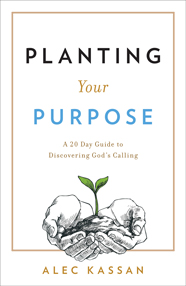
Alec Kassan: Planting Your Purpose: A 20 day Guide to Discovering God's Calling
Read the full transcriptAlec Kassan
Alec Kassan is the author of Planting Your Purpose: A 20 Day Guide to Discovering God's Calling. A consultant and digital entrepreneur, he is the creator and host of The Current Christian, a YouTube channel dedicated to helping people grow in their walk with Christ. He earned a bachelor of science from the School of Education at Syracuse University. In his book, he draws on the teachings of respected pastors and business leaders to help readers find direction, confidence in their faith, and the freedom to live the life they feel called to.
📚 Books by Alec Kassan
Transcript
[0:00:21] CH: Hey everyone, you are listening to Author Hour, the show where we interview authors about their new books. Today’s episode is with Alec Kassen. The author of Planting Your Purpose: A 20 day Guide to Discovering God’s Calling. Do you ever feel burdened by the expectations of others or worry that you’re not living your life to the fullest? Maybe the advice of following your passion is no longer enough to motivate you. In this episode, Alec provides you with stories and insights that can help you turn things around. See, Alec believes that finding our calling and our purpose are not things that require some dramatic epiphany moment. Instead, it’s simply the willingness to take one step in the direction where God is pointing and having faith that God will guide you every step of the way. Alec believes that God’s spirit is pulling you towards something greater than where you are now. His mission is to help you uncover your calling and find your purpose. By the end of this episode, you’ll be one step closer to finding out who God made you to be. Now, here is our conversation with Alec.
[0:01:38] Alec Kassan: Yes, I’ll never forget the day I woke up and it was like super early in the morning, the light was like barely even coming in through the windows and I’m sitting at the edge of my bed and I just had this thought of like, man, I can’t believe that I’m that guy. I am the guy who is living in his parent’s basement. And it’s not that it was like a bad house setup or bad basement, it was just that at the point that I was at in my life, I never saw myself — I saw myself being so much further than where I was. Like after graduating college I was like yeah, I’ll get my degree and this degree will open up all these doors of opportunity and it will just be great. I’ll be making a lot of impact and money but all the doors that I found that this degree was opening was just towards paths that were totally unfulfilling. It had me just sort of sit and question like man, “What have I been doing with the past like, five years of my life?” The thing that really sort of hurt the most was at that point, I really saw myself having like my own house, making my own income and none of that was happening and it really felt that everything I was doing was kind of all for nothing. It was a shame because every type of inspired thought that I had always felt like it was a place where, God was really directing me of some place to go, when I felt like I had that inspiration from God, I would like totally pour my whole heart into that project or into that opportunity and it just seemed like they all would start off strong — and then just sort of — not go anywhere. It would be difficult because I could sense — God would be like, “Okay, it’s time to let go of this thing and I’m like, “but I put so much hard work in my — all this time and resources into me, just want me to let go of it?” He’s just like yes. After like five years of that, in school and coming out, and then just going back home to my parents, I was like, I’m done, I just remember sitting, I was praying and I was just like, “God, I’m done. I’m not moving anymore until I get some more clarity of where you’re trying to direct me” — and in that moment, there’s a thought that kind of came up, like bubbled up in my head and it sort of felt like — If you could imagine a cup of coffee. Just black coffee, no creamer in it, there are these bubbles that sort of rose up from the bottom of it and only as it got closer to the top could you see that these bubbles were coming to the surface. As this idea came to the surface of my mind, it felt like what God was trying to tell me was like, well, you need to know what the vision and the mission is. It wasn’t vision and mission like this stereotypical business sense but it was like vision, meaning where is it that you’re trying to go, what’s the end goal and then mission was like, how are you going to get there? Okay, well, God, what is it? What is the mission? And then, the next thought that came to my mind was like good, that’s a good question. Keep asking those questions and I was like okay, that’s how this is going to be. I started going on this journey just trying to learn from other people who have run successful ministries, who have started successful businesses, and learn from them for how they did it because there’s a saying that I had heard — success leaves clues. I was like, okay, well, if I can learn what they learned in 10 years and get that in just 10 minutes, I can probably buy back all the time that I had spent in school that didn’t really go anywhere. That’s essentially just like what I had started to do. I started conducting all these researches, reading about all these different people, these famous pastors and entrepreneurs, business leaders. From it, I started to form all this information that would later become the book Planting Your Purpose. Yeah, that’s kind of like the origin story of how the book came about.
[0:05:29] CH: I love that Alec, I really relate to that story. I was saying earlier that I went through a similar journey where I graduated during the recession and spent months applying for jobs, not getting anywhere and wondering, “Man, what were the last several years for if it didn’t prepare us to get out and succeed in the world?” It sounds like you had a very entrepreneurial journey which I’m sure, every entrepreneur listening to you can relate to. That feeling of trying things over and over and nothing getting the traction that you need to be financially successful or to serve people at a higher level. Tell me a little bit more about what kind of things that you tried that didn’t pan out?
[0:06:23] Alec Kassan: Well, the very first thing. What I went to school for, you might think like, you must have gone to school for like some business thing or maybe like seminary, nope, it was health and exercise science. I was trying to be a physical therapist and that was the first peg that fell down. I was trying to go to school for the physical therapist, the second year in is when I started to intern at a physical therapy facility and immediately I was like holy cow, this is not for me. I was so thankful that I did that internship, I was like, this is just not for me.
[0:06:55] CH: How did you know?
[0:06:57] Alec Kassan: It was just a thing where it felt like all of this effort that I was putting in towards helping people, it was like, I wanted to help them sooner. A lot of the people that we were seeing — some people go to physical therapy because they get injuries and then they have to get rehabilitated so that then, they can regain normal function. There’s a lot of people who were in there who were injured just because of improper over-use. If you can imagine like your car, if like the wheels aren’t properly aligned, it will damage the car after driving a hundred thousand miles with misaligned wheels. It’s going to really damage the car and that was all the people that I was seeing, I was like wow, they’re just not walking properly on their feet which is causing their knees to buckle and which causes the hip pain that throws out the lower back which is giving them the neck pain and now they got these headaches and it’s like. I was like, I can’t help them that much now, it’s too late. That was the mentality in terms of, like, helping people physically — so it’s like, okay, well maybe I can be a personal trainer where people want to take that step. I tried to be a personal trainer, that too, I was like, I don’t know what that next thing is but I want to help people even earlier than that. Ultimately, what I began to realize as I’m learning more about physical therapy, all the stuff, I was also really diving deep into my walk with Jesus. He was starting to highlight that I really want to help people on a deeper level. I was seeing it like a timeline but I was trying to help people earlier but he wanted me to help people on a deeper level. I was misinterpreting those cues which was why I wanted to help people before they get injured. So the personal training job, eventually I got let go from there. They were downsizing and then I was like well, I’ve got all this knowledge of personal training, I’m going to start a fitness app and I was working on that and it just felt like I was constantly working and working on this thing. It just wasn’t bearing any fruit. Then I was like okay, well, I’m going to just, I don’t know — I just have to maybe pause for a little bit and then I started getting some inspiration for a YouTube channel. I still have the YouTube channel called The Current Christian but it wasn’t like that too, it wasn’t taking off as much as I had wanted but it was kind of cool because that had laid the foundation for building up the biblical knowledge that I have now to help produce Planting a Purpose. So, yeah, hopefully, that story answered that question.
[0:09:27] CH: Yeah, man, I’ve got a buddy right now who is — he has been in the exact same position, he’s a fitness trainer, he’s been working on an app for years and it is so hard to walk away from those projects but like you said, you started hearing that it was time to walk away from these things and to discover your purpose. Planting Your Purpose: A 20 Day Guide to Discovering God’s Calling — the cover of this book is beautiful by the way.
[0:09:54] Alec Kassan: Thank you.
[0:09:55] CH: I love that it’s structured to be a 20 day roadmap, it’s not too much, it’s not too little. Before we walk through the process a bit, tell me what are the common challenges or problems you see people having without having a purpose. What does their day-to-day look like or what are symptoms of people who don’t have a purpose?
[0:10:24] Alec Kassan: Well, one thing. There’s just a lot of studies out there that have straight up just asked people. Are you feeling satisfied and fulfilled with what you're doing? Our culture is so much of like, if you go up to someone, you’re like, “Hi, my name’s Rob, what’s your name?” or “My name’s Tim, what do you do?” It immediately goes to vocation, goes to people’s work. It makes sense because we spend a third, 33% of our entire lives working and there’s this Christian organization called Barna Group who went around and was asking people, working Christians, just like how are you feeling in your current role and it’s like two-thirds of all of the working millennial and Gen X Christians that they had talked with said that they were dissatisfied with their current roles at work and 60% of the millennials and 65% of Gen Xers said that they weren’t fulfilled with the future opportunities that their work was offering. They’re there in a job that they most likely don’t like and then when they look to the future, they most likely don’t have any hope for where it’s going to lead them. If we spend like a third of our life in that, like you can just begin to imagine all of like the mental stress and a mental burdens that come with that because as Christians, one of the character traits that’s very heavily emphasized is this idea of endurance and perseverance and both of those things, if you think of sports, and again, I’m the exercise guy so I’m going to use a lot of sports analogies, but if you think of like sports, which sports uses perseverance and endurance the most? It’s runners. When runners hit these points of hitting these walls, the first thing that comes to mind is just like two more steps forward because they know those two steps are bringing them closer to the goal, to the finish line and if you’re working in a job where there’s no future hope of where it’s going to lead you. Then it’s kind of like two more steps towards what? They get this frustration and you get this depression that’s coming on and with all of that going on. When you do get done with your work, you come home and you don’t have any energy to pursue any other type of passion. It just creates this downward spiral of this void of purpose and of course, you know, people try to — well, “I’ll just try to make more money at my job” but it’s like a Bob Marley quote, “money is just a number.” It can always just be a higher number and statistically, there’s this thing where once you make a certain amount of income, the amount of happiness that you get from it — it’s inverse. It does not go up like there is that point earlier on when yes, when we make more income, studies show that we are happier but it does get to a point where it doesn’t matter how much more money you make, it just doesn’t press that button of like I’m feeling better, I’m feeling more joyful. And that’s where this purpose thing comes in, like who is it, that God — not necessarily what is God calling you to do but who is God calling you to be. That’s the real emphasis of this book so it’s not necessarily like, you’ll get to the end of the book and it’s like wow, I’ve been working as an engineer this whole time but I was really supposed to be a piano player, it’s like no, it’s not. It’s, what’s the character that God wants you to thrive in? What are the values that you should have?
[0:13:47] CH: What did this process do for you, where is your life now compared to where it was?
[0:13:51] Alec Kassan: Well, that idea of that future hope, it’s one of those things that I was kind of telling you a little bit earlier, after having written this book, it’s like wow, it kind of ended at a point where I just want to provide even more value. I feel like there are even more topics to talk about and more problems that can be solved. And it feels like I not only had going through the ‘planting your purpose’ process for me helped me to better see vocationally where God is bringing me but relationally it’s helped out a whole lot. So I am newly married and being a husband is brand new, I’ve never been a husband before. And this is the first time I have been one and I don’t plan on being a new husband ever again. This is the most important role I think I have ever had in my entire life because no one else can replace me. In a job you can get fired and business can replace you but, I am not getting, A, fired from this position and, B, I don’t want anyone to replace me for her. So what does it look like for me to be a husband and having gone through the Planting Your Purpose book the values that I discovered through it and that is the thing too. When you go through this you are discovering who it is that God is calling you to be. It is not me telling you. I am not giving you the things. It’s like you are the materials and God begins to highlight things for you as you are going through the book. So by the end of it, I was like, “Oh wow, as a husband I am to be an encouraging, trustworthy, generous and serving husband.” So those were some of the values there. It is encouraging, like, I am looking for the strengths in my wife. And I am speaking light into those things, I am calling those things out. Trustworthy. When I say I am going to do something I am going to do it right then and there because that is something I struggle with a little bit and then she’ll be like, “Oh babe can you help me with getting the laundry out?” I’ll be like, “Oh yeah.” But I don’t mean oh yeah right now. I mean oh yeah whenever I feel like it.
[0:15:50] CH: Three days later.
[0:15:53] Alec Kassan: Yeah, right? And then we don’t have any clean clothes and it’s a mess but yes that’s trustworthy. I am going to get up, when I say I’d do something I’m going to do it right then and there. Generous, I am going to do things despite me feeling like I don’t want to do them. When we are generous it’s not like, “Oh I have the things to give you.” It’s if someone has a hundred million dollars and they give a thousand dollars to some charity, that’s like a drop in the bucket for them. But for someone who is only making thirty-thousand a year, if they give a thousand, then that’s like, “Wow, that is very generous of them.” So moments when I don’t feel like I got the energy for something it’s like bam, I’m going to be a generous husband. I am going to do that and then serving. Everything I do I want to do for the betterment of my wife and those values are ones that super stuck out for me as I was going through the book. Because God was highlighting that stuff for me in a very unique way and using the analogy of planting, ‘planting your purpose’, it is a garden there are some seeds that won’t do well in certain types of soil and in the Bible there is a lot of talk about having a hard and soft and fertile heart. So I use that analogy in this book where if our heart is this garden and the seeds that we try to plant in there aren’t the ones that God wants to plant then they are not going to be fruitful. You can’t try to plant a cactus in a Florida marshland. That doesn’t work and you can’t try to plant an apple tree in the desert. At least I don’t think you can because it is too dry there. So you are going through this book and it’s like, “Wow, these are the values that God really wants to emphasize and have these become fruitful in my life and knowing those things early on, I have only been married for like it’s almost been a year now. And having that knowledge now, oh my gosh, I can’t even begin to imagine all of the petty arguments that have been avoided because of this stuff. It’s helped us grow closer together and it’s also helped avoid a lot of unnecessary friction.
[0:18:06] CH: Yeah and imagine — and congratulations by the way on becoming a husband, welcome to the club. So I guess for your book, like you said, you follow the gardening analogy of laying the groundwork, cultivating, digging, envisioning, planting, watering, and so we can’t go through all of them but let’s walk the listeners through the groundwork. What do they need to do at the very beginning to lay the groundwork for their purpose?
[0:18:42] Alec Kassan: Well, in the groundwork section of the book, it is very much about trying to establish like I want everyone to be on the same page when they are going through this book. So for example, terminology. In the book when I am talking about calling, a lot of people hearcalling and they’ve told me. They’re like, “Oh cool, so I am going to know my spiritual gifts.” I was like, “If it is about spiritual gifts I would have mentioned spiritual gifts.” Or they’ll be like, “Oh calling. So yeah you mean like a job” and I’m like, “No, in the Bible God very much cares more about who you are than what you do.” So laying certain terminology foundations like that and then another one, for example, vision-mission. At the end of the book, you will have a vision-mission statement but again, it is not like a business vision-mission statement. It’s like a creed or a personal motto type of thing. So for me, being an encouraging, trustworthy, and generous serving husband that’s the vision. That is what I am aiming for and then the mission would be specific steps of reaching that, fulfilling that. Other things of groundwork include just understanding like the severity of what’s going on. 60% of millennials, 65% of Gen-Xers not being satisfied with their job at the workplace or not feeling fulfilled of the future opportunities that it holds. So if there is someone who is going through that and they read that and they’re like, “Oh wow, okay so I am not the only one.” It makes it feel less like the individual is doing something wrong and makes it more aware that this is slightly more of a systemic problem here.
[0:20:16] CH: Well you have day three here, which says “First things first,” what’s that part about?
[0:20:21] Alec Kassan: So for example on day three, there is this whole chapter talking about first things first and in the Bible, I have a quote here on Mathew 6:33. Jesus saying, “Seek first His kingdom,” meaning God’s kingdom, “And His righteousness and all these things will be given to you as well.” and he is talking about how people are very stressed out about, “Oh what am I going to wear? Where am I going to get food?” and it’s like hey, all of these things are going on around us. But I want you to focus on first is seeking what God is doing in you and around you and this chapter, it not only says, “Oh yeah do that” but it also points out the bad side-effects of what happens if you aren’t seeking that out first because a lot of times, I have experienced it in some churches where it is like the real quote for the Bible, and they’re like, that’s it. It’s closed and I’m like, “Oh come on, give me some more.”
[0:21:12] CH: There is no room for interpretation there.
[0:21:15] Alec Kassan: Yeah, right? So I’m like okay, so in this I actually, for example, what happens if you are putting people first? And if you are putting people first, your identity is based on how other people are treating you, do they accept you, what do they expect of you, their opinions of you, that totally influences what you view for yourself and it doesn’t matter if it is true or false. If you are putting other people first, everything that comes out from those other people — it drastically influences your image of yourself. So your trajectory, where you’re going in life, it is totally limited by what others think is best for you. And it is sad because I know there are people in my life who really love me but when I heard this idea that, “Wait, you are not going to be a physical therapist? You’re going to what? You’re going to try to start a YouTube channel?” And then it’s like, “You’re going to try it right? You know you don’t make a lot of money for books,” and they are not saying that because they don’t like me. But they genuinely believe that what is best for me is to do the things that are safest. You can’t thrive if you are always playing it safe. Where we go in life is limited by those types of people. Our discernment is limited by other people’s perspectives and it is not that other people’s perspectives are bad but you are only getting a small view of what is going on and it is also distorted to meet what they want and desire because we all have our own wants and desires. So when people are trying to think of what is right or what is best for you, it is ultimately going to be that their decision is influenced by what they want and what they desire. So you could think of helicopter moms. What they would ultimately love is for all of their baby boys and baby girls to just stay at home, not leave the house ever. But yeah that’s totally daily. He can’t function as a human being living like that and yeah, I don’t want to go too much deeper into the whole thing of putting people first. But that is just one example. Imagine putting money first or putting possessions first or putting pleasure first and then even putting your work first. I was telling you about this like I’ll just keep working. It’s just like I feel I got to keep doing stuff but God doesn’t call us to just continue to work. When Jesus calls to you it’s like, “Oh you can find rest in me.” so it’s like wait, if Jesus is talking all this stuff about rest then why am I so driven to do work? And if I had it be first, it could be totally devastating in my relationships and just my health and things like that. So this chapter, that day three, really goes into depth with all of those things and as you read through it, it’s ultimately going to happen. You are going to read something and like, “Holy crap that’s me, I am doing that” and it happens. There’s this idea of being a living sacrifice that they talk about in the Bible as well and that idea is like a dead sacrifice. We don’t do animal sacrifices and stuff, at least we shouldn’t do animal sacrifices and stuff but imagine them sacrificing an animal or even sacrificing money. Bam, you give money. It’s done, it’s over with, it can’t do anything but being a living sacrifice, it means you have the opportunity to get yourself up off the altar and walk away. So recognizing these things is like, “Oh man, I am putting these things first” — that’s part of being a living sacrifice but you got to acknowledge it. And then you gotta be willing to put yourself back in that place of being like, “Okay Jesus, I am going to put you first.” Yeah, so it is actually a pretty short day, the day three one but it talks about a lot of really important stuff.
[0:24:38] CH: Yeah and like I said, there are so many more things in the book that we just don’t have time to go through, which is why listeners will need to pick up a copy on Amazon. So tell me, have you put a bunch of other people through this 20 day journey or even has your wife gone through it and if so, what’s been your favorite transformation or success story that you have witnessed?
[0:25:05] Alec Kassan: I think the biggest success that I have seen with people who are going through this is A, they’re like, “Wow, this is almost a new way of experiencing growth, spiritually.” And then the other thing is, it sparks that desire to at least want to go further in the journey because there’s this expression that ‘the opposite of love is hate’ and no, the opposite of love is apathy. You just totally don’t care. Jesus talks about that — how you’d rather have someone who is super-hot or super cold in terms of their desire to be with Him. But the person who is lukewarm, that is in the middle, doesn’t really care too much, He’s like, “I spit that.” He was talking about water like you’d rather have hot water or cold water but the lukewarm, you spit it out and the thing that’s been really cool is that this at least really sparks that desire where it’s like, “I want to go further in this journey with Jesus” and because it is a guide, it allows people to do that. So maybe in the beginning, it begins to stir that curiosity there. And then by the end of it, it’s like “Wow, I’m feeling so much closer to God and I am so much more aware of what he is trying to do in my life to kind of produce fruit and all of these various areas and these roles that I fill in my life.”
[0:26:22] CH: So Alec, tell the listeners where they can find you, where they can get more information about what you are doing and potentially follow your work?
[0:26:33] Alec Kassan: Right now I am building out the website for plantingyourpurpose.com. It’s just one word and if you want to see me on YouTube, I have all of my various Facebook, Instagram and Twitter links on YouTube but if you go on YouTube, type in “The Current Christian” it’s three separate words, my YouTube channel, it should pop up first. I’ve tried my hardest to improve the search engine optimization for that but The Current Christian. See me on YouTube there, feel free to subscribe but you can also find me on Facebook and Instagram and Twitter through the links that I have provided on that channel.
[0:27:11] CH: Excellent. The book is Planting Your Purpose: A 20-day Guide to Discovering God’s Calling. Alec, thank you so much for being on the show.
[0:27:20] Alec Kassan: Oh hey, thank you so much for having me here. I’ll tell you the truth, I was a little nervous at first but you know the time has flown by. You are a really great host and super thankful for that.
[0:27:32] CH: Thank you sir, I appreciate it. Thanks so much to Alec Kassen for being on the show. You can buy his book, Planting Your Purpose, on amazon.com. If you haven’t already, be sure to subscribe to Author Hour on Apple Podcast and take a second to leave us a ranking and review. It means a lot. We’ll see you next time.
Want to Write Your Own Book?
Scribe has helped over 2,000 authors turn their expertise into published books.
Schedule a Free Consult