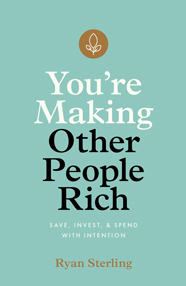
Ryan Sterling: You're Making Other People Rich
Read the full transcript
Ryan Sterling
Ryan Sterling is the founder and head wealth coach at Future You Wealth. He has over fifteen years of experience helping individuals and families achieve their financial goals, in addition to teaching financial literacy courses in underserved communities. He has a BA in economics from Carleton College, an MBA with a specialization in investment management from Vanderbilt University, and is a CFA Charterholder. He is the author of You're Making Other People Rich: Save, Invest, and Spend with Intention.
📚 Books by Ryan Sterling
Transcript
[0:00:24] DA: Many of us live in constant unrest as we fill voids with possessions and battle the urge to consume. As a financial advisor or Wall Street, Ryan Sterling has seen it all; unfulfilled millionaires, disgruntled divorcees, and ego-driven over spenders. Money was no longer a beneficial resource, but instead an incredible burden that eventually define them. But when them turned into him, and he found himself on the verge a personal collapse, it became clear that building and managing wealth is a lot more complex than formulas or forecasts. In You’re Making Other People Rich, Ryan explores how to use mindfulness and intention to restore your relationship with wealth. He shows you not only how to invest, but also how to make deliberate strides towards financial independence. Hey listeners, my name is Drew Appelbaum. I’m excited to be here today with Ryan Sterling, author of You’re Making Other People Rich. Ryan, I’m excited that you’re here. Welcome to the Author Hour podcast.
[0:01:20] Ryan Sterling: Yeah. Thanks for having me Drew.
[0:01:22] DA: Ryan, first, tell us a little bit about your background.
[0:01:26] Ryan Sterling: Yeah, so my professional background has been all in wealth management. So, I was the kid who graduated college, this was early 2000s and I wanted to be an investment banker. I had no clue what an investment banker did on a day-to-day basis, what their function was in society. I just knew that’s what I wanted to do. Where really, I just wanted to be in financial services. I didn’t really necessarily have a why, it was just something I was always attracted to. When going through the whole interview process, I landed in the world of wealth management, where for the last 16 years now, I’ve been working with individuals and families to help people achieve their financial goals, wherever they are in life, whatever those goals happen to be.
[0:02:20] DA: Now, you open the book talking about not being happy, having credit card debt piling up, being at the brink of divorce. Talk to us about how you got to that point.
[0:02:30] Ryan Sterling: Yeah, I mean this is the ironic part about this, is that, I was advancing in my career. Again, I was in the wealth management field, so I was helping people with their money and I knew all the technicals. I have my MBA, I’ve worked at some of the top firms in the world, I have all the professional certifications you can ask for. So, I knew from a technical side how to manage money and how to help my clients. But for myself, I really neglected our personal finances. And we fell victim to what a lot of young professionals and just a lot of people fall victim to. It’s a phenomenon known as lifestyle creep. Lifestyle creep is, the way you can think about it, it’s basically every time you earn more income, it becomes an invitation to develop more expensive habits. You can get a nicer car, you can have a nicer home, you can go to nicer dinners, take nicer vacations. So it’s one of those where every time I make an extra $100,000, our annual expenses would go up by $120,000. It happens way easier than you think. It was one of those things where — remember early in my career, this is kind of the one classic stories of, I was 25 years old and I was pulling something from the printer. And there was a print job ahead of mine that I picked up inadvertently. And it was the W-2 from one of the more senior colleagues at the firm. And the senior colleague was probably in their late 30s or so. I saw their W-2 and I saw the amount of money they were making. And at that point, I was making like, I don’t know, like $60,000 a year, something like that. I saw this number and my eyes were popping out of my head, I could not believe it. And I was thinking, “Man, when I hit that number, that is going to be my I-made-it number, I have arrived. So then fast forward ten years later, and as you mentioned, I’m in this downward spiral. But it’s not – you wouldn’t have noticed it. If you’d met me, you would have thought that everything was great. It wasn’t like it was horrible, but everything you just said is totally true. In credit card debt, financially unstable, dependent on the next paycheck, the next bonus. My marriage was in disarray. I wasn’t healthy. We weren’t living the life that we really wanted to live. We’re just kind of reacting to the things around us. It was one of those things where it was the end of the year, and my birthday falls at the end of the year. And I was just kind of reflecting on the last ten years of my career. It was also at the time when I’m like, “Wait a sec, it’s the end of the year. How much money am I going to make?” And I logged into ADP and I looked at my income. And it really hit me, that moment ten years ago when I picked up that W-2 inadvertently off the printer, I realized I hit that number. It was one of those moments where like, “Wow, I just hit my I-made-it number,” and I would trade places with my 25-year-old self in a second. It really dawned on me — there was a whole series of moments but it really dawned on me that just because I’m good at what I do with respect to helping my clients, and I have all the technical knowledge that managing wealth, it’s not just about having the technicals. It’s not just about knowing what a net worth statement is, helping people track a budget, investing, knowing modern portfolio theory, all the like. It actually more comes down to your personal relationship with money. And designing a life that you want to live and have money being a resource that aids you in living your best life, not just something that is a resource to acquire just more stuff. I realized at that point that we were stuff and image rich but really poor everywhere else.
[0:06:32] DA: Now, who is this book for? Is this for folks who are high earners like yourself or can all walks of life find gems in here?
[0:06:41] Ryan Sterling: I mean, this book was written for really the 25-year-old me or even the 35-year-old me. So actually, I wrote the book for a former version of myself. And that person was – the acronym is HENRY, it’s high earner, not rich yet. So, it’s the person who is making, call it a six-figure income. It doesn’t have to be six figures but let’s just use six figures. And they get to the end of the month or they get to the end of the year and ask, “Where did all my money go?” That’s really who this person is for, and I think the person who fits that criteria is going to get the most out of this book. But that said, if you’re a college kid who is about to start their first job, I think you can read it and avoid a lot of the traps that a lot of us in our 30s, 40s and 50s fall into.
[0:07:36] DA: Totally guilty of all those traps, so I understand, completely. To get into the book, you started off with a quote that there’s an instant gratification generation in the world right now.” Which I think we’re all a part of in some way. What did you find that drives this need for instant gratification?
[0:07:55] Ryan Sterling: I mean, I just think we’re innately wired for instant gratification. It’s one of those things where, if you think about you have a choice. Let’s say you have $500. And you can put that $500 in a retirement account. And I can tell you 30 years from now, if it’s invested in a diversified portfolio that — I mean, so let’s just say $500 in a diversified portfolio. Thirty years from now, you’re talking that’s going to be roughly $2,000 let’s say. We got to round up number. So I’ll tell you, you take that $500 and it’s going to be $2,000 30 years from now. And think about if you put $500 once a month in the market, how that compounds and how that adds up over time. So I sit there and I tell you about this. But as I’m telling you about this, right in front of you is -- I mean, name the thing that you enjoy. It could a new guitar, it could be a new pair of shoes or a whole new outfit. It could be a new gadget, a new iPhone, a new whatever it may be. It’s one of those where on a second by second basis, we are being bombarded with images and messages of these things that provide this dopamine release. You have this new thing, it’s fun, it’s shinning, it hits those pleasure sensors in your brain and it’s one of those things where it feels good and exciting. Where the alternative, of taking that $500 and putting it away and saying, “Okay. At some point, it’s going to be worth significantly more than $500 and I can use it for my future self.” That’s just not interesting, right? That’s not compelling, that’s not exciting, that doesn’t get that dopamine rush that we all want to need. So we are just wired to want to consume now and just ignore the future because now is what matters more than the future.
[0:09:49] DA: I think we have to look no further than how many users the Robinhood app, which is stock trading app has gained during this quarantine, that people are saying, “Hey, I’m saving $30 by not going out to eat tonight. I’m going to trade it right now and I want to see it when it grows.” And their numbers are through the roof, but the amount of people that probably invested in a long-term savings plan during this pandemic are probably way, way, way smaller.
[0:10:17] Ryan Sterling: I think you have a really good point, because I think a lot of these Robinhood traders -- don’t get me wrong, there’s nothing inherently wrong with Robinhood, and I think Robinhood is getting a bad name because I tell people to open up Robinhood accounts all the time and invest in an S&P 500 index fund, which you can get into if you want. Which you can do and it’s a super easy, cheap and effective way to do it. So there’s nothing inherently wrong with Robinhood. But to hit on your points, that dopamine rush, that instant gratification, that pleasure sensor that we all want activated, that’s the problem with how people are using the Robinhood app, is they’re buying these momentum, high flying stocks. And you invest a thousand dollars, and a month later it’s $2,000 and you think you’re this amazing trader, but look what’s happening now. So, it’s one of those where, I think unfortunately people are going to be severely punished for this day trading mentality. And we’d be much better served by taking a long-term orientation. But again, that’s not fun. That’s not exciting. People don’t want to hear that.
[0:11:20] DA: Can you tell us about some of the ways that you see us being exploited for the profit of others?
[0:11:28] Ryan Sterling: Yeah, I mean, part of it is, you think about the job of a marketer, think about a boardroom and think about a marketing team at any sort of retailer. It’s their job. They’re not bad people, they’re great people. But you have to think about, it’s their job on a day-to-day basis to figure out new and creative ways to get you to spend your money. And when you think about whether it’s advertising, hitting on social media influencers, there’s the whole idea of loss and less. If they convince you that you lost out on something or that you have less than somebody else, they’re going to beat you every single time. You’re going to be forced into consumption, because that’s the anxiety that you have of, “If I’m not consuming this, then I’m not embodying the identity of what I want people to think I am.” If you start a company today and it’s retail focused, and you go to any venture capital firm and you’re looking to raise money. The firms that are easily racing money are those who have reduced friction points between the customer and the sale. So what I mean by that? Well, think about the process of buying a pair of shoes back in 1940, I’m just making that up. There were number of natural frictions points that existed between you and buying the pair of shoes. You had to number one, say you need a pair of shoes, then you have to look, do you have cash or do you not have cash. If you don’t have cash, you have to go to the bank, you have to wait in line, you have to get your cash from a teller. Then you have to drive to a store location, you have to dig through inventory. If they don’t have what you have, then you have to go to another store location. I mean, if you think about 60, 70, 80 years ago, the process of buying a pair of shoes could be a four to six-hour affair. Whereas today, you can get an alert on your watch, press one button in your phone and you can have 20 pairs of shoes delivered a day later. The friction points are gone and this is intentionally designed. So you think about how we’re being manipulated to spend, it’s the constant bombardment of images of people who have more than us. We have an innate need to pursue pleasure, and it’s knowing how to activate those pleasure sensors as I’ve mentioned before. The idea of FOMO, the idea of missing out, of having less than someone else. They know this and they know who to tug on these emotions. They’re very smart, they’re very sophisticated and they know when you’re most vulnerable. So take all of that and then take account the fact that the friction points have been reduced to absolutely nothing. And it’s no wonder why we’re a nation that it’s in credit card debt, why 70% of Americans have less than $1,000 in savings. It makes a lot of sense when you think about the messages out there, and then the fact that it’s so easy for us to spend our money.
[0:14:24] DA: Now, you talk in the book about ways to find that. And one of the great sections is, you list some questions to ask ourselves to find out what we really want. Can you talk to us about some of those questions we should ask?
[0:14:38] Ryan Sterling: Yeah. So when you think about what do you really want at the core of who you are as a person. And I give a couple constraints, it can’t be more money and it can’t be anything material. So think about what you want really at the core of who you are. What gives you peace? What gives you purpose? What lights you up? What makes you feel connected? What makes you feel love? And when you start asking what you want adding the constraint where it can’t just be more money or can’t be material things, you actually get to the core of what you want, is more human connection. What you want is to embrace some sort of challenge, to grow as a human being, to pursue something that scares you a little bit. It’s one of those things where our wants actually usually don’t involve needing more money or having to spend more money. For me personally, again, this is something I went through in that exercise when I went back. And I picture myself looking at my paycheck for the year or my numbers for the year and think of, “Wow, I hit that number. I hit my I-made-it number and I’m as miserable as ever.” And I realized that what I was spending my money on, it’s just the things that were filling me up in the moment, but weren’t really filling me up as a human being. And when I actually sat down, I said, “What do I want? Like, I want to have a really good marriage. Okay? I want to start a business. I want to have more freedom. I want to have more control over my time. I want to spend more time with my friends.” It was when I took out the material side of it all, it really brought to light of the things that I was missing out on and the things that were truly wants that were going to fulfill me as a human being and I just lost touch with all of those.
[0:16:31] DA: Why are we attached to these certain things or why are we so attached to having certain things in our lives?
[0:16:38] Ryan Sterling: I mean, we are wired from a young age to be attached. I mean, if you think about it, just look at the standard American dream. I’m not an anti-American dream person, but I’m also not saying that we all need to fall in line and live in accordance to this dream that’s been scripted out for us. But just look at, think about if you’re a high achiever, so you go through middle school and you’re getting good grades. And then you go into the top classes in high school, and you continue to get good grades, and you’re checking off all the boxes, you’re in the right clubs, you’re doing the right activities and you have the grades. You study for the standardized test and you do tell on the test. And then what does that do? Well, that leads you into a “good college.” So now you go to a top-ranked school. You’re a high achiever, so you’re going to continue to be a high achiever. So you can kind of continue to do the exact same things. Go to the same clubs, get the good grades, you’re going to make sure you know what’s on the task and that you deliver on the task. So then what happens? Well, then you say, okay, what does a high achiever do? I’m just making this up and I apologize to all the attorneys out there, but I’m going to use an attorney as an example. God bless you all. So then you say, “Okay. What am I going to do? Now, I’m going to law school because that’s what high achievers do. Okay. So now I’m going to law school.” And then once again, you’re getting the good grades, you’re checking up all the boxes. And then what do the top law students do? Well, we need the big paychecks so we’re going to work at X, Y, Z big firm in New York working as a corporate attorney. And I’m working 100-hour weeks, and again, I have about $60,000, $70,000 signing bonus. I’m making really good money right out of school. Again, I’m a high achiever. And now, all of a sudden, I’ve got to live this lifestyle. I’ve got to live in the right place. My kids need to go to the right private school. I need to belong to the right clubs. I mean, we become attached to this identity of who and what we think we are, but more importantly what other people need to think of who we are. And it’s ingrained from a very young age, it’s just following the next step of what a high achiever does without really a lot of thought into, is this my best life? Is this how I want to spend my time? Is this something that excites me? Am I checking off all of the boxes of what it means to be a whole and wealthy person? Or I’m just doing the next thing that it’s in front of me, that net should that I think I should be doing? And I tell you, in my practice now, I have a completely different approach in the firm that I run today and we talk a lot about lifestyle design. And I tell you, there’s so many people that fall into this high achiever trap, where they are attached to their identity of being a high achiever. And as you become an adult and as you get into your 30s, 40s and 50s -- and what’s interesting, when you are someone that identifies as a high achiever and you’re always checking off all the boxes. At some point in time, you kind of start missing out on boxes to check because you kind of check all of them. So then you have to figure out how to earn your significance through other ways. I talk about this in the book where I say, think about it if your proxy for success was always grades, and it then it became the school you went to, and then it became the graduate school you went to, and then it became the law firm or whatever firm you’re working for. And again, that’s your identity, that’s where you’re driving your significance from. Well then, at some point, you also have to drive your significance from showing how successful you are and not only do I work at a top firm, but I’m like the top attorney at the firm. There are definitely ways that people can earn their significance through their actual work. But another way is through showing people how successful you are because money is a proxy for how our time is valued. And if you think about how — so think about it if you get your significance through being known as the fit person and fitness is really important to you. Well, it’s pretty clear when someone is physically fit, you can see it in them. But when your significance is tied up into and you’re attached to people seeing you as successful, well, it would be a faux pas to broadcast your net worth on a t-shirt but we do it in other ways. So we do it in the shoes that we wear, the cars that we drive, the clubs that we belong to, the neighborhoods that we live, the private schools that our kids go to. Giving you a long answer on this attachment one, but that’s where it’s so easy to fall on these attachments because there’s so much identity, ego and self-worth tied up into what things and outcomes say about who we are and our self-worth as a human being.
[0:21:35] DA: Yeah, I mean you’re absolutely right. Money and ego will affect many, many decisions. And let’s say, earlier in the conversation you were telling us about, you realized this stuff is making you unhappy and that maybe you haven’t hit those goals or you haven’t found out what you really want. So let’s start taking action against this. Let’s call it the cycle of sadness. You call it the cycle of madness. What should people do to start organizing their finances to find out where they stand right now?
[0:22:01] Ryan Sterling: Yeah, it’s a really good question and it’s one that, this is the biggest hurdle for people, so I see this in our practice all the time. So one thing I talk about is that, the problem that I solve in the world, it’s really unrest. And when people come to me, they’re in a state of unrest and money is the proxy for their unrest. But it’s one of those things where they’re feeling out of control and they need some help. So they know something is wrong. But with taking action, the first steps are really uncomfortable one, and that is putting everything out on paper and staring at it. So number one, you have to know where you’re starting from. So think about, again, you’re someone who identifies as a high achiever and you’re checking out all the boxes and you have all the titles. Again, you’re moving in the right direction but you know you’re in a credit card debt, you know that you have an unsustainable lifestyle. The idea that, again, that unrest is there. But then, taking that first step of taking action an actually putting everything down on paper and saying, “I’m $35,000 in credit card debt.” It’s really scary. I mean, it’s the equivalent of fitness where if you’re someone who’s neglected your fitness and taking a picture of yourself and posting it on social media. I’m not advocating people post their net worth on social media. But it’s one of those things where like when you have to stare at it, and accept it and know this is where you’re starting from, it’s really scary. But it’s something that’s so important and necessary to do. So the first step is always just putting everything out on paper, the good, the bad and the ugly. And not starting from where you think you are, not starting from where you want to be, not starting from where you think you should be, starting from where you actually are. So that’s step number one. Step number two, once you know where you are, now you need to know where you’re going. And this is another thing that people come to me with, where they’re like, “I’m 35 years old. I have $38,000 in credit cards debts and I just read this article and it said that I should have at least $600,000 saved by now.” I’m just like, “Okay. Stop that right there.” This is not going to happen overnight. There’s nothing you can do about the past. But okay, we know we’re now $38,000 in credit card. All right. We wish we weren’t, but this is the reality that we’re faced with right now. Okay. So what’s the first step? So the first step, it’s not saying, “Okay. I want $500,000.” And trying to get there in the next two months. That’s just not going to happen. But maybe it’s paying down a thousand dollars of that in the first couple of months. Create these short-term achievable goals that are moving in the right direction. And I can’t tell you how powerful momentum is. And again, that person with $38,000 in credit card debt, let’s say you can get to $35,000 of credit card debt by the end of the quarter. That’s going to make you feel excited. You’re moving in the right direction. You’re seeing progress. But then most importantly and this goes with then setting the goals, you have to set the goals, again, short-term achievable goals. But then you have to figure out, so how are you going to achieve those goals? And when it comes to money then, that comes with tracking where your money is going. It's really interesting. In my practice, I have a pretty diverse set of clients. So I have that client who is 35 years old, who has massive credit card debt. But I also have some of my former high net worth client who have come with me over the years, that 75-year-old who has $6 million saved for retirements. A lot of these clients, it’s funny when you talk to them, it’s not like they had necessarily one big in-flow of money. Part of it was just having a consistent practice that built up over time. And a big thing that my clients tell me is that, my clients who are retired, is that they knew where their money was going. And the irony of it today is that we have all of these tracking apps and it seems like it’s easier than ever to track your money. But I’m a big proponent that if something’s made too easy, then you don’t value it as much. And ultimately, you just get an alert once a month that you spend X amount of money and then nothing changes. So I actually encourage people to get very active about it and actually track all of their expenses. You don’t have to do it forever, but do it by hand, do an Excel spreadsheet, whatever you need to do. Know where every penny is going, do it for a month. I can’t tell you how amazed people are when they go through this, like they have no clue, the inefficiencies. They have no clue the traps they’re falling into. They have no clue that they’re unintentionally spending — sometimes, as much as they’re spending $2,000 a month on things that again provide no value, they were just going through the motions. The first wave of taking action is knowing where you are, setting short-term achievable goals and then taking action to make sure you’re checking these short-term goals of.
[0:27:22] DA: I loved in the book, you actually gave some examples and I think I’m just a numbers geek. But one of the examples is, how much folks could save by not getting a daily latte? Which turns out to being $1,500 to $3,600 a year. Do you have in the back of your mind any other eye-opening numbers you found where folks can save?
[0:27:41] Ryan Sterling: Yeah, it’s really good question. And by the way, I can’t stress enough that this is not an exercise to say you need to be constrained. A budget shouldn’t be constraining. It actually should be a reflection of your values. So ultimately, the idea of this is to say — it’s not to say, “Don’t buy the latte.” If you get an amazing amount of joy and satisfaction from the latte, buy the latte. My point is, if you’re going through the motions in spending money in an area that you’re definitely not getting a ton of value from, well then, you’re just wasting money. And maybe those are things where you can pull back on. So, food is a big one. I’ll just give you a quick example from myself when I was in that moment that I was telling you about. There was a juice place not too far from my office. I was like, every day at three o’clock, I would go to this place and I would get a juice or a smoothie, whatever you call it. And I’m spending like $11 on like a juice or a smoothie and thinking it was healthy. And probably it’s healthy, I’m not saying it’s not. But it was like $11 a day. I mean, that really adds up if you think about it. And I just said, “You know what, I’m not going to do that.” So, I tracked my expenses and I realized, like wow, that’s actually a lot of money on a monthly basis to think about it. So after I, again, have that awareness of where my money is going, I decided, “Okay. I’m not going to do that for a month.” And it was funny because it took about a week before I realized like I didn’t need the juice, I just needed to go for a walk. And that was my excuse to go for a walk. So you think about that, just making that decision. Saving over $50 a week for something that I wasn’t really getting a lot of value out of, it was actually I think ironically making me fat. So it was one of those things like, l just needed to go for a walk at three o’clock.So food is a big one. So little things like that again. I’m not saying don’t get the latte. I’m just saying bring intention to it. Going out to eat is a big one too, and that’s -- and by the way, I’m not a foodie, so I’m just going to put that out there. So for me, restaurant food kind of all taste the same. I’ll just be totally honest with that. So I like going out to eat because it’s to be out, it’s to be social, to be with friends, to be out of my apartment to again get the ambiance. So it’s one of those things where it’s hard to think about. Like, wait a second, I don’t need to go to the most expensive place and get a $40 plate of pasta. I just want to be out. Are there places that I like the ambiance, that’s a cool vibe, I can be with friends, I can get all the value that I get from being out but I don’t have to pay $40 for a plate of pasta that is going to be totally forgettable a couple of hours later? So it’s one of those things where it’s like, instead of spending $150 on a night out with my wife and I, can we do it for $60. And just kind of thinking about what are some of these areas, and it’s going to be different for everybody, and that’s why you have to put it on a sheet of paper. And also, going back to the what do you want exercise. Is it getting you closer to the life you want to live or is it taking you away from it? I was missing a connection. So for me, I like being out and I get a lot of value for being with my friends. And if going out to eat is part of that, that’s great. But if it’s just me or just my wife and I, and it’s a random Tuesday, we don’t need to go to a super expensive place. Because, what’s the objective? What are we trying to get out of it?
[0:31:20] DA: You talk about gamification in the book and gamification is huge in the tech world. You mentioned earlier about apps that could track your spending. How could someone use gamifications to push forward their financial goals?
[0:31:32] Ryan Sterling: Yeah, I mean I think it’s actually; it’s taking -- because I’m also not a tech guy, but I appreciate what the tech world has done with this. And I think you can apply it, but I think it’s, instead of using an app, just come up with your own fun spending game. So for example, games that I play with myself and my clients play that are super effective. For example, I’ll play a game where it’s a no-spending day, and I will go an entire day without spending money. And I’ll set this up in advance. I’ll say, “Monday is going to be a no-spending day. I’m not spending any money.” So yeah, you’ve got to prep in advance. You have to make sure that you kind of eat on Monday and that household items are stocked up and the like. But the reason that no-spending day works really well is that it stops you from making those small impulse purchases. It’s creating that space, it’s creating that boundary, it’s creating that control of, “I’m not going to spend money today and I don’t need to spend money today.” And when you frame it as a game, then it becomes a challenge. And when it becomes a challenge, we’re wired to like challenges, we’re all innately competitive. So it’s one of those things where, when I say this is a game, it’s a game that I’m playing, it’s a no-spending day. I’m more inclined to do it than if I just say, “Hey, maybe I should go the day without spending money.” That’s one example of a game. Another game and I’ve done this with friends and I have clients who do this is, “Hey, we’re going to play a game where we’re just going to find happy hour place for the month, and we’re only going to go out if it’s happy hour pricing. So let’s see who can find the best happy hour deals.” And it’s a game that you can create community with. Where again, you’re going out, you’re getting the full benefits of being out but you’re going to spend half the amount of money on your going-out budget because you’re doing a happy hour pricing. Another one and this is big and a lot of clients have gotten benefits from this one. A just say no month, where you’re saying no to new things. So if something shows up in your feed and it’s a new article of clothing, no, you don’t have to think about it. I don’t care if it’s 95% off, you’re not doing it. And even though you might miss out on sales here and there, it just provides a sense of control. But again, when you put the game framework around it, it jolts your competitive instincts. And again, so many of the people who are going to read this book are high achievers and so many of my clients again identify as high achievers. So when there’s a game around it, they want to win.
[0:34:03] DA: Now, you have a ton of helpful investing tips to increase wealth from stocks, bond, real estate. But we'll let readers find those tips when they get the book. But right now, I want to talk about the end of the book where you put together a pretty comprehensive list of guides and accountability exercises. Can you tell us how you put them together and what they cover?
[0:34:24] Ryan Sterling: Yeah, I mean I put them together. The first person that went through this was me. So it was, I knew I needed to make a change and I knew saying I just need a change isn’t going to do it. I actually needed to put some sort of framework around it, and I need to -- I’m a competitive person, so I needed some sort of accountability and I needed something that I could track. So the accountability exercise is, again, number one, going through what do you want. Going through that exercise and actually, I have a whole framework and it’s in the book. I have the steps and the questions that you go through for each want that you have, what is this want, why do I want it, what do I need to do to achieve this want and so and so forth. So number one was to really bring into the surface what do I actually want, let me drill down and let me get to the core of it. And then let me ask the questions of like, “Well, who do I need to be and what life do I need to live and what actions do I need to take in order to deliver on those wants?” So that’s number one. Number two is the detachment framework. I realized from myself again, I had all these attachments that we hit on before. And going through a process of detaching and part of that is and it sounds kind of silly, but it actually works. Think about the character in the movie that you most admire. So for me, I really love the movie, The Pursuit of Happyness. So thinking about Chris Gardner who was played by Will Smith. When you think about that character in the movie, I’m not drawn to that character because he had a lot of money and his life was perfect and he have this perfect image. I was drawn to this character because he was on his ass, and he had faced all of these obstacles and he had to pull himself up one step at a time. And that resiliency, that drive, he was moving forward, he was trying to get better. I mentioned that when I realized that I hit my number that I would have traded places with my 25-year-old self that was eyes popping out of his head when he saw that one big number. And the reason being is because my 25-year-old me was striving to get better, and had goals, and had benchmarks and had a challenge in front of him that I just didn’t have anymore. When I thought about this detachment framework, how can I detach? It was thinking about, “You know what? I don’t want my identity to just be somebody who seems like I have it all and someone who is basically playing the same game as everybody else. I want to detach from that and ultimately, the person I want to be is the person that’s always getting it better and always pushing myself to be the best version that I can be.” And going through that and thinking about why do I like the characters in the movie that I like, it all has to do with some sort of personal growth and development. So that was a really important exercise for me and I think people will get a lot of benefit from this and take it away from themselves. The next one is wealth on my terms. So when we think about wealth, we think about money. Money is part of wealth, there’s no doubt about it but there’s so many components of wealth in our life that we have a wealth of time. I asked this, who would you rather be? Would you rather be a 22-year-old with an unwritten future or would you rather be an 82-year-old billionaire? I can guarantee you; any 82-year-old billionaire will trade their billion dollars to be a 22-year-old again in a heartbeat. So it really made me think about, “Gosh, time is so valuable and I don’t want to waste it.” I’m 38 years old right now and this really made me think about, “Gosh, I want to make sure that I’m using this time in the most intentional way because I have this gift that’s in front of me and I don’t want it to pass before my eyes. Love, human connections, adventures.” Who has a wealthier life? Someone that went out there, took risk, saw the world, again, maybe got hurt along the way or the person that made a lot of money but sat behind the desk under a fluorescent light and never actually tried anything? So there’s a lot of wealth behind our adventures. So just really thinking about all of these components of wealth in our life, and am I hitting on all of these components or am I being too singular in my focus. And then ultimately, just taking accountability and thinking about, “Okay. Defining what I want, okay, that’s great. That’s where it starts. But now I have to commit to things. Now I have to actually set a commitment to, okay, what am I going to do about it and what action am I going to take?” As I mentioned with the savings part and the budgeting, I am a fan of short-term achievable goals. Okay. What’s going to be my goal for the week? What’s going to be my goal for the month? What’s going to be my goal for three months? And just taking the next step that’s in front of me and not being in the past, and not saying, “Gosh, I wish I would have been better saving when I was 25 years old. Not being in the future, just being where I am right now.
[0:39:23] DA: Last question for you. Do you want to start a t-shirt company that shows the number that’s inside your bank account with me?
[0:39:34] Ryan Sterling: I kind of do and I think we’ll call it Gucci. How about that?
[0:39:39] DA: I love it. Is that safe investment? Well, writing a book is no joke so first of all, congratulations.
[0:39:46] Ryan Sterling: Thank you. I really appreciate it. I was an incredible process. I have to say, I’m really proud of what I put on the world.
[0:39:52] DA: You totally should be. And if readers could take away one thing from your book, what would it be?
[0:40:01] Ryan Sterling: I think it’s the importance of adding a layer of intention to money. And really thinking about money as a resource until you have your best most intentional life. And not just a resource to buy things significance and to provide a proxy for your self-worth and ego.
[0:40:25] DA: Well, thank you so much. Ryan, this has been a pleasure and I’m so excited for people to check out this book. Everyone, the book is called You’re Making Other People Rich. You can find it on Amazon. Besides checking out the book, where can people find you online, Ryan?
[0:40:38] Ryan Sterling: So they can find me, I’m active on LinkedIn. They can find me then on Instagram. I just started Instagram a couple of months ago, so I’m new to it but theryansterling on Instagram. They can also go to my website, ryansterling.com and then they can view my firm website, which is futureyouwealth.com.
[0:41:01] DA: Awesome. Thank you so much for coming on the show, Ryan.
[0:41:03] Ryan Sterling: Absolutely. Thanks for having me.
[0:41:05] DA: Thanks for joining us for this episode of Author Hour. You can get Ryan Sterling’s You’re Making Other People Rich on Amazon. Also, you could find a transcript of this episode and all of our other episodes on our website, authorhour.co. For more Author Hour, subscribe to this podcast on your favorite subscription service. Thank you for joining us, we’ll see you next time. Same place, different author.
Want to Write Your Own Book?
Scribe has helped over 2,000 authors turn their expertise into published books.
Schedule a Free Consult