Brett Russo: Underwear in My Shoe, a memoire about your journey to have a baby
Read the full transcript
Brett Russo
Brett Russo was born and raised in New Jersey and earned a degree in business management from Bucknell University. She serves as chief executive officer of her family's printing company alongside her twin brother and father. After marrying her husband in 2015, she went through a difficult IVF journey that became the subject of her memoir, The Underwear in My Shoe: My Journey Through IVF, Unfiltered. She lives in New Jersey with her husband and their son.
📚 Books by Brett Russo
Transcript
[0:00:29] EG: At age 38, Brett Russo had a loving partner and a great career. By many standards, she had it all, but when she and her husband decided to have a kid, they unknowingly set off on what would become the hardest year of Brett’s life, as she realized it would have to happen through IVF. Brett shares her journey with all its vulnerability and humor in her new book, Underwear in My Shoe: My Journey Through IVF Unfiltered. In our interview, Brett stayed true to her unfiltered style as she talked about her struggles in both getting pregnant and writing a book about it. What struck me most about our conversation was the way she spoke about her resilience along the way, and her commitment to show other women going through IVF that they are not alone. Today, I’m sitting down with Brett Russo, author of Underwear in My Shoe, a memoire about your journey to have a baby. Brett, it’s been such a pleasure to read your book, I’m so excited to have you here on author hour.
[0:01:30] Brett Russo: Thank you, I’m really excited to be here.
[0:01:33] EG: Let’s start by giving listeners the movie trailer version of your story. What are the highlights from your book?
[0:01:41] Brett Russo: Basically, I went through IVF a few years ago, and I found it to be very dark time for myself. I found that there wasn’t really a lot out there that prepared me for what I went through. I got inspired to sit down and write for myself first, just to kind of get out what I was feeling. That turned into this passion project of wanting to share my stories so that other women going through it don’t feel as up ended as I felt, and are a little prepared, and maybe slightly entertained along the way as well, because there are some things that sometimes you have to just laugh about. This memoire is really just my story about going through what I felt was a really difficult time, one that I think a lot of women and couples struggle with but don’t talk about it. It needs to be talked about, just so people feel that they’re not alone, and people that aren’t going through it but know people are can understand what the process really is, because it is hard to go through, and I don’t think a lot of people know that. That was my goal and that’s really what is inside this book.
[0:02:52] EG: I love that and I loved coming across lines where you speak directly to the reader about that. I can’t remember exactly where in the story it came up that you said something like, “This would have been different if I’d had a book to tell me about how this would be,” and then in parenthesis, you're like, “You’re welcome.”
[0:03:11] Brett Russo: Yeah, I wanted to have a very intimate relationship with the reader. My thought is that a lot of the readers that are reading this will probably be women going through this and I wanted them to have intimate relationship with me. I wanted them to feel comfortable, and feel understood, and say a hundred times, “Oh my god, this is me, this is so me, this is my life,” or, “I’m feeling this too. Maybe this isn’t as weird or depressing, it’s more common than I thought.”
[0:03:38] EG: Among the things that are so common, I think not just for folks going through fertility treatments but for women in general, is that sticking your underwear in your shoe moment of going to the doctor. I’m curious why you chose that for your title?
[0:03:52] Brett Russo: The title came to me way before a lot of this was even written, because I would be in this doctor’s offices and you know, taking off your pants, you take off your underwear, you shove it in your shoe, and then you’re just sitting there. It was a lot of waiting and a lot of thinking and I just found myself always staring at my underwear in my shoe. It became the thing I fixated on, you know? Drop this process, I think it’s something that humanizes you whether it’s wearing an ugly pair of underwear by accident or, you know, just kind of seeing, you have a nice pair of shoes and here you are in fertility doctor just staring at your underwear when you should be at work, you know? Things like that, I think that that just came to me because, you know, it’s something throughout the book, a theme that I kind of come back to just kind of those innate details of being a woman feeling like I’m sick of seeing my underwear in my shoe. I’ve had a lot of answers about that but what does that mean? And I think a lot of women once they read it will say, yes, I’ve been there, you know?
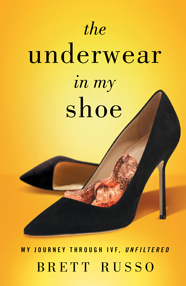
[0:04:52] EG: Your cover just so succinctly, I mean, the cover is very simple, it’s a pair of underwear inside like a high-heeled, beautiful designer shoe and I think just the visual on top of the title, you look at that as a woman and your’e like, yeah, I know exactly what you’re’ talking about.
[0:05:07] Brett Russo: Yeah, we spent a lot of time on that because I wanted to make sure that I didn’t want it to look like it was something that – you were out or you were at a night out or something like that. I mean, it was really important for me to have a struggle and that, where you’re flinging off one of your shoes, and you kind of shoving this like dirty pair underwear in your shoe, and this beautiful shoe. We had a lot of back and forth about what shoe to wear but it just felt like that was kind of screamed what ‘s inside the book which is very – it had to be right, you know?
[0:05:40] EG: Even extending from there, your book is so full of details that are so wonderfully vulnerable. You tell a story, the first instance, actually, of sticking your underwear in your shoe is telling a story of going to the doctor and you’re wearing the wrong underwear, like, you’re wearing the old worn out, not elastic-y underwear and, man, just to connect with that sense of judgement that we all feel when we go to the doctor. You know, the doctor doesn’t care what underwear we’re wearing but we care what they’re going to see about us.
[0:06:12] Brett Russo: Totally, I think like with two things with that is that I wanted to capture the fact that you're going through this huge ordeal, trying to have a baby. I mean, that’s as big as it comes. You don’t lose who you are as a girl, like wanting to look sexy in front of your husband, or wanting to feel that you’re still a woman or if they’re still a cool factor left in you, you know, even when you’re going through this. I kind of wanted to bring up something like that where, you know, you're still fixated on those little things even though you’re in this huge life-changing experience. I knew that for this book, if I wasn’t vulnerable and I didn’t throw myself out there, it wouldn’t be authentic and it wouldn’t be believable to the women going through this. I remember having multiple discussions with my husband who at first had a hard time with so much of our personal life kind of out there and saying, do you want people to view you this way? I said, “You know, it has to be vulnerable in order to be real, and if we’re not going to really do it then why do it at all?” The connections that the women that have read it have said is that exact thing where it just feels so real and this is me and, you know, you can’t pretend to be someone that you want to be, you have to be you. You have to be the person in their darkest moment and all those vulnerabilities are important. Especially in a memoire like this where you know, what’s the point if you're not going to put yourself out there?
[0:07:36] EG: You know, this is always the case with memoire, in that our own stories dovetail with the stories of the people in our lives, and we can’t tell our own stories without, at bare minimum, mentioning who these other people are. Your husband and even your doctors, like so many people play pivotal roles in your story. What was it like to write about them, to share that vulnerability with your husband, to make decisions about what was going to be in and what was going to be out in your writing?
[0:08:07] Brett Russo: I mean, I’ll be honest with you, that was probably one of the biggest challenges of writing the book. Some of my first few drafts, there’s a lot in there and I did dial it back up a lot for protection of people and things like that but that is the hardest balance because to your point, all these doctors and all of these experiences were real for me but I don’t want anyone to feel bad. My purpose isn’t to make anyone feel bad that, if I’m in here, I took something the way they said it or my husband, you know, too much of our personal life in there. I mean, those are really hard decisions to make and I fought for them. I really did, there was certain battles I lost, there was actually chapter in there called the chapter my husband begged me to remove, and he won that chat.
[0:08:53] EG: He knew you were going to talk about it on this podcast, right?
[0:08:57] Brett Russo: The undergrad chapter. That was our biggest challenge, was just trying to find the happy medium, you know, but I had to fight for what I wanted because again, I just – I wanted my experience to be documented the way I wanted it to be documented, and that way was how I lived it, and a lot of those things really happened. There are a lot of women going through this, they’re going to have their friend that said the wrong thing, or didn’t understand, or made them feel bad, and that’s not against the friend that’s in there, just that’s the experience. Other women out there are going to have that similar experience and it’s okay. It took some discussions with a lot of people and, you know, I sent different chapters to different people and kind of played around with names and stuff to protect certain people. That was an educational experience for sure, not one that I thought of, but that was a challenge for sure.
[0:09:50] EG: It strikes me that your son some day will grow up and probably be quite curious about this book that his mom wrote about him coming into the world, and I’m curious what you’ve been thinking about that, like when you might share it with him or how you might present it?
[0:10:06] Brett Russo: I’ve thought about this a lot. I know, you know my husband felt a little bit like, is this something that he would be embarrassed with? I love the story, it’s a story about him and I, and it’s a story about my fight to become his mother. I feel that – I hope that when he’s old enough that he can understand and pull from the book what most people are pulling, which is the fight and the bravery and the perseverance and the passion for a child you never met before. You know, I think it will always be a part of our lives. I think he won’t even care about it for probably most of his life and then one day, he’ll probably want to hear about it. I’m really proud of our IVF experience, I know a lot of people are still a little scared to open up about it but I was proud of what we went through, and I definitely want to have that a dialogue in our house, always. I don’t think it’s something I want to hide from him and then tell him. I want him to always understand what went on and how proud I am of our journey.
[0:11:11] EG: That fight element of just really being willing to continue with this at all costs, and across all setbacks, is so prevalent across your whole book. I don’t’ even think I remember a searing moment where you doubted that this was the thing you needed to do or the thing that you wanted to do. How did you grapple with, what I think for most people, is a natural question of like, at what point should I ever give up?
[0:11:40] Brett Russo: It’s hard, you know, with IVF, everyone’s stories are different and everyone’s variables are different and I think the feelings everyone feels are the same though. I think that in my heart, I knew I wanted to be a mother. I just knew that the eggs were in there, I just knew that if I could just keep going, and the further I got, the more scared I got of course, but I couldn’t believe that there was a life that I wouldn’t be a mother. I think as I got further along, and even more when I spoke to people that had gone through it with other outcomes, whether it’s an egg donor or adoption or something like that, you know, you become more comfortable with those options as you open up your story, you know? There’s a chapter in there about a girl named Janine, who I went to college with, she ended up adopting a daughter after some failed IVF and talking with her and opening up to her about my story and learning about hers, I mean, you get a comfort level in terms of, “Okay, well, this is someone just like me that went through this,” and you realize that you can’t be afraid to change your ending. There’s so many great amazing options out there, but when you're going through it, it’s just hard. You want the ending that you dreamed of your whole life. You want the way you dreamt it up and I think that for me, I just, I had to keep going. It’s hard because you get to a point where you know, I was four rounds in and you know, my husband and my parents, you know, people want you to start opening up your options and I just, at that point, refused, I knew that there was – I just couldn’t believe a world that it wasn’t going to happen for me.
[0:13:18] EG: Yeah, a hard journey on so many levels, not just because of the big dream at the end that you're striving toward, but also because this is a road paved with crazy hormonal swings. I so appreciate how vulnerable you got about that on your book. Was it hard to write about that?
[0:13:41] Brett Russo: It wasn’t hard. I think for me, a lot of my writing was to help myself and I felt that kind of – the craze it got and the worse it got, I would say to myself, “Okay, you know, I’m going to write this down, this is another chapter, this is” – and it got me through some of those tough times, kind of writing it out made me understand what I was feeling a little more. I think that that helps. The darker it got, the easier I was to write. While I was writing, I didn’t know if I was going to ever finish and publish it. You know I didn’t know where it was going. I just knew I had to get it out and so I think it did help me through those, understand some of those confusing feelings, and those failure feelings, and all of these things that you just have never dealt with before. I mean, you know, in my life, I would have to assume a lot of people’s lives, you know these are feelings that you are just not equipped to deal with. You don’t see it coming, you don’t expect it to happen to you and you find yourself smack in the middle of it and you don’t know how to cope, and you don’t know how to ask for help, and you’re fighting to be the same person that you were, but you’re not. You are going through something that is different. I have to believe that is the similar feeling for anyone going through anything. I think that that’s one of the biggest things I have learned through this process is that, whether it is an illness, or whether it’s a death of someone close, or whatever your thing is. If you have a thing you know it opens you up to an awareness that everyone’s got something going on, and we have to be sensitive to people, and you have to understand that you don’t know what they are going through because you haven’t been through it and that’s okay. It is okay to say, “I don’t know what you are going through because I haven’t been there but I am here for you.” Whatever capacity that is and I think that that’s the biggest lesson that came out of this for me.
[0:15:31] EG: Was there any particular moment where a shift happened between, “I am just writing this book for myself to understand what I feel,” to, “I definitely have to share this with people to help them?”
[0:15:45] Brett Russo: Absolutely, I started writing, and then I stopped writing in the middle of this, and started just adding to an outline every time I had something I felt. Then a friend of mine was going through it and I had just gotten some positive results, and it kind of put this behind me a little bit. I sent her a few chapters just to kind of make her feel better, because she was asking me about some of the details. When I heard her response, it clicked something in my head, and when we became pregnant I uploaded something on Facebook, saying, “The journey can be hard, hang in there,” kind of implying that we have had some fertility issues. The responses I got on the side, side messages from – I must have gotten 30 or 40 messages from people, and from women that I knew from high school, college, sort of knew through friends, and just saying, “I am going through this too." Reaching out and so desperate for guidance, and it was that moment where I am like, “Oh my god, there is so many women struggling in silence like I was.” I felt so alone but they don’t have to feel alone, and at that moment, once I started – like I remember I went to bed, I woke up and my Facebook was like blowing up, and that is when I’m like, “I got to finish this.” I literally became almost obsessed with it. I just had to get it out. I feel like the words were haunting me at night. I really just wanted to get it out and I want to get it out fast so that I could help as many girls as I could. I even thought even if it was one person that felt better about it that’s when it clicked. Like when I announced my pregnancy, I just knew. I knew in my heart and in my gut that this was something I had to finish and it was no longer about me and my experience. It was about what were the women reading this going to pull out for themselves.
[0:17:37] EG: That’s wonderful. I’ve mentioned before how vulnerable you are in the writing of this book, were there some parts that were more difficult to write than others?
[0:17:47] Brett Russo: My biggest fear with this book was that women with other endings or other variables wouldn’t connect with it. I know my story, you know, I don’t want to give away too much but my story – there was a lot that was tough about my story but there was a lot about my journey that I didn’t experience that other women do have to experience. My biggest fear was throwing my story out there and women that have had it harder say: “Oh she thinks this is hard? Look what I have to go through.” Or my ending didn’t end this way, and I didn’t want to offend anyone or make anyone feel less hopeful. That was my biggest fear and I think that you know by incorporating different experiences that I had, it was very important for me to make sure that I included all of the thought processes, with all the endings that could have happened, and the women I met along the way, and so that was a little scary. And it was also scary too I mean what you say life, you know I own a company. So I have clients, I have coworkers, you have all of these crazy personal stuff that is out there and it is definitely a little scary. You know my intention is not to make anyone feel bad or anything, know too much about me, but at the end of the day, just kept coming back to the same ending, which is: I have to get this out there for the women going through this and the positive outweighs – It is not about me. I am white noise, my life is white noise in this. My husband is white noise in this. People are going to pull out it what they need to pull out of it and they are. You know there is a lot in the story. It is a love story. It is about family, there is humor in it, but there is also parts about being dark, and feeling like a failure, and feeling depressed, and you know those feelings, it doesn’t matter what the variables are and we’ve all been there. I think that I want people to connect with what they need to connect within the book and it’s bigger than my story. It is bigger than my client reading about my husband’s sperm, you know what I mean? Yeah, connecting was way bigger than selfishly not put it out there and that is how I felt. It was definitely a passion for me and so I think those are the two things that I was most afraid of.
[0:19:56] EG: Another really striking thing about your book is your acknowledgement of how much future thinking goes into this process of trying to have a kid, and of course, not the obvious future thinking of planning of life with a new being in your family, but these tiny, tiny details that you are planning out. Like, in the beginning of the book, you write about how in that first IUI treatment, you were imagining how you’re going to surprise your husband with news that you were pregnant. Or how you were going to plan out the delivery of your child to try to bookend with your brother’s kids and have them all be nearby ages. I am so curious how your relationship to that future forward thinking either morphed or changed as you went through this journey?
[0:20:45] Brett Russo: You know it is funny, it is a very good question because I feel like those plans haunt you. I think when you are going through IVF, the worst thing is the death of another month, you know another month that it didn’t work, whether you are trying naturally and you keep getting those negative results on pregnancy tests, whether you are trying all of these treatments and every time you have to start again, time is a very interesting theme throughout it all. I think that when you are planning to have a baby, you don’t think, for the most part, a lot of women do know there may be issues but I didn’t, and I lot of women don’t and. You are saying, “Oh okay, well I am going to have – I am going to take a year off with my husband, and then I am going to have a wedding in Mexico in December, so I am going to not start until February” and you think it is just going to happen the way you want it to and when it doesn’t it haunts you. Because you are constantly trying to keep up with, “Oh, well I wanted to be pregnant here. Well now this one is pregnant,” and now you feel left behind. I think that is a really hard part because any time, whether there is a hiccup along the way, or there is a surgery you need, or something that they find, you know those delays kill you. That is the common thing when I talked to hundreds of women while I have been writing this and everyone has the same thing. Like those little hiccups along the way, they screw with your head, because it is time. It is time that’s being not wasted but you are not progressing forward, and you just feel like you’re just in this puddle, and everyone else is moving forward and you are not. I think that is an interesting thing that you picked up because I think that is something that you’re constantly haunted with. You have the vision of a family and you have the vision of everything that you wanted and it is all put on hold, and it is just getting further and further, and feeling further away, and I think that’s the root of a lot of the anxiety and a lot of the sadness along the way.
[0:22:43] EG: You have this constant resetting of a life that would have been.
[0:22:48] Brett Russo: Totally, and it’s like you say things like, “Oh I’ll be pregnant then,” or, “Oh well” – you know, a big part of the book was we moved. We were living in New York City and living the New York City life it was so great, and we bought this house completely thinking that we would have a baby by then, and we didn’t, and here I am moving into this family life without the family. That’s tough, that’s another example of how time plays tricks on you because you plan, and you have these expectations but, sometimes, it doesn’t work out that way.
[0:23:23] EG: Until all of a sudden, at least in your case, it does.
[0:23:26] Brett Russo: Right, that’s very true. I know a big part of this as well was, once you are pregnant there is still a lot of feelings, residual feelings, that are inside. You know these feelings – you know, you’ve had a few years of things not going your way and failed attempts and setbacks and all of a sudden you have this success and you are just waiting for the next shoe to drop, and you’re waiting for it not to work and you’re waiting. You know it doesn’t feel like comfortable and it’s not like getting pregnant is the end of your grief. It is the beginning of it in a way. I don’t want to give away too much of the book but that is a big part of it as well, where the ending – once you are pregnant you don’t want to say, “Oh yay! This is amazing!” All of a sudden you forget everything you went through. It is almost like, “Well wait, now what am I supposed to feel with all of that grief still in the wings, what am I supposed to do?” Am I supposed to be excited? Am I supposed to be nervous? You know all of these things you’re afraid of what the next thing could be, you know?
[0:24:31] EG: Well, writing a book is such a feat and of course, this book is just a culmination of a journey for you that was an even bigger feat. Congratulations, and if you wanted people to take one or two things away from your book, what would they be?
[0:24:45] Brett Russo: I mean the main thing, which was my goal this whole time, and what drove me to start it and finish it, is that I just don’t want women out there to feel that they are alone. I want them to know that what they are feeling is normal and even though our stories may be different, it is okay to feel sad. It’s okay to feel like you have lost yourself. It is okay to argue with your husband, and all of those things are just common things. I am not downplaying what they are going through, but it is okay, and it is okay to feel those things. I think by reading this, I just want people to see it is nothing to be embarrassed about. You’re not a failure. You didn’t do anything wrong. You are not as good as the girl that got pregnant right away. You know you are just as good as her. I just want people to know what this process is like. You know if you are going through it, I don’t want you to feel alone. If you aren’t, I want you to know you know, yeah, a lot of people say, “Oh well, you are not dying from it. It is not cancer. It is not this” – yeah, but it is really, really hard. It is a very niche thing. You know it’s not that I don’t know, I don’t know a lot of women that are going through it but when you do go through it, it’s tough and I want people to know that and it is okay to talk about it. There is nothing to be ashamed of.
[0:26:00] EG: That’s wonderful. Brett, it’s been such a pleasure talking to you. Such a pleasure sitting in the vulnerability of your book and hearing you go deeper on this interview. Again, the book is called, Underwear in My Shoe, and besides checking out the book, where can people find you?
[0:26:17] Brett Russo: They could find me on my website, which is brett-russo.com, and I will be uploading all updates about the book on there and reviews and things like that. There will be a place where people can share their stories, and I really hope that people do, because I would love to be there for whoever is going through what they are going through. I would love to connect with as many people as I can, that’s that. It’s launching on September 29th so it’s very exciting.
[0:26:47] EG: Fantastic. Well thank you so much, Brett.
[0:26:50] Brett Russo: Thank you.
[0:26:52] EG: Thanks for joining us again for another episode of Author Hour. You can find, Underwear in My Shoe, on Amazon. A transcript of this episode as well as all of our other previous episodes is available at authorhour.co. For more Author Hour, subscribe to the podcast on your favorite subscription service and thank you so much for joining us. We’ll see you next time, same place, different author.
Want to Write Your Own Book?
Scribe has helped over 2,000 authors turn their expertise into published books.
Schedule a Free Consult