Bob Moesta: Demand Side Sales 101
Read the full transcript
Bob Moesta
Bob Moesta is a builder, teacher, entrepreneur, author, and co-founder of The Re-Wired Group, a design and development firm based in Detroit, Michigan. Early in his career, Bob received an education in building and launching new products from renowned innovators Dr. Clayton Christensen, Dr. Genichi Taguchi, Dr. W. Edwards Deming, and Dr. Willie Hobbs Moore. The worldview he gained has enabled him to work on and launch thousands of new products over the last thirty years, be the founder of ten different companies, and become a mentor to the next generation of builders and problem solvers. Bob is an adjunct lecturer at the Kellogg School at Northwestern University and a guest lecturer at Harvard Business School, and MIT’s Sloan School of Management.
📚 Books by Bob Moesta
Transcript
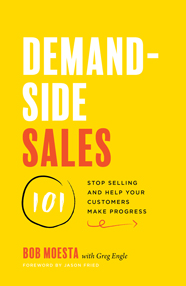
[0:00:15] DA: For a lot of us, selling feels — icky. It’s not really our fault, we weren’t taught how to sell. Plus, when we’ve been sold before, it’s left us with a bitter taste. Bob Moesta, a lifelong innovator shares his approach for flipping the lens on sales in his new book, Demand Side Sales 101. Bob shifts the focus of sales from selling to helping people buy and make progress in their lives. You’ll learn to really see what your customers see, hear what they hear, and understand what they mean. You’ll not only be a more effective and innovative sales person, you’ll want to help people make progress. Hey listeners, my name is Drew Applebaum and I’m excited to be here today with Bob Moesta, author of Demand Side Sales 101. Bob, I’m excited you’re here, welcome to the podcast.
[0:01:02] Bob Moesta: Hey Drew, thanks for having me on. It’s like, to be honest, this is the end of a very long process for me. In some cases, I’m excited to have it over and excited for new things to begin on it. Excited to be here, thanks for having me.
[0:01:14] DA: Why don’t you fill us in a little bit about your background?
[0:01:17] Bob Moesta: Yeah, the way I usually describe it is I’m 55 but I’ve been breaking things for over 50 years. I’ve been fixing things for probably 45 years. But I’ve been building things for 30 years. And so, I’ve helped design, build, launch over 3,500 different products and services across the whole array of things. Everything from guidance systems for a patriot missile to working on Pokémon, mac and cheese, and base camp software, and 5 Gum, and all these different places. Along the way, I’ve also done seven startups. And one of the things that I realized was that there was so — like, as an entrepreneur, one of the hardest things to do is sales and selling. What I found is like I’m sitting with one of my mentors at the Harvard Business School, his name is Clay Christensen, and I asked him one day. I’m like, “Why are there no sales professors?” He looked at me, like, “That’s a really good question.” There’s marketing professors, there’s finance professors, there’s HR, there’s like organizational behavior. All these different things but like, nobody is teaching sales at any of the top business schools. And we start to think about and like, “It’s so hard.” As an entrepreneur, it’s the hardest thing I had to learn yet there’s no training in it, it’s like, “Well, you know what? It’s very specific to every industry and so it really doesn’t belong at the business school.” How is that possible? I Just started to pull that thread of like why are there no sales professors and why in the world don't we teach it at entrepreneurial school because, to be honest, it’s the place they need it the most. I kind of set out to think about it that way and the answer I got was, “Well, there’s no theory behind it so there’s nothing really to teach.” Wow. So one of the things that Clay and I developed was a theory called ‘Jobs to Be Done’ and that people don’t buy products, they hire them to make progress in their life. What I did is I took that theory that’s helped me innovate and say like, “How do I apply it to sales?” Ultimately, what it is, this is what this book is about — is like, the supply side is like, I build product. The demand-side is where the customer has a problem or is trying to do something they couldn’t do before. To be honest, sales is really not a demand-side concept, it’s actually a supply side concept. What I did is I said, “We should actually just start with, how do people buy things, how do people decide that today’s the day I need a new mattress.” — “I need some new ERP, I need a new CRM.” And so we start with kind of the customer, irrelevant of the product because most people start — even though they might say they're customer-focused, they all start with, “Well, I make mattresses, we’ve actually figured out who needs a new mattress.” Versus, “Who can’t sleep at night?”
[0:03:55] DA: Right.
[0:03:57] Bob Moesta: This book really kind of takes the Jobs to Be Done Theory and frames around the sales process and then, to be honest, once we did that, we started to actually just talk to sales organizations about some of their problems and struggles. And we’ve been able to innovate like crazy to help them sell completely differently. And to understand, they have a timeline and we have a timeline. And, like, they don’t really care about our timeline. They care about their timeline.
[0:04:20] DA: Now, was the hole in the entire education for sales, or was there an ‘aha’ moment that was the inspiration for the book? Was it Jobs to Be Done really working well?
[0:04:29] Bob Moesta: That’s a good question. I think an aha moment is kind of like, when all the forces kind of line up and kind of go, like, “Yeah, this is a big idea.” I think the reality is, like, it took probably maybe 15 years for it to kind of really ferment. I think we’ve — I’ve been talking about it for at least 10. It’s one of those things where it’s like, “Where is the greatest struggling moment in business? Where do people need a new, fresh perspective on something and how can I help?” That’s really kind of where this came from but it’s the aspect to me. The big aha, if you will, was the realization that everybody sells, we all sell all the time. We all are trying to make progress; we’re trying to get other people to help other people make progress. to be honest, we’re buying all the time. The reality is if we frame it through the buying lens, for example, what causes somebody to say, “Today is the day I’m going to go to a new church.” How do they actually decide which church to go to? It’s not just for software or for food products, it’s just about everything. And so part of this is helping people understand what’s causing them to say, “Today’s the day I’m leaving something, and how do I pick what I’m hoping for the moment that I actually commit to that new thing.”
[0:05:44] DA: I think it’s important what you just mentioned that this book isn’t just for you traditional salesman.
[0:05:51] Bob Moesta: Yeah, actually I think it’s not for those, I think I wrote in the very introduction to say like, you’re successful in sales, the reality is like, you probably already either know all these or, like, just keep doing what you're doing. But I wrote it for like, the nurse who actually has to help somebody who just had a stroke to actually learn how to actually write again. They have to sell more or less, they have to help people figure out how to actually do the rehab. In the end, no nurse would say, “I have to sell” — but the reality is, they have to help their patient make progress. For all those people who don’t feel like they’re selling, a teacher actually sells a lesson. But the reality is, we have to figure out how to fit it in the student’s lives, right? Part of this is to reframe it all from that consumer side of — “What progress are people trying to make?”
[0:06:37] DA: Now, what have you found that’s wrong in sales today?
[0:06:42] Bob Moesta: I think part of it is in the phrase that I’ve labeled it — and it’s not a fair phrase but it’s — I call it the ‘Church of Finance,’ right? The Church of Finance is like, they have rules and they have a book and they have, “This is what we do,” and you know, “Cash flow is king.” And we have to do these things and so, think about this, as a sales person, “Well, it’s getting to be the end of the quarter and we need to make sure we meet the projections that we had so we’re going to offer 20% discount, we’re going to build a promotion to get people to commit earlier,” right? I can see why they would do that but from the customer side, it feels like, actually, when you look at it I’m like, I’m going to give you 20% discount and say, “Yeah, I’m going to save money but the reality is, like, you’re devaluing what your solution is. Why would you give me 20% off to do it earlier.” That doesn’t make it like — “If it’s really as good as it’s supposed to be, then next time, I’m just going to wait for the next promotion.” You start to realize that because sales people have been relegated to order takers and cash flow makers, that the fact is that at some point, they’re at the mercy of the marketers and the finance people. But the reality is what they love to do is help people. Ultimately, they’re caught between this realm of doing exactly what the company needs or making small changes in what the company needs to actually sacrifice some of the customer. And what I find is that is actually where that small little razor-thin view grows into a great chasm very quickly for most companies.
[0:08:13] DA: Yeah. Now, you mentioned it earlier, can you talk to us about the jobs to be done, you mentioned in the book as JTD, the theory you came up with, with your friend?
[0:08:22] Bob Moesta: Yeah, Jobs to Be Done is, again, the premise that people don’t really buy things, they hire them to make progress in their life. And so it’s the notion of actually studying people switching from one thing to the next. Ultimately, as much as companies innovate, consumers innovate too. There has to be so much energy, so much motivation for people to go like “Yeah, I’m going to get rid of my old matters and buy a new mattress.” Or, “I’m going to buy a new pair of shoes.” At some point, there has to be some motivation somewhere in their story. This is where we dive deep and we understand both what we call the pushes, what about their context, right? That says, today is the day they need to do something different. What about the outcome? What are they hoping for that they can’t get today? What’s going to be better about this? What are the anxieties they have? What are the habits they have to overcome? It’s actually built on criminal and intelligence interrogation methods to actually help us understand the unreeling causal mechanisms for why people change. From it, it actually helps us understand what solutions to go build and what solutions not to go build. And how people actually measure success versus how we as a company might measure success. From that — that framework, and to be honest, I’ve been doing that for almost 30 years. It’s one of those things that once you see it, you can’t really unsee it, right? The crazy part about the book is when people — some of the people have read the book, it’s like, they get what I’m trying to talk about but in the end, they almost — everybody says, like, “You know what? I feel like I’m a better consumer than I was before because I’m literally, when I say I want to go buy something, I’m stopping myself — why do I want to buy this?” What am I trying to accomplish, what part I am trying to make and it’s like, when they’re stuck on something, they can start to analyze, like, “Well, what am I worried about? What’s the anxiety I have? What am I going to do with this?” And you start to realize, you actually become a better consumer by understanding these forces and the timeline that you're on in terms of trying to buy.
[0:10:20] DA: Yeah, it seems like you’re breaking down the fourth wall here just by talking about it. Talk about those forces that are involved when a buyer is making a purchaser decision?
[0:10:30] Bob Moesta: I always talk about context, right? Context creates value, right? Here’s the thing, it’s like, I’ll ask you, do you like steak or do you like pizza, Drew?
[0:10:39] DA: Tough, do I have to choose? I’ll choose pizza right now.
[0:10:41] Bob Moesta: Okay, pizza. Here’s the thing, most people would say, “I like both.”
[0:10:45] DA: Right.
[0:10:45] Bob Moesta: Right? It’s like, “Wait a second, you can’t like both.” It’s like, You can.” You’re not a person that likes only one thing. What I would say is if I talk to you about the last time you had pizza, so when did you have pizza last?
[0:10:57] DA: I had a picnic and I had a pizza delivered to my picnic on Saturday.
[0:11:01] Bob Moesta: Got it, right? Why was a pizza perfect for that situation?
[0:11:05] DA: Very quick delivery, it’s something that you could eat, it could sit out for an hour, you could still eat it and it was —
[0:11:11] Bob Moesta: How many people did you have?
[0:11:12] DA: There were about four people.
[0:11:13] Bob Moesta: Four people? Was this an impromptu picnic or was this a planned picnic?
[0:11:17] DA: This was a planned picnic but only for about a day or two.
[0:11:21] Bob Moesta: Were you supposed to bring something and you didn’t?
[0:11:23] DA: No, we had everything there but it extended a little bit longer than we thought and we got hungry.
[0:11:28] Bob Moesta: Got it. That’s what I would call a pizza context, right? You’re multiple people, you need something quick, something that’s not going to actually spoil it, like, you don’t have to eat in the fast moment, the fact is like, it lets you keep your leisure time and it actually helps you extend the moment, right? That’s the outcome you wanted, right? If I think about steak, how well does steak fit in that situation?
[0:11:49] DA: Steak would be disgusting and steamed and —
[0:11:52] Bob Moesta: Well, you had to get a grill, you had to — you could have actually had it delivered but then when it gets cold, it’s not as good. You start to realize, the hiring criteria for steak in that situation isn’t there. If I talk about the last time you had steak, and I try to take it out and I put pizza in it, you’re like “No, pizza doesn’t fit in this situation at all.” What you start to realize is that the context adds as much value as the product. And that’s the key — is when we start to look at things from what we call the supply side, from the sales side, we actually ignore people’s context or we generalize people’s context. “Well, you’re hungry and you like food so you’ll like pizza.” And it’s not, it’s the specifics. And it’s not just one thing, it’s the set of things, it’s the set of the forces that make this the opportunity for pizza to fit in it and steak not to fit in it. That is basically, if you can actually help people see those moments of where opportunity, it almost like, it opens up and it closes because of the situation. It’s not ‘who’ anymore, it’s when and where and who, right? Most of the time, we’re marketing to who. But we are not marketing to when and where and who. And so that’s where all of a sudden you start to see, like you said, looking through the fourth wall. You start to realize that this is more of time and space play than it is just a who play. Because in some cases, the who is actually less relevant but the context is actually way more relevant. So I can take somebody who is 25 and somebody who is 65 and they can actually have the same job. And most people will say, “Well, they’re different segments” and I’m like, yeah they’re different segments but they both need a pizza because they want to extend the situation and it doesn’t matter whether they’re 25 or 55.
[0:13:35] DA: Now, we have been talking about purchase decisions but I like to just pivot a little bit because you talk about job interview techniques, which is essentially you are selling yourself and you being hired is a sale, it’s a transaction so —
[0:13:51] Bob Moesta: So here’s the thing, the job interview is actually — what I did with you is a mini-job interview because what I am actually doing is I am understanding why you hired pizza for that situation. You actually hired it so what’s the job the pizza was trying to do? And so ultimately that’s what I’m actually — when we talk about jobs interviews we are actually understanding the job, the product or the service does for you as a consumer. And so we’re not actually just talking about the job like a career job. We are talking about how every product is hired to do a job. And what is that and so from that that’s where we actually break things down. Tell me why, tell me when, tell me where, tell me who else was there, why not this? And out of it we actually can start to piece together the underlying — I will say the 20% of the causes that represent 80% of the reasons why you do it. And so the crazy part is this, is most people think you need big data. You can literally see an entire market in 10 interviews because you are going way — like each interview, take for example, I’ve talked to you for maybe two minutes. These interviews are typically an hour long. And you’re like, “How can we talk about pizza for an hour long?” Because I can talk about how to pick the place because — “Which pizza place did you order from? Who else was involved in the discussion?” We can actually break this down into a story of how actually the pizza ended up there? And then how well did it do based on what it is? And will you actually hired again?
[0:15:15] DA: Right, so you actually talk in the book, you go through a ton of case studies, which I think are so great for learning. And you mentioned that in all of these case studies, in all of these scenarios you put together that there are consistent patterns in each one. Can you tell us if you interviewed a 100 people who just purchased something with some consistent patterns that you’d see?
[0:15:34] Bob Moesta: Oh so here is the thing is that so first of all, the reason why patterns are so important is I am dyslexic. As I said, I was breaking things, like, almost out of the womb. By the time I was seven, I had three close-head brain injuries and I basically am dyslexic. I can’t read and I can’t write. So one of the reasons why I love Scribe is they can actually help me take the things that I see and what things that I say and turn them into words to create the book. I mean this is just a fabulous situation for me. But the reality is, like, the way my mom taught me to read was, if I looked at a paragraph she would notice that I’ll — the first thing that I see is the space between the words. So I see spaces first. And then what happens is I can tell you where the big spaces are like, “This must be a big word because there’s space on one side and the other side are bigger” so she can say, “Circle the five largest words on the page” and I could figure out large words. As long as it was seven letters or longer, I could figure it out. So I can circle five words in a paragraph and I go like, “What do these words have in common? Why do I think this paragraph is about?” very Columbo like, right? And ultimately, I am able to see the patterns and I can actually — I can read but I don’t read like anybody else reads. So I think of it as like, dyslexia is the greatest gift I ever got but I would actually never wish it upon my children, right? And to get to the interview part is that in the interviews, you start to see these patterns. The things like, “Look, this was actually” — it was a planned event but the reality was, part of it was it was extending it, which was not planned, right? It was the fact that it wasn’t just for you. It was for you and other people. I would have asked, “What else was it about?” So part of it was actually to be able to abstract and understand those underlying patterns to say like, “It was this.” And ultimately you hired the pizza to extend the time together. and most people say, “No, you hired the pizza because it’s delicious” it’s like no. It is delicious enough to spend the time.
[0:17:29] DA: Right. There are many foods that would have been delicious.
[0:17:32] Bob Moesta: So an example of this is one of my favorite is — I have worked in lots of categories and I always bring up the mattress one. But it’s like, the pattern that you could see is, most people’s problem is that they can’t sleep. And they never think of the mattress. The mattress is the last thing they think of. And what we heard was all of these things that the pattern of what people did to actually make themselves tired so they could sleep on their crappy mattress, right? And it would be one of those things like, “Yeah, I have been taking ZzzQuil for two years,” and so we’ve built an ad that said like, “How many bottles of ZzzQuil do you have to have before you actually realize you need a new mattress, right?” And it’s like — and whether it’s, “How many bottle of scotch do you have to drink? How late you have to stay up?” There are all these things that people do that — what we call hacks or workarounds that literally when you call them out on it they go like, “Yeah, why am I doing it?” Why am I sleeping on the parking lounger, right? And you start to realize there are these compensated behaviors you call people out on. And it really helps them understand it. And so to be honest, they are in every category you can imagine. I wrote a book on — called Choosing College. It is like, most people talk about where to go to college, which is the best college but why do you go to college? Why is actually more important than where and so the book is called Choosing College. And it literally walks through the five different jobs that people hire college for. And one of the jobs is — “Help me escape,” right? “I don’t like my job, I don’t like where I live, I need to get away, I’m not me. I want to actually be myself. And whether I’m an engineer and I want to be a teacher, I hate being it like I went to school to be an engineer.” But at some point, if you hated to be an engineer it’s like, “Okay, I need to go back to school to be a teacher.” You realize you are going back to school because they want to escape the engineering world, right? Part of this is actually understanding why people are willing to pay 40, 50, $100,000 to go to school. It is not where but why.
[0:19:27] DA: Now when you figure out the ‘why’ as a business owner, let’s say, where do you put this into play? Is it a commercial? Do you use this on the sales floor? What do you do with it to think about?
[0:19:38] Bob Moesta: It is interesting. So this is the thing as I started doing this where it helped people actually build new products and services, right? So this is where you come up with different — Casper is a really good example of where — think about this, they’re walking into an industry. Casper is a mattress company that you order and they ship it to you to your home, right? And if you think about the industry, it has been around for over a 100 years in terms of the way it is built, right? There are major players in it and yet, how many people want to go buy a mattress?
[0:20:10] DA: No one.
[0:20:11] Bob Moesta: No one, and if you do it’s like, “Oh my god, I am going to walk into this store where there is nobody here but one sales person. “I don’t actually know what I am supposed to be buying. I know I can’t sleep with the fact this is,” it’s like, “They’re going to tell me to lay down on it and I don’t know who else has laid down on it.” And you just go on and on and on and you just start to actually understand that. You realize that they are struggling moments about doing that and that they needed a new bed. They basically just push it off because they don’t know how to choose a new bed. So Casper went out and said, “Let me ask you a few questions about it. I am going to ask you online. I am only going to give you three or four options to actually pick from and I am going to ship it to your house.” They’re a billion dollar company now.
[0:20:53] DA: And it doesn’t hurt that those mattresses are very comfortable.
[0:20:56] Bob Moesta: They are very comfortable but what I will say is this, is that comfortable enough? And let’s be clear, all they have to be is better than the old mattress. They don’t have to be the best mattress. The reference point for most people is the old mattress, not the best mattress, or the most expensive one. And so part of it is you can use this information not only to build products but now all of a sudden to change the way you sell. To change the way you market. To be honest, to change how you partner. There are just many, many different ways in which you can actually make this. You know you could use this information. And so I have been using it, like I, said for innovation for a long time. But when I started using it for sales, it was like, “Oh my gosh, this is crazy.” We can actually help people buy faster and actually more effectively than trying to give them the pre-planned presentation. Here are the 14 features and benefits of our product and here is what we have to do. It’s like no, ask them three questions and based on those answers, give them the three answers that they actually need so they can buy today.
[0:21:54] DA: Towards the end of the book, you talk about connecting the dots between sales, marketing and support and from experience, this seems like this might be the hardest part of the whole process.
[0:22:04] Bob Moesta: It is. But I think the reality is it is hardest because we are so internally focused, right? There are these hand-offs, marketing’s job is to generate the leads, the sales job is to take the leads to a contract, and then customer success is to the contract to a customer, right? To make it happen. But the reality is, is that if they actually just focused on helping the customer making progress — I actually need sales or I need marketing the entire way through the process of buying. When I am onboarding new people to the system, that’s marketing. When I am actually figuring out why do we have this system? — That’s sales. And so part of this is instead of trying to give these handoffs to people, it is actually letting people understand what’s your role in the entire process of somebody buying, switching, and using and building new habits around your product? And so it is not limiting marketing to a certain point, it is literally making sure that they see each other as a team and they help each other as opposed to sales going, “Give me better leads.” It is like “Boy, I need more leads,” or “Boy, these people don’t have any idea what they’re going to use this for.” It is like you spend all of your energy pointing at each other as opposed to pointing to the customer.
[0:23:11] DA: Right, it’s a really great point. Hey Bob, writing a book is no joke so first of all, congratulations.
[0:23:17] Bob Moesta: Well, I have to say you guys made it so easy. Scribe was amazing. It is one of those things where I didn’t really know what I was getting myself into. But the process itself. So I have actually written two other books and they were just impossible to do and it is like I have all of these ideas in my head. I actually have five more books on the docket. I’ve already started my fourth book. I had finished this one in June, I took the month off, in August I started the next one. It will be done by November. It will be out by the middle of next year. And then I have already got the next three after that.
[0:23:46] DA: Well this is Bob and Drew part one of five then.
[0:23:49] Bob Moesta: Yeah, there you go that’s right and to be honest, the process is amazing and the people have really helped me be able — my favorite part is when somebody who knows me very well picks up the book and listens to the book or reads the book, they literally are like, Janet, who is my author, she just captured my voice so well, they’re like, “God, it feels like you are reading it to me.” It is like that. It’s just awesome.
[0:24:11] DA: I’m glad you had a great experience. Now if readers could take away one thing from your book, what would it be?
[0:24:18] Bob Moesta: That there is no randomness in people buying things. Nobody buys anything randomly. They might think they do but the reality is it is all cause. And understanding the causes makes you a better consumer, it makes you a better business person. And understanding what causes people to say, “Today is the day I’m buying this,” or “Today is the day I’m leaving this,” will make you better and make them better at the same time. So understand what causes something and realize that randomness is a really bad idea.
[0:24:52] DA: Bob, this has been such a pleasure. I am so excited for people to check out this book. Everyone, the book is called, Demand Side Sales 101, and you could find it on Amazon. Now Bob, besides checking out the book, where else could people find you?
[0:25:03] Bob Moesta: LinkedIn, Bob Moesta and Twitter @bmoesta.
[0:25:08] DA: Awesome Bob, thank you so much for coming on the podcast today.
[0:25:10] Bob Moesta: Thank you. Thanks for having me Drew.
[0:25:13] DA: Thanks for joining us for this episode of Author Hour. You can get Bob Moesta’s book, Demand Side Sales 101, on Amazon. Also, you can also find a transcript of this episode and all of our other episodes on our website at authorhour.co. For more Author Hour, subscribe to this podcast on your favorite subscription service. Thank you for joining us, we’ll see you next time. Same place, different author.
Want to Write Your Own Book?
Scribe has helped over 2,000 authors turn their expertise into published books.
Schedule a Free Consult